
Chapter 12 – Advanced Optimization Applications
True / False
1. Revenue management methodology was originally developed for the banking industry.
a. True
b. False
2. The goal of portfolio models is to create a portfolio that provides the best balance between risk and return.
a. True
b. False
3. In portfolio models, risk is minimized by diversification.
a. True
b. False
4. Revenue management methodology can be applied in the case of nonperishable assets.
a. True
b. False
5. A nonlinear optimization problem is any optimization problem in which at least one term in the objective function or a
constraint is nonlinear.
a. True
b. False
6. A function is quadratic if its nonlinear terms have a power of 4.
a. True
b. False
7. Nonlinear programming algorithms are more complex than linear programming algorithms.
a. True
b. False

Chapter 12 – Advanced Optimization Applications
8. Many linear programming algorithms such as the simplex method optimize by examining only the extreme points of the
feasible region.
a. True
b. False
9. A feasible solution is a global optimum if there are no other feasible solutions with a better objective function value in
the immediate neighborhood.
a. True
b. False
10. A feasible solution is a global optimum if there are no other feasible points with a better objective function value in
the feasible region.
a. True
b. False
11. For a typical nonlinear problem, duals price are relatively insensitive to small changes in right-hand side values.
a. True
b. False
12. The interpretation of the dual price for nonlinear models is different than the interpretation of the dual price for linear
models.
a. True
b. False
13. In the case of functions with multiple local optima, most nonlinear optimization software methods can get stuck and
terminate at a local optimum.
a. True
b. False

Chapter 12 – Advanced Optimization Applications
14. For a minimization problem, a point is a global minimum if there are no other feasible points with a smaller objective
function value.
a. True
b. False
15. There are nonlinear applications in which there is a single local optimal solution that is also the global optimal
solution.
a. True
b. False
16. Functions that are convex have a single local maximum that is also the global maximum.
a. True
b. False
17. The function f (x, y) = x 2 + y 2 has a single global minimum and is relatively easy to minimize.
a. True
b. False
18. The problem of maximizing a concave quadratic function over a linear constraint set is relatively difficult to solve.
a. True
b. False
19. Because most nonlinear optimization codes will terminate with a local optimum, the solution returned by the codes
will be the best solution.
a. True
b. False
20. An index fund is an example of passive asset management.

Chapter 12 – Advanced Optimization Applications
a. True
b. False
21. A key trade-off in most portfolio optimization models must be made between risk and return.
a. True
b. False
22. The objective for the Markowitz portfolio model is to minimize portfolio return variance.
a. True
b. False
23. Revenue management methodology enables an airline to maximize the number of full-fare seats it sells on each flight.
a. True
b. False
24. The Markowitz mean-variance portfolio model is a classic application of non-linear programming.
a. True
b. False
Multiple Choice
25. Revenue management methodology was originally developed for
a. a cruise line.
b. an airline.
c. a car rental company.
d. a hotel chain.
26. The overall goal of portfolio models is to create a portfolio that provides the best balance between
a. short-term and long-term investments.
b. gains and losses.

Chapter 12 – Advanced Optimization Applications
c. risk and return.
d. liquidity and stability.
27. Modern revenue management systems maximize revenue potential for an organization by helping to manage
a. pricing strategies.
b. reservation policies.
c. short-term supply decisions.
d. All of the alternatives are correct.
28. To develop a portfolio that provides the best return possible with a minimum risk, the linear programming model will
have an objective function which
a. minimizes the maximum risk.
b. minimizes total risk.
c. maximizes return and minimizes risk.
d. maximizes the minimum return.
29. Which of the following is incorrect?
a. A global optimum is a local optimum in a nonlinear optimization problem.
b. A local maximum is a global maximum in a concave nonlinear optimization problem.
c. A global minimum is a local minimum in a convex nonlinear optimization problem.
d. A local optimum is a global optimum in a nonlinear optimization problem.
30. Which of the following is not true regarding a concave function?
a. It is bowl-shaped down.
b. It is relatively easy to maximize.
c. It has multiple local maxima.
d. It has a single global maximum.
31. A convex function is
a. bowl-shaped up.
b. bowl-shaped down.
c. elliptical in shape.
d. sinusoidal in shape.

Chapter 12 – Advanced Optimization Applications
32. If the coefficient of each squared term in a quadratic function is positive, the function is
a. concave.
b. convex.
c. elliptical.
d. sinusoidal.
33. Revenue management methodology enables an airline to
a. maximize the number of full-fare seats it sells on each flight.
b. minimize the number of discount-fare seats it sells on each flight.
c. increase the average number of passengers per flight.
d. decrease the number of overbooked flights.
34. Each point on the efficient frontier graph associated with the Markowitz portfolio model is the
a. maximum possible risk for the given return.
b. minimum possible risk for the given return.
c. maximum return for the least risk.
d. minimum diversification for the least risk.
35. A linear programming application used to measure the relative efficiency of operating units with the same goals and
objectives is
a. game theory.
b. asset allocation.
c. revenue management.
d. data envelopment analysis.
36. In data envelopment analysis, the percentage of an individual operating unit’s resources that are available to the
composite operating unit is the
a. efficiency index.
b. local optimum.
c. global optimum.
d. equilibrium point.

Chapter 12 – Advanced Optimization Applications
37. The composite unit in data envelopment analysis
a. has as input a weighted average of the inputs of the individual units.
b. has outputs greater than or equal to the outputs of any individual unit.
c. has as output a weighted average of the outputs of the individual units.
d. All of the alternatives are correct.
38. A DEA linear programming model involving 4 input measures and 3 output measures will have
a. 7 constraints.
b. 8 constraints.
c. 12 constraints.
d. 13 constraints.
39. In general, every DEA linear programming model will include a constraint that requires the weights for the operating
units to sum to
a. 1.
b. the number of operating units.
c. 100.
d. any arbitrary value.
40. The logic of a DEA model is to determine whether _________ facility can achieve the same or more output than
________ facility while requiring less input.
a. an actual; another actual
b. an actual; any other actual
c. a hypothetical composite; an actual
Subjective Short Answer
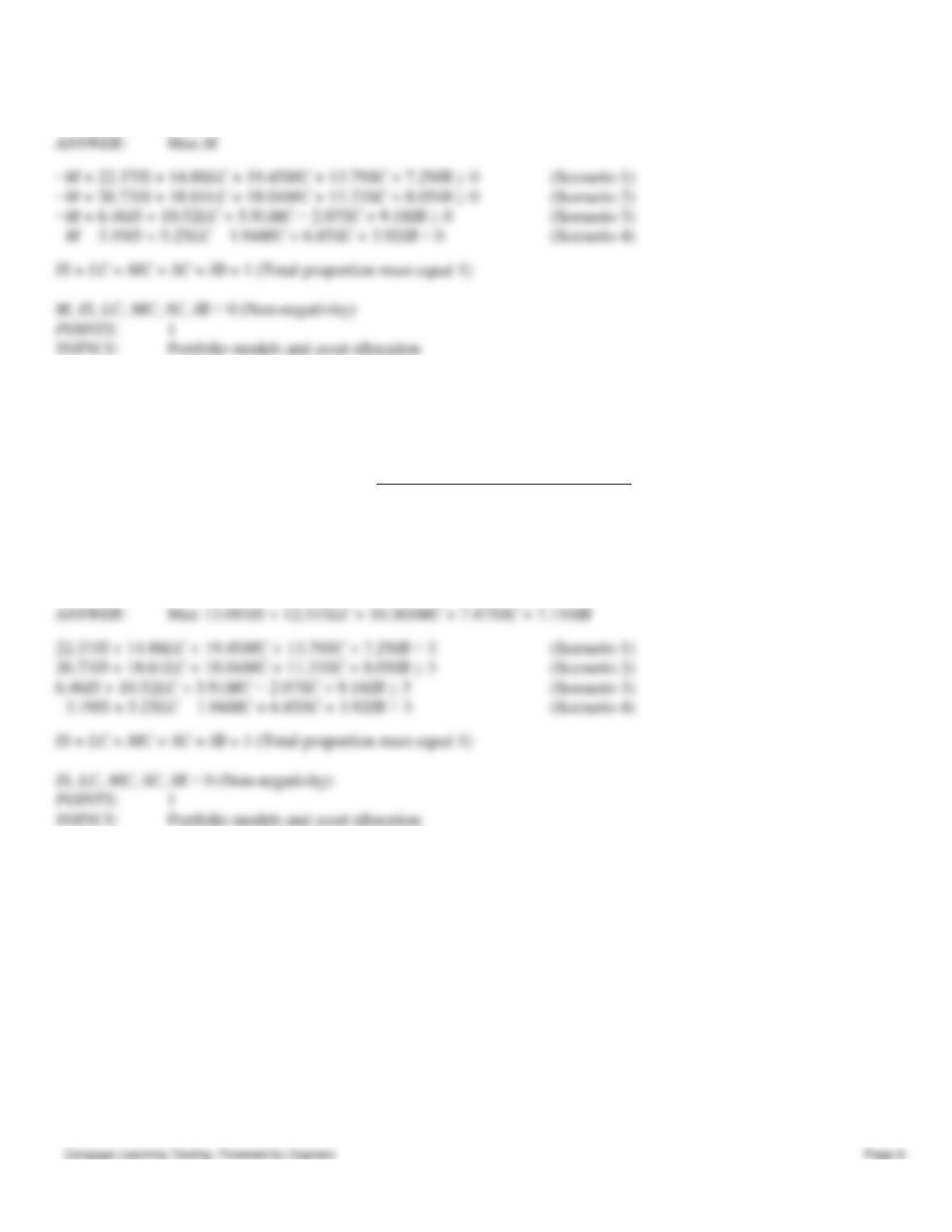
41. Portfolio manager Max Gaines needs to develop an investment portfolio for his conservative clients. His task is to
determine the proportion of the portfolio to invest in each of the five mutual funds listed below so that the portfolio
provides the best return possible with a minimum risk. Formulate the maximin linear program.
Annual Returns (Planning Scenarios)
Mutual Fund Year 1 Year 2 Year 3 Year 4
International Stock 22.37 26.73 6.46 −3.19
Large-Cap Blend 14.88 18.61 10.52 5.25
Mid-Cap Blend 19.45 18.04 5.91 −1.94
Chapter 12 – Advanced Optimization Applications
Small-Cap Blend 13.79 11.33 −2.07 6.85
Intermediate Bond 7.29 8.05 9.18 3.92
42. Portfolio manager Max Gaines needs to develop an investment portfolio for his clients who are willing to accept a
moderate amount of risk. His task is to determine the proportion of the portfolio to invest in each of the five mutual funds
listed below so that the portfolio provides an annual return of no less than 3%. Formulate the appropriate linear program.
Annual Returns (Planning Scenarios)
Mutual Fund Year 1 Year 2 Year 3 Year 4
International Stock 22.37 26.73 6.46 −3.19
Large-Cap Blend 14.88 18.61 10.52 5.25
Mid-Cap Blend 19.45 18.04 5.91 −1.94
Small-Cap Blend 13.79 11.33 −2.07 6.85
Intermediate Bond 7.29 8.05 9.18 3.92
43. Hervis Car Rental in Austin, TX has 50 high-performance Shelby-H Mustangs in its rental fleet. These cars will be in
greater demand than usual during the last weekend in July when the Central Texas Mustang Club holds its annual rally in
Austin. At times like this, Hervis uses a revenue management system to determine the optimal number of reservations to
have available for the Shelby-H cars.
Hervis has agreed to have at least 60% of its Shelby-H Mustangs available for rally attendees at a special rate. Although
many of the rally attendees will request a Saturday and Sunday two-day package, some attendees may select a Saturday
only or a Sunday only reservation. Customers not attending the rally may also request a Saturday and Sunday two-day
package, or make a Saturday only or Sunday only reservation. Thus, six types of reservations are possible. The cost for
each type of reservation is shown here.
Two-Day Saturday Sunday
Package Only Only
Rally $125 $75 $65

Chapter 12 – Advanced Optimization Applications
Regular $150 $85 $75
The anticipated demand for each type of reservation is as follows:
Two-Day Saturday Sunday
Package Only Only
Rally 20 10 15
Regular 10 20 25
Hervis Car Rental would like to determine how many Shelby-H Mustangs to make available for each type of reservation
in order to maximize total revenue.
a. Define the decision variables.
b. Formulate a linear programming model for this revenue management application.
44. MegaSports, Inc. produces two high-priced metal baseball bats, the Slugger and the Launcher, that are made from
special aluminum and steel alloys. The cost to produce a Slugger bat is $100, and the cost to produce a Launcher bat is
$120. We can not assume that MegaSports will sell all the bats it can produce. As the selling price of each bat model –
Slugger and Launcher – increases, the quantity demanded for each model goes down.
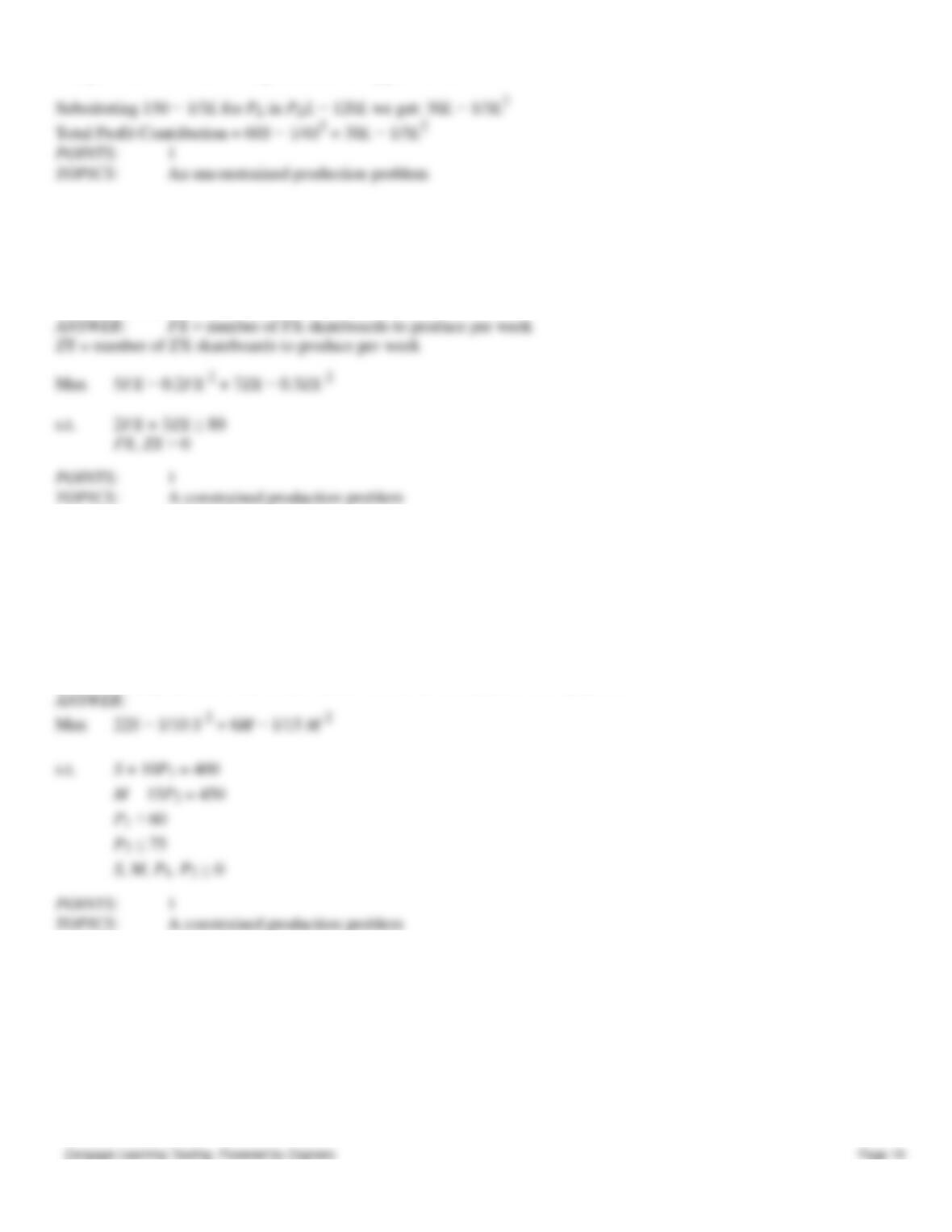
Assume that the demand, S, for Slugger bats is given by S = 640 − 4PS and the demand, L, for Launcher bats is given by L
= 450 − 3PL where PS is the price of a Slugger bat and PL is the price of a Launcher bat. The profit contributions are PSS
− 100S for Slugger bats and PLL − 120L for Launcher bats. Develop the total profit contribution function for this problem.
Chapter 12 – Advanced Optimization Applications
45. Skooter’s Skateboards produces two models of skateboards, the FX and the ZX. Skateboard revenue (in $l,000s) for
the firm is nonlinear and is stated as (number of FXs)(5 − 0.2 number of FXs) + (number of ZXs)(7 − 0.3 number of
ZXs). Skooter’s has 80 labor-hours available per week in its paint shop. Each FX requires 2 labor-hours to paint and each
ZX requires 3 labor-hours. Formulate this nonlinear production planning problem to determine how many FX and ZX
skateboards should be produced per week at Scooter’s.
46. Native Customs sells two popular styles of hand-sewn footwear: a sandal and a moccasin. The cost to make a pair of
sandals is $18, and the cost to make a pair of moccasins is $24. The demand for these two items is sensitive to the price,
and historical data indicate that the monthly demands are given by S = 400 − 10P1 and M = 450 − 15P2 , where S =
demand for sandals (in pairs), M = demand for moccasins (in pairs), P1 = price for a pair of sandals, and P2 = price for a
pair of moccasins. To remain competitive, Native Customs must limit the price (per pair) to no more than $60 and $75 for
its sandals and moccasins, respectively. Formulate this nonlinear programming problem to find the optimal production
quantities and prices for sandals and moccasins that maximize total monthly profit.
47. LeapFrog Airways provides passenger service for Indianapolis, Baltimore, Memphis, Austin, and Tampa. LeapFrog
has two WB828 airplanes, one based in Indianapolis and the other in Baltimore. Each morning the Indianapolis based
plane flies to Austin with a stopover in Memphis, and the Baltimore based plane flies to Tampa with a stopover in
Memphis. Both planes have a coach section with a 120-seat capacity.
LeapFrog uses two fare classes: a discount fare D class and a full fare F class. Leapfrog’s products, each referred to as an
origin destination itinerary fare (ODIF), are listed below with their fares and forecasted demand.
ODIF Origin Destination Fare Class ODIF Code Fare Demand

Chapter 12 – Advanced Optimization Applications
1 Indianapolis Memphis D IMD 175 44
2 Indianapolis Austin D IAD 275 25
3 Indianapolis Tampa D ITD 285 40
4 Indianapolis Memphis F IMF 395 15
5 Indianapolis Austin F IAF 425 10
6 Indianapolis Tampa F ITF 475 8
7 Baltimore Memphis D BMD 185 26
8 Baltimore Austin D BAD 315 50
9 Baltimore Tampa D BTD 290 42
10 Baltimore Memphis F BMF 385 12
11 Baltimore Austin F BAF 525 16
12 Baltimore Tampa F BTF 490 9
13 Memphis Austin D MAD 190 58
14 Memphis Tampa D MTD 180 48
15 Memphis Austin F MAF 310 14
16 Memphis Tampa F MTF 295 11
Develop a linear programming model for LeapFrog’s problem situation and determine how many seats LeapFrog should
allocate to each ODIF.

Chapter 12 – Advanced Optimization Applications
48. Lymann Brothers has a substantial number of clients who wish to own a mutual fund portfolio that closely matches the
performance of the S&P 500 stock index. A manager at Lymann Brothers has selected five mutual funds that will be
considered for inclusion in the portfolio. The manager must decide what percentage of the portfolio should be invested in
Chapter 12 – Advanced Optimization Applications
each mutual fund.
Annual Returns (Planning Scenarios)
Mutual Fund Year 1 Year 2 Year3 Year 4
International Stock 25.64 27.62 5.80 −3.13
Large-Cap Blend 15.31 18.77 11.06 4.75
Mid-Cap Blend 18.74 18.43 6.28 −1.04
Small-Cap Blend 14.19 12.37 −1.92 7.32
Intermediate Bond 7.88 9.45 10.56 3.31
S&P 500 13.00 12.00 7.00 2.00
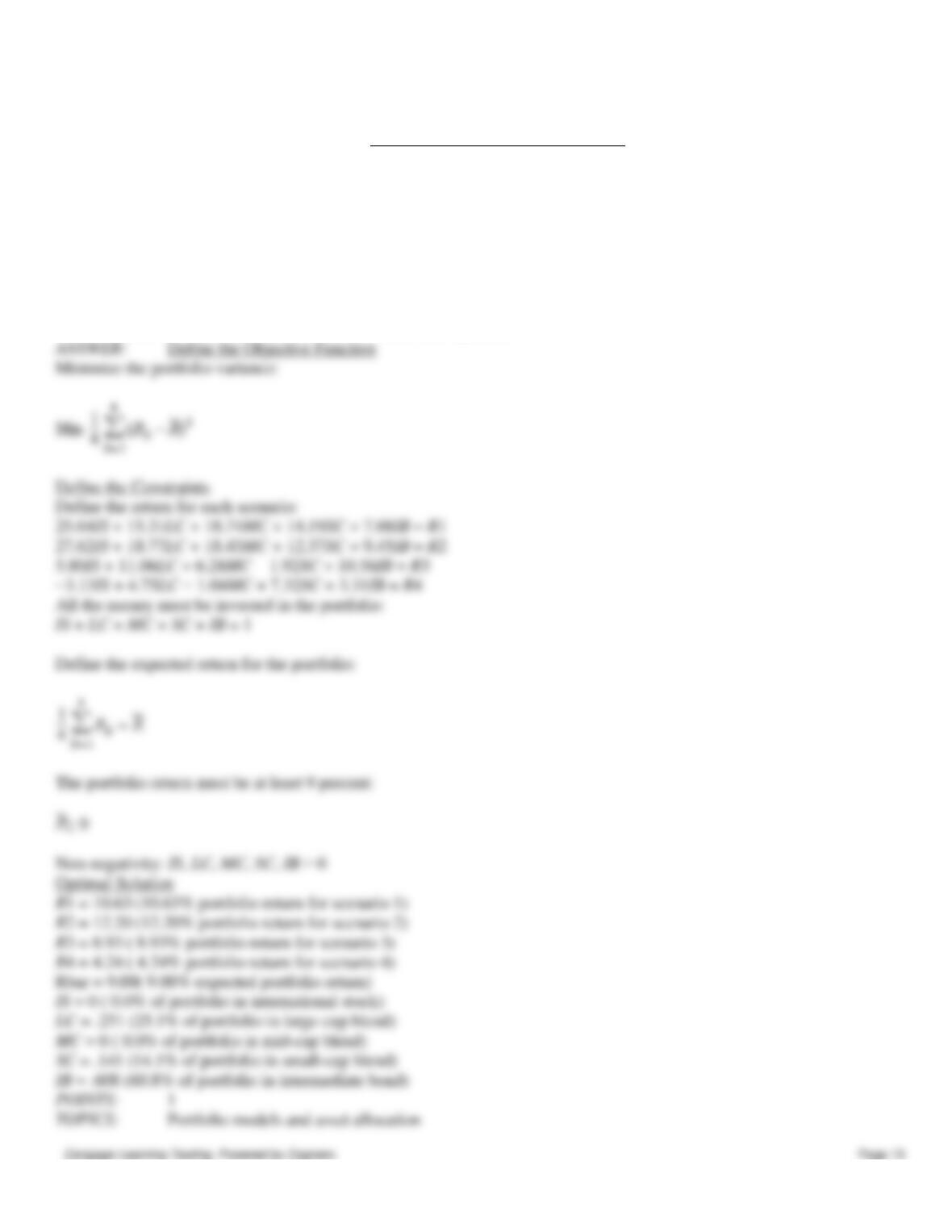
Minimize the variance of the portfolio subject to constraints on the expected return, assuming that Lymann Brothers’
client requires the expected portfolio return to be at least 9 percent.

Chapter 12 – Advanced Optimization Applications
49. The Eastern Washington County School Corporation is interested in comparing educational performance at four
elementary schools and has hired you to prepare a DEA model to do so. After detailed conversations with the corporation
administrative staff and the building principals, you have isolated the following input and output measurements:
Input Measures Output Measures
Average classroom size Percent of children in remedial classes
Percent of students on reduced price lunch Average first grade score on standard test
Average number of parent volunteer hours per week Average fifth grade score on standard test
Data is collected for each school on each measure
School
Archer Hayes Ralston Creekside
Inputs
Classroom size 21 28 32 20
% reduced lunch 10 8 25 2
Avg. vol. hours 30 46 15 64
Outputs
% remediation 15 12 19 3
1st grade score 83 84 62 85
5th grade score 76 72 53 79
Develop the DEA model that would evaluate the efficiency of Ralston Elementary School.
50. Mountainside State Park has four visitor centers. To study the operation of these centers, a DEA model has been
developed that compares inputs (size, number of staff, weekly hours of operation) and outputs (% of visitors attending
educational program, daily sales in gift shop). The computer solution is shown below. What can you conclude about the
efficiency of the North center?
LINEAR PROGRAMMING PROBLEM
Min 1E+0wn+0ws+0we+0ww
S.T. 1) −400E+400wn+1200ws+2400we+1500ww<0
2) −3E+3wn+6ws+10we+7ww<0
3) −56E+56wn+108ws+92we+108ww<0

Chapter 12 – Advanced Optimization Applications
4) −49E+49wn+83ws+56we+72ww>0
5) −38E+38wn+425ws+1200we+630ww>0
6) +1wn+1ws+1we+1ww=1
OPTIMAL SOLUTION
Objective Function Value = 1.000
Variable Value Reduced Cost
E 1.000 0.000
wn 1.000 0.000
ws 0.000 0.000
we 0.000 0.000
ww 0.000 0.000
Constraint Slack/Surplus Dual Price
1 0.000 0.008
2 0.000 0.000
3 0.000 0.001
4 0.000 −0.034
5 0.000 −0.013
6 0.000 −1.000
51. The output shows the solution to a DEA model where facilities in Seaview (S), Farmington (F), Lewiston (L), and San
Domingo (D) are compared. The inputs, in order, are number of machines, size of work force, and goodness of location.
The outputs, in order, are production, quality rating, and on-time completion percentage. The model examines the
efficiency of Lewiston.
Min 0S+0F+0L+0D+1E
S.T. 1) 1S+1F+1L+1D=1
2) 5S+22F+36L+15D−36E<0
3) 400S+1500F+3150L+1060D−3150E<0
4) 24S+13F+32L+17D−32E<0
5) 800S+2900F+1860L+1700D+0E>1860
6) 95S+92F+83L+94D+0E>83
7) 83S+85F+90L+91D+0E>90
OPTIMAL SOLUTION
Objective Function Value = 0.510
Variable Value Reduced Cost
S 0.000 0.385
F 0.167 0.000
L 0.000 0.490
D 0.833 0.000
E 0.510 0.000
Constraint Slack/Surplus Dual Price

Chapter 12 – Advanced Optimization Applications
1 0.000 1.365
2 2.208 0.000
3 474.479 0.000
4 0.000 0.031
5 40.000 0.000
6 10.667 0.000
7 0.000 −0.021
a. Is the Lewiston plant efficient? Why or why not? If not, which plants should it emulate in order to improve?
b. How much more production does the composite facility provide than the Lewiston site?
c. What is the quality rating for the composite facility?
Essay
52. List several industries in which revenue management has been applied and list several different types of decisions
being made with the aid of the methodology.
53. Explain the differences between the LP formulations for a conservative portfolio and moderate-risk portfolio.
54. Explain how the local minimum, local maximum, local optimum, global minimum, global maximum, and global
optimum relate to one another in nonlinear optimization problems.
55. Provide several examples of both nonlinear objective functions and nonlinear constraints.
56. List several types of organizations with multiple operating units where data envelopment analysis might be applied
and give examples of possible inputs and outputs for each organization.

Chapter 12 – Advanced Optimization Applications
57. Write a summary of the DEA approach and explain how you would interpret the solution.
58. Explain the logic of a DEA model. On what basis can the facility being evaluated be judged as relatively inefficient?