120
INDEPENDENT DEMAND ORDERING SYSTEMS
CHAPTER 11
ANSWERS TO PROBLEMS
11.1
11.2
11.3
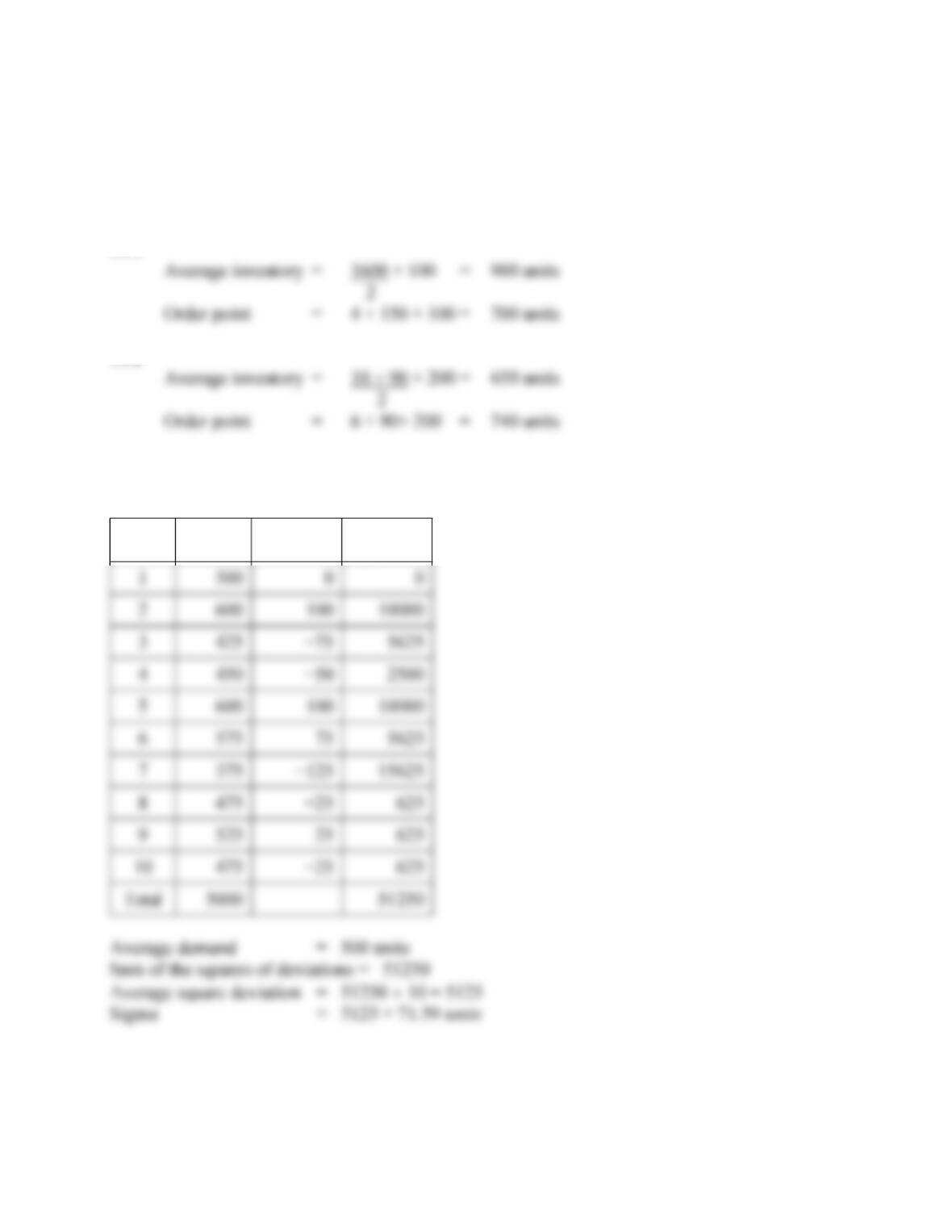
Period
Actual
demand
Deviation
Deviation
squared
121
11.4
11.6 Safety factors taken from Figure 11.5
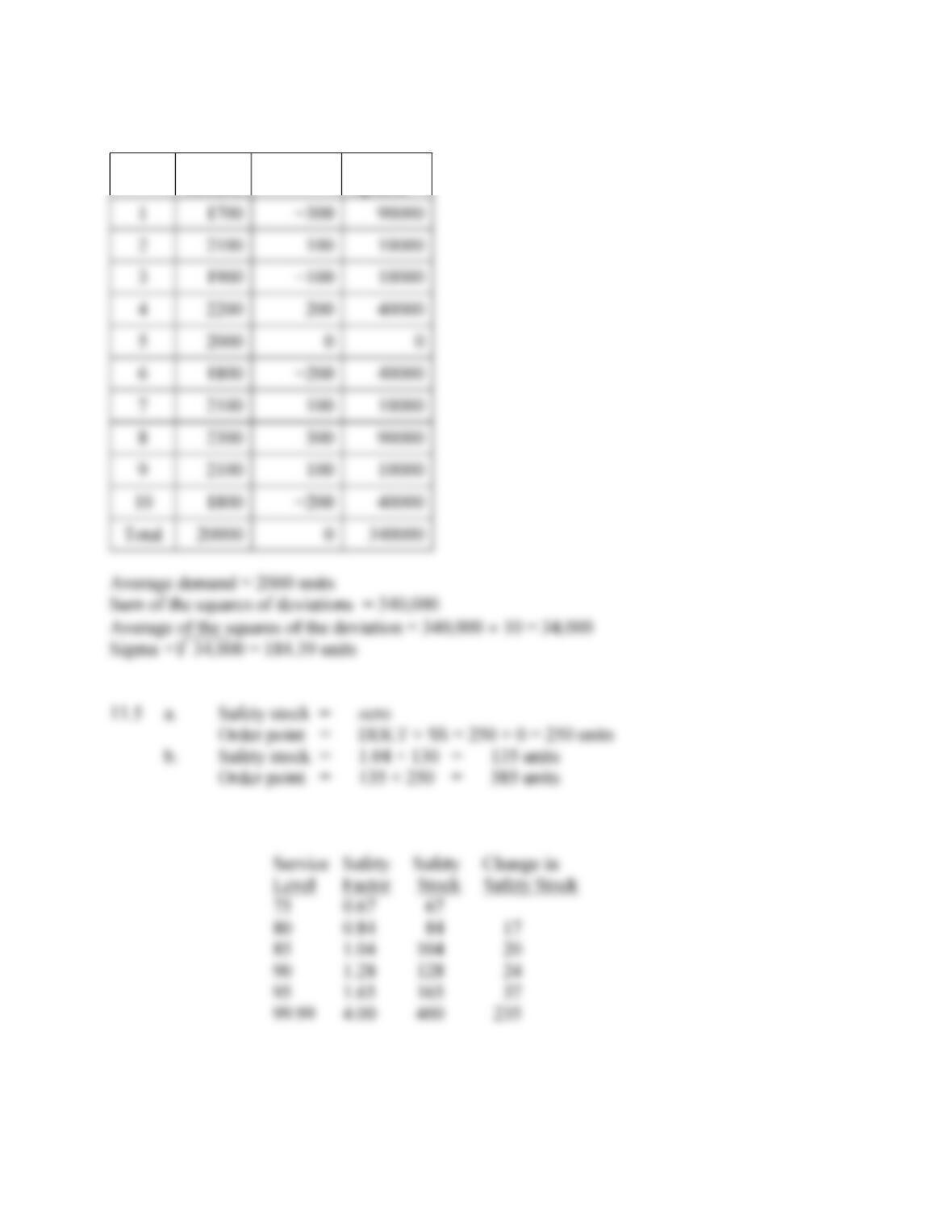
Period
Actual
demand
Deviation
Deviation
squared
122
11.7 Orders per year = 10,000 ÷ 750 = 13.33
11.8 Orders per year = 225 × 52 = 14.625
11.9 Orders per year = 600× 52 = 12.5
11.10
11.11
123
11.12
11.13
11.14
124
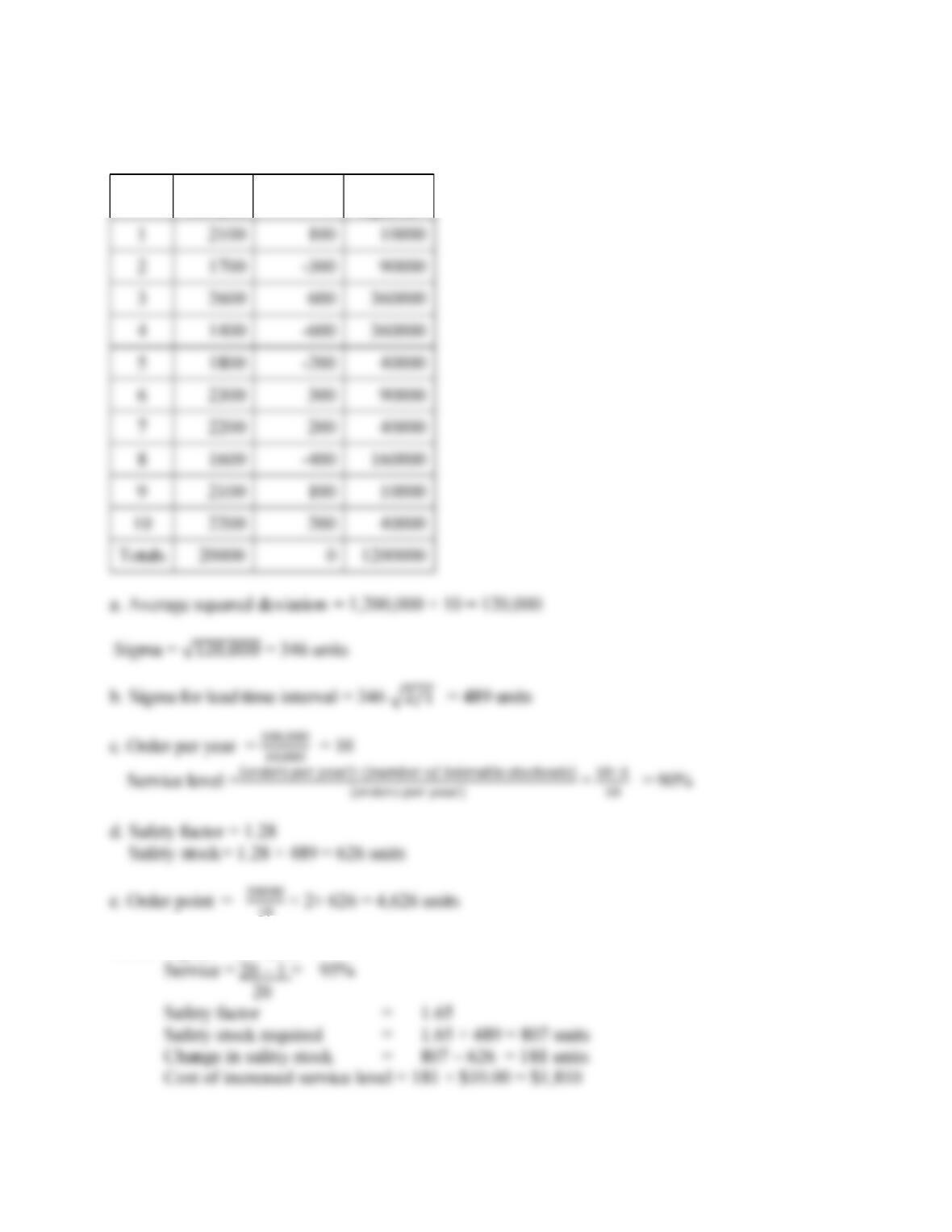
11.15
Week Actual
Demand
Deviation
Deviation
squared
11.16 Sigma = 489 units
125
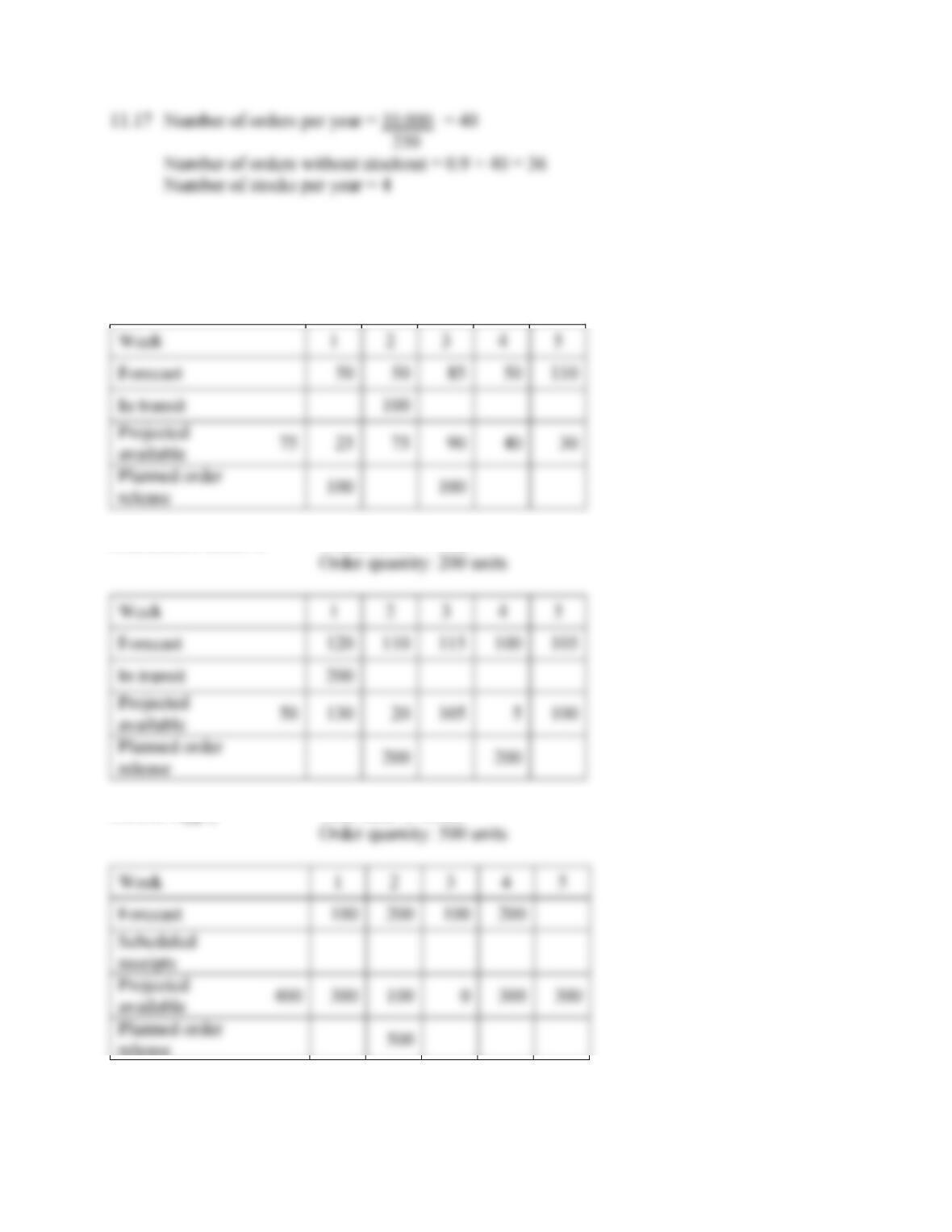
11.18
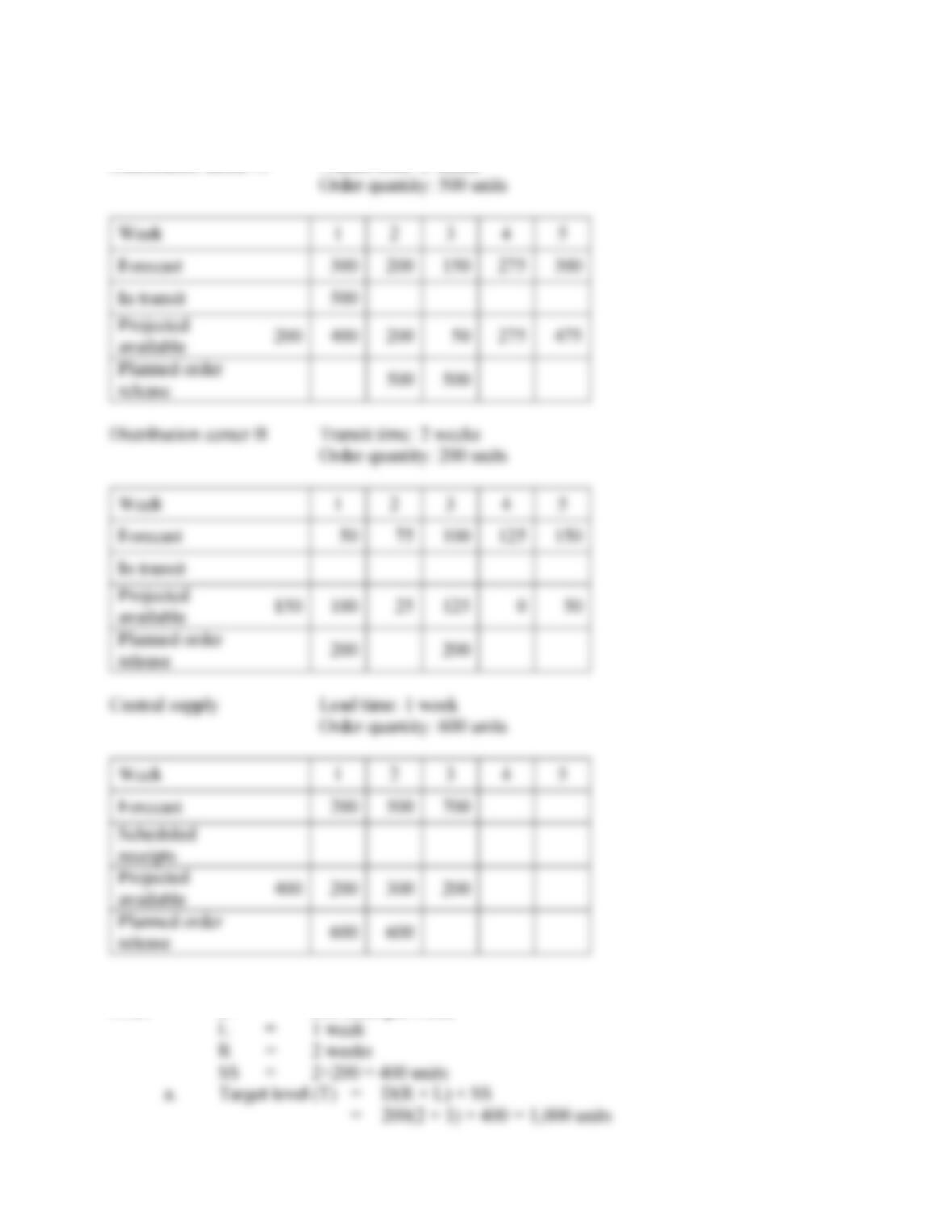
Distribution center A Transit time: 2 weeks
Order quantity: 100 units
Distribution center B Transit time: 1 week
Central supply Lead time: 2 weeks
release
126
11.19
Distribution center A Transit time: 2 weeks
11.20 D = 200 units per week
127
11.21 D = 20 cases per day
128
MULTIPLE CHOICE QUESTIONS
1. Which of the following are basic systems for determining when to order INDEPENDENT demand
items?
I. Order point system
II. Periodic review system
III. Material Requirements Planning
a. I only
b. II only
c. I and II only
d. I and III only
e. II and III only
2. Which of the following statements is best?
a. order point = DDLT + SS
b. average inventory = Q ÷ 2 + SS
c. safety stock is always needed
d. a and b are true
c. d and c are true
3. When using the order point system which of the following is true?
a. order quantities are usually fixed
b. the order point depends upon the demand during the lead time plus safety stock
c. time intervals between orders are constant
d. a and b above
e. b and c above
4. Which of the following statements is true about safety stock?
a. it must always be carried
b. it depends only on the amount of demand
c. it depends on the required service level
d. all the above are true
e. none of the above is true
5. Select the description which most closely fits the term ORDER POINT:
a. the time it takes to replenish an item in inventory.
b. extra inventory of an item carried to protect against variations in demand during lead
time
c. a listing of components required to manufacture a product
d. the time when an order should be placed
e. none of the above
129
6. Select the description which most closely fits the term SAFETY STOCK:
a. the time it takes to replenish an item in inventory.
b. extra inventory of an item carried to protect against variations in demand during lead
time
c. a listing of components required to manufacture a product
d. the time when an order should be placed
e. none of the above
7. Select the description which most closely fits the term LEAD TIME:
a. the time it takes to replenish an item in inventory
b. extra inventory of an item carried to protect against variations in demand during lead
time
c. a listing of components required to manufacture a product
d. the time when an order should be placed
e. none of the above
8. Among other things the amount of safety stock carried will depend upon:
a. the frequency of reorder
b. the service level desired
c. variability of demand during the lead time
d. all the above
e. a and b above
9. Which of the following statements is best?
a. safety stock depends on the service level desired
b. safety stock depends on the length of the lead time
c. safety stock depends on the variation of demand during the lead time
d. all of the above are correct
e. none of the above is correct
10. If the standard deviation of demand is 100 units and the average demand is 1000 units, then we can
be 95% confident that actual sales will be 1000 units plus or minus about:
a. 100 units
b. 150 units
c. 200 units
d. 300 units
e. 400 units
11. Which of the following statements is best?
a. most demand patterns tend to be stable and predictable
b. the most common predictable pattern is called a normal distribution
c. the normal curve can be described by its average (mean) and the variation of actual
demand
about the average
d. all the above are true
e. only and b are true
12. If the sum of the absolute deviations of demand was 500 for 10 periods, MAD would be:
a. 5
b. 500
130
c. 50
d. 0.02
e. none of the above
13. Management states that they will tolerate one stockout every year for a specific item. If 10 orders
are placed for the item each year the service level desired is:
a. 80%
b. 85%
c. 90%
d. 95%
e. none of the above
14. The average demand for an item is 1000 per month. The mean absolute deviation of monthly
demand is 300 units. The MAD for yearly sales will be approximately:
a. 3600 units
b. 12,000 units
c. 1040 units
d. 3464 units
e. none of the above
15. Given that the lead time is 1 week and the sigma is 100 units, if the lead time changes to 2 weeks
then the sigma would change to about:
a. 200 units
b. 180 units
c. 160 units
d. 140 units
e. 120 units
16. Management is willing to tolerate one stockout every 2 years for a specific item. If 10 orders are
placed for the item each year the service level desired is:
a. 80%
b. 85%
c. 90%
d. 95%
e. none of the above
17. Which of the following is the best statement?
a. stockouts do not cost money because customers are willing to wait
b. the cost of a stockout will vary depending on the market served, the customer, and
competition
c. stockouts can occur at any time in the inventory cycle
d. stockouts do not depend on the frequency of reorder
e. all the above statements are true
131
18. Which of the following systems are used to determine when the order point is reached?
I. Two-bin system.
II. Perpetual inventory system.
III. Periodic inventory system.
IV. Safety stock system.
a. all are used to tell when the order point is reached
b. I and II only are used
c. I, II and III only are used
d. I and III only are used
e. II and III only are used
19. ____________ is an inventory record system that keeps a continuous account of transactions as
they occur:
a. Perpetual inventory system
b. Periodic inventory system
c. Two-bin system
d. Safety stock system
e. All the above keep a continuous account
20. The demand placed on a factory or a central warehouse by distribution centers is considered:
a. dependent
b. independent
c. uniform
d. all of the above
e. none of the above
21. An order system in which the order quantity is allowed to vary and the order cycle is fixed is called
the:
a. periodic review system
b. two-bin system
c. reorder point system
d. red-tag system
e. none of the above
22. If the lead time is 1 week, the review period 4 weeks, the average demand 100 units per week and
the safety stock is 50 units, the target level will be:
a. 150 units
b. 200 units
c. 250 units
d. 300 units
e. 550 units
132
23. Using the periodic review system the target level is:
a. forecast demand during lead time
b. forecast demand during the review period
c. the sum of a and b
d. the sum of a and b plus the safety stock
e. none of the above
24. If the lead time is 1 week, the review period 1 week, the average demand 100 units per week and
the safety stock is 50 units, the target level will be:
a. 150 units
b. 200 units
c. 250 units
d. 300 units
e. none of the above
25. Which of the following is correct?
a. order quantities are fixed in the periodic review system
b. the two-bin system is an example of the order point system
c. the safety stock does not depend upon the frequency of reorder
d. all of the above are true
e. none of the above is true
26. Which of the following statements is best?
I. In a pull system central supply determines what is needed by the distribution centers
II. In a push system all decisions are made by the distribution centers.
III. An advantage of a pull system is central coordination
a. I and II only are true
b. II and III only are true
c. I and III only are true
d. all the above are true
e. none of the above are true
27. Which of the following are objectives of distribution inventory management?
I. To provide the required level of customer service.
II. To minimize the costs of transportation and handling.
III. To always have enough of everything on hand so there are no stockouts.
IV. To be able to interact with the factory so as to minimize scheduling problems.
a. all the above are objectives
b. I, II and III
c. I, II and IV
d. I, III and IV
e. II, III and IV
133
28. The distribution inventory management system which forecasts when the various demands will be
made by the system on central supply is called:
a. pull system
b. push system
c. distribution requirements planning
d. inventory replenishment
e. order point system
29. If the on hand inventory is 40 units, the safety stock 20 units and the target level is 120 units then
an order should be placed for:
a. 100 units
b. 80 units
c. 60 units
d. 40 units
e. 20 units
30. For a given item the lead time is 1 week, the on hand inventory is 50 units, demand is 20 units per
week, safety stock is set at 3 weeks supply and the item is ordered every 2 weeks. The order
quantity should be:
a. 70 units
b. 60 units
c. 50 units
d. 40 units
e. 120 units
31. A company that keeps no safety stock can expect an average service level of
a. 0%
b. 15%
c. 50%
d. 85%
e. Safety stock does not affect the service level.
32. A company that has regular replenishments of small value items such as a grocery store would use
the _____________ system.
a. Order Point
b. Materials Requirements Planning
c. Push
d. Kanban
e. Periodic Review
33. Management has carefully measured the standard deviation of the demand of a product and plans to
use this to calculate the level of safety stock. If they keep one Standard Deviation of safety stock then
the expected service level should be approximately:
a. 15%
b. 35%
c. 85%
d. 90%
e. 100%
134
34. Lead time for a given item is 3 weeks and sales have been recorded in 1 week intervals. If the
Standard Deviation for the sales interval is 25 then the Standard Deviation for the lead time should be
approximately:
a. 25
b. 43
c. 75
d. 14
e. 8
35. For a given item controlled by a periodic review system the target level is 100 units. If there are 40
units on the shelf and the lead time is 2 weeks then the order quantity should be:
a. 140 units
b. 120 units
c. 85 units
d. 60 units
e. 40 units
36. A product has a standard deviation of demand of 15. The safety stock for a service level of 98%
would be approximately:
a. 15
b. 26
c. 31
d. 8
e. 14.7
Use the following information to answer the next two questions
Distribution Center A
Transit time: 1week
Order Quantity 200 units
Week 1 2 3 4 5
Gross Requirements 150 125 125 100 150
In Transit 200
Projected Available 75
Planned Order Release
37. There will be a planned order release(s) in weeks:
a. 2 and 3
b. 1 and 2
c. 1 and 3
d. 1, 2 and 3
e. Intransit inventory will cover all the orders.

135
38. What will be the projected available for periods 2, 3 and 4?
a. 200, 75, 175
b. 125, 0, 100
c. 75, 175, 25
d. 0, 75, 175
e. 125, 0, 75
39. Demand on Central Supply tends to be:
a. Smoothed out with planned orders.
b. Continuous
c. Monotonous
d. Lower than the Distribution Centers
e. Lumpy
40. The Gross Requirements on Central Supply are:
a. The sum of the planned order releases from the Distribution Centers
b. Taken from the Distribution Centers and offset by the lead time
c. The sum of the Gross Requirements for the Distribution Centers
d. The sum of the g offset by the lead time.
e. The same as the Intransit Inventory