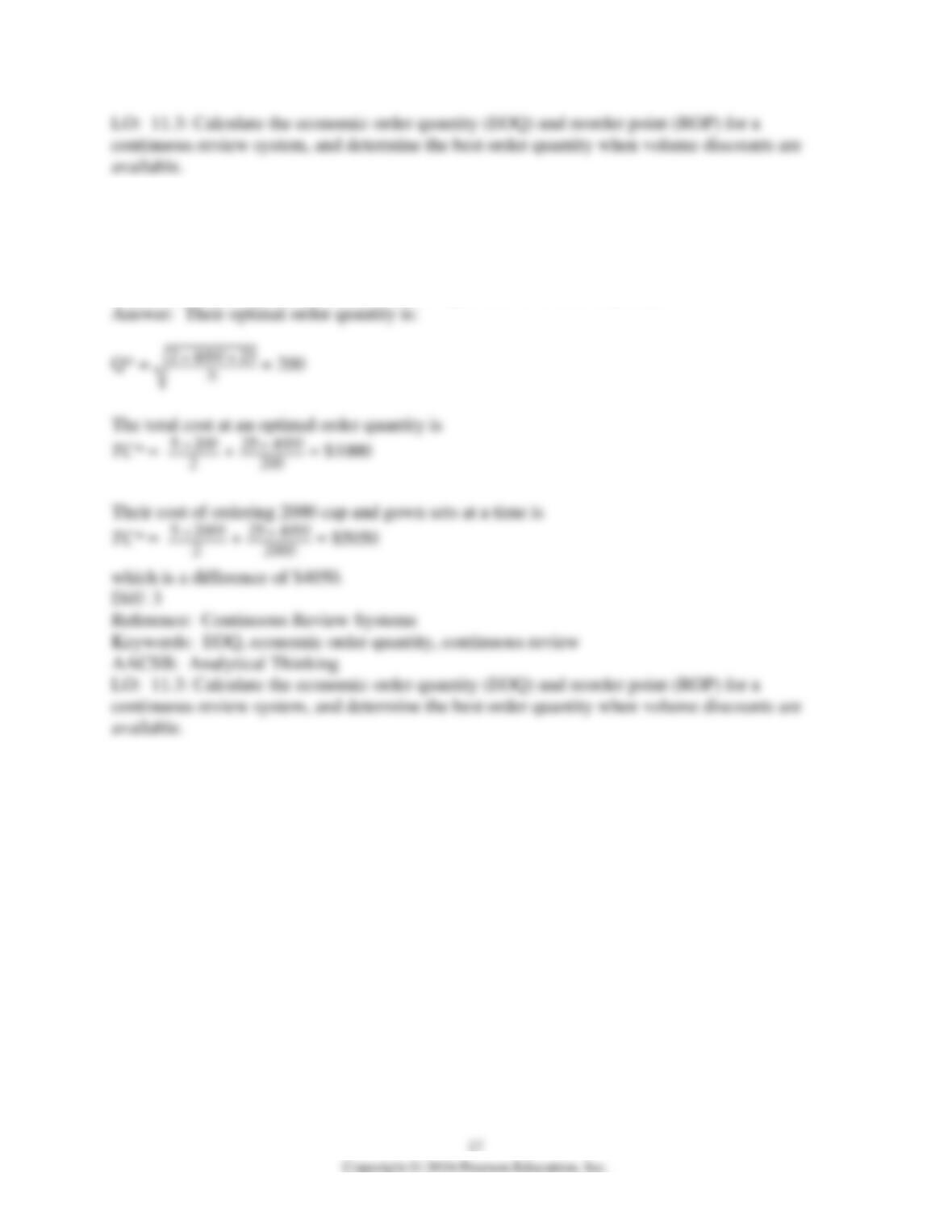
25) The campus bookstore sells 4,000 sets of graduation regalia each year. Placing an order from
their supplier costs $25 regardless of order quantity, so they usually place a large order (a half
year’s supply) at a time. It costs $5 per year to hold a cap and gown in inventory, primarily
insurance costs for the highly flammable material. What is the difference in their holding cost if
they order at their optimal order quantity compared to their current policy?
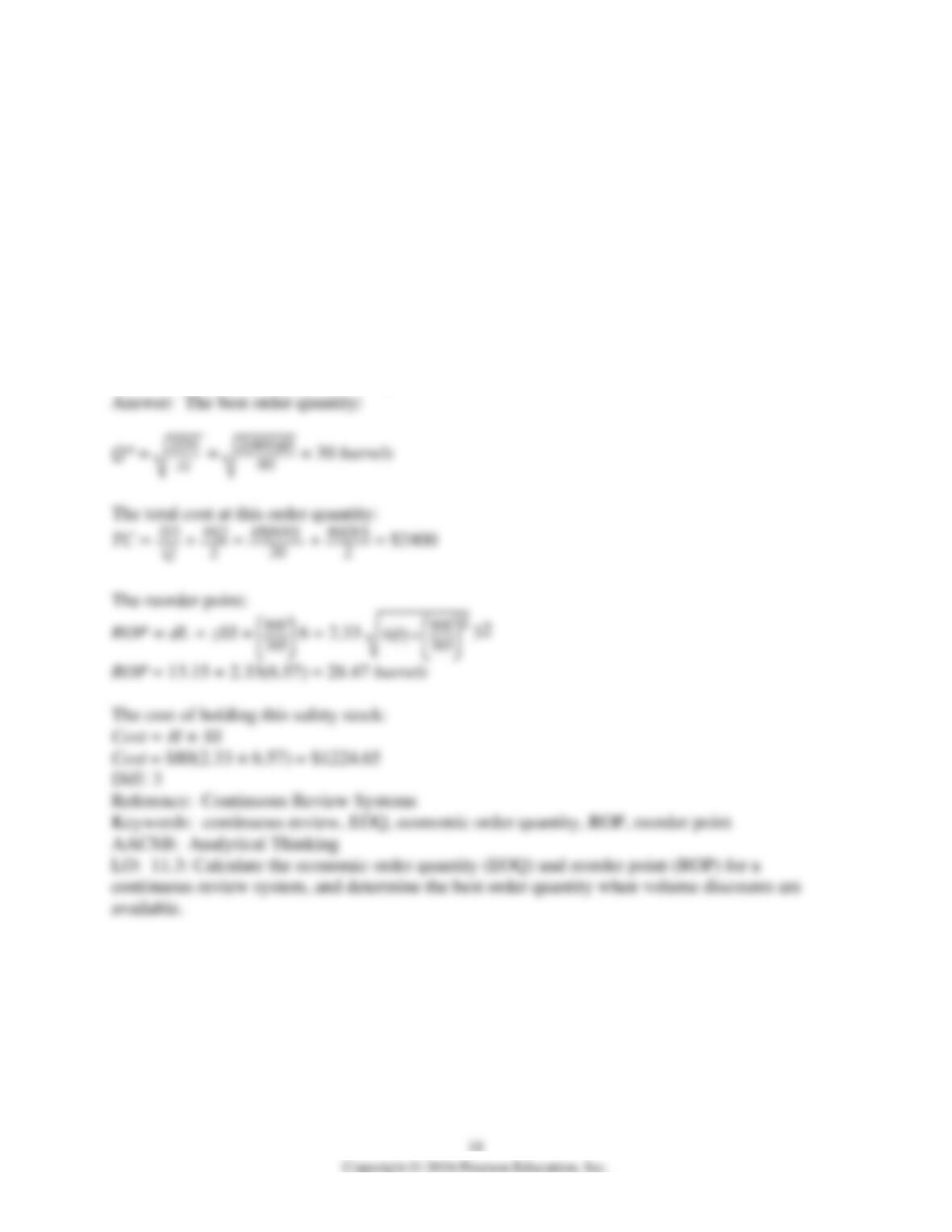
26) A catfish bait manufacturer uses a secret blend of ingredients to make their infamous bait.
One of these ingredients, we’ll call it X for proprietary reasons, is the major component in the
mixture. X is ordered in 55 gallon barrels from out of state and is used at the rate of 800 barrels
per year. Each order that is placed with the supplier costs $45 to process. Storage space is at a
premium on the manufacturing floor and out in the yard, so their annual cost to hold inventory is
$80 per barrel. The owner’s brother-in-law provides transportation services and his record has
been less than stellar, so lead time has averaged 6 days with a standard deviation of 3 days.
Stopping the process would be disastrous, so the plant manager has set a 99% service level on
the reorder point.
What is the best order quantity?
What is the total cost at this reorder point?
What is the reorder point?
What is the cost of holding this safety stock?
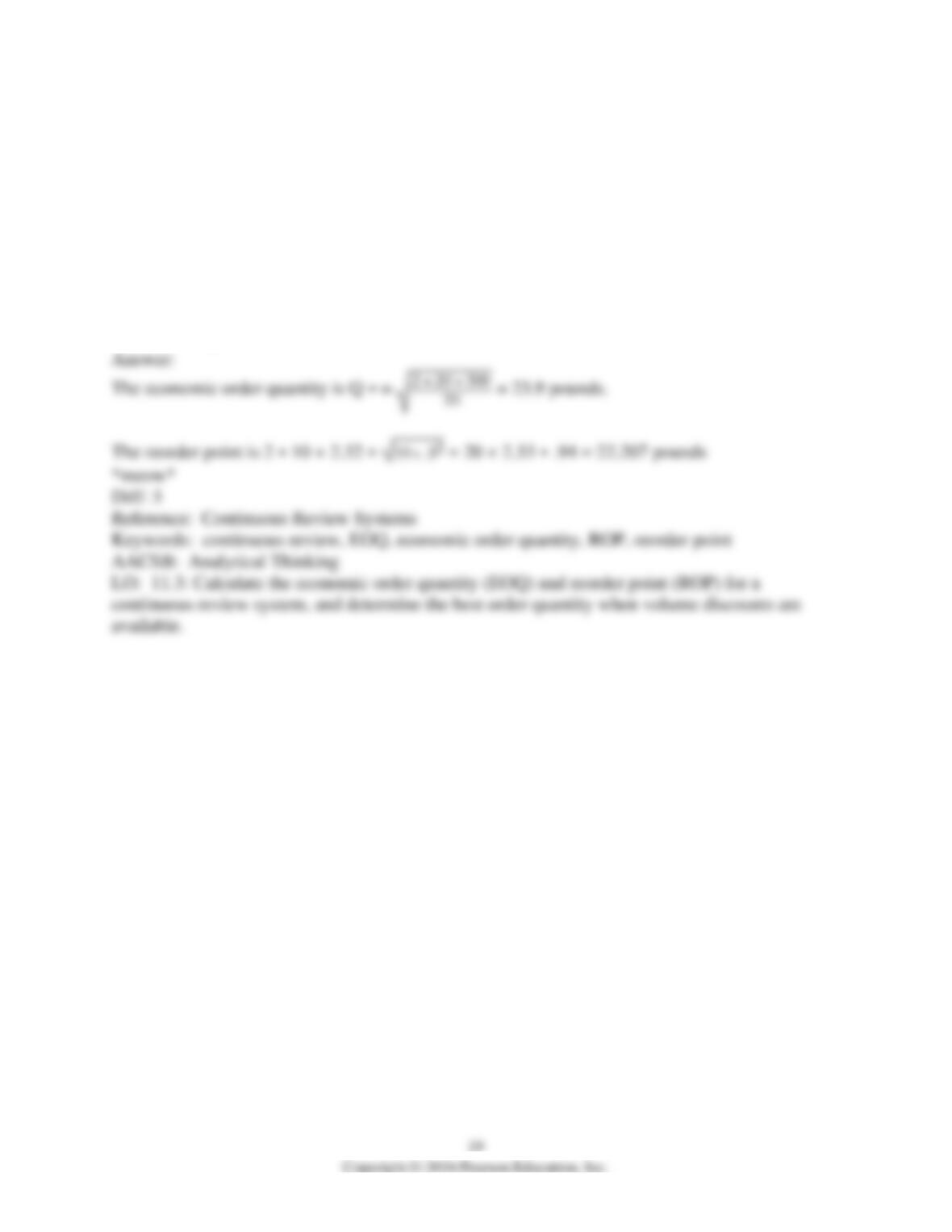
27) Nothing is too good for my cats, so all their food is custom made at Catastic, who operates a
specialty organic food mill in an adjacent state. We need 500 pounds of food per year, distributed
evenly throughout the year. It costs $20 shipping and handling to place and receive an order for
this delicious food. The cats are fed only on week days, so the 500 pounds per year translates to
2 pounds per day (we go out to restaurants on the weekends). Of course, my cats don’t always eat
exactly 2 pounds per day, their demand could more precisely be described as an average of 2
pounds and a standard deviation of 0.3 pounds per day. It takes ten days on average to receive an
order for food once I place it. It costs $35 to hold a pound of food in inventory for a year and the
food costs $850 per pound. It’s expensive, yes, but again, nothing is too good for my cats.
What amount should I order and when should I order it if I want only a 1% chance of running out
of food for my cats?
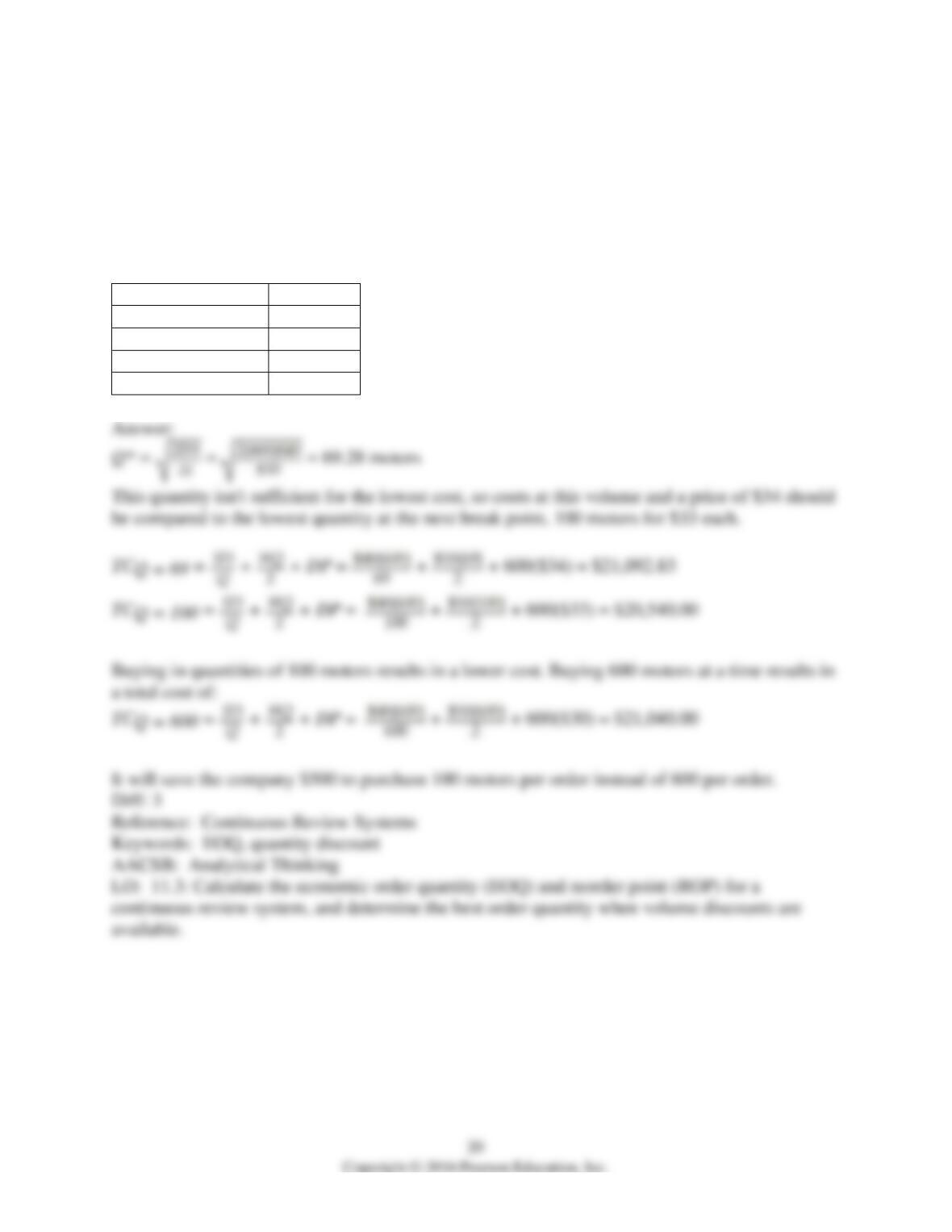
28) A small refrigeration shop stocks up on electric motors from a catalog supplier located in the
Midwest. The price of the motors varies depending on the quantity purchased; the price breaks
are shown in the table. The refrigeration shop knows it will need around 600 motors for the
coming season and that it will cost them about $40 to place an order. Storage cost for the motors
is $10 each. In previous years they have bought all 600 at once and they are considering doing
this again. What order quantity would you advise and how much can they save using your
recommendation instead of their one order per year strategy?
Quantity
Price/unit
1-49
$35.00
50-99
$34.00
100-499
$33.00
500 or more
$30.00
Learning Objective 11-4
1) The excess cost of an item is the profit you would have made on it.
2) A target service level is the point where the expected cost of a shortage equals the expected
cost of having excess units.
3) Buying advance tickets for the Giraffe Massacre concert on New Year’s Eve saves the buyer
one-tenth of one percent on the face value of the tickets. It would be wise to buy tickets well in
advance of the concert date.
4) In a single period inventory system, as the average demand rises, the standard deviation of
demand falls.
5) The food engineers at Moria Foods have developed a new variety of banana they have named
the “mayfly banana” which holds perfect ripeness for exactly one day before becoming a black-
skinned sack of putrid mush. Which of these actions will result in a lower order quantity from the
many retail establishments clamoring to stock up on this new foodstuff?
A) an increase in the price consumers are willing to pay for the mayfly banana
B) an increase in the standard deviation of the number of mayfly bananas demanded by
consumers
C) a decrease in the salvage value of the mayfly bananas
D) a decrease in the disposal cost of the mayfly bananas
6) A local barbecue joint makes one massive batch of potato salad each day. If they run out of
this savory side before the end of the day, their last few customers are less than satisfied, but if
they make too much, they sell it to the local hog farmer for feed. Every serving costs an
equivalent of $0.23 to make, but can be sold for $1.50 to customers and for $0.08 to the hog
farmer. The average daily demand is for 200 servings with a standard deviation of 20 servings.
How many servings should be made each day?
A) 220
B) 225
C) 230
D) 235
7) A local barbecue joint makes one massive batch of potato salad each day. If they run out of
this savory side before the end of the day, their last few customers are less than satisfied, but if
they make too much, they sell it to the local hog farmer for feed. Every serving costs an
equivalent of $0.23 to make, but can be sold for $2.50 to customers and for $0.12 to the hog
farmer. The average daily demand is for 400 servings with a standard deviation of 40 servings.
How many servings should be made each day?
A) 467
B) 453
C) 462
D) 455
8) Geoff hesitated as he read the fast food menu, unsure whether he should supersize his order of
delicious golden French fries. Doing so would increase his cost from $0.99 to $1.59 and just
might provide him the nutrition he needed to make it through the second half of his day at the
office. Of course, if he finished his hamburger and the usual amount of fries, he would simply
throw the extra ones away. However, if he failed to supersize his order, he would have to take a
candy bar break mid-afternoon and they weren’t exactly giving them away in the break room
vending machines. He would likely need two candy bars, which sold for $0.95 each. What is
Geoff’s target service level?
A) 0.29
B) 0.61
C) 0.76
D) 0.87
24
Copyright © 2016 Pearson Education, Inc.
9) Warren hesitated as he read the fast food menu, unsure whether he should supersize the orders
of delicious golden French fries. As the office lunch boy, he was responsible for buying enough
food to keep his coworkers satiated during the rest of the work day. Supersizing would increase
his cost from $0.99 to $1.59 and just might provide his colleagues the nutrition they needed to
make it through the second half of his day at the office. Of course, if they finished his hamburger
and the usual amount of fries, Warren would simply throw the extra ones away. However, if he
failed to supersize the orders, he would have to purchase candy bars during the afternoon and
they weren’t exactly giving them away in the break room vending machines. Each hungry
colleague would likely need two candy bars, which sold for $1.25 each. With a demand that is
normally distributed with a mean of 15 and standard deviation of five, what is Warren’s optimal
supersize decision?
A) 16.3
B) 17.3
C) 18.3
D) 19.3
10) Degan routinely drove the 400-mile round trip to his favorite grocery store to stock up on
bread, which cost $1.50 per loaf. Running out would be disastrous — an unplanned trip to this
store would mean a custom order that would run $7.75 per loaf. Overstocking wasn’t a big issue,
he could sell it to his teaching partner for $0.10 per loaf. With a demand that is normally
distributed with a mean of 125 and standard deviation of 15, what is Degan’s optimal purchase
quantity on his next trip to the store?
A) 139
B) 173
C) 115
D) 128
11) In a single period system, the target ________ is the balancing point between shortage costs
and excess costs.
12) Three Chums Fish Company buys fresh salmon daily from the fishermen that ply the deep
waters of Puget Sound. Salmon are purchased for $2.50 per pound and sold to the public at $8.50
per pound. The salmon are kept fresh by displaying them on ice but at the end of the day, any
unsold fish have a noticeable odor and are sold to a nearby chowder stand for $1 per pound. The
past year’s demand for salmon on Saturdays is shown in the table. Based on this information,
what should their target service level and stocking point be? What is the significance of the target
stocking level?
Daily Demand (pounds)
# Days at This Level
300
3
320
4
340
6
360
9
380
9
400
8
420
6
440
5
460
2
13) Tickets for the gala Opening Night festivities in Oklahoma City are available for $80 in
advance at a couple of area businesses. If you wait until you arrive at the venue, you will pay full
face value of $100 per ticket to enjoy the same festivities. If you buy a ticket and don’t use it, you
can buy $25 worth of chemicals and treat the ticket so that it can be used the following year. You
have been taking orders from your friends for a few years and historically demand has been
normally distributed with a mean of 50 tickets and a standard deviation of 10. What’s the best
quantity of tickets to purchase for this year’s event?
14) A local barbecue joint makes one massive batch of potato salad each day. If they run out of
this savory side before the end of the day, their last few customers are less than satisfied, but if
they make too much, they sell it to the local hog farmer for feed. Every serving costs an
equivalent of $0.23 to make, but can be sold for $2.50 to customers and for $0.12 to the hog
farmer. The average daily demand is for 400 servings with a standard deviation of 40 servings.
How many servings should be made each day? One day the hog farmer cancels the contract —
evidently there are some things that even hogs won’t eat. With no fallback position, how many
servings of potato salad should the barbecue joint make? Discuss the discrepancy between the
two numbers.
Learning Objective 11-5
1) The bullwhip effect says that a small change in demand downstream in the supply chain
causes a large change in demand upstream.
2) The flexibility of inventory increases as materials move down the supply chain.
3) The value of goods on a “per unit” basis upstream in a supply chain is greater than the value of
those same goods downstream in a supply chain.
4) Order quantity decisions are typically made in isolation from considerations of transportation,
packaging, and material handling.
5) The factory produces product and ships it to the distributor. The distributor sends it to the
wholesaler when they receive an order. The wholesaler ships the product to the retailer as the
retailer requests replenishment. The customer visits the retailer’s bricks and mortar store to
purchase the product when they run out. Which of these supply chain members is most likely
subjected to the greatest variability in customer demand?
A) retailer
B) wholesaler
C) distributor
D) factory
6) Supply chain inventory:
A) increases in cost as materials move downstream.
B) decreases in value as materials progress downstream.
C) increases in flexibility as materials progress upstream.
D) is governed by the bullwhip effect, which says a small change upstream can cause a large
change downstream.
7) The ________ is an extreme change in the supply position upstream generated by a small
change in demand downstream.
8) Define the bullwhip effect and discuss the advantages of holding inventory far upstream or
downstream in the supply chain.