Introduction to Operations and Supply Chain Management, 4e (Bozarth/Handfield)
Chapter 11 Managing Inventory throughout the Supply Chain
Learning Objective 11-1
1) Cycle stock can occur at more than one point in a supply chain.
2) Companies do not plan to use safety stock.
3) Dependent demand inventory never needs to hold hedge inventory.
4) The inventory that companies hold to protect themselves against uncertainties in either
demand or replenishment time is called:
A) safety stock.
B) anticipation inventory.
C) hedge inventory.
D) smoothing inventory.
5) Individual links in the supply chain can stabilize their production at the most efficient level by
using:
A) safety stock.
B) anticipation inventory.
C) linkage inventory
D) smoothing inventory.
6) Inventory that is “in the pipeline” moving from one link to another is:
A) anticipation inventory.
B) transportation inventory.
C) smoothing inventory.
D) hedge inventory.
7) The mismatch between timing of customer demand and supply chain lead times is what drives
the need for:
A) safety stock.
B) anticipation inventory.
C) cycle stock.
D) hedge inventory.
8) Tata Motors assembles cars from their own parts and subassemblies and also controls the
mining and fabrication of the materials used to create those parts. When Anand ordered his
luxury sedan with the platinum dashboard he knew he wouldn’t be taking delivery of his dream
car the next week. Rather, he would be waiting a while thanks to:
A) a mismatch between supply chain lead time and customer demand.
B) a mismatch between overall demand levels and productive capacity.
C) a mismatch between demand and the most efficient production volume.
D) a mismatch between demand and the most efficient shipment volume.
9) Which of the following relationships shows dependent demand inventory?
A) A business purchases a new car when the old one wears out.
B) A tire maker buys cleaning supplies.
C) An automaker purchases four tires for each car they produce.
D) A winemaker buys grapes from farmers in the Columbia Valley.
10) Gordon went to the grocery store and bought a bag of carrots. He needed only three for his
cottage pie recipe, but they came twelve to a bag so he diced three and tossed the rest in the
crisper compartment of his stainless steel refrigerator. As he screamed his insults at his children
they reminded themselves that he wasn’t upset with them, rather he was concerned about the high
level of ________ stock he was holding.
11) Extra inventory that is held to protect against uncertainties in either demand or lead time is
called ________.
12) Inventory items with demand levels that are beyond an organization’s complete control are
termed ________.
13) Describe any four types of inventory and the drivers that spur their need.

Learning Objective 11-2
1) The order quantity in a periodic review system rises as the on-hand inventory falls.
2) The restocking level increases as the service level falls.
3) The beef jerky driver shows up every Monday to take orders from his convenience store
customers. One fine Monday morning he stops in the Quik-E Mart and notes that there are only
three sticks on the shelves. Consulting his route sheet, he discovers that the restocking level is
40. The order quantity is therefore:
A) 3 sticks.
B) 37 sticks.
C) 40 sticks.
D) Cannot be determined with the information given.
4) In a periodic review system, if the average demand increases by 100%, the restocking level is:
A) increased by 200%.
B) decreased by 100%.
C) decreased by 50%.
D) increased by 40%.
5) In a periodic review system, if the average demand increases by 100%, the safety stock level
is:
A) increased by 200%.
B) increased by 100%.
C) decreased by 50%.
D) increased by 40%.
6) A hospital’s biomedical repair shop uses a 4-week periodic system to maintain the inventory
on the blood pressure cuff repair parts. They use an average 40 adult arm cuffs with a standard
deviation of 6 cuffs every 4 weeks. Cuffs aren’t the most critical item they carry, but the manager
would like to avoid the embarrassment of a stockout at least 95% of the time. What should their
restocking level be?
A) 40 cuffs
B) 46 cuffs
C) 50 cuffs
D) 52 cuffs
Learning Objective 11-3
1) A company that orders at their economic order quantity has an annual ordering cost that is half
of their total cost.
2) In order for the economic order quantity model to work, demand must be known and constant.
3) Decreases in the standard deviation of demand reduce the amount of safety stock that should
be held.
4) In order to find the lowest cost ordering policy in a quantity discount model, you must
compare the holding cost, ordering cost, and the price per unit for various order quantities.
5) Which of these conditions is NOT necessary for the economic order quantity model to be
valid?
A) The item has a constant demand.
B) The item has a constant lead time.
C) The item has a constant price.
D) The item has a constant safety stock.
6) The cashier waved the can of golden hominy across the holographic bar code reader and it
emitted a piercing beep. At the same time the customer’s bill was rising, the grocery store’s
inventory was automatically being reduced by 1 can of golden hominy down to 3 cans. This was
the bare minimum amount of hominy the store manager dared carry in inventory, so the
computer system automatically sent a message to the hominy man, who loaded a few cases onto
his delivery truck for tomorrow morning’s trip to replenish the store. This is a classic example of:
A) a periodic review system.
B) safety stock.
C) a continuous review system.
D) cycle stock.
7) If annual demand increases by 100%, the average inventory held in a system governed by the
EOQ model is:
A) increased 100%.
B) decreased by 100%.
C) decreased by 50%.
D) increased by 40%.
8) A law firm always orders 50 cases of paper from their office supply company. They incur an
annual holding cost of $15 per case and have an ordering cost of $25 each time they place an
order. If their annual demand is 480 cases, how much could they save annually by switching to
their economic order quantity?
A) $15
B) $25
C) $40
D) $80
9) The campus bookstore sells 4,000 sets of graduation regalia each year. Placing an order from
their supplier costs $25 regardless of order quantity, so they usually place a large order (a half
year’s supply) at a time. It costs $5 per year to hold a cap and gown in inventory, primarily
insurance costs for the highly flammable material. What is their optimal order quantity?
A) 150
B) 200
C) 1,000
D) 2,000
10) The campus bookstore sells 4,000 sets of graduation regalia each year. Placing an order from
their supplier costs $25 regardless of order quantity, so they usually place a large order (a half
year’s supply) at a time. It costs $5 per year to hold a cap and gown in inventory, primarily
insurance costs for the highly flammable material. What is the total cost if they order at their
optimal order quantity?
A) $1,650
B) $1,500
C) $1,000
D) $2,000
11) The campus bookstore sells 4,000 sets of graduation regalia each year. Placing an order from
their supplier costs $25 regardless of order quantity, so they usually place a large order (a half
year’s supply) at a time. It costs $5 per year to hold a cap and gown in inventory, primarily
insurance costs for the highly flammable material. What is the difference in the total cost if they
order at their optimal order quantity compared to their current policy?
A) $4,550
B) $5,050
C) $3,550
D) $4,050
12) The campus bookstore sells 4,000 sets of graduation regalia each year. Placing an order from
their supplier costs $25 regardless of order quantity, so they usually place a large order (a half
year’s supply) at a time. It costs $5 per year to hold a cap and gown in inventory, primarily
insurance costs for the highly flammable material. What is the difference in their holding cost if
they order at their optimal order quantity compared to their current policy?
A) $4,500
B) $4,400
C) $4,200
D) $4,000
13) A manufacturer replenishes their packaging materials according to the economic order
quantity model. They use 25,000 cases of packaging materials per year and order 500 cases at a
time. Their cost to carry a case in inventory for a year is $12. How much does it cost them to
place an order with their supplier?
A) $12
B) $60
C) $720
D) $5
14) Which of these conditions is likely to cause a decrease in the probability of a stockout?
A) higher lead time variance
B) lower lead time
C) higher demand level variance
D) lower service level
15) Safety stock increases when:
A) probability of a stockout increases.
B) average demand increases.
C) delivery speed increases.
D) demand fluctuations decrease.
16) Central Perk orders their organic coffee filters from a South American supplier that mails
them as inexpensively (hence, as slowly) as possible. Central Perk uses 80 filters a day with a
standard deviation of 5 days. It would be disastrous if they ran out of these filters, years ago
customers caught them using paper towels from the men’s room and business suffered. They
have set their service level at 99% in hopes of avoiding a similar situation. It takes a fortnight to
receive a shipment and the standard deviation of the shipping time is two days. What is their
reorder point?
A) 1120 filters
B) 1450 filters
C) 1490 filters
D) 1515 filters
17) Central Perk orders their organic coffee filters from a South American supplier that mails
them as inexpensively (hence, as slowly) as possible. Central Perk uses 80 filters a day with a
standard deviation of 15 days. It would be disastrous if they ran out of these filters, years ago
customers caught them using paper towels from the men’s room and business suffered. They
have set their service level at 99.5% in hopes of avoiding a similar situation. It takes a fortnight
to receive a shipment and the standard deviation of the shipping time is five days. What is their
reorder point?
A) 1865 filters
B) 1962 filters
C) 2074 filters
D) 2158 filters
18) A university orders all office supplies, including red grading pens, out of a catalog from the
same supplier. Conservative estimates of the demand for these red pens are 12,000 pens per year.
There is a $25 charge for placing an order and the university has a $10 annual cost for holding
these pens. Prices for the pens are based on the quantity purchased, so if less than 100 are
ordered, the unit price is $2.50, if 100 to 299 are ordered, the unit price is $2.40, if 300 to 499 are
ordered, the unit price is $2.30, and if 500 or more are ordered, the unit price is $2.20. What
order quantity will result in the lowest total annual cost to the university?
A) 100
B) 245
C) 300
D) 500
19) A haberdashery orders cravats from manufacturers overseas to satisfy their demand rate of
5,000 units per year that has been stable for the past decade. Placing an order costs 15 euro and
holding each cravat in inventory for a year costs 2 euro. The manufacturer offers price breaks for
large orders: ordering between 1 and 99 cravats earns the haberdashery a price of 3.5 euro, but
ordering 100 to 999 carries a 3.4 euro price. An order of 1000 cravats or more drops the price to
3.3 euro. What’s the optimal order quantity for the haberdashery?
A) 99
B) 274
C) 382
D) 999
20) In a(n) ________ review system, orders are placed at a constant time interval, but in a(n)
________ review system, a constant order is placed at a variable time level.
21) A replenishment order for inventory is made when a predetermined stock level is reached in
a(n) ________ inventory system.
22) A company using the basic EOQ model has annual ________ costs equal to annual
________ costs.
23) Cavalier Enterprises elects to hold no safety stock. Their service level is therefore ________.
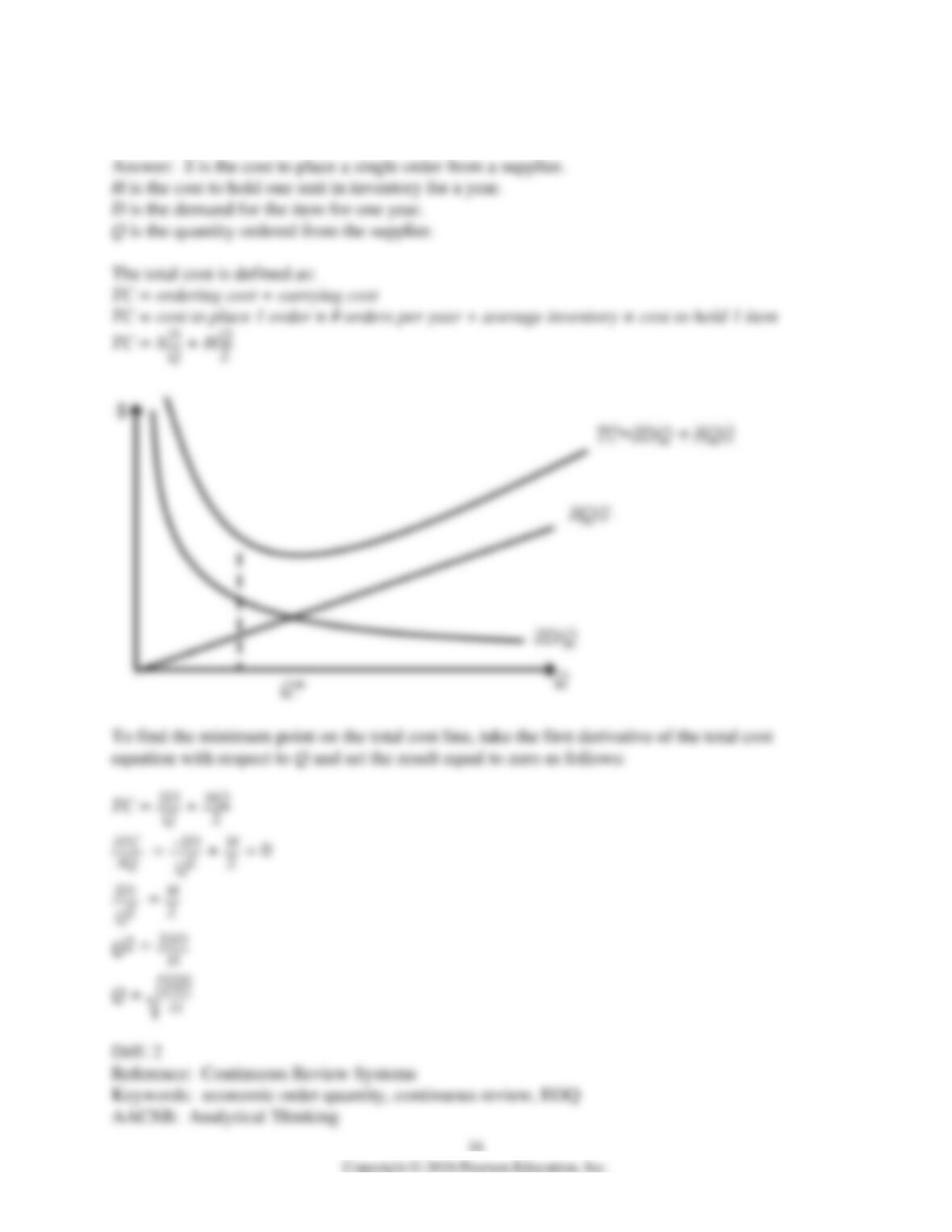
24) Derive the economic order quantity model, beginning with a definition of terms and graph of
cost curves.