16. What are the three types of compensation that managers typically receive?
17. What is a “stock option” and does it always have value?
18. Why are non-financial measures necessary in today’s business environment?
19. How does the balanced scorecard approach differ from traditional approaches to performance
evaluation?
20. What are the four perspectives looked at by the balanced scorecard approach?
21. Both traditional financial measures of performance and the balanced scorecard approach examine
financial factors, but how does their appraisal of financial factors differ?
22. Describe the customer perspective of the balanced scorecard and provide an example of a critical
success factor for this perspective.
23. Describe the internal business perspective of the balanced scorecard and provide an example of a
critical success factor for this perspective.
24. Describe the learning and growth perspective of the balanced scorecard and provide an example of a
critical success factor for this perspective.
25. Match the following critical success factors with the appropriate perspective of the balanced scorecard.
Use the following key: F = Financial, C = Customer, IB = Internal business, and LG = Learning and
growth.
a.
the efficient and effective use of employees
b.
increasing the quality of products and services
c.
increasing the number of new products
d.
improving quality throughout the production process
e.
increasing information systems capabilities
f.
increasing ROI
g.
reducing delivery time
h.
increasing customer satisfaction
a.
b.
C
c.
d.
e.
F
g.
C
h.
C
26. Describe one method that a company might use to improve or monitor the quality of its products or
services.
Managerial ACCT Test Bank Chapter 11 37
27. You are the manager of a new restaurant in town. List one method that you might use as a measure of
quality.
28. List the four categories of quality costs and one example of each.
Categories:
Examples:
product recalls, legal liability costs, lost sales.
29. Classify the following examples of quality costs as prevention (P), appraisal (A), internal failure (IF),
and external failure (EF).
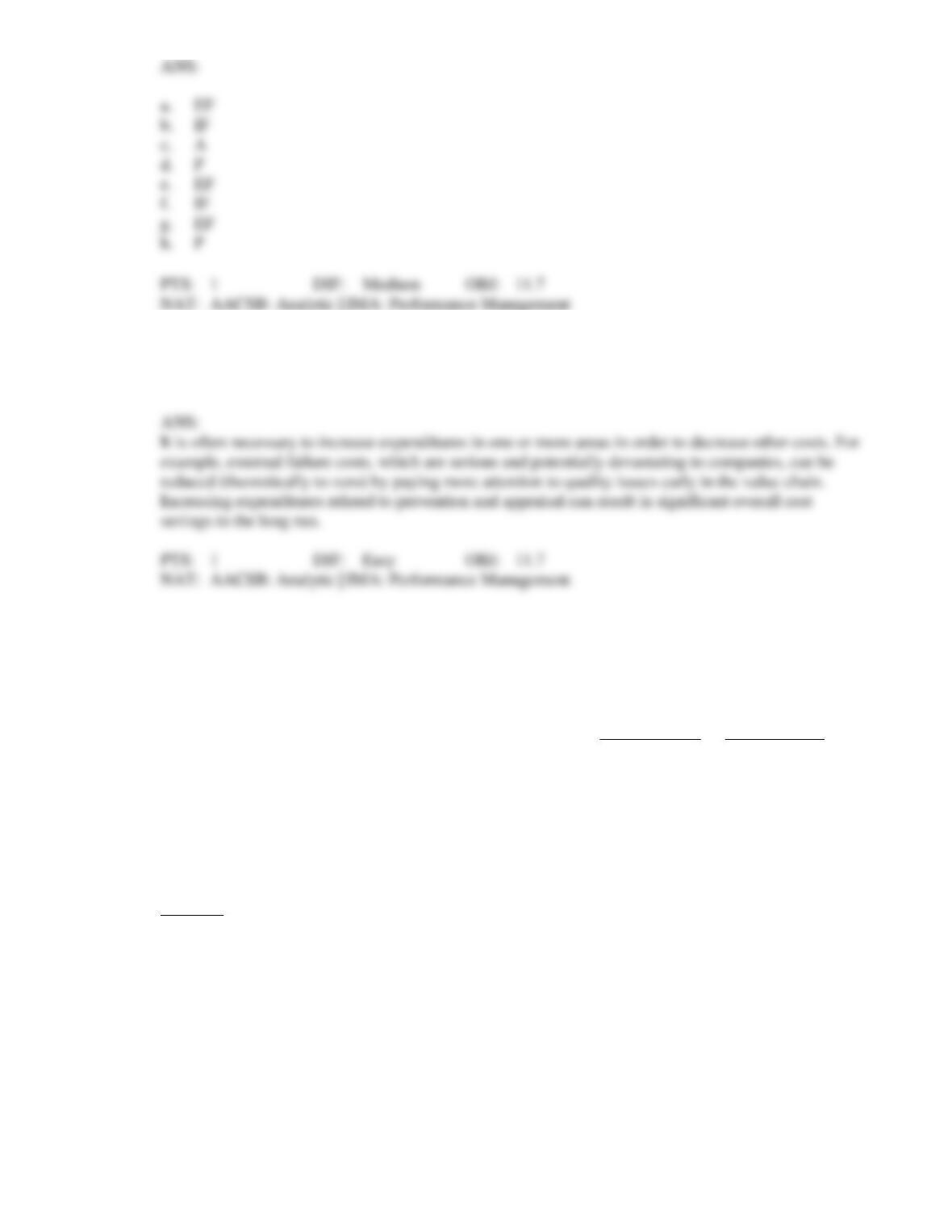
a.
the cost of repairs made under warranty
b.
downtime caused by quality problems
c.
costs of inspecting raw materials
d.
costs of quality improvement projects
e.
liability costs arising from legal actions against the seller
f.
costs of scrap and spoilage
g.
lost sales
h.
design and engineering costs
Managerial ACCT Test Bank Chapter 11 38
30. As a new manager of a production division, you have made the decision to incur more quality costs
than the previous manager of the division incurred. How can you defend quality costs to executive
management?
PROBLEM
1. Bauer Enterprises Ltd. has two product lines: B-40 and B-100. Revenue and cost information for each
of the product lines for 2008 are as follows:
B-40
B-100
Selling price per unit
$30
$50
Variable costs per unit
12
24
Traceable fixed expenses
$20,000
$50,000
In 2008, Bauer had common fixed expenses of $80,000, and the company produced and sold 10,000
units of B-40 and 8,000 units of B-100.
Required: Prepare a segmented income statement with a column for each product line and the total
company.
b.
A
d.
P
g.
h.
P
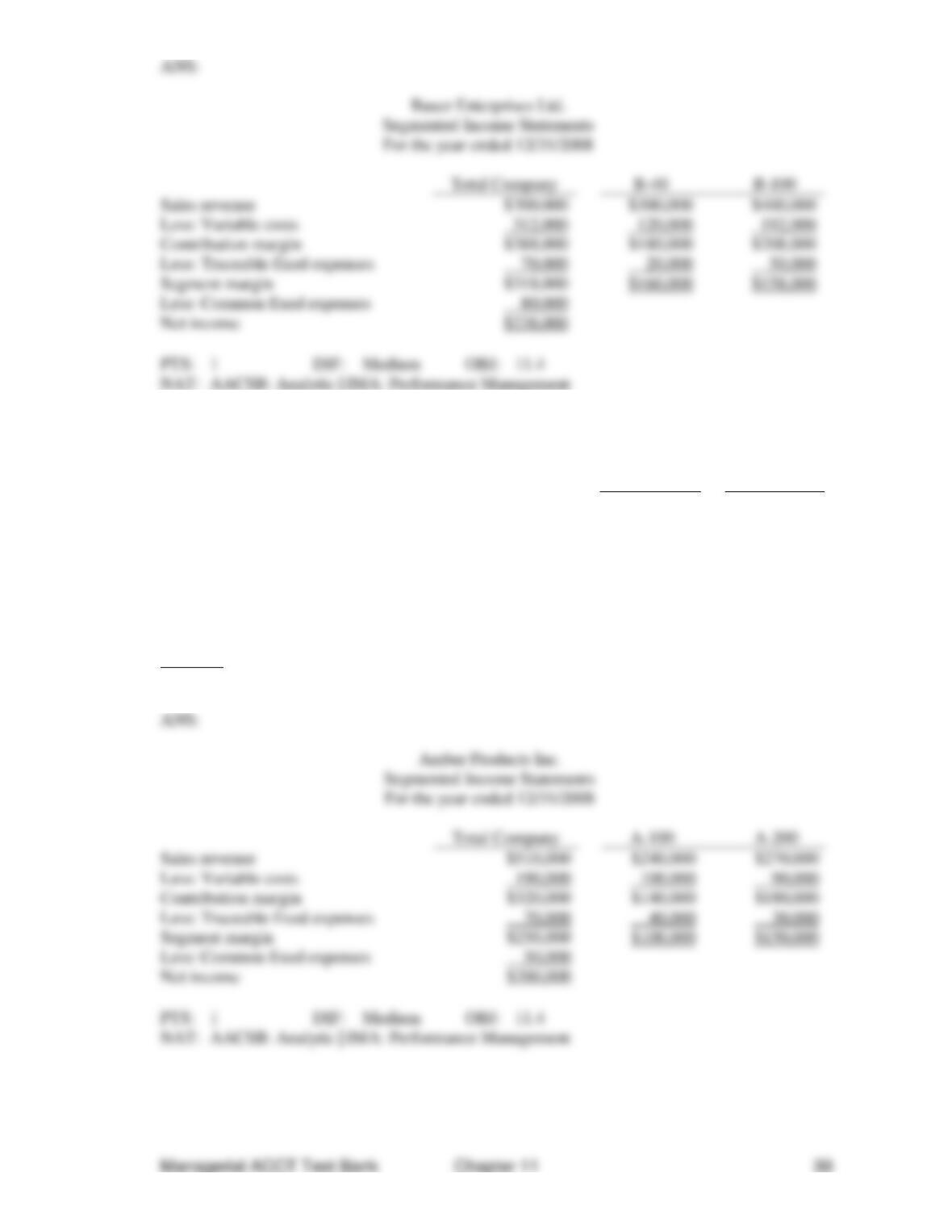
Sales revenue
Less: Variable costs
120,000
Contribution margin
$180,000
Less: Traceable fixed expenses
Segment margin
$160,000
Less: Common fixed expenses
Net income
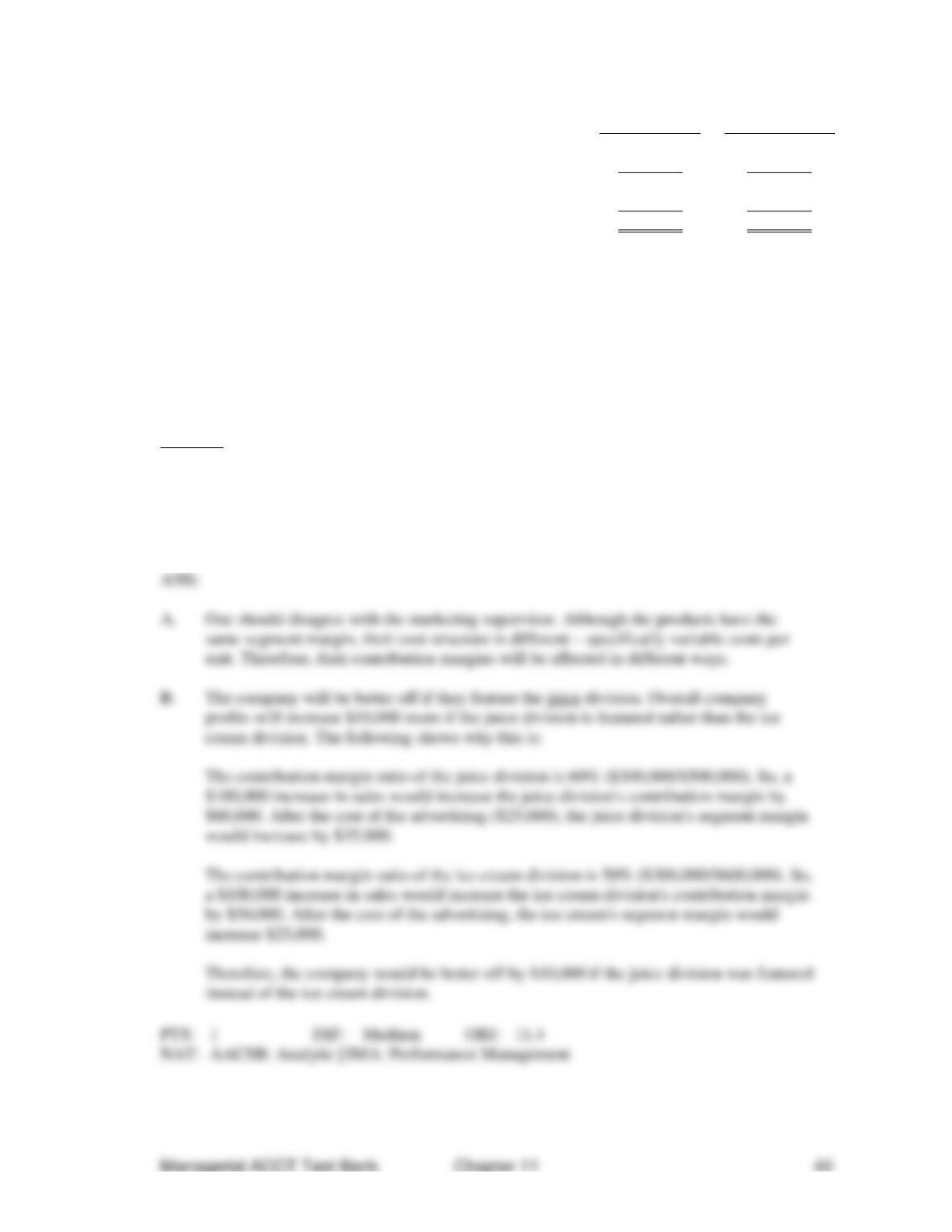
2. Amber Products Inc. has two product lines: A-100 and A-200. Revenue and cost information for each
of the product lines for 2008 are as follows:
A-100
A-200
Selling price per unit
$60
$45
Variable costs per unit
25
15
Traceable fixed expenses
$40,000
$30,000
In 2008, Amber had common fixed expenses of $50,000, and the company produced and sold 4,000
units of A-100 and 6,000 units of A-200.
Required: Prepare a segmented income statement with a column for each product line and the total
company.
A-100
A-200
90,000
30,000
3. Fun Treats Inc. sell a variety of drink and food products including juice and ice cream. The segmented
income statements for these two products are as follows:
Juice
Ice Cream
Sales
$500,000
$600,000
Variable expenses
200,000
300,000
Contribution margin
300,000
300,000
Traceable fixed expense
100,000
100,000
Segment margin
$200,000
$200,000
The company’s management is considering a special advertising campaign that will run on a Saturday
morning when many children are watching television. The advertising campaign is expected to cost
$25,000 and only one product can be featured. In-house marketing studies show that the campaign
could increase sales of the juice division by $100,000 or increase sales of the ice cream division by
$100,000.
The marketing supervisor has decided that since both products have the same segment margin, the
company will be equally as well off regardless of which product is featured.
Required:
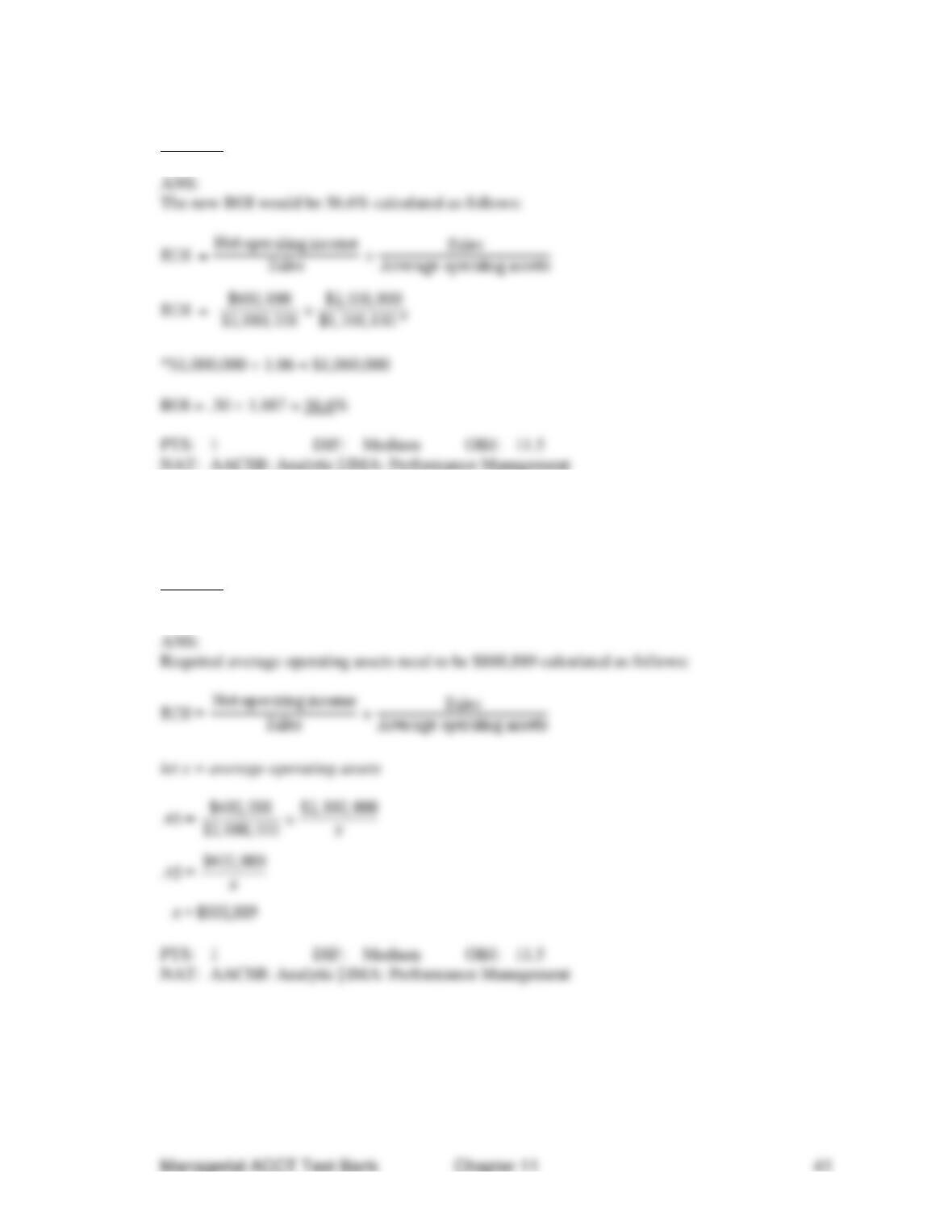
A.
Do you agree or disagree with the marketing supervisor? Why or why not.
B.
Which product do you feel should be featured? Show calculations to support your
answer.
profits will increase $10,000 more if the juice division is featured rather than the ice
cream division. The following shows why this is:
$60,000. After the cost of the advertising ($25,000), the juice division’s segment margin
increase $25,000.
instead of the ice cream division.
4. Ramsey Automotive Ltd. had sales of $2,000,000 and net operating income of $600,000 last year.
Operating assets last year averaged $1,000,000. The company’s manager is considering the purchase of
a new machine which is expected to increase average operating assets by 6%.
Required: Calculate the company’s new ROI if the new machine is purchased.
5. Vance Inc. requires all of its divisions to maintain a return on investment (ROI) of at least 45%. The
manager of one of the divisions expects the division’s net operating income to be $400,000 and its
sales to be $2,000,000.
Required: Calculate the division’s required average operating assets in order to achieve the minimum
ROI.
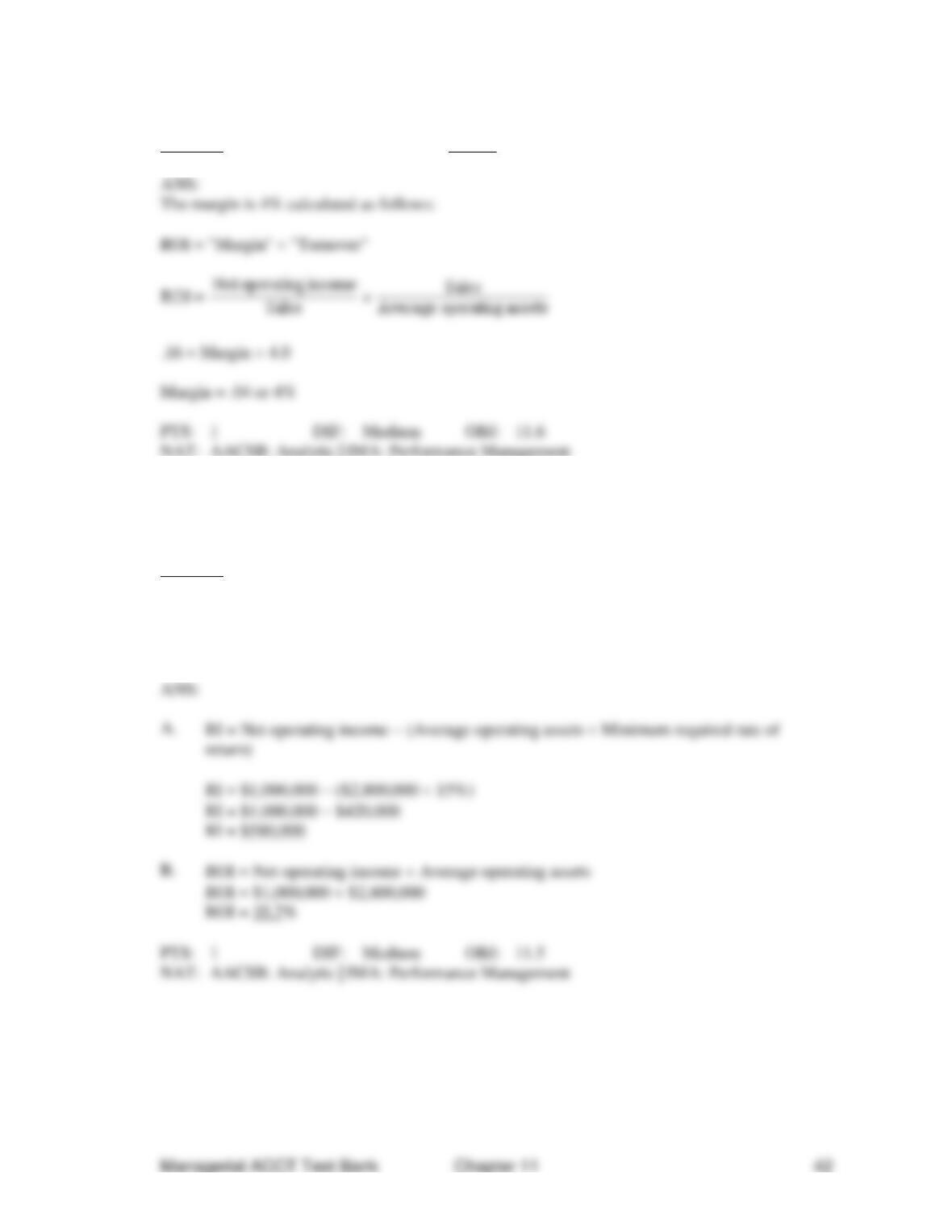
6. Hedding Inc. has two divisions: classic and modern. In the most recent year, the classic division
reported sales of $900,000 and an asset turnover of 4.0. The rate of return on average invested assets
was 16%.
Required: What was the classic division’s margin?
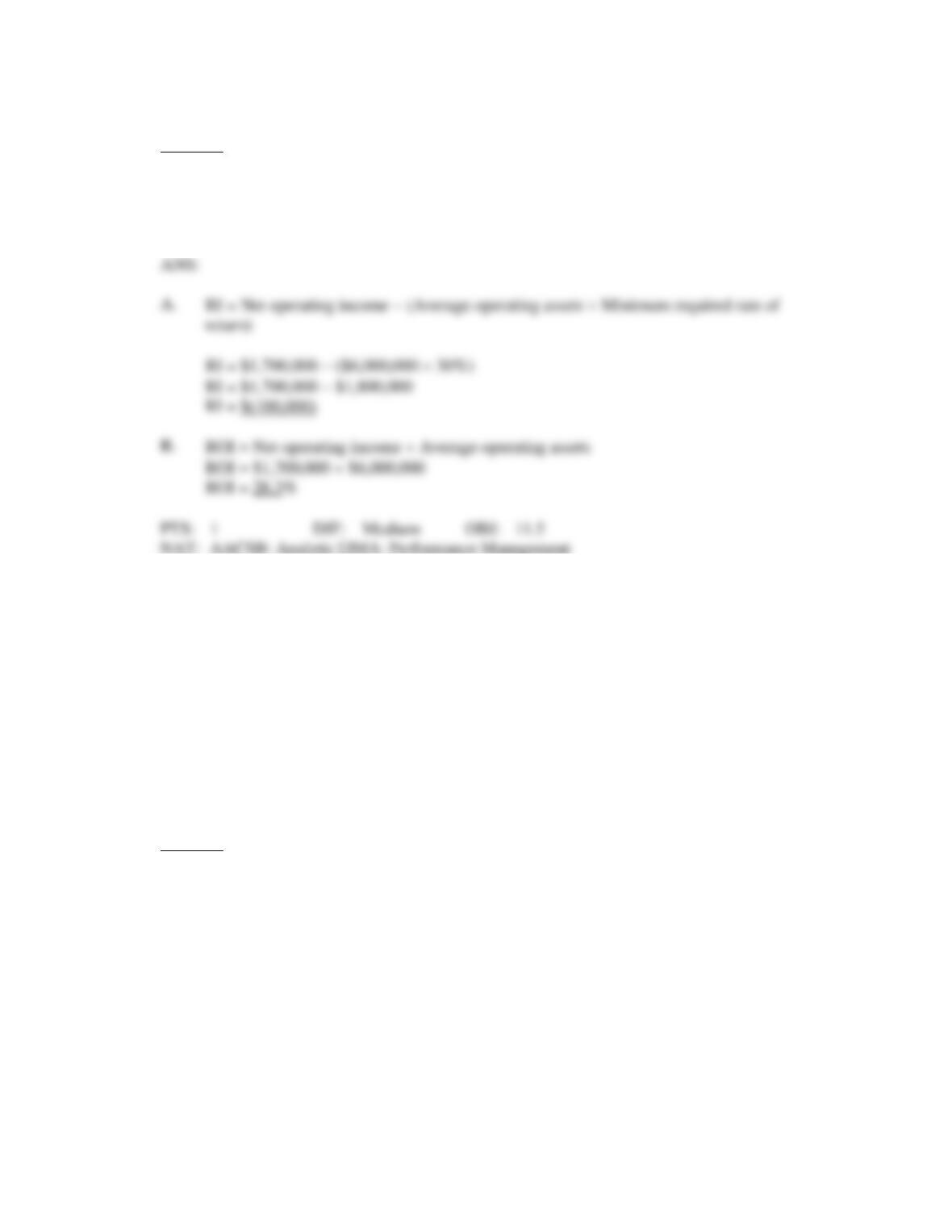
7. Thompson Ltd. has a division that generated $5,000,000 in sales and operating income of $1,000,000
on average operating assets of $2,800,000. The company’s management team expects division
managers to generate sufficient income to guarantee a minimum return of 15 percent.
Required:
A.
What is the division’s residual income?
B.
What is the division’s return on investment (ROI)?
return)
RI = $1,000,000 − ($2,800,000 15%)
RI = $1,000,000 − $420,000
RI = $580,000
ROI = Net operating income Average operating assets
ROI = $1,000,000 $2,800,000
ROI = 35.7%
Managerial ACCT Test Bank Chapter 11 43
8. Mahim Products has a division that generated $10,000,000 in sales and operating income of
$1,700,000 on average operating assets of $6,000,000. The company’s management team expects
division managers to generate sufficient income to guarantee a minimum return of 30 percent.
Required:
A.
What is the division’s residual income?
B.
What is the division’s return on investment (ROI)?
9. Perk Inc. manufactures and sells coffee makers. A popular consumer magazine has recently evaluated
coffee makers and has ranked Perk’s coffee makers as being of “poor quality”. As a result, Perk’s
management team has begun to analyze all costs associated with their coffee makers in more detail,
and has compiled the following data:
Scrap costs
$15,000
Quality training
50,000
Warranty claims
90,000
Rework costs
18,000
Inspection of incoming materials
12,000
Product quality audits
25,000
Statistical process control
20,000
Required:
A.
What are total prevention costs?
B.
What are total appraisal costs?
C.
What are total internal failure costs?
D.
What are total external failure costs?
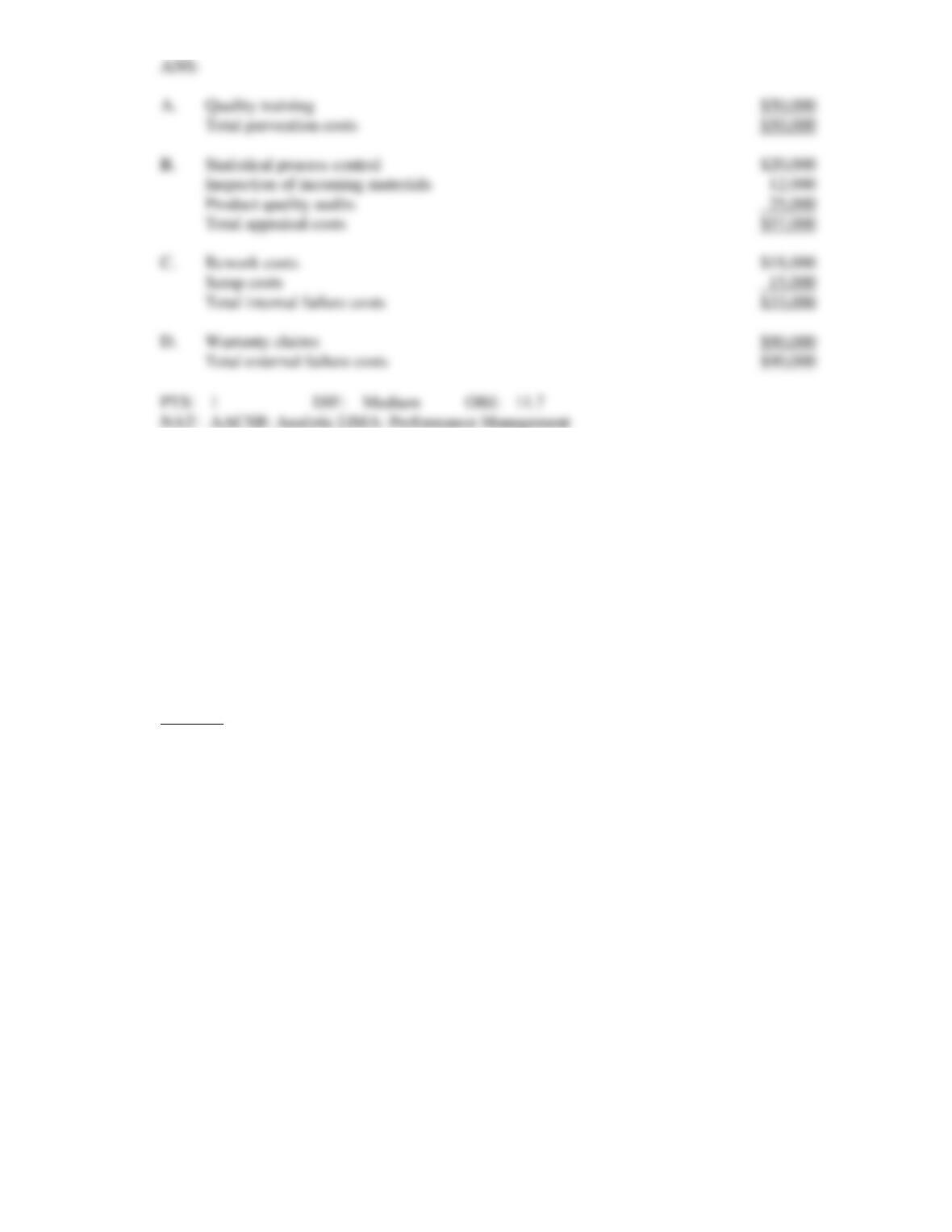
RI = $1,700,000 − ($6,000,000 30%)
RI = $1,700,000 − $1,800,000
RI = $(100,000)
ROI = Net operating income Average operating assets
ROI = $1,700,000 $6,000,000
ROI = 28.3%
Managerial ACCT Test Bank Chapter 11 44
10. Kenny Inc. manufactures and sells laminate flooring. Recently, management has noticed more
customer complaints about product defects and, as a consequence, warranty claims have significantly
increased. Kenny’s management has asked their managerial accountant for a breakdown in quality
costs for the past six months. The following data has been compiled:
Scrap costs
$ 45,000
Quality training
25,000
Warranty claims
100,000
Rework costs
20,000
Inspection of incoming materials
9,000
Product quality audits
15,000
Statistical process control
10,000
Required:
A.
What are total prevention costs?
B.
What are total appraisal costs?
C.
What are total internal failure costs?
D.
What are total external failure costs?
A.
Quality training
$50,000
Total prevention costs
B.
Statistical process control
$20,000
Inspection of incoming materials
12,000
Product quality audits
25,000
Total appraisal costs
C.
Rework costs
$18,000
Scrap costs
Total internal failure costs
$33,000
D.
Warranty claims
$90,000
Total external failure costs
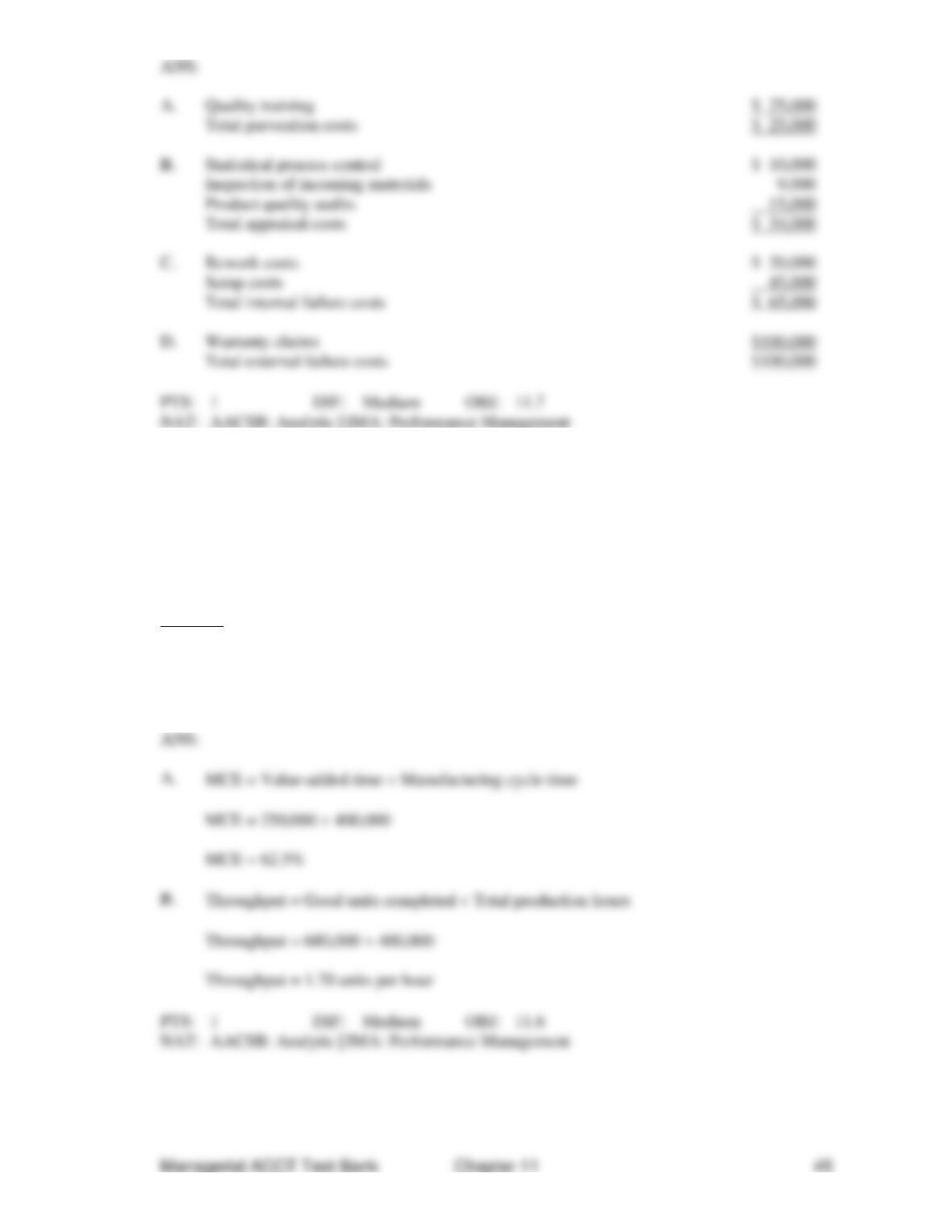
Quality training
Total prevention costs
B.
Statistical process control
Inspection of incoming materials
Product quality audits
Total appraisal costs
C.
Rework costs
Scrap costs
Total internal failure costs
Warranty claims
Total external failure costs
11. Sanford Products Inc. produces a variety of plastic products which it sells to retail stores throughout
the country. The following data is available for the year for one of the products:
Units started into production
600,000
Total good units completed
680,000
Total hours of value-added production time
250,000
Total production hours
400,000
Required:
A.
Compute the manufacturing cycle efficiency (MCE).
B.
What is the total throughput per hour? Round your answer to two decimal places.
MCE = Value-added time Manufacturing cycle time
MCE = 250,000 400,000
MCE = 62.5%
Throughput = Good units completed Total production hours
Throughput = 680,000 400,000
Throughput = 1.70 units per hour
12. Charlotte Products Inc. produces a variety of electronic products which it sells to retail stores
throughout the country. The following data is available for the year for one of the products:
Units started into production
2,000,000
Total good units completed
1,950,000
Total hours of value-added production time
300,000
Total production hours
380,000
Required:
A.
Compute the manufacturing cycle efficiency (MCE).
B.
What is the total throughput per hour? Round your answer to two decimal places.
MCE = 300,000 380,000
MCE = 78.95%
Throughput = Good units completed Total production hours
Throughput = 1,950,000 380,000
Throughput = 5.13 units per hour