CHAPTER 11—BOND FUNDAMENTALS
TRUE/FALSE
1. Public bonds differ from other debt because they are sold to the public rather than to a single investor.
2. A nonrefunding provision prohibits a call and premature retirement of an issue from the proceeds of a
lower-coupon refunding bond.
3. In the case of a bond, the only contractual factor is the amount of interest payments, since beginning
and ending bond prices are determined by market forces.
4. In the Eurozone, the government sector is the largest bond market segment.
5. Wealthy individual investors typically account for 90 to 95% of investors in the bond market.
6. High-yield bonds are considered “investment” grade.
7. Government bond issues require an annual sinking fund payment of not less than one percent of the
outstanding issue.
8. Most U.S. municipal bonds are serial issues which are subject to state and local taxes when they are
issued in the investor’s home state.
9. The secondary bond market is significantly more active than the stock market.
10. High-yield bonds are considered “investment” grade.
11. A bond’s price is determined by the issue’s coupon rate, length to maturity, and the prevailing yield in
the market.

2
12. Bonds can have different types of collateral and can be secured, unsecured or registered bonds.
13. A bond’s maturity is affected by: call features, non-refunding provisions, and sinking fund provisions.
14. Inflation-indexed bonds ensure that investors will received the promised yield in real terms by
indexing bond principal and interest payments to the stock market.
15. The coupon of a bond indicates the income that the bond investor will receive over the life of the bond.
16. Bonds rated BB or above are considered to be investment grade bonds.
17. All U.S. municipalities are required to buy insurance when they issue bonds.
MULTIPLE CHOICE
1. Which bond market segments tend to be highly correlated and move together?
a.
Short and long term bonds.
b.
Short and intermediate term bonds.
c.
Intermediate and long term bonds.
d.
Short, intermediate and long term bonds.
e.
None of the above.
2. Of the following provisions that might be found in a bond indenture, which would tend to reduce the
coupon interest rate?
a.
A call provision
b.
No restrictive covenants
c.
A sinking fund provision
d.
Change in bond rating from Aaa to Aa
e.
None of the above (that is, all will increase the coupon rate)

3
3. The refunding provision of an indenture allows bonds to be retired unless
a.
They are replaced with a lower coupon bond issue.
b.
The remaining time to maturity is less than five years.
c.
The remaining time to maturity is greater than five years.
d.
The stated time period in the indenture has not passed.
e.
The stated time period in the indenture has passed.
4. Serial bonds
a.
Can be callable.
b.
Can have sinking funds.
c.
Have different maturity dates.
d.
All of the above.
e.
None of the above.
5. Which of the following statements is not true regarding bond ratings?
a.
The ratings assigned are meant to indicate the probability of default for the bond issuer.
b.
The bonds assigned one of the top four rating classes are considered investment grade
bonds.
c.
Once a rating is assigned to an issue it cannot be changed for the first two years after
which it is reviewed on a regular basis.
d.
Bonds rated BB and below are referred to as high yield or “junk” bonds.
e.
The rating agencies modify the ratings with + and − signs or numbers after the letters.
6. When a fixed income security is being traded but the issuer is not meeting interest payments it is
trading
a.
Stamped.
b.
Registered.
c.
Flat.
d.
Round.
e.
No accrual.
7. The corporate bond market in Japan
a.
Consists of three components.
b.
Is largely unregulated.
c.
Has always been rated like the U.S. bond market.
d.
Is regulated by the Kisaikai.
e.
Is regulated by the Nikkei Exchange.

4
8. The bonds issued by the Bank of England are known as
a.
Gilts.
b.
Bunds.
c.
Limies.
d.
Treasuries.
e.
Benchmarks.
9. When a bond issue is secured by a legal claim on equipment it is known as a
a.
Junior bond.
b.
Income bond.
c.
Bearer bond.
d.
Trust certificate.
e.
Perpetuity.
10. Which set of conditions will result in a bond with the greatest volatility?
a.
A high coupon and a short maturity
b.
A high coupon and a long maturity
c.
A low coupon and a short maturity
d.
A low coupon and a long maturity
e.
A deferred call feature and a sinking fund.
11. The annual interest paid on a bond relative to its prevailing market price is called its
a.
Promised yield.
b.
Yield to maturity.
c.
Coupon rate.
d.
Effective yield.
e.
Current yield.
12. The institutions which invest most heavily in corporate bond issues are
a.
Life insurance companies and commercial banks.
b.
Life insurance companies and property and liability insurance companies.
c.
Life insurance companies and pension funds.
d.
Commercial banks and property and liability insurance companies.
e.
Commercial banks and pension funds.
13. Which of the following is not a major rating agency for bonds?
a.
Moody’s
b.
Standard & Poor’s
c.
Fitch Investor Services
d.
Value Line
e.
Dominion Bond Rating Service

5
14. What is a bond guaranteed by a piece of property called?
a.
Collateral trust bond.
b.
Mortgage bond.
c.
Municipal bond.
d.
Trust certificate.
e.
Trust bond.
15. The major owners of high-yield bonds have been
a.
Chartered banks.
b.
Credit Unions.
c.
Mutual funds.
d.
Insurance companies.
e.
European banks.
16. When a fixed income security is being traded at the price above its face value it is trading
a.
At a discount.
b.
At par.
c.
At a premium.
d.
Flat.
e.
No accrual.
17. A security that has a coupon that is periodically adjusted is a
a.
Variable note.
b.
Variation note.
c.
Adjustable coupon note.
d.
Money market certificate.
e.
Deep discount bond.
18. The following are participating issuers in bond markets
a.
Governments.
b.
Municipalities.
c.
Corporations
d.
Choices a and c.
e.
Choices a, b and c.
19. The following are participating investors in bond markets.
a.
Canadian Treasury.
b.
Life insurance companies.
c.
Chartered banks.
d.
Choices a and b.
e.
Choices b and c.

6
20. Institutional investors typically account for about
a.
90 to 95% of bond market trading.
b.
40 to 50% of bond market trading.
c.
10 to 15% of bond market trading.
d.
Less than 5% of bond market trading.
e.
None of the above.
21. Alternative institutions favour different sectors of the bond market based on
a.
The level of interest rates.
b.
The tax code applicable to the institution.
c.
The nature of the institution‘s asset structure
d.
Choices a and b.
e.
Choices b and c.
22. Bond ratings are positively related to
a.
Leverage.
b.
Size.
c.
Type of business.
d.
All of the above.
e.
None of the above.
23. Bond ratings are negatively related to
a.
Profitability.
b.
Cash flow coverage.
c.
Earnings instability.
d.
All of the above.
e.
None of the above.
24. Inflation-indexed bonds are Canadian Treasury securities where the coupon rate is
a.
Zero
b.
Indexed to the rate of inflation.
c.
Indexed to the discount rate.
d.
Indexed to the prime rate.
e.
None of the above.

7
25. If the yield to maturity for a par value inflation-indexed bond with 8 years to maturity is 3%, and the
yield to maturity of a Canadian Treasury note with 8 years is 4.25%, this implies that
a.
The expected annual rate of inflation over the next 8 years is −1.25%.
b.
The expected annual rate of inflation over the next 8 years is 1.25%.
c.
The expected annual rate of inflation over the next 8 years is −2.25%
d.
The expected annual rate of inflation over the next 8 years is 2.25%
e.
None of the above.
26. The face value of a Canadian government agency security
a.
Is always $1000.
b.
Ranges from $1000 to $5000.
c.
Ranges from $1000 to $100,000.
d.
Ranges from $1000 to $50,000.
e.
Is always $10,000.
27. A major source of risk faced by CMO issues is
a.
Default risk.
b.
Prepayment risk.
c.
Counterparty risk.
d.
Choices a and b.
e.
Choices a, b and c.
28. When homeowners pay off mortgages when they sell their homes, or when homeowners refinance
home mortgages, they effectively
a.
Make the maturities of CMO securities longer.
b.
Make the maturities of CMO securities shorter.
c.
Make the maturities of Canadian Treasury securities longer.
d.
Make the maturities of Canadian Treasury securities shorter.
e.
None of the above.
29. General obligation bonds are
a.
Treasury bonds backed by the full faith and credit of the issuer.
b.
Treasury bonds backed by income generated form specific projects.
c.
Municipal bonds backed by the full faith and credit of the issuer.
d.
Municipal bonds backed by income generated from specific projects.
e.
A type of U.S. agency security.

8
30. Revenue bonds are
a.
Treasury bonds backed by the full faith and credit of the issuer.
b.
Treasury bonds backed by income generated form specific projects.
c.
Municipal bonds backed by the full faith and credit of the issuer.
d.
Municipal bonds backed by income generated from specific projects.
e.
A type of U.S. agency security.
31. Collateralized Mortgage obligations are
a.
Mortgage pass-through securities.
b.
Mortgage pass-through securities with varying maturities.
c.
Mortgage pass-through securities with no default risk.
d.
Mortgage pass-through securities with variable coupon rates.
e.
None of the above.
32. A bond denominated in Canadian dollars and sold in Japan to Japanese investors is called a
a.
Samurai bond.
b.
Eurobond.
c.
Yankee bond.
d.
Euroyen bond
e.
Foreign bond.
33. The legal document setting forth the obligations of a bond’s issuer is called
a.
A debenture.
b.
A warrant.
c.
An indenture.
d.
A rights certificate.
e.
A trustee deed.
34. Collateralized mortgage obligations (CMOs) offset some of the problems associated with traditional
mortgage pass-throughs because
a.
They are over collateralized.
b.
They have variable rates.
c.
Collateralized by auto-loans.
d.
They are deep discount instruments.
e.
Collateralized by credit card debt.

9
35. A bond that only pays a principal payment at maturity date is known as a:
a.
Blank bond.
b.
Maturity bond.
c.
Interest free bond.
d.
Mini-coupon bond.
e.
Zero coupon bond.
36. What was developed in the early 1980s to offset some of the problems with traditional mortgage
pass-throughs.
a.
Variable rate mortgages.
b.
Collateralized mortgage obligations (CMOs)
c.
Leveraged buyouts (LBOs)
d.
Deep discount bonds (DDBs)
e.
High yield bonds.
37. Which of the following statements regarding Collateralized Debt Obligations (CDOs) is false?
a.
CDOs experienced rapid growth since the year 2000.
b.
The assets used to back the CDOs are substantially diverse.
c.
The credit quality within a CDO at the time of issue is diverse.
d.
CDOs have generated significant credit and liquidity problems.
e.
All of the above statements are true.
38. A Canadian dollar-denominated bond sold in Canada by a Japanese-firm is called a(n):
a.
Maple bond.
b.
Homeland bond.
c.
International bond.
d.
Canadian Domestic bond.
e.
Japanese Canadian. Regional bond.
39. Which of the following entities acquire mortgages and create mortgage backed securities?
a.
Federal National Mortgage Association (Fannie Mae)
b.
Government National Mortgage Association (Ginnie Mae)
c.
Federal Home Loan Mortgage Corporation (Freddie Mac)
d.
All of the above.
e.
None of the above.

10
40. When a borrower pledges financial assets as collateral for a bond it is called a(n)
a.
Mortgage bond.
b.
Equipment trust certificate.
c.
Mortgage pass-through security.
d.
Collateral trust bond.
e.
Collateralized mortgage obligation (CMO).
41. A 4.75% coupon bond issued by the provincial government of Quebec sells for $1,000. What coupon
rate on a corporate bond selling at $1,000 par value would produce the same after tax return to the
investor as the tax-free municipal bond if the investor is in the 28% marginal tax bracket?
a.
1.1%
b.
5.8%
c.
6.6%
d.
7.3%
e.
9.7%
42. A 6.5% coupon bond issued by the provincial government of Ontario sells for $1,000. What coupon
rate on a corporate bond selling at $1,000 par value would produce the same after tax return to the
investor as the tax-free municipal bond if the investor is in the 26% marginal tax bracket?
a.
1.69%
b.
11.25%
c.
8.78%
d.
14.63%
e.
25%
43. An 8.5% coupon bond issued by the provincial government of Nova Scotia sells for $1,000. What
coupon rate on a corporate bond selling at $1,000 par value would produce the same after tax return to
the investor as the tax-free municipal bond if the investor is in the 25% marginal tax bracket?
a.
2.13%
b.
12.25%
c.
11.33%
d.
13.53%
e.
34.71%
11
44. A 7.0% coupon bond issued by the provincial government of Alberta sells for $1,000. What coupon
rate on a corporate bond selling at $1,000 par value would produce the same after tax return to the
investor as the tax-free municipal bond if the investor is in the 29% marginal tax bracket?
a.
7.59%
b.
12.25%
c.
9.86%
d.
14.63%
e.
30.71%
45. At what point would an investor be indifferent between a Drifton corporate bond yielding 12.5% and a
tax-free municipal bond of equal financial strength if the investor’s marginal tax rate is 25%?
a.
6.05%
b.
7.10%
c.
8.15%
d.
9.38%
e.
16.27%
46. At what point would an investor be indifferent between a Compco corporate bond yielding 8.5% and a
tax-free municipal bond of equal financial strength if the investor’s marginal tax rate is 25%?
a.
6.05%
b.
7.10%
c.
8.15%
d.
6.38%
e.
2.34%
47. At what point would an investor be indifferent between a Trifton corporate bond yielding 12.0% and a
tax-free municipal bond of equal financial strength if the investor’s marginal tax rate is 25%?
a.
6.00%
b.
7.10%
c.
9.00%
d.
9.15%
e.
14.00%
12
48. At what point would an investor be indifferent between a Bridgford corporate bond yielding 8.0% and
a tax-free municipal bond of equal financial strength if the investor’s marginal tax rate is 25%?
a.
5.00%
b.
7.10%
c.
8.00%
d.
9.15%
e.
6.00%
49. You purchase a 10 3/8s 2009 Feb. $10,000 par Treasury Note at 103:11 and hold it for exactly one
year at which time you sell it. What is your rate of return if your selling price is 101:13?
a.
8.14%
b.
8.16%
c.
8.22%
d.
8.32%
e.
8.47%
50. You purchase a 9 3/4s 2009 Feb. $10,000 par Treasury Note at 101:11 and hold it for exactly one year
at which time you sell it. What is your rate of return if your selling price is 101:17?
a.
8.14%
b.
8.75%
c.
9.75%
d.
9.81%
e.
10.47%
13
51. You purchase a 8 1/2s 2009 Feb. $10,000 par Treasury Note at 105:16 and hold it for exactly one year
at which time you sell it. What is your rate of return if your selling price is 105:16?
a.
8.00%
b.
8.06%
c.
8.22%
d.
8.50%
e.
8.47%
52. You purchase a 11 3/8s 2009Feb. $10,000 par Treasury Note at 103:11 and hold it for exactly one year
at which time you sell it. What is your rate of return if your selling price is 100:13?
a.
10.14%
b.
11.75%
c.
8.22%
d.
8.32%
e.
8.16%
53. You purchase a 10 1/4s 2009 Feb. $10,000 par Treasury Note at 102:15 and hold it for exactly one
year at which time you sell it. What is your rate of return if your selling price is 104:14?
a.
11.92%
b.
8.16%
c.
8.55%
d.
8.61%
e.
10.25 %
= (10,443.75 − 10,246.875 + 1,025.00) 10,246.875
= 11.92%
Exhibit 11-1
USE THE FOLLOWING INFORMATION TO ANSWER THE NEXT PROBLEM(S)
Company
Ticker
Coupon
Maturity
Last
Price
Last
Yield
EST
Spread
UST
Est $
Vol
(000’s)
Gen Elec
GE
4.75
9/15/2014
99.544
4.808
62
10
158736
54. Refer to Exhibit 11-1. What annual dollar coupon amount will investors receive?
a.
$4.75
b.
$47.50
c.
$4.808
d.
$48.08
e.
$62
55. Refer to Exhibit 11-1. What price would you pay in dollars to purchase this bond?
a.
$62
b.
$9.954
c.
$48.08
d.
$99.544
e.
$995.44
15
56. Refer to Exhibit 11-1. What is the estimated yield on Treasury securities?
a.
4.188%
b.
5.428%
c.
5.371%
d.
4.132%
e.
4.753%
57. Refer to Exhibit 11-1. What is the current yield for this bond?
a.
4.18%
b.
5.88%
c.
4.77%
d.
8.125%
e.
4.063%
58. Refer to Exhibit 11-1. What is the capital gains/loss yield on this bond?
a.
−0.038%
b.
0.456%
c.
0.038%
d.
−0.456%
e.
None of the above
59. How much would you expect to pay for a $10,000 Treasury note quoted at 96:27?
a.
$9,627.00
b.
$10,000.00
c.
$968.44
d.
$9,684.38
e.
None of the above
16
60. How much would you expect to pay for a $10,000 stripped Treasury bond quoted at 101:16?
a.
$10,150.00
b.
$10,000.00
c.
$101.16
d.
$10,160.00
e.
None of the above
61. For bonds A and B below, find the values of X and Y assuming each is a zero coupon bond with a
$1,000 face value (semiannual compounding).
Bond
Maturity
Yield
Price
(Years)
(Percent)
($$)
A
X
10
458.10
B
9
Y
212.00
a.
8 years and 4%
b.
10 years and 8%
c.
12 years and 10%
d.
14 years and 12%
e.
8 years and 18%
17
62. Calculate the yield to maturity of a zero coupon bond with a face value of $1000, maturing in 10 years
and selling for a price of $529.30.
a.
6.57%
b.
8.45%
c.
4.16%
d.
10.23%
e.
12.17%
63. Calculate the yield to maturity of a zero coupon bond with a face value of $1000, maturing in 15 years
and selling for a price of $525.75.
a.
5.62%
b.
4.38%
c.
8.74%
d.
15.26%
e.
16.27%
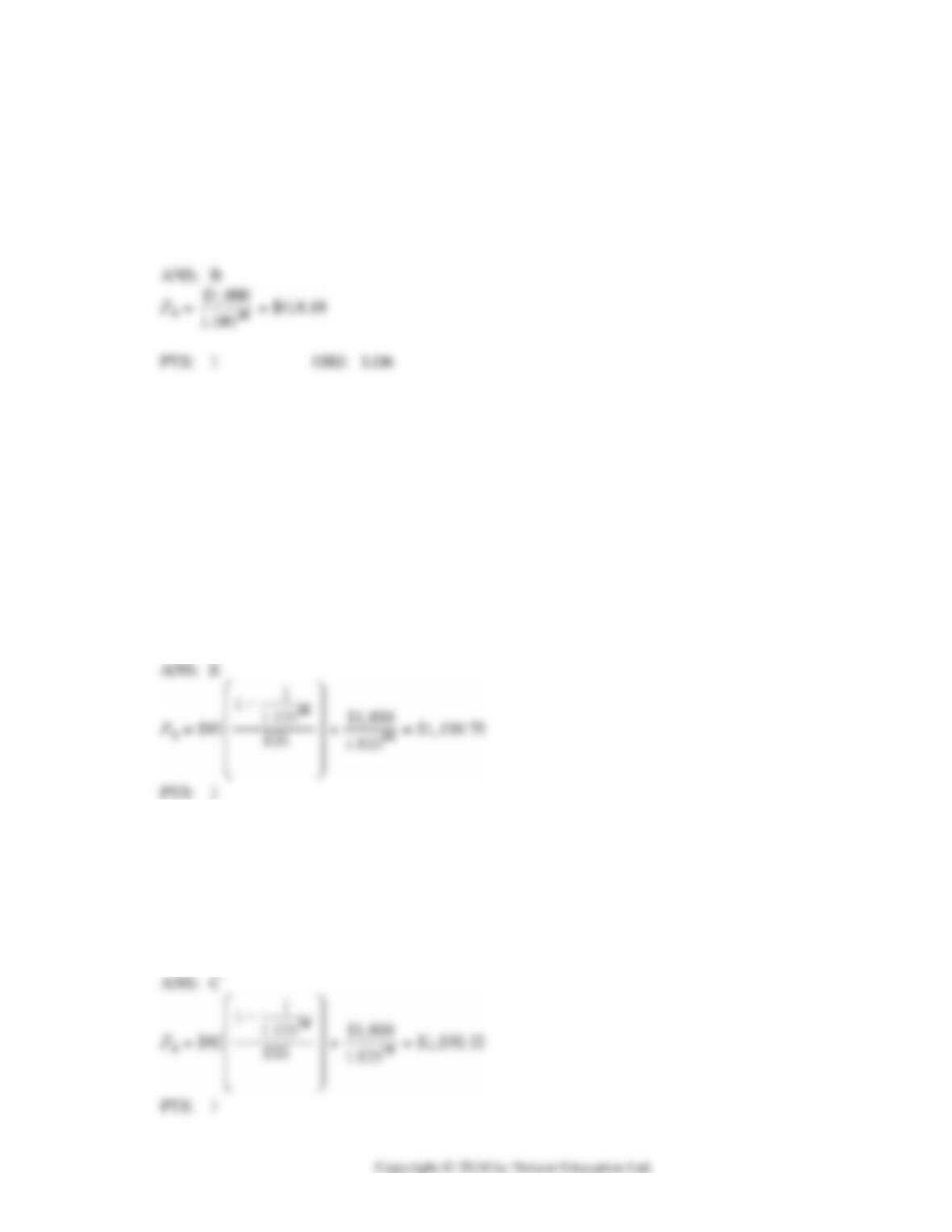
64. Calculate the price of a zero coupon bond with yield to maturity of 8.75%, a face value of $1000, and
maturing in 5 years.
a.
$1000
b.
$756.43
c.
$675.44
d.
$435.12
e.
$875.14
18
65. What is the value of a zero coupon bond with a yield to maturity of 9%, a par value of $1,000, and 10
years to maturity? (Assume semi-annual compounding)
a.
$208.29
b.
$414.64
c.
$422.41
d.
$643.93
e.
$910.00
Exhibit 11-2
USE THE FOLLOWING INFORMATION TO ANSWER THE NEXT PROBLEM(S)
XLR Corporation just issued a $1,000 par value bond with a 7% yield to maturity, twenty years to
maturity, with an 8% semi-annual coupon rate.
66. Refer to Exhibit 11-2. What is the price of the XLR Corporate bond?
a.
$901.04
b.
$932.04
c.
$1,102.62
d.
$1,105.94
e.
$1,106.78
67. Refer to Exhibit 11-2. If market interest rates are constant, what will the price of the XLR Corporate
bond be in three years?
a.
$904.29
b.
$1,097.63
c.
$1,098.50
d.
$1,102.85
e.
$1,105.62
19
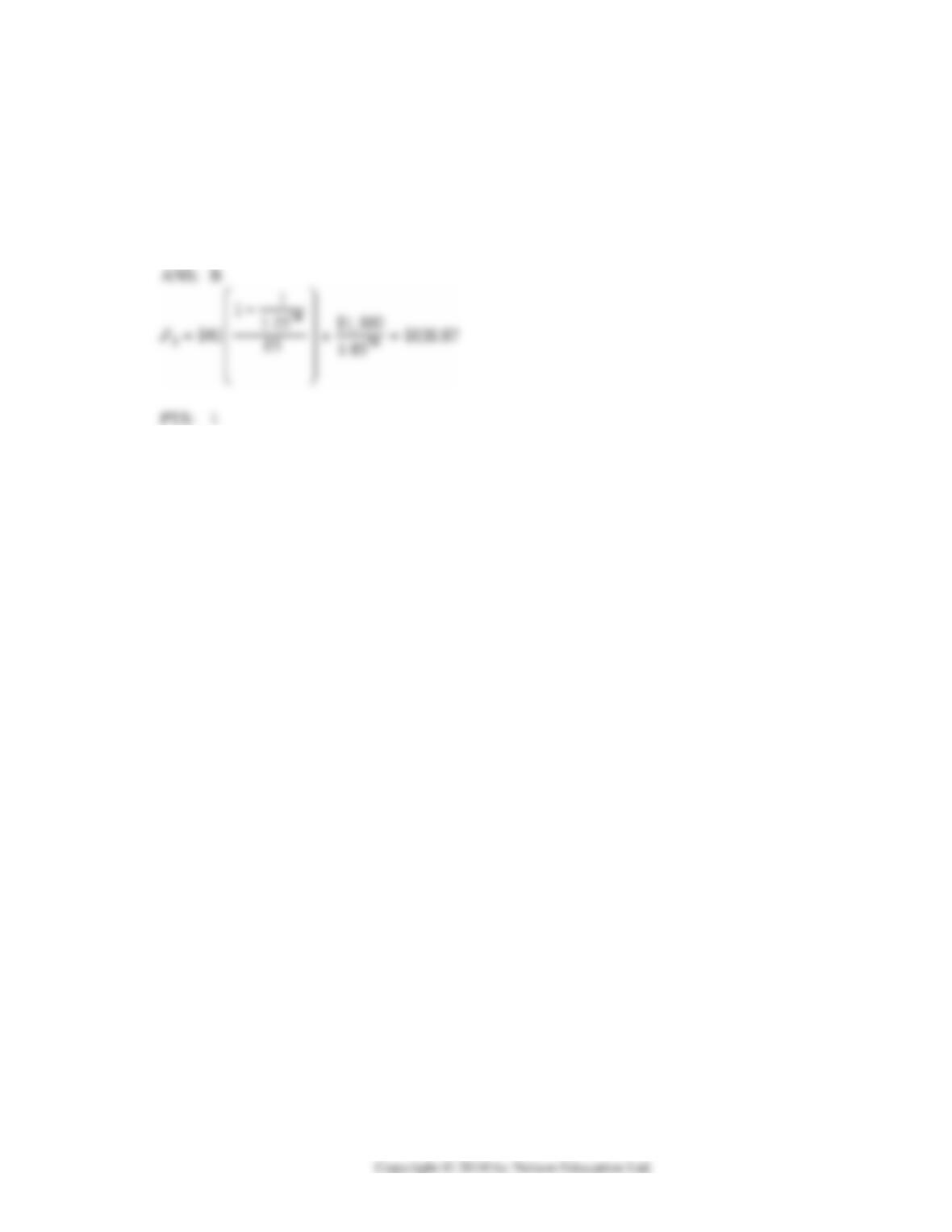
68. Refer to Exhibit 11-2. If market interest rates rise to 10%, what will the price of the XLR Corporate
bond be in three years?
a.
$832.89
b.
$838.07
c.
$1097.63
d.
$1,102.85
e.
$1,191.43