72. Which of the following is true of the prime lending rate?
73. Suppose that debt-equity ratio (D/E) and the sales-asset ratio (S/A) were two factors influencing the past
default behavior of borrowers. Based on past default (repayment) experience, the linear probability model is
estimated as: PDi = 0.5(D/Ei) + 0.1(S/Ai). If a prospective borrower has a debt-equity ratio of 0.4 and
sales-asset ratio of 1.8, the expected probability of default is
74. Which of the following is the major weakness of the linear probability model?
75. According to Altman’s credit scoring model, which of the following Z scores would indicate a low default
risk firm?
76. How can discriminant analysis be used to make credit decisions?
77. What is the most important factor determining bankruptcy, according to the Altman Z-score model?
78. What is the least important factor determining bankruptcy, according to the Altman Z-score model?
79. Which of the following is a problem in using discriminant analysis to evaluate credit risk?
80. Confidence Bank has made a loan to Risky Corporation. The loan terms include a default risk-free
borrowing rate of 8 percent, a risk premium of 3 percent, an origination fee of 0.1875 percent, and a 9 percent
compensating balance requirement. Required reserves at the Fed are 6 percent. What is the expected or
promised gross return on the loan?
81. What is the essential idea behind RAROC?
82. Marginal default probability refers to the
83. Cumulative default probability refers to
84. Which of the following refers to the term “mortality rate”?
85. Which of the following is NOT a valid conceptual or application problem of the mortality rate approach to
estimate default risk?
86. Error! Hyperlink reference not valid.
87. Which of the following completes the statement? All else equal, the higher the duration of a loan,
88. From the lender’s point of view, debt can be evaluated as
89. What does the KMV model use as equivalent to holding a call option on the assets of the firm?
90. Simulations by KMV have shown which of the following models to be relatively better predictors of
corporate failure and distress?
91. What is the Z-score if the debt to asset ratio is 40 percent, net income is 12 percent, and the dividend payout
ratio is 60 percent?
92. Using Z=1.682 as the cut-off rate, what should be the debt to asset ratio of the firm in order for the bank to
approve the loan?
93. The Z score for the firm would be
94. According to Altman’s credit scoring model, this firm should be considered
95. Suppose X3 = 0.2 instead of -0.30. According to Altman’s credit scoring model, the firm would fall under
which default risk classification?
96. What is the implied probability of repayment on one-year B-rated debt?
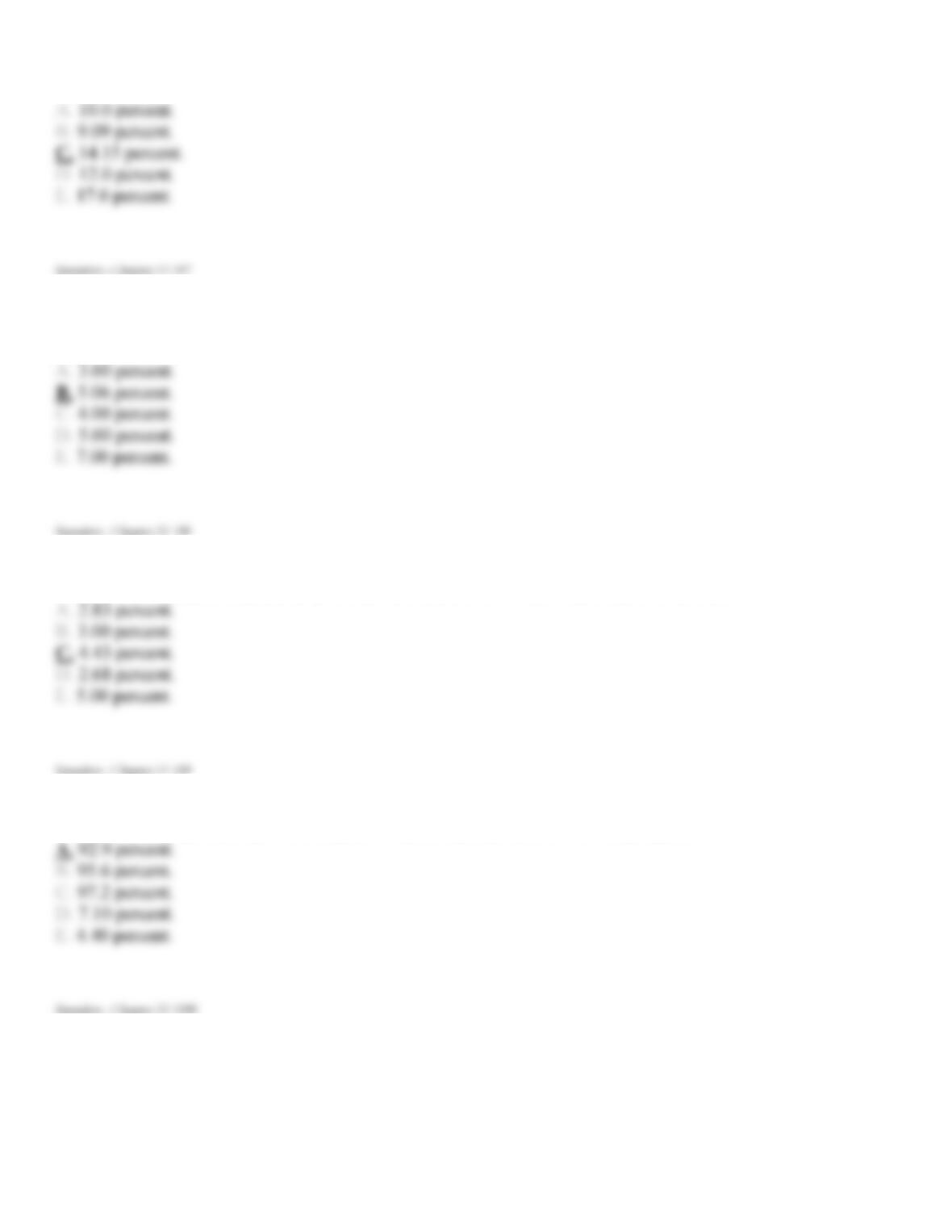
97. What rate is expected on a one-year B-rated corporate bond in one year? (Hint: Use the implied forward
rate.)
98. What spread is expected between the one-year maturity B-rated bond and the one-year Treasury bond in one
year?
99. What is the expected probability of default in year 2 of two-year maturity B-rated debt?
100. What is the probability that two-year B-rated corporate debt will be fully repaid?
101. What is the cumulative mortality rate of the A-rated and B-rated loans for year 2?
102. If the cumulative mortality rate in year 3 is 3.46 percent for the B-rated loan, what is its yearly mortality
rate in year 3?
103. Calculate the value of x (the implied forward rate on one-year maturity Treasuries to be delivered in one
year).
104. Calculate the value of y (the implied forward rate on one-year maturity BBB corporate debt to be delivered
in one year).
105. Using the term structure of default probabilities, the implied default probability for BBB corporate debt
during the current year is
106. Using the term structure of default probabilities, the implied default probability for BBB corporate debt
during the following year is
107. The cumulative probability of repayment of BBB corporate debt over the next two years is
108. What is the capital (loan) risk of the loan if the current average level of interest rates for this category of
bonds is 12 percent?
109. If the fee income on this loan is 0.4 percent and the spread over the cost of funds to the bank is 1 percent,
what is the expected income on this loan for the current year?
110. What is the estimated risk-adjusted return on capital (RAROC) of this loan?
111. If the minimum RAROC acceptable to the bank is 8 percent, what should be its expected percentage fee
income in order for it to approve the loan?
112. What is the current market value of the loan?

113. What is the required yield on this risky loan?