Chapter 11 – Aggregate Planning and Master Scheduling
47. Aggregate planners seek to match supply and demand:
48. In practice, the more commonly used techniques for aggregate planning are:
Chapter 11 – Aggregate Planning and Master Scheduling
49. The main disadvantage(s) of informal techniques used for aggregate planning is(are):
50. Inventory information for firm ABC:
What is the expected inventory at the end of April, 1999?
Chapter 11 – Aggregate Planning and Master Scheduling
51. Inventory information for firm ABC:
What was the inventory at the end of March, 1999?
52. Linear programming to produce an aggregate plan:
Chapter 11 – Aggregate Planning and Master Scheduling
53. Simulation to produce an aggregate plan:
54. Which term is most closely associated with the term disaggregation?
Chapter 11 – Aggregate Planning and Master Scheduling
55. The direct result of disaggregating the aggregate plan is the:
56. Moving from the aggregate plan to a master production schedule requires:
Chapter 11 – Aggregate Planning and Master Scheduling
57. That portion of projected inventory which enables marketing to make realistic
commitments about delivery dates for new orders is:
58. Proactive and Reactive aggregate planning strategies are best associated with:
Chapter 11 – Aggregate Planning and Master Scheduling
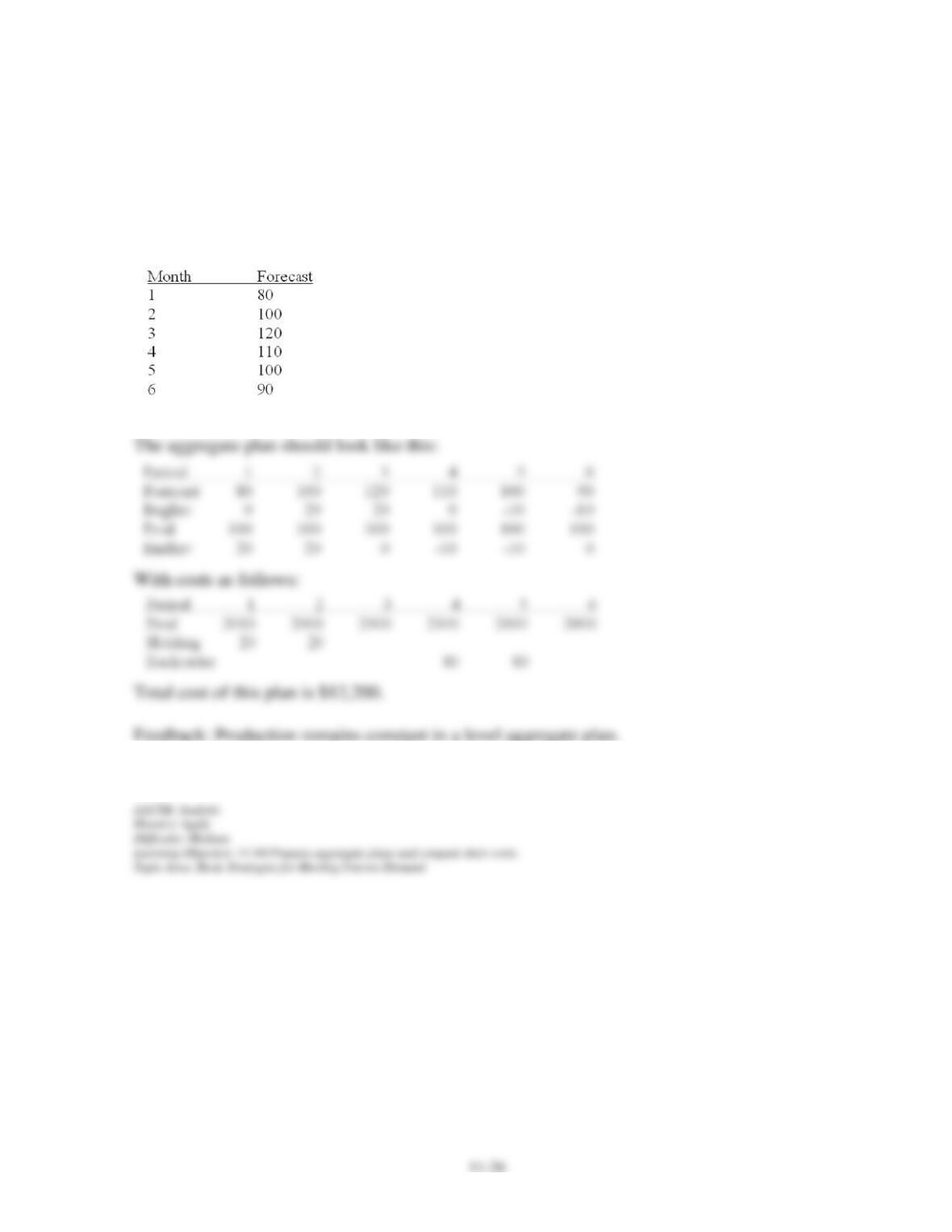
59. A manager has prepared a forecast of expected aggregate demand for the next six months.
Develop an aggregate plan to meet this demand given this additional information: A level
production rate of 100 units per month will be used. Backorders are allowed, and they are
charged at the rate of $8 per unit per month. Inventory holding costs are $1 per unit per month
in ending inventory. Determine the cost of this plan if regular time cost is $20 per unit and
beginning inventory is zero.
Chapter 11 – Aggregate Planning and Master Scheduling
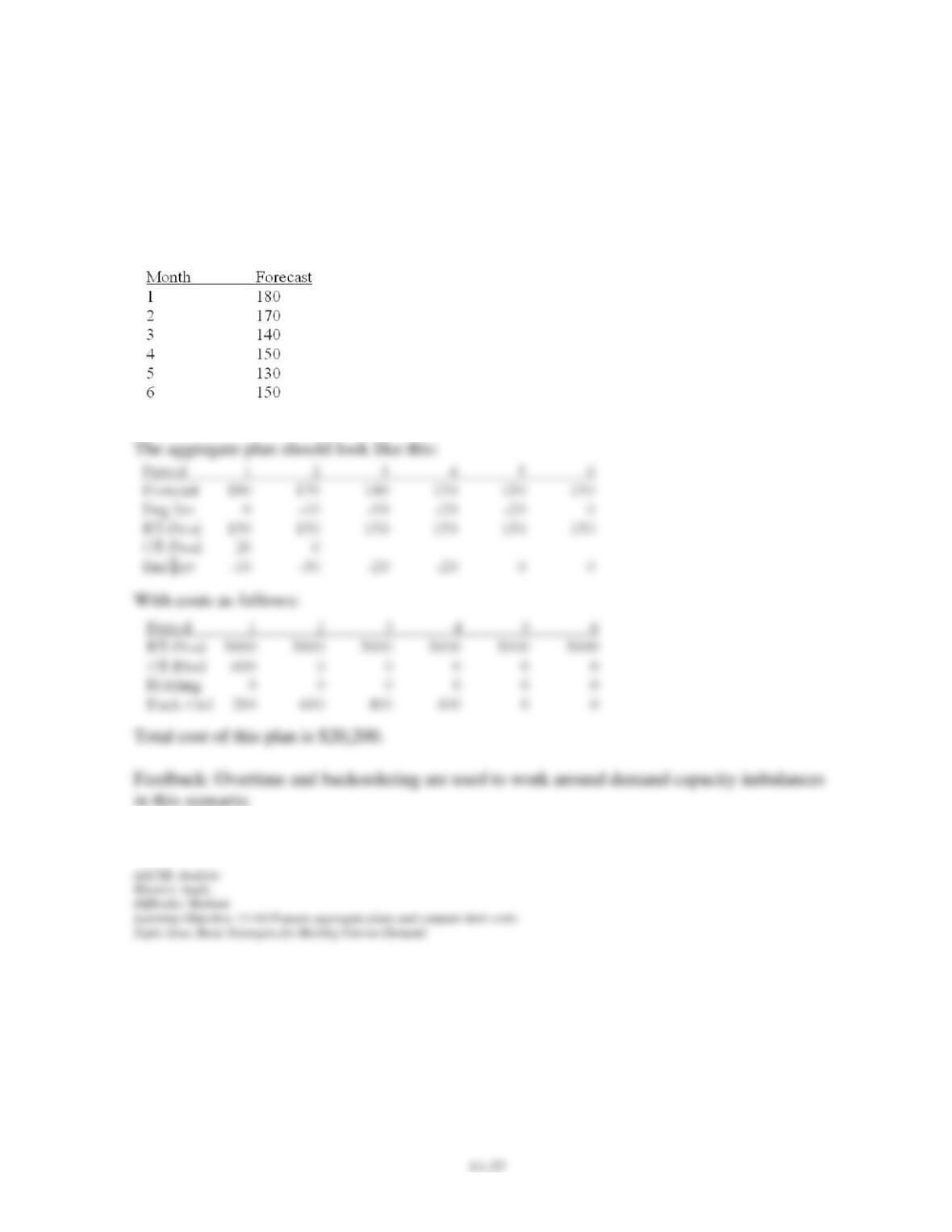
60. Given the projected demands for the next six months, prepare an aggregate plan that uses
inventory, regular time and overtime, and backorders. The plan must wind up with no units in
ending inventory in Period 6. Regular time capacity is 150 units per month. Overtime capacity
is 20 units per month. Overtime cost is $30 per unit, backorder cost is $20 per unit, inventory
holding cost is $5 per unit, regular time cost of $20 per unit, and beginning inventory is zero.
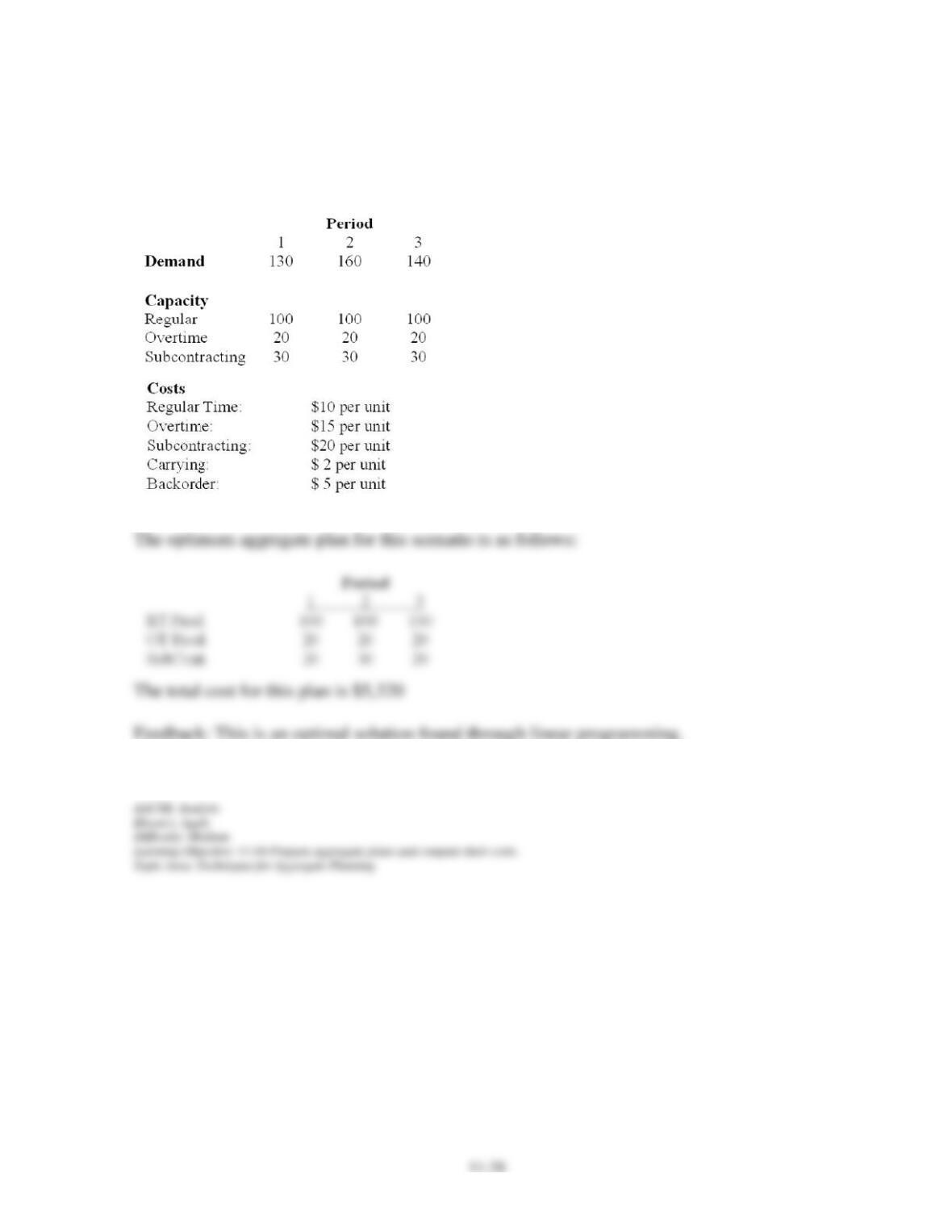
Chapter 11 – Aggregate Planning and Master Scheduling
61. Use either the transportation method or linear programming to develop an optimum
aggregate plan, given the following data:
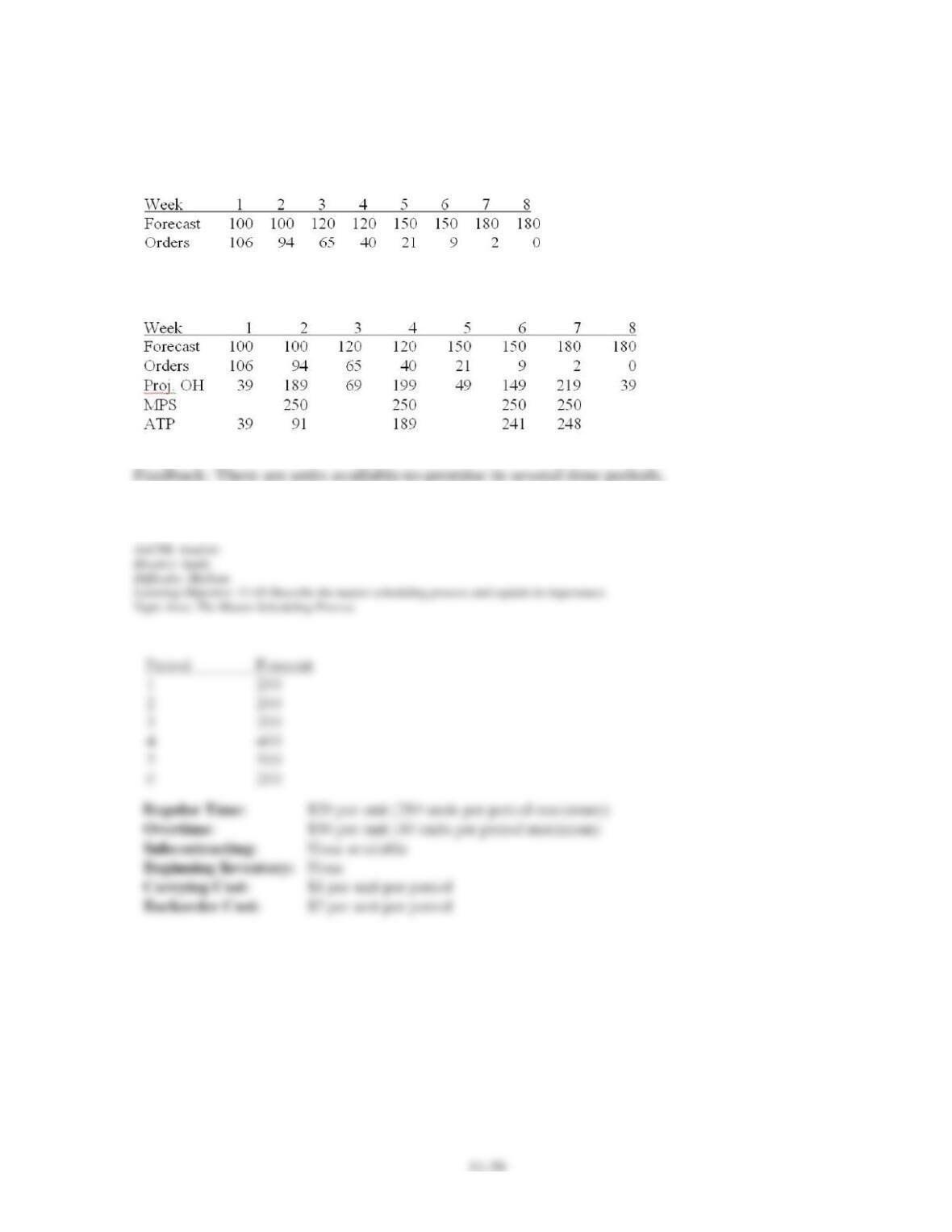
Chapter 11 – Aggregate Planning and Master Scheduling
62. Prepare a master schedule based on the following information:
Currently there are 145 units in inventory. Policy calls for a fixed order quantity of 250 units.
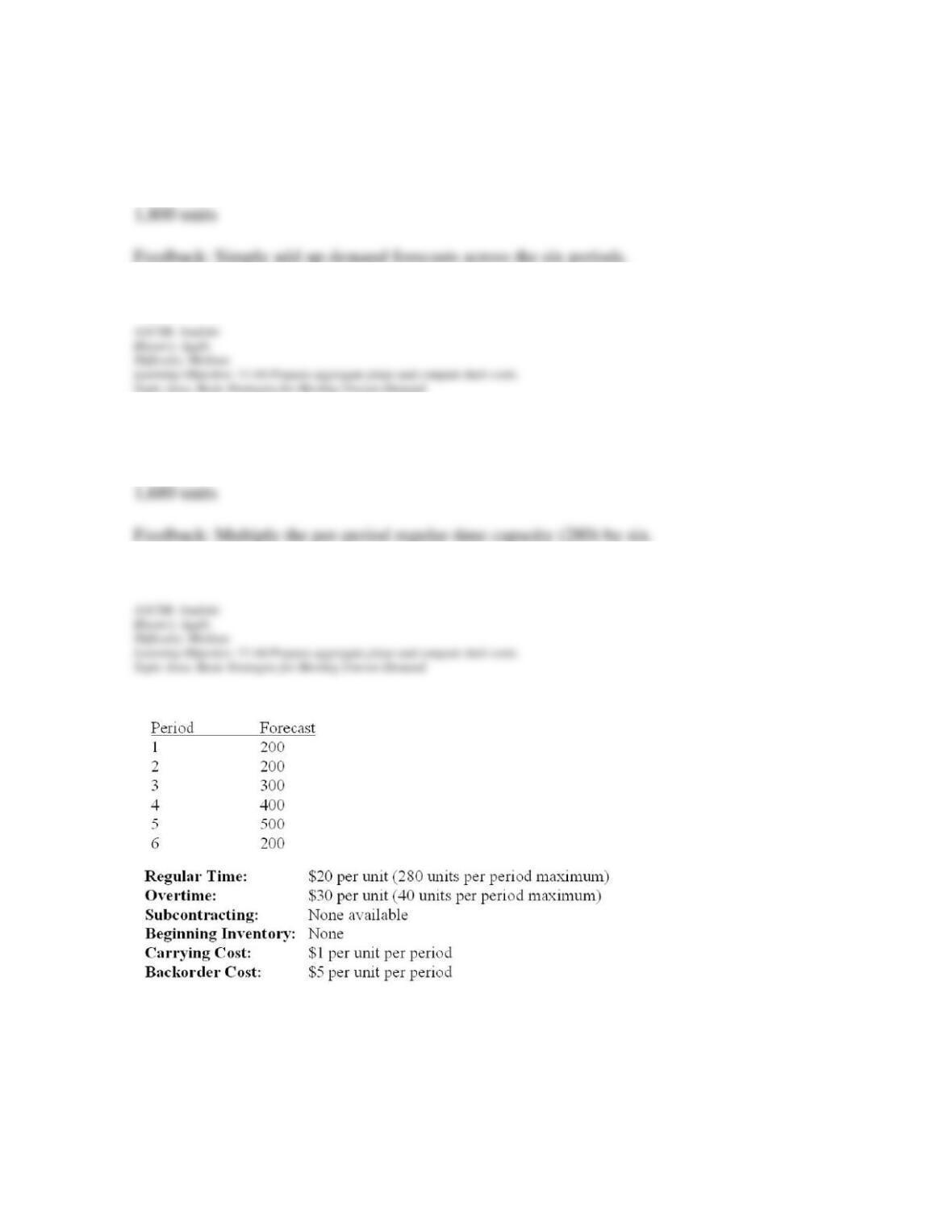
Chapter 11 – Aggregate Planning and Master Scheduling
11–30
63. What is total forecasted demand?
64. What is total regular time capacity?
Chapter 11 – Aggregate Planning and Master Scheduling
65. How should overtime capacity be utilized?
66. What are total regular time costs?
67. What are total overtime costs?
Chapter 11 – Aggregate Planning and Master Scheduling
68. What are total carrying costs?
69. What are total backorder costs?
70. What are total costs for each period?
Chapter 11 – Aggregate Planning and Master Scheduling
71. What are total costs for the six periods?
A firm has 43 units of a certain product on hand. Forecasts for the first two planning periods
are 20 units each. A production quantity of 80 units is planned to be available in period 3.
Customer orders are 22 for period 1 and 17 for period 2.
72. What is the projected on-hand inventory at the end of period 2?
Chapter 11 – Aggregate Planning and Master Scheduling
73. What quantity is available for commitment to new customers in either of the first two
periods?
A firm has 56 units of product X on hand. Forecasts of demand are for 20 units per week. An
MPS quantity of 100 units is planned to arrive in period 3. Customer orders are 24 for period
1, 18 for period 2, and 15 for period 3.
74. What is the projected on hand inventory at the end of period 2?
Chapter 11 – Aggregate Planning and Master Scheduling
75. What quantity is available for commitment to new customers prior to the receipt of the
MPS quantity in week 3?
76. When the opportunity cost of lost revenue is relatively high, _________ become(s)
relatively more attractive.
Chapter 11 – Aggregate Planning and Master Scheduling
77. The more __________ demand is, the more the aggregate plan will tend to reflect the
____________ strategy.
78. In a service setting, the aggregate plan results in a time-phased projection of __________
requirements.
Chapter 11 – Aggregate Planning and Master Scheduling
79. Which of the following differs between aggregate planning in services and aggregate
planning in manufacturing?
80. At XYZ Corp., the aggregate planning unit reflects the fact that 50% of its output is
product version A, 30% is version B, and 20% is version C. Suppose that over the coming
year forecasted total demand (in planning units) is for 10,400 units. Once the production plan
is disaggregated, what will the weekly forecast for version A be (assume 52 weeks per year)?
Chapter 11 – Aggregate Planning and Master Scheduling
81. A master production schedule quantity of 300 units will arrive in week 6. Weekly demand
over weeks 3 through 10 is forecasted at 50 units. At present, orders have been booked in
various quantities in weeks 1, 2, 3 and 4. What is the available to promise for week 6?
82. Which of the following steps is necessary to ensure that a master schedule is valid?