Chapter 10S – Acceptance Sampling
1. Acceptance sampling is applied to batches of items during the production process.
2. Acceptance sampling procedures are applicable for inspection both before and after
production.
3. Flexible acceptance sampling revises the sampling plan in response to actual results.
Chapter 10S – Acceptance Sampling
4. The purpose of acceptance sampling is to decide whether a batch of items satisfies pre-
determined standards.
5. A good sampling plan will occasionally reject a lot with very good quality.
6. Acceptance sampling is most useful when the cost consequences of passing defectives are
low.
Chapter 10S – Acceptance Sampling
7. Acceptance sampling procedures can be applied to both attribute and variables inspection.
8. Acceptance sampling plans must specify the lot size, the sample size, and the
acceptance/rejection criteria.
9. In a single-sampling plan, the entire lot, or batch of items, is accepted or rejected based
upon only one specified sized sample.
Chapter 10S – Acceptance Sampling
10. A double-sampling plan requires a second sample of exactly twice the size of the first
sample.
Chapter 10S – Acceptance Sampling
11. Sampling plans are designed considering both the cost and time required for the
inspection.
12. In a double-sampling plan, a second sample may not be taken if the results of the first
sample are conclusive.
13. Acceptance sampling is a form of inspection applied to items during an ongoing process.
Chapter 10S – Acceptance Sampling
14. In a double-sampling plan, a second sample is taken if the results of the first sample are
inconclusive.
15. The ability of an acceptance sampling plan to discriminate between good and bad lots is
described by its operating characteristic curve.
16. The AQL determines the percentage level of defects in batches that are acceptable.
Chapter 10S – Acceptance Sampling
17. The Lot tolerance percent defective (LTPD) is associated with a consumer’s risk.
18. The Acceptable quality level (AQL) is associated with a producer’s risk.
19. An alternative to acceptance sampling is 100% inspection.
Chapter 10S – Acceptance Sampling
20. Due to the nature of acceptance sampling, the average outgoing quality limit (AOQL)
occurs when the incoming fraction defective reaches a maximum.
21. “Average outgoing quality” curves show the average quality level of inspected and un–
inspected lots for any given incoming fraction defective.
22. The purpose of acceptance sampling is to:
Chapter 10S – Acceptance Sampling
23. Acceptance sampling plans might call for selection of:
24. Which one of the following would not be a reason for using acceptance sampling?
Chapter 10S – Acceptance Sampling
25. Sampling plans typically specify:
26. A lot can be “accepted” or “rejected” in a double-sampling plan:
Chapter 10S – Acceptance Sampling
27. A lot can be “accepted” or “rejected” in a multiple-sampling plan:
28. An OC curve shows:
Chapter 10S – Acceptance Sampling
29. The ability of a sampling plan to discriminate between lots of high quality and lots of low
quality is described by:
30. The AQL indicates:
Chapter 10S – Acceptance Sampling
31. A Type II (beta) error occurs when:
32. A Type I (alpha) error occurs when:
Chapter 10S – Acceptance Sampling
33. An AOQ curve shows:
34. In acceptance sampling, the level of inspection automatically adjusts to the quality of lots
being inspected, assuming that
Chapter 10S – Acceptance Sampling
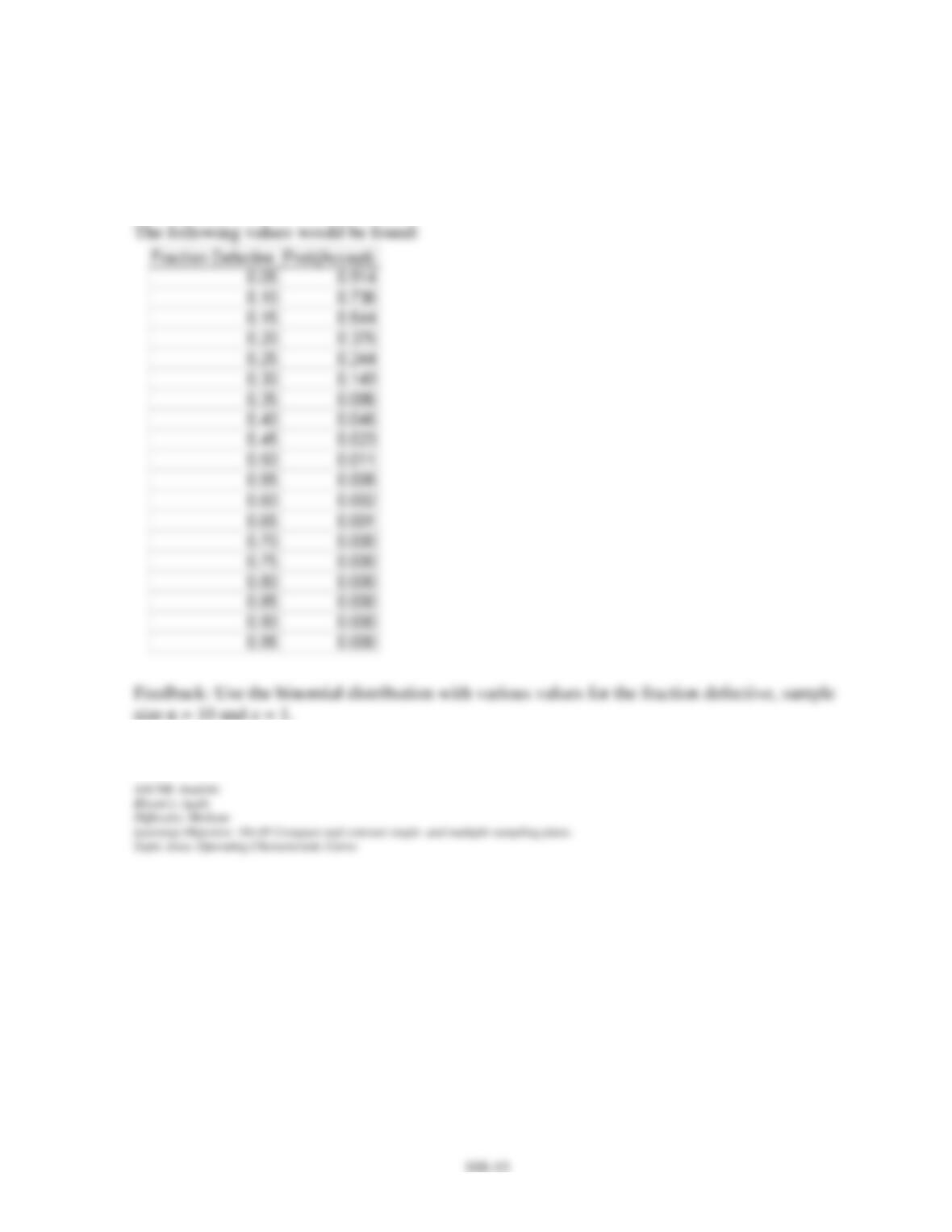
35. Shipments of bowling balls are sampled before delivery to a warehouse. Lots of 600 balls
are checked, using 10 observations from each lot. Any lot with more than one defective is
rejected. Calculate values for the operating characteristic curve for this sampling plan.