
Chapter 10—Measuring Exposure to Exchange Rate Fluctuations
1. Translation exposure reflects:
a.
the exposure of a firm’s international contractual transactions to exchange rate
fluctuations.
b.
the exposure of a firm’s local currency value to transactions between foreign exchange
traders.
c.
the exposure of a firm’s financial statements to exchange rate fluctuations.
d.
the exposure of a firm’s cash flows to exchange rate fluctuations.
2. Transaction exposure reflects:
a.
the exposure of a firm’s international contractual transactions to exchange rate
fluctuations.
b.
the exposure of a firm’s local currency value to transactions between foreign exchange
traders.
c.
the exposure of a firm’s financial statements to exchange rate fluctuations.
d.
the exposure of a firm’s cash flows to exchange rate fluctuations.
3. Economic exposure refers to:
a.
the exposure of a firm’s international contractual transactions to exchange rate
fluctuations.
b.
the exposure of a firm’s local currency value to transactions between foreign exchange
traders.
c.
the exposure of a firm’s financial statements to exchange rate fluctuations.
d.
the exposure of a firm’s cash flows to exchange rate fluctuations.
e.
the exposure of a country’s economy (specifically GNP) to exchange rate fluctuations.
4. Diz Co. is a U.S.-based MNC with net cash inflows of euros and net cash inflows of Swiss francs.
These two currencies are highly correlated in their movements against the dollar. Yanta Co. is a
U.S.-based MNC that has the same level of net cash flows in these currencies as Diz Co. except that its
euros represent net cash outflows. Which firm has a higher exposure to exchange rate risk?
a.
Diz Co.
b.
Yanta Co.
c.
the firms have about the same level of exposure.
d.
neither firm has any exposure.

5. Jacko Co. is a U.S.-based MNC with net cash inflows of euros and net cash inflows of Sunland francs.
These two currencies are highly negatively correlated in their movements against the dollar. Kriner
Co. is a U.S.-based MNC that has the same exposure as Jacko Co. in these currencies, except that its
Sunland francs represent cash outflows. Which firm has a high exposure to exchange rate risk?
a.
Jacko Co.
b.
Kriner Co.
c.
the firms have about the same level of exposure.
d.
neither firm has any exposure.
6. According to the text, currency variability levels ____ perfectly stable over time, and currency
correlations ____ perfectly stable over time.
a.
are; are not
b.
are; are
c.
are not; are not
d.
are not; are
7. Which of the following operations benefits from appreciation of the firm’s local currency?
a.
borrowing in a foreign currency and converting the funds to the local currency prior to the
appreciation.
b.
receiving earnings dividends from foreign subsidiaries.
c.
purchasing supplies locally rather than overseas.
d.
exporting to foreign countries.
8. Which of the following operations benefit(s) from depreciation of the firm’s local currency?
a.
borrowing in a foreign country and converting the funds to the local currency prior to the
depreciation.
b.
purchasing foreign supplies.
c.
investing in foreign bank accounts denominated in foreign currencies prior to depreciation
of the local currency.
d.
A and B
9. Economic exposure can affect:
a.
MNCs only.
b.
purely domestic firms only.
c.
A and B
d.
none of the above

10. Under FASB 52:
a.
translation gains and losses are included in the reported net income.
b.
translation gains and losses are included in stockholder’s equity.
c.
A and B
d.
none of the above
11. Assume that the British pound and Swiss franc are highly correlated. A U.S. firm anticipates the
equivalent of $1 million cash outflows in francs and the equivalent of $1 million cash outflows in
pounds. During a ____ cycle, the firm is ____ affected by its exposure.
a.
strong dollar; favorably
b.
weak dollar; not
c.
strong dollar; not
d.
weak dollar; favorably
12. A U.S. MNC has the equivalent of $1 million cash outflows in each of two highly negatively
correlated currencies. During ____ dollar cycles, cash outflows are ____.
a.
weak; somewhat stable
b.
weak; favorably affected
c.
weak; adversely affected
d.
none of the above
13. Magent Co. is a U.S. company that has exposure to the Swiss francs (SF) and Danish kroner (DK). It
has net inflows of SF200 million and net outflows of DK500 million. The present exchange rate of the
SF is about $.40 while the present exchange rate of the DK is $.10. Magent Co. has not hedged these
positions. The SF and DK are highly correlated in their movements against the dollar. If the dollar
weakens, then Magent Co. will:
a.
benefit, because the dollar value of its SF position exceeds the dollar value of its DK
position.
b.
benefit, because the dollar value of its DK position exceeds the dollar value of its SF
position.
c.
be adversely affected, because the dollar value of its SF position exceeds the dollar value
of its DK position.
d.
be adversely affected, because the dollar value of its DK position exceeds the dollar value
of its SF position.
14. Generally, MNCs with less foreign costs than foreign revenues will be ____ affected by a ____ foreign
currency.

a.
favorably; stronger
b.
not; stronger
c.
favorably; weaker
d.
not; weaker
e.
B and D
15. When the dollar strengthens, the reported consolidated earnings of U.S.-based MNCs are ____
affected by translation exposure. When the dollar weakens, the reported consolidated earnings are
____ affected.
a.
favorably; favorably affected but by a smaller degree
b.
favorably; favorably affected by a higher degree
c.
unfavorably; favorably affected
d.
favorably; unfavorably affected
16. A firm produces goods for which substitute goods are produced in all countries. Appreciation of the
firm’s local currency should:
a.
increase local sales as it reduces foreign competition in local markets.
b.
increase the firm’s exports denominated in the local currency.
c.
increase the returns earned on the firm’s foreign bank deposits.
d.
increase the firm’s cash outflow required to pay for imported supplies denominated in a
foreign currency.
e.
none of the above
17. A firm produces goods for which substitute goods are produced in all countries. Depreciation of the
firm’s local currency should:
a.
decrease local sales as foreign competition in local markets is reduced.
b.
decrease the firm’s exports denominated in the local currency.
c.
decrease the returns earned on the firm’s foreign bank deposits.
d.
decrease the firm’s cash outflow required to pay for imported supplies denominated in a
foreign currency.
e.
none of the above
18. If a U.S. firm’s cost of goods sold exposure is much greater than its sales exposure in Switzerland,
there is a ____ overall impact of the Swiss franc’s depreciation against the dollar on ____.
a.
positive; interest expenses
b.
positive; gross profit
c.
negative; gross profit
d.
negative; interest expenses

19. Assume that your firm is an importer of Mexican chairs denominated in pesos. Your competition is
mainly U.S. producers of chairs. You wish to assess the relationship between the percentage change in
its stock price (SPt) and the percentage change in the peso’s value relative to the dollar (PESOt). SPt is
the dependent variable. You apply the regression model to an earlier subperiod and a more recent
subperiod. In the recent subperiod, you increased your importing volume. You should expect that the
regression coefficient in the PESOt variable would be ____ in the first subperiod and ____ in the
second subperiod.
a.
negative; positive
b.
positive; positive
c.
positive; negative
d.
negative; negative
20. A set of currency cash inflows is more volatile if the correlations are low.
a. True
b. False
21. Which of the following is not a form of exposure to exchange rate fluctuations?
a.
transaction exposure.
b.
credit exposure.
c.
economic exposure.
d.
translation exposure.
22. Subsidiary A of Mega Corporation has net inflows in Australian dollars of A$1,000,000, while
Subsidiary B has net outflows in Australian dollars of A$1,500,000. The expected exchange rate of the
Australian dollar is $.55. What is the net inflow or outflow as measured in U.S. dollars?
a.
$500,000 outflow.
b.
$500,000 inflow.
c.
$275,000 inflow.
d.
$275,000 outflow.

23. Dubas Co. is a U.S.-based MNC that has a subsidiary in Germany and another subsidiary in Greece.
Both subsidiaries frequently remit their earnings back to the parent company. The German subsidiary
generated a net outflow of €2,000,000 this year, while the Greek subsidiary generated a net inflow of
€1,500,000. What is the net inflow or outflow as measured in U.S. dollars this year? The exchange rate
for the euro is $1.05.
a.
$3,675,000 outflow
b.
$525,000 outflow
c.
$525,000 inflow
d.
$210,000 outflow
24. One argument for exchange rate irrelevance is that:
a.
MNCs can hedge exchange rate exposure much more effectively than individual investors.
b.
investors can invest in a diversified stock portfolio of MNCs that have different exposures
to exchange rates.
c.
purchasing power parity does not hold very well.
d.
MNCs are typically not diversified across numerous countries.
25. ____ exposure is the degree to which the value of contractual transactions can be affected by exchange
rate fluctuations.
a.
Transaction
b.
Economic
c.
Translation
d.
None of the above
26. If an MNC expects cash inflows of equal amounts in two currencies, and the two currencies are ____
correlated, the MNC‘s transaction exposure is relatively ____.
a.
negatively; high
b.
negatively; low
c.
positively; low
d.
none of the above
27. If an MNC has a net inflow in one currency and a net outflow of about the same amount in another
currency, then the MNCs’ transaction exposure is ____ if the two currencies are ____ correlated.
a.
high; positively
b.
low; negatively
c.
high; negatively

d.
none of the above
Exhibit 10-1
Cerra Co. expects to receive 5 million euros tomorrow as a result of selling goods to the Netherlands.
Cerra estimates the standard deviation of daily percentage changes of the euro to be 1 percent over the
last 100 days. Assume that these percentage changes are normally distributed. Use the value-at-risk
(VAR) method based on a 95% confidence level for the following question(s).
28. Refer to Exhibit 10-1. What is the maximum one-day loss if the expected percentage change of the
euro tomorrow is 0.5%?
a.
−0.5%
b.
−2.2%
c.
−1.5%
d.
−1.2%
29. Refer to Exhibit 10-1. What is the maximum one-day loss in dollars if the expected percentage change
of the euro tomorrow is 0.5%? The current spot rate of the euro (before considering the maximum
one-day loss) is $1.01.
a.
−$75,750.
b.
−$60,600.
c.
−$111,100.
d.
−$25,250.
30. The maximum one-day loss computed for the value-at-risk (VAR) method does not depend on:
a.
the expected percentage change in the currency for the next day.
b.
the standard deviation of the daily percentage changes in the currency over a previous
period.
c.
the current level of interest rates.
d.
the confidence level used.
Exhibit 10-2
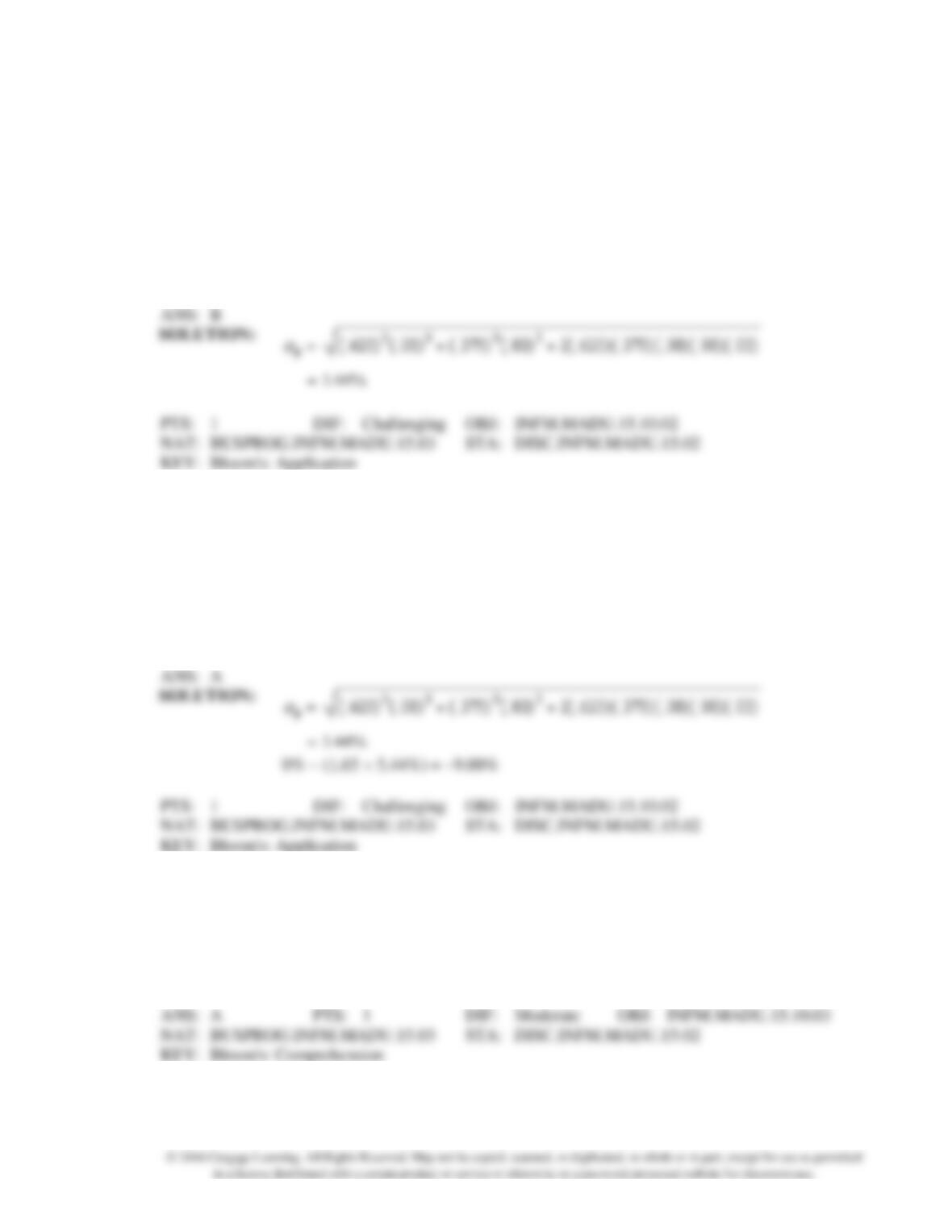
Volusia, Inc. is a U.S.-based exporting firm that expects to receive payments denominated in both
euros and Canadian dollars in one month. Based on today’s spot rates, the dollar value of the funds to
be received is estimated at $500,000 for the euros and $300,000 for the Canadian dollars. Based on
data for the last fifty months, Volusia estimates the standard deviation of monthly percentage changes
to be 8 percent for the euro and 3 percent for the Canadian dollar. The correlation coefficient between
the euro and the Canadian dollar is 0.30.
31. Refer to Exhibit 10-2. What is the portfolio standard deviation?
a.
3.00%.
b.
5.44%.
c.
17.98%.
d.
none of the above
32. Refer to Exhibit 10-2. Assuming an expected percentage change of 0 percent for each currency during
the next month, what is the maximum one-month loss of the currency portfolio? Use a 95 percent
confidence level and assume the monthly percentage changes for each currency are normally
distributed.
a.
−9.00%.
b.
−30.00%.
c.
−5.00%.
d.
none of the above
33. Appreciation in a firm’s local currency causes a(n) ____ in cash inflows and a(n) ____ in cash
outflows.
a.
reduction; reduction
b.
increase; increase
c.
increase; reduction
d.
reduction; increase

34. In general, a firm that concentrates on local sales, has very little foreign competition, and obtains
foreign supplies (denominated in foreign currencies) will likely ____ a(n) ____ local currency.
a.
be hurt by; appreciated
b.
benefit from; depreciated
c.
be hurt by; depreciated
d.
none of the above
35. The ____ the percentage of an MNC’s business conducted by its foreign subsidiaries, the ____ the
percentage of a given financial statement item that is susceptible to translation exposure.
a.
greater; smaller
b.
smaller; greater
c.
greater; greater
d.
none of the above
36. Under FASB 52, consolidated earnings are sensitive to the functional currency’s weighted average
exchange rate.
a. True
b. False
37. If the U.S. dollar appreciates, an MNC’s:
a.
U.S. sales will probably decrease.
b.
exports denominated in U.S. dollars will probably increase.
c.
interest owed on foreign funds borrowed will probably increase.
d.
exports denominated in foreign currencies will probably increase.
e.
all of the above
38. Assume that Mill Corporation, a U.S.-based MNC, has applied the following regression model to
estimate the sensitivity of its cash flows to exchange rate movements:
PCFt = a0 + a1et +
t
where the term on the left-hand side is the percentage change in inflation-adjusted cash flows
measured in the firm’s home currency over period t, and et is the percentage change in the exchange
rate of the currency over period t. The regression model estimates a coefficient of a1 of 2. This
indicates that:
a.
if the foreign currency appreciates by 1%, Mill’s cash flows will decline by 2%.
b.
if the foreign currency appreciates by 1%, Mill’s cash flows will decline by .2%.
c.
if the foreign currency depreciates by 1%, Mill’s cash flows will increase by 2%.
d.
if the foreign currency depreciates by 1%, Mill’s cash flows will decline by 2%.

e.
none of the above
39. ____ is (are) not a determinant of translation exposure.
a.
The MNC’s degree of foreign involvement
b.
The locations of foreign subsidiaries
c.
The local (domestic) earnings of the MNC
d.
The accounting methods used
40. The following regression model was run by a U.S.-based MNC to determine its degree of economic
exposure as it relates to the Australian dollar and Sudanese dinar (SDD):
PCFt = a0 + a1et +
t
where the term on the left-hand side is the percentage change in inflation-adjusted cash flows
measured in the firm’s home currency over period t, and et is the percentage change in the exchange
rate of the currency over period t. The regression was run over two subperiods for each of the two
currencies, with the following results:
Regression Coefficient (a1)
Regression Coefficient (a1)
Currency
Earlier Subperiod
Recent Subperiod
Australian dollar (A$)
−.80
.10
Sudanese dinar (SDD)
.20
.25
Based on these results, which of the following statements is probably not true?
a.
The MNC was more sensitive to movements in the Australian dollar than in the dinar in
the earlier subperiod.
b.
The MNC was more sensitive to movements in the dinar than in the Australian dollar in
the more recent subperiod.
c.
The MNC probably had more outflows than inflows in Australian dollars in the earlier
subperiod.
d.
The MNC probably had more inflows than outflows denominated in dinar in the more
recent subperiod.
e.
All of the above are true.
41. Consider an MNC that is exposed to the Taiwan dollar (TWD) and the Egyptian pound (EGP). 25% of
the MNC’s funds are Taiwan dollars and 75% are pounds. The standard deviation of exchange
movements is 7% for Taiwan dollars and 5% for pounds. The correlation coefficient between
movements in the value of the Taiwan dollar and the pound is .7. Based on this information, the
standard deviation of this two-currency portfolio is approximately:
a.
5.13%.
b.
2.63%.
c.
4.33%.
d.
5.55%.
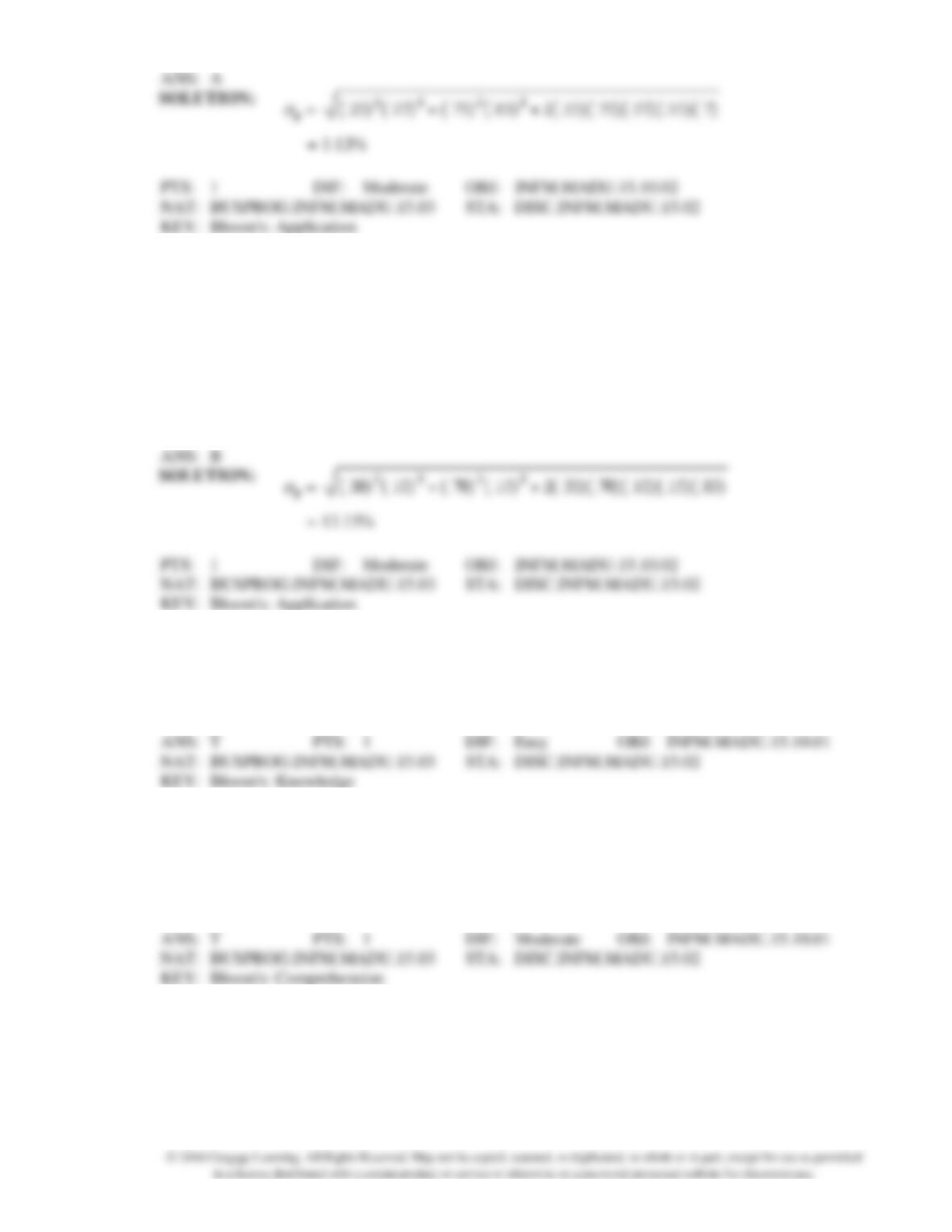
42. Consider an MNC that is exposed to the Bulgarian lev (BGL) and the Romanian leu (ROL). 30% of
the MNC’s funds are lev and 70% are leu. The standard deviation of exchange movements is 10% for
lev and 15% for leu. The correlation coefficient between movements in the value of the lev and the leu
is .85. Based on this information, the standard deviation of this two-currency portfolio is
approximately:
a.
17.28%.
b.
13.15%.
c.
14.50%.
d.
12.04%.
43. One argument why exchange rate risk is irrelevant to corporations is that shareholders can deal with
this risk individually.
a. True
b. False
44. Because creditors may prefer that firms maintain low exposure to exchange rate risk, exchange rate
movements may cause earnings to be more volatile, and because investors may prefer corporations to
perform hedging for them, exchange rate risk is probably relevant.
a. True
b. False
45. A firm’s transaction exposure in any foreign currency is based solely on the size of its open position in
that currency.
a. True
b. False

46. Two highly negatively correlated currencies move in tandem almost as if they are the same currency.
a. True
b. False
47. The transaction exposure of two inflow currencies is offset when the correlation between the
currencies is high.
a. True
b. False
48. The Canadian dollar consistently appears to move almost independently of other currencies. That is it
exhibits low correlations with the other currencies.
a. True
b. False
49. U.S. exporters may not necessarily benefit from weak-dollar periods if foreign competitors are willing
to reduce their profit margin.
a. True
b. False
50. If the functional currencies for reporting purposes are highly correlated, translation exposure is
magnified.
a. True
b. False
51. An MNC can avoid translation exposure if its earnings are not remitted by the foreign subsidiary to the
parent.
a. True
b. False

52. Assume a regression model in which the dependent variable is the firm’s stock price percentage
change, and the independent variable is percentage change in the foreign currency. The coefficient is
negative. This implies that the company’s stock price increases if the foreign currency appreciates.
a. True
b. False
53. A company may become more exposed or sensitive to an individual currency’s movements over time
for several reasons, including a reduction in hedging, a greater involvement in the foreign country, or
an increased use of the foreign currency.
a. True
b. False
54. Regression analysis cannot be used to assess the sensitivity of a company’s performance to economic
conditions because economic conditions are unpredictable.
a. True
b. False
55. A high correlation between two currencies would be desirable for achieving low exchange rate risk if
one is an inflow currency and the other is an outflow currency.
a. True
b. False
56. Firms with more in foreign costs than in foreign revenues will be favorably affected by a stronger
foreign currency.
a. True
b. False
57. The exposure of an MNC’s consolidated financial statements to exchange rate fluctuations is known as
transaction exposure.
a. True
b. False

58. In general, translation exposure is larger with MNCs that have a larger proportion of earnings
generated by foreign subsidiaries.
a. True
b. False
59. A reduction in hedging will probably reduce transaction exposure.
a. True
b. False
60. The VAR method presumes that the distribution of exchange rate movements is normal.
a. True
b. False
61. The VAR method assumes that the volatility (standard deviation) of exchange rate movements changes
over time.
a. True
b. False
62. If exchange rate movements are less volatile in the past than in the future, the estimated maximum
expected loss derived from the VAR method will be underestimated.
a. True
b. False
63. Some MNCs are subject to economic exposure without being subject to transaction exposure.
a. True
b. False

64. If positions in a specific currency among an MNC’s subsidiaries offset each other, the decision by one
subsidiary to hedge its position in that currency would increase the MNC’s overall exposure.
a. True
b. False
65. Vada, Inc. exports computers to Australia invoiced in U.S. dollars. Its main competitor is located in
Japan. Vada is subject to:
a.
economic exposure.
b.
transaction exposure.
c.
translation exposure.
d.
economic and transaction exposure.
66. Jenco Co. imports raw materials from Japan, invoiced in U.S. dollars. The price it pays is not expected
to change for the next several years. If the Japanese yen appreciates, its imports from Japan will
probably ____ and if the Japanese yen depreciates, its imports from Japan will probably ____.
a.
increase; decrease
b.
decrease; increase
c.
increase; stay the same
d.
stay the same; stay the same
67. Yomance Co. is a U.S. company that has exposure to Japanese yen and British pounds. It has net
inflows of 5,000,000 yen and net outflows of 60,000 pounds. The present exchange rate of the
Japanese yen is $.012 while the present exchange rate of the British pound is $1.50. Yomance Co. has
not hedged its positions. The yen and pound movements against the dollar are highly and positively
correlated. If the dollar strengthens, then Yomance Co. will:
a.
benefit, because the dollar value of its pound position exceeds the dollar value of its yen
position.
b.
benefit, because the dollar value of its yen position exceeds the dollar value of its pound
position.
c.
be adversely affected, because the dollar value of its pound position exceeds the dollar
value of its yen position.
d.
be adversely affected, because the dollar value of its yen position exceeds the dollar value
of its pound position.
68. Generally, MNCs with less foreign revenues than foreign costs will be ____ affected by a ____ foreign
currency.
a.
favorably; stronger

b.
favorably; weaker
c.
not; stronger
d.
not; weaker
69. If a U.S. firm’s cost of goods sold in Switzerland is much greater than its sales in Switzerland, the
appreciation of the Swiss franc has a ____ impact on the firm’s ____.
a.
positive; interest expenses
b.
positive; gross profit
c.
negative; gross profit
d.
negative; interest expenses
70. If a U.S. firm’s sales in Australia are much greater than its cost of goods sold in Australia, the
appreciation of the Australian dollar has a ____ impact on the firm’s ____.
a.
positive; interest expenses
b.
positive; gross profit
c.
negative; interest expenses
d.
negative; gross profit
71. U.S. based Majestic Co. sells products to U.S. consumers and purchases all of materials from U.S.
suppliers. Its main competitor is located in Belgium. Majestic Co. is subject to:
a.
economic exposure.
b.
translation exposure.
c.
transaction exposure.
d.
no exposure to exchange rate fluctuations.
72. Vermont Co. has one foreign subsidiary. Its translation exposure is directly affected by each of the
following, except:
a.
the interest rate in the country of the subsidiary.
b.
proportion of business conducted by the subsidiary.
c.
its accounting method.
d.
the exchange rate movements of the subsidiary’s currency.

73. Treck Co. expects to pay €200,000 in one month for its imports from Greece. It also expects to receive
€250,000 for its exports to Italy in one month. Treck Co. estimates the standard deviation of monthly
percentage changes of the euro to be 3 percent over the last 40 months. Assume that these percentage
changes are normally distributed. Using the value-at-risk (VAR) method based on a 95% confidence
level, what is the maximum one-month loss in dollars if the expected percentage change of the euro
during next month is −2%? Assume that the current spot rate of the euro (before considering the
maximum one-month loss) is $1.23.
a.
−$38,468
b.
−$21,371
c.
−$17,097
d.
−$4,274
74. Jensen Co. expects to pay €50,000 in one month for its imports from France. It also expects to receive
€200,000 for its exports to Belgium in one month. Jensen estimates the standard deviation of monthly
percentage changes of the euro to be 2.5 percent over the last 50 months. Assume that these percentage
changes are normally distributed. Using the value-at-risk (VAR) method based on a 97.5% confidence
level, what is the maximum one month loss in dollars if the expected percentage change of the euro
during next month is 2%? Assume that current spot rate of the euro (before considering the maximum
one-month loss) is $1.35.
a.
−$4,303
b.
−$7,830
c.
−$5,873
d.
−$1,958
75. Lazer Co. is a U.S. firm that exports computers to Belgium invoiced in euros and to Italy invoiced in
dollars. Additionally, Lazer Co. has a subsidiary in Korea that produces computers in South Korea and
sells them there. Lazer also has competitors in different countries. Lazer Co. is subject to:
a.
transaction exposure.
b.
economic exposure.
c.
translation exposure.
d.
all of the above.

76. Lampon Co. is a U.S. firm that has a subsidiary in Hong Kong that produces light fixtures and sells
them to Japan, denominated in Japanese yen. Its subsidiary pays all of its expenses, including the cost
of goods sold, in U.S. dollars. The Hong Kong dollar is pegged to the U.S. dollar. If the Japanese yen
appreciates against the U.S. dollar, the Hong Kong subsidiary’s revenue will ____, and its expenses
will ____.
a.
increase; decrease
b.
decrease; remain unchanged
c.
decrease; increase
d.
increase; remain unchanged
77. Assume that the Japanese yen is expected to depreciate substantially over the next year. The
U.S.-based MNC has a subsidiary in Japan, where its costs exceed revenues. The overall value of
MNC will ____ because of the yen’s depreciation.
a.
decrease
b.
increase
c.
remain unchanged
d.
A and C are possible
78. If the net inflow of one currency is about the same amount as a net outflow in another currency, the
firm will benefit if these two currencies are negatively correlated because the transaction exposure is
offset.
a. True
b. False
79. A purely domestic firm is never exposed to exchange rate fluctuations.
a. True
b. False
80. The transaction exposure of two inflow currencies is offset when the correlation between the
currencies is high.
a. True
b. False

81. Currency correlations are generally negative.
a. True
b. False
82. Dollar cash flows associated with two foreign inflow currencies will normally be less volatile if the
standard deviations of the individual currencies are lower.
a. True
b. False
83. The maximum one-day loss estimated using the value-at-risk (VAR) method is independent of the
confidence level used.
a. True
b. False
84. The degree to which a firm’s present value of future cash flows can be influenced by exchange rate
fluctuations is referred to as transaction exposure.
a. True
b. False
85. Purely domestic firms are never affected by economic exposure.
a. True
b. False
86. Translation exposure affects an MNC’s cash flows.
a. True
b. False
87. Since earnings can affect stock prices, many MNCs are concerned about translation exposure.
a. True

b. False
88. Which of the following is not true regarding currency correlations?
a.
Two highly positively correlated currencies act almost as if they are the same currency.
b.
If two inflow currencies are highly positively correlated transaction exposure is somewhat
offset.
c.
If two inflow currencies are negatively correlated transaction exposure is somewhat offset.
d.
If two currencies, one an inflow currency and the other an outflow currency, are highly
positively correlated, transaction exposure is somewhat offset.
89. If the U.S. dollar appreciates,
a.
an MNC’s U.S. sales will probably decrease.
b.
an MNC’s exports denominated in U.S. dollars will probably increase.
c.
an MNC’s interest owed on foreign funds borrowed will probably increase.
d.
an MNC’s exports denominated in foreign currencies will probably increase.
e.
all of the above
90. Which of the following is not true regarding economic exposure?
a.
Even purely domestic firms can be affected by economic exposure.
b.
In general, depreciation of the firm’s local currency causes a decrease in both cash inflows
and outflows.
c.
The degree of economic exposure will likely be much greater for a firm involved in
international business than for a purely domestic firm.
d.
The impact of a change in the local currency on inflow and outflow variables can
sometimes be indirect and therefore different from what is expected.
e.
All of the above are true.