
Chapter 10 Groups, Teams, and Their Leadership Answer Key
True / False Questions
1.
(p. 393)
Groups are characterized by mutual interaction and reciprocal influence.
2.
(p. 395)
Social contact is better satisfied by organizations than by groups.
3.
(p. 396)
Leaders with a large span of control tend to display more consideration and use more
personal approaches when influencing followers.
4.
(p. 399)
Task-oriented behavior is adequate for accomplishing long-term objectives.

5.
(p. 402)
With role ambiguity, the problem is lack of clarity about just what the expectations are.
6.
(p. 404)
An outsider to a group often is able to learn more about norms than an insider.
7.
(p. 404)
Highly cohesive groups are likely to be characterized by low absenteeism and low
turnover.
8.
(p. 407)
Ollieism occurs when people in a highly cohesive group become more concerned with
striving for unanimity than in objectively appraising different courses of action.
9.
Norms can be imported from the organization existing outside the team.
(p. 413)

Type: Knowledge
10.
(p. 418)
Type: Knowledge
In the Team Leadership Model (TLM), the four process measures of effectiveness are
good leverage points for fixing a problem.
11.
(p. 421)
Type: Knowledge
Design is often the most frequently omitted step in teamwork that occurs in traditional
organizations.
12.
(p. 424)
Type: Knowledge
Using instruments such as the Campbell Interest and Skills Survey to select personnel
may help a team’s effort level from an individual perspective.
13.
(p. 426)
Type: Knowledge
Teams operate most effectively under one fixed type of authority over time.

14.
(p. 428)
Leaders can influence team effectiveness by providing frequent coaching while the team
is performing its task.
15.
(p. 429)
With virtual teams, the ability to communicate electronically ensures that effective
teamwork will occur.
16.
(p. 430)
According to Terence Brake’s guidelines for the leadership of virtual teams, leaders should
focus on completing tasks before developing relationships in order to enhance the team’s
sense of accomplishment.
17.
(p. 431)
Research indicates that the distance between virtual teams is geographical,
organizational, temporal, and cultural.

18.
(p. 432)
Due to the multidimensional distance that exists with virtual teams, less leadership is
required than with in-place teams.
19.
(p. 432)
Research suggests that e-mail and video conferencing are the best forms of
communication for virtual teams.
20.
(p. 433)
Clusters are intact, self-managed teams that strive to achieve the organization’s goals.
Multiple Choice Questions
21.
(p. 393)
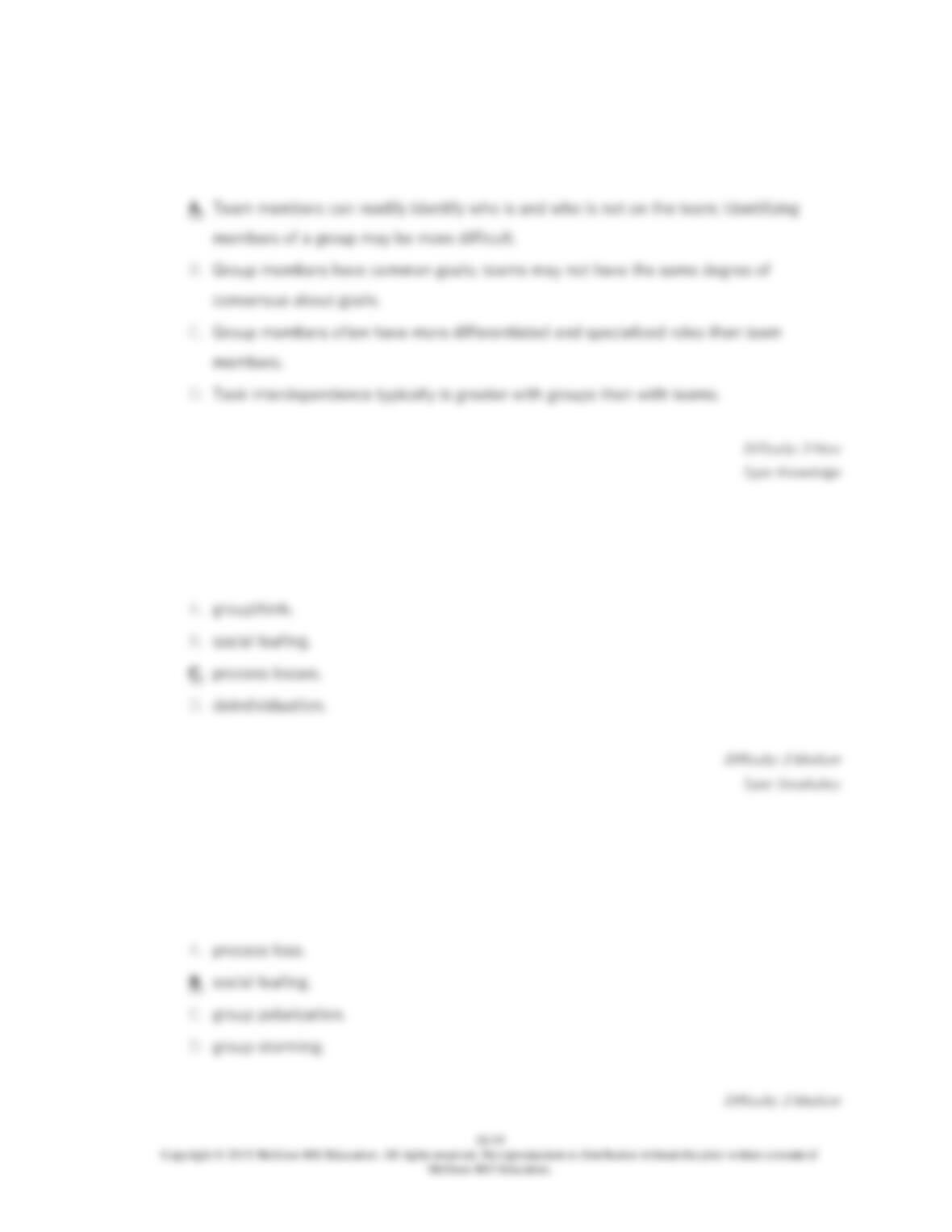
In comparing teams and group members, which statement is most likely true?
22.
(p. 397)
The inefficiencies created by more and more people working together is called:
23.
(p. 397)
The phenomenon of reduced effort by people when they are not individually accountable
for their work is referred to as:

Type: Vocabulary
24.
(p. 397)
Type: Vocabulary
_____ refers to any time people increase their level of work due to the presence of others.
25.
(p. 397)
Type: Vocabulary
The _____ stage of development of groups is characterized by polite conversation, the
gathering of superficial information about fellow members, and low trust.
26.
(p. 397)
The clear emergence of a leader and the development of group norms and cohesiveness
are the key indicators of the _____ stage of group development.

Type: Vocabulary
27.
(p. 397)
Type: Vocabulary
Functional, interdependent roles are characteristic of which stage of group development?
28.
(p. 399)
Type: Vocabulary
Which term refers to the set of expected behaviors associated with a particular job or
position?

29.
(p. 401)
A manager makes the following statement to a subordinate, “I need this report back in five
minutes, and it had better be perfect.” Which term best describes this type of role
conflict?
30.
(p. 401)
Receiving conflicting information from two or more people about their expectations for
your work behavior reflects:

31.
(p. 401)
What type of conflict most likely occurs when a store manager encourages a salesperson
to mislead customers about the quality of the store’s products if deception is inconsistent
with the salesperson’s values and beliefs?
32.
(p. 402)
Molly, a member of a product development team, is most likely experiencing _____ if she
wonders, “Just what am I supposed to be doing?”
33.
(p. 402)
_____ are the informal rules that groups adopt to regulate and regularize group members’
behaviors.
Type: Vocabulary
34.
(p. 404)
Type: Vocabulary
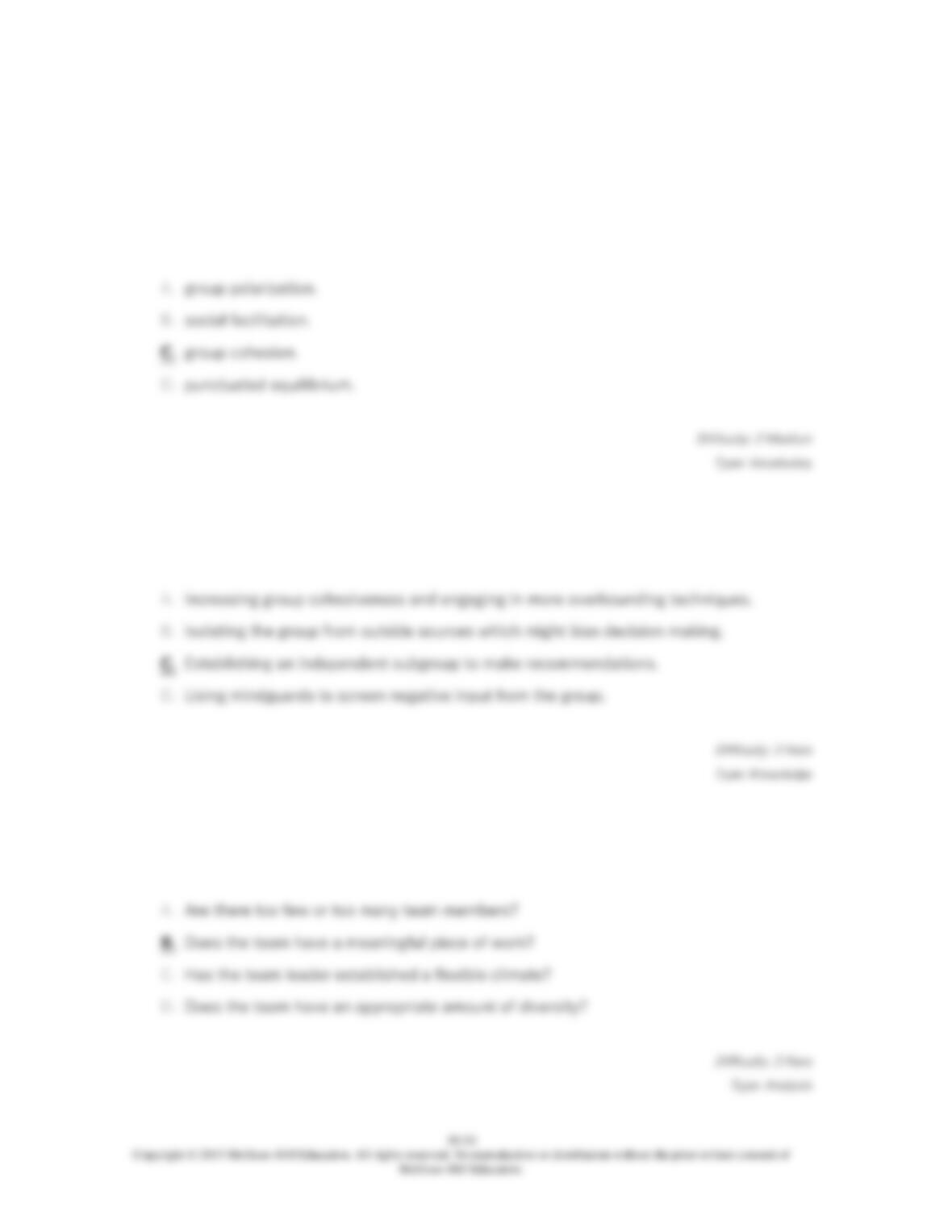
The sum of forces that attract members to a group, provide resistance to leaving it, and
motivate them to be active in it is called:
35.
(p. 406)
Type: Knowledge
Which of the following is a possible solution for groupthink?
36.
(p. 413)
Which question is most relevant to the task variable of team design?