59. EDI is
A) electronic delivery infrastructure.
B) the exchange between two organizations of standard transactions through a network.
C) the use of Internet technologies for electronic data transactions.
D) electronic data invoicing.
60. The process of sourcing goods and materials, negotiating with suppliers, paying for goods, and making
delivery arrangements is called
A) e–procurement.
B) sourcing.
C) procurement.
D) SCM.
61. An extranet that links a large firm to its suppliers and other key business partners is called a(n)
A) e–hub.
B) private industrial network.
C) exchange.
D) marketspace.

62. E–hubs are more ________ than private industrial networks.
A) collaborative
B) transaction–oriented
C) independent
D) supply–chain oriented
63. A mapping of a person’s significant online, personal relationships is called a social
A) community.
B) Web.
C) graph.
D) map.
64. A third–party Net marketplace that connects many buyers and suppliers for spot purchasing is called a(n)
A) vertical market.
B) private exchange.
C) e–hub.
D) exchange.
65. Goods that are involved in the actual production process are referred to as
A) indirect goods.
B) raw materials.
C) purchasing goods.
D) direct goods.
66. Which of the following statements about m–commerce is not true?
A)
M–commerce annual revenues are approximately $30 billion.
B) In 2012, m–commerce represented less than 10 percent of all e–commerce.
C) M–commerce is the fastest growing form of e–commerce.
D) In 2012, the top–grossing category of m–commerce was e–book sales.
67. You are building an e–commerce Web site that will sell e-books and are looking for a hosted solution. Which
of the following functionalities is least important for your business goals?
A) digital catalog
B) customer database
C) site tracking system
D) inventory management
68. You are planning the requirements for a site tracking and reporting system for your company Web site.
Which of the following information requirements would not be essential for this function?
A) number of unique visitors
B) secure credit card clearing
C) pages visited
D) products purchased
69. Which of the following is the least costly way to build a Web site?
A) Outsource the Web site development to overseas vendors.
B) Use a site–building package.
C) Use a hosted solution and pre–built templates.
D) Build your site yourself from scratch using existing software.
70. You are advising an accounting firm that wants to establish its first Web site. Approximately how much of
the Web site budget should you assign to purchasing software?
A) 50 percent
B) 10 percent
C) 25 percent
D) none, as no software will need to be purchased
71. ________ refers to the ability of consumers to discover what merchants actually pay for products.

72. ________ are the merchants’ costs of changing prices.
73. Pinterest and Kaboodle are examples of ________ shopping sites.
74. The Internet enables ________ marketing, by leveraging the fact that there is always some demand, however
small, for a product.
75. A(n) ________ market is a peer–to–peer market in which participants bet on the outcomes of current events or
business or social trends.
76. The ________ targeting of ads results in consumers responding ten times more frequently than when
delivered ads randomly.
77. ________ goods, such as office supplies, are those not involved firsthand in the production process.
78. Online ________ marketing is like traditional word–of–mouth marketing except that it is spread via online
communities.
79. Before building an e–commerce site, business objectives and functionalities must be translated into a set of
precise information ________.
80. In Web server ________, a firm purchases or leases a Web server but locates the server in a vendor’s physical
facility.
81. What is the most profound way in which e–commerce and the Internet has changed the relationship between
companies and their customers? Support your answer.
82. “Knowledge increases exponentially” is a phrase with which we are all familiar. How does this concept apply
to electronic business and the emergence of the digital firm? Support your contentions.
83. You are consulting for Lucky’s, a chain of gas stations. What types of e–commerce opportunities, if any, are
relevant to Lucky’s? Could Lucky’s make use of any Internet business models for this opportunity?
84. Describe the use of personalization and customization in e–commerce. What business value do these
techniques have?
85. List and describe the four main features of social e–commerce and their value to marketers.
86. List and describe at least five different Internet business models. Which of these models do you think would
be the most risky for a startup business today? Support your answer.
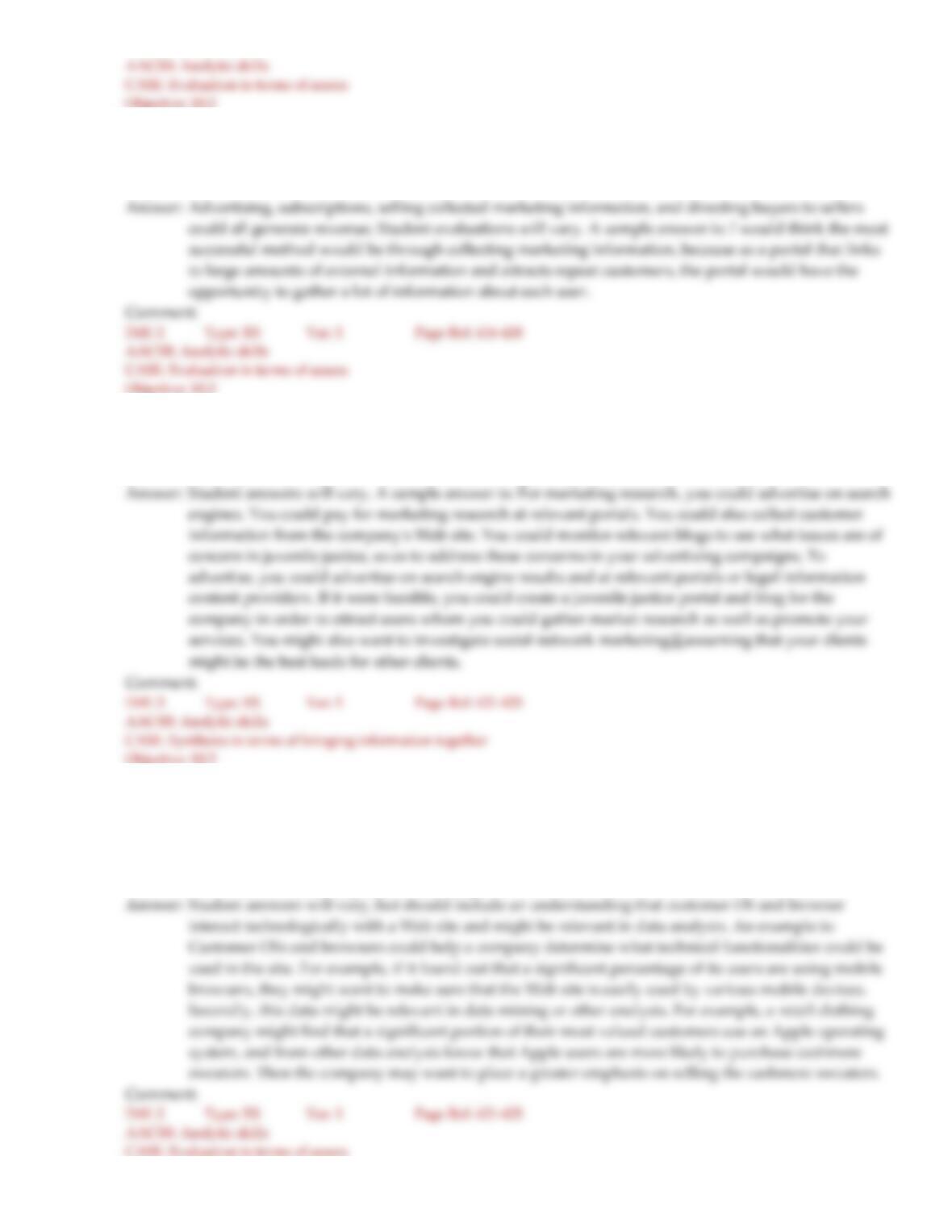
87. What methods could a portal use to generate revenue? Which do you think might be most successful, and
why?
88. You have been hired as a marketing consultant by a law firm in Los Angeles that specializes in juvenile
justice. What ways can you use the Internet as a marketing tool and to advertise the firm’s services?
89. Web site tracking software can log the path a customer took through the Web site, the time spent on the site,
and what geographic area in general the customer is from, all of which can help in customer analysis. It can
also log the customer’s operating system and which browser the customer is using. How could these last two
data items be of interest to a company? Give examples.
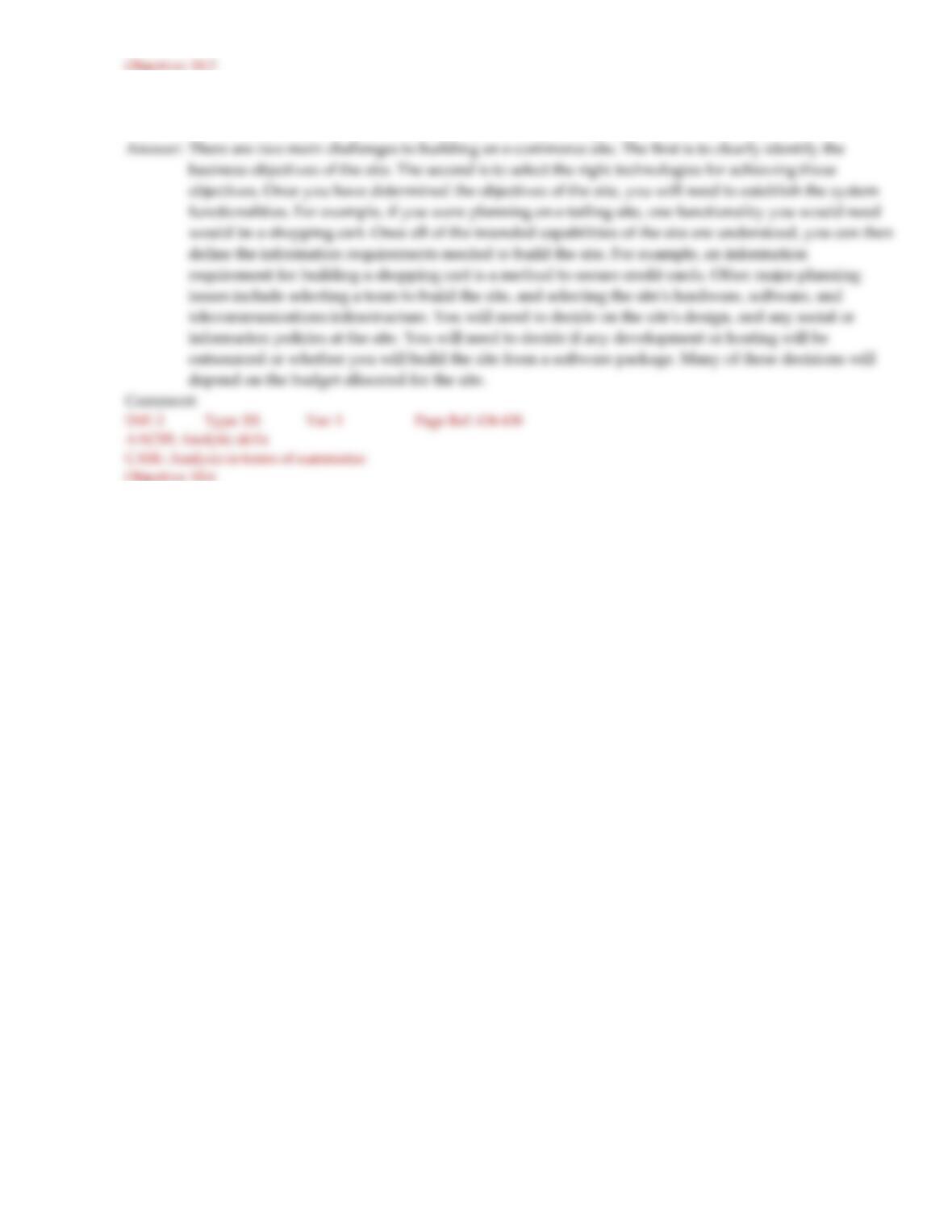
90. Describe the overall process and main decisions involved in planning a new e–commerce site.