Introduction to Operations & Supply Chain Management, 5e (Bozarth)
Chapter 10 Sales and Operations Planning (Aggregate Planning)
10.1 S&OP in the Planning Cycle
1) Within the context of the planning cycle, the planning that takes place at the highest levels of the firm is
called:
A) strategic planning.
B) operational planning.
C) tactical planning.
D) detailed planning and control.
2) Planning numbers are somewhat aggregated (month by month) in what planning level?
A) strategic planning
B) operational planning
C) tactical planning
D) detailed planning and control
3) There are few, if any, options for adjusting capacity levels for managers involved in what planning
level?
A) strategic planning
B) operational planning
C) tactical planning
D) detailed planning and control
4) To develop a superior plan, sales and operations planning must consider:
A) customer demand.
B) capabilities of suppliers.
C) capabilities of logistics service providers.
D) All of these must be considered when performing S&OP.
5) Tactical capacity resources include:
A) customer demand.
B) the size of the workforce.
C) major process choice decisions.
D) construction of new plants.
6) Detailed planning and control is riskier than strategic planning.
7) Sales and operations planning indicates how the organization will use its tactical capacity resources to
meet expected customer demand.
8) Compared to other levels of planning, detailed planning and control offers the greatest ability to adjust
capacity.
9) Sales and operations planning should inform all members of the supply chain what to do and what not
to do.
10) Among strategic, tactical and detailed planning, it is ________ planning that presents managers with
the fewest options for altering capacity.
11) The purpose of aggregate planning is to help businesses develop effective ________ plans.
12) What is the purpose of S&OP and what takes place at the strategic, tactical, and detailed planning and
control levels?
13) Distinguish between strategic, tactical and detailed planning and control in terms of their ability to
adjust capacity, the amount of risk, and the specificity of the plans.
14) How can a sales and operations plan be articulated so that all supply chain participants can
understand what is needed?
10.2 Major Approaches to S&OP
1) A company has a sales forecast for the following five months as shown in the table. If they have a
beginning inventory of 100 units, what amount should be produced under a level plan in order for them
to have an ending inventory of zero units at the end of the five-month period?
Month
Forecast
January
350
February
400
March
300
April
500
May
350
A) 320 units per month
B) 360 units per month
C) 400 units per month
D) 440 units per month
2) A company has a sales forecast for the following five months as shown in the table. If they have a
beginning inventory of 350 units, what amount should be produced under a level plan in order for them
to have an ending inventory of zero units at the end of the five-month period?
Month
Forecast
January
525
February
600
March
650
April
750
May
875
A) 580 units per month
B) 595 units per month
C) 610 units per month
D) 640 units per month
3) A company has a sales forecast for the following five months as shown in the table. If they have a
beginning inventory of 225 units, what amount should be produced under a level plan in order for them
to have an ending inventory of zero units at the end of the five-month period?
Month
Forecast
January
825
February
600
March
650
April
550
May
475
A) 580 units per month
B) 595 units per month
C) 585 units per month
D) 575 units per month
4) A company has a sales forecast for the following five months as shown in the table. If they have a
beginning inventory of 1225 units, what amount should be produced under a level plan in order for them
to have an ending inventory of zero units at the end of the five-month period?
Month
Forecast
January
1575
February
1420
March
1680
April
1750
May
1975
A) 1,435 units per month
B) 1,595 units per month
C) 1,385 units per month
D) 1,515 units per month
5) What is the ending inventory level for April in the production plan shown in the table? All entries in
the table are in terms of sales units.
Month
Forecast
Regular
Production
Overtime
Production
Ending
Inventory
January
250
250
0
0
February
200
300
0
March
300
325
25
April
500
400
25
A) 150 units
B) 125 units
C) 100 units
D) 75 units
6) It costs $10 to make a single unit using regular production and $15 to make a single unit using
overtime production. Total overtime production is limited to 1000 units for the five–month period. The
manufacturing plant has a regular production capacity of 250 units per month and 225 units in inventory
at the start of the planning period. There is a $5 per unit charge for holding inventory at the end of each
month and a limit of 600 units ending inventory for any period. What is the minimum cost production
plan if the forecast must be met with a zero ending inventory each month?
Month
Forecast
January
250
February
200
March
300
April
400
May
500
A) $15,850
B) $16,150
C) $16,500
D) $16,800
7) It costs $12 to make a single unit using regular production and $15 to make a single unit using
overtime production. Total overtime production is limited to 500 units for the five month period. The
manufacturing plant has a regular production capacity of 250 units per month and 50 units in inventory
at the start of the planning period. There is a $5 per unit charge for holding inventory at the end of each
month and a limit of 250 units ending inventory for any period. What is the lowest cost production plan if
the forecast must be met with a zero ending inventory each month?
Month
Forecast
January
250
February
200
March
300
April
400
May
500
A) $20,850
B) $19,750
C) $19,500
D) $20,550
8) It costs $12 to make a single unit using regular production and $15 to make a single unit using
overtime production. Total overtime production is limited to 500 units for the five month period. The
manufacturing plant has a regular production capacity of 250 units per month and 50 units in inventory
at the start of the planning period. There is a $5 per unit charge for holding inventory at the end of each
month and a limit of 250 units ending inventory for any period. What is the total number of units to be
produced using overtime throughout the entire planning period if the forecast must be met and costs are
to be minimized with a zero ending inventory each month?
Month
Forecast
January
250
February
200
March
300
April
400
May
500
A) 450
B) 500
C) 400
D) 350
9) It costs $10 to make a single unit using regular production and $15 to make a single unit using
overtime production. Finished units sell for $17 and are built to order. The manufacturing plant has a
regular production capacity of 250 units per month and no inventory at the start of the planning period.
What is the BEST net cash flow for the entire planning period if the manufacturer uses a chase plan?
Month
Forecast
January
250
February
200
March
300
April
400
A) $6,800
B) $7,050
C) $7,300
D) $7,550
10) Regular production costs $25 per unit and selling a unit represents a cash inflow of $30 per unit.
Assume that all units reflected on the forecast will be sold. What is the cumulative net cash flow at the
end of April?
Month
Forecast
Regular Production
January
250
250
February
200
200
March
300
300
April
400
400
A) $10,000
B) $12,000
C) $5,750
D) $2,000
11) Regular production costs $15 per unit and selling a unit represents a cash inflow of $25 per unit.
Assume that all units reflected on the forecast will be sold. What is the net cash flow for March?
Month
Forecast
Regular Production
January
250
250
February
200
200
March
300
300
April
400
400
A) $11,500
B) $7,500
C) $4,500
D) $3,000
12) Regular production costs $13 per unit and selling a unit represents a cash inflow of $28 per unit.
Assume that all units reflected on the forecast will be sold. What is the cumulative net cash flow through
March?
Month
Forecast
Regular Production
January
250
250
February
200
200
March
300
300
April
400
400
A) $11,250
B) $4,500
C) $8,400
D) $3,900
13) A company has the cost structure shown in the table and faces a demand in July that exceeds capacity
by 200 units. They enter June with an inventory of zero and a demand equal to capacity. Their best course
of action in order to completely fill all of the orders for both June and July by the end of July is to:
Managerial Lever
Cost
Regular production
$1,000/unit
Overtime production
$1,300/unit
Subcontracting
$1,200/unit
Inventory holding
$100/unit/month
Backlog cost
$400/unit/month
A) subcontract 200 units in June and use 100% of their regular capacity in both June and July.
B) subcontract 100 units in both June and July and use 100% of their regular capacity in both June and
July.
C) produce 200 units using overtime in July and use 100% of their regular capacity in both June and July.
D) subcontract 200 units in July and use 100% of their regular capacity in both June and July.
14) Willow Trees Inc. makes seven different products, four of which are within their first year of
existence. The demands for all products, especially the newest ones, are not well known. The newest
products are intended to complement their existing products and take different materials, different
processes, and an entirely different set of labor skills for production. Which of these statements regarding
their likely sales and operations planning activities is BEST?
A) The planning values for the oldest items in the product line should be used for the new items in the
product line.
B) Willow Trees Inc. should avoid using sales and operations planning until their product line matures.
C) Willow Trees Inc. should use top-down planning.
D) Willow Trees Inc. should use bottom-up planning.
15) Seventy percent of a house painter‘s business is exterior work and the other thirty percent is interior.
The average exterior paint job takes 20 hours of labor and $400 of paint and primer, but the average
interior job takes only 6 hours of labor and $75 of paint and primer. If he gets 20 service calls for the
coming month, which of the following resource requirements is correct?
A) The painter has supply costs of $4750 for next month.
B) The painter has a labor demand of 260 hours for next month.
C) The painter has supply costs of $6050 for next month.
D) The painter has a labor demand of 204 hours for next month.
16) Forty percent of a house painter’s business is exterior work and the other sixty percent is interior. The
average exterior paint job takes 30 hours of labor and $500 of paint and primer, but the average interior
job takes only 6 hours of labor and $80 of paint and primer. If he gets 25 service calls for the coming
month and 30 calls for the month after that, which of the following resource requirements is correct?
A) The painter has supply costs of greater than $13,500 but less than $13,600 for the next two months.
B) The painter has a labor demand of greater than 800 hours but less than 850 hours for the next two
months.
C) The painter has supply costs of greater than $13,400 but less than $13,500 for the next two months.
D) The painter has a labor demand of greater than 850 hours but less than 900 hours for the next two
months.
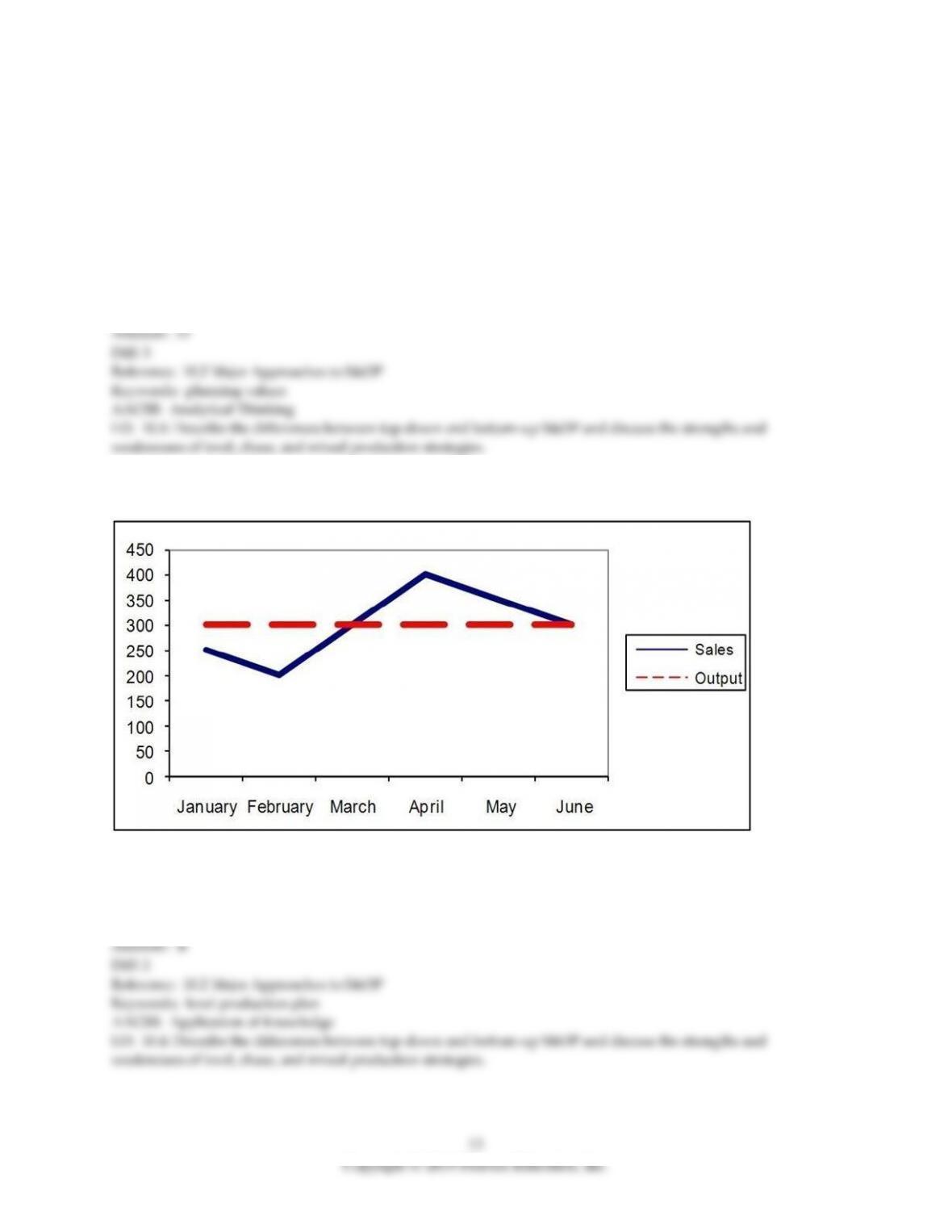
17) This graph of expected sales level and expected output shows:
A) a chase production plan is being used.
B) a level production plan is being used.
C) a mixed production plan is being used.
D) planning levels have been computed.
18) The standard equation used by Gigi Enterprises for production planning is Production = Demand.
The sales and operations planner is probably using:
A) a mixed production approach.
B) a level production approach.
C) a chase production approach.
D) a bottom-up planning approach.
19) A company has the cost structure shown in the table and faces a demand in July that exceeds capacity
by 200 units. They enter June with an inventory of zero and a demand equal to capacity. Their best course
of action in order to completely fill all of the orders for both June and July by the end of July is to
subcontract the extra 200 units in June and hold the inventory one period for July’s demand.
Managerial Lever
Cost
Regular production
$1,000/unit
Overtime production
$1300/unit
Subcontracting
$1200/unit
Inventory holding
$100/unit/month
Backlog cost
$400/unit/month
20) Bottom-up planning should be used when the product/service mix is unstable and resource
requirements vary greatly across the offerings.
21) The alternative production strategies of level, chase, or mixed that are available in top-down planning
cannot be used in bottom-up planning.
22) Last month a firm made 100 model A’s using all of their available labor. If they have already taken
orders for 150 model A’s for next month, then their planning value must be 1.5.
23) Planning values are used in bottom-up planning, but cannot be used in top-down planning.
24) When the products and services have very different resource requirements and the mix is unstable
from one period to the next, bottom-up planning works best.
25) At the beginning of the semester, you decide to devote 12 hours a week outside of class time to your
operations management studies, regardless of scheduled tests, assignments, or project due dates. This is a
level plan approach to your favorite course.
26) Net cash flow is the difference between the value added and the cash on hand at the end of the
period.
27) A(n) ________ production plan matches production in each time period with the sales forecast.
28) A sales and operations plan that varies both production and inventory levels is called a(n) ________
production plan.
29) In order for ________ planning to work, the mix of products or services must be essentially the same
from one time period to the next or the products must have very similar resource requirements.
30) A production planner can confirm future capacity requirements based on released or planned orders
by referring to a(n) ________.