NARRBEGIN: Atkinson Landscaping
Atkinson Landscaping
Atkinson Landscaping applies variable overhead based on direct labor hours. At the beginning of the
current year, Atkinson had estimated the following:
Estimated variable overhead
$56,000
Estimated units of production
10,000 units
Standard direct labor hours per unit
2.5 hours
During the year, 11,000 units were produced using a total of 27,200 direct labor hours and actual
overhead costs were $60,000.
NARREND
72. Refer to the Atkinson Landscaping information above. Atkinson’s variable overhead spending
variance for the year was:
a.
$ 672 F
b.
$ 928 F
c.
$4,000 U
d.
$ 145 U
73. Refer to the Atkinson Landscaping information above. Atkinson’s variable overhead efficiency
variance for the year was:
a.
$ 672 F
b.
$ 928 F
c.
$4,000 U
d.
$ 145 U
74. The fixed overhead volume variance is calculated by taking the difference between:
a.
actual fixed overhead and budgeted fixed overhead.
b.
budgeted fixed overhead and budgeted variable overhead.
c.
budgeted fixed overhead and applied fixed overhead.
d.
budgeted fixed overhead per the flexible budget and budgeted fixed overhead per the static
budget.
75. Which of the following variances is generally not reported as being favorable or unfavorable?
a.
Variable overhead efficiency variance
b.
Direct labor rate variance
c.
Fixed overhead volume variance
d.
Direct materials usage variance
76. Refer to the Armstrong Products information above. Armstrong’s fixed overhead spending variance
is:
a.
$8,000 F
b.
$8,000 U
c.
$2,000 F
d.
$2,000 U
77. Refer to the Armstrong Products information above. Armstrong’s fixed overhead volume variance is:
a.
$2,000
b.
$6,000
c.
$8,000
d.
$ 0
NARRBEGIN: Hayward Inc.
Hayward Inc.
Hayward Inc. produces a unique item. Hayward’s management team wishes to perform a variance
analysis on its fixed overhead. Fixed overhead is applied to units produced using direct labor hours as
its cost driver. The company’s managerial accountant has compiled the following information:
Projected data:
Estimated direct labor hours
50,000 hours
Estimated fixed overhead
$75,000
Actual data:
Actual production
104,000 units
Actual direct labor hours used
52,000 hours
Actual fixed overhead
$80,000
NARREND
78. Refer to the Hayward Inc. information above. Hayward’s fixed overhead spending variance is:
a.
$2,000 F
b.
$2,000 U
c.
$5,000 F
d.
$5,000 U
79. Refer to the Hayward Inc. information above. Hayward’s fixed overhead volume variance is:
a.
$5,000
b.
$2,000
c.
$3,000
d.
$2,500
80. Which of the following types of companies would not have a need to calculate a fixed overhead
volume variance?
a.
A company that uses variable costing.
b.
A company that uses absorption costing.
c.
A company that applies fixed overhead based on direct labor hours.
d.
A company that uses activity-based costing (ABC).
81. Washington Inc. has an unfavorable fixed overhead spending variance. Which of the following would
be the most likely reason for this variance?
a.
More units were actually produced than predicted.
b.
Fewer units were actually produced than predicted.
c.
Actual fixed overhead was more than predicted.
d.
Actual fixed overhead was less than predicted.
82. New Hampshire Products has a favorable fixed overhead spending variance. Which of the following
would be the most likely reason for this variance?
a.
More units were actually produced than predicted.
b.
Fewer units were actually produced than predicted.
c.
Actual fixed overhead was more than predicted.
d.
Actual fixed overhead was less than predicted.
83. Which of the following statements is false regarding variance analysis in the modern manufacturing
environment?
a.
It is often not timely enough to be useful to managers.
b.
It is often too detailed to be of much use to managers.
c.
Not all variances are required to be investigated.
d.
It can influence employee behavior.
84. Which of the following statements is true regarding variance analysis in the modern manufacturing
environment?
a.
It requires all variances, regardless of size, to be investigated by managers.
b.
The use of ideal standards over practical standards will always be the best motivator to
employees.
c.
An “unfavorable” variance should always be interpreted as “bad“.
d.
It is often not performed in a timely enough manner to be useful to employees.
85. Which of the following statements is true regarding “management by exception“?
a.
It is rarely used in variance analysis.
b.
It forces managers to investigate all variances, regardless of size.
c.
It requires the use of flexible budgets.
d.
It requires managers to calculate standard costs but not actual costs.
86. When managers use the process called “management by exception”:
a.
they take action when there is a significant variance between planned and actual results.
b.
they take action when there is a variance of any size or amount between planned and
actual results.
c.
they are allowed to use standard costs rather than actual costs on financial statements
issued to decision makers.
d.
they are not required to compute the standard cost of making a product.
87. Managers who properly apply the concept called “management by exception” will:
a.
investigate only unfavorable variances.
b.
investigate only favorable variances.
c.
always investigate unfavorable and favorable variances regardless of size.
d.
investigate only variances of a certain size or scope.
SHORT ANSWER
1. As a manager, how might you determine the standard price and quantity of materials, labor, and
overhead for a particular product?
2. What is “task analysis” and how is it used in the context of variance analysis?
3. Answer the following questions:
A.
How do ideal and practical standards differ?
B.
As an employee who is evaluated based upon standards, which would you prefer and
why?
An ideal standard is one that is attainable only in near-perfect conditions, whereas a
practical standard is attainable under normal, efficient operating conditions.
4. What is the difference between a static and a flexible budget? Which one is most often used in
variance analysis and why?
Managerial ACCT Test Bank Chapter 10 23
5. True or False: Indicate whether each of the following statements is true (T) or false (F).
1.
The sales price variance is computed by comparing the actual sales price to the
flexible budget sales price and multiplying that amount by the actual sales
volume.
2.
The computation for the flexible budget variance can be thought of as
taking the difference between operating income on the static budget
and actual operating income.
3.
Any differences in sales revenue between the flexible budget and actual
results must be attributable to differences in the budgeted sales volume
and actual sales volume.
4.
When the quantity of direct materials purchased and used are not the
same, the direct materials price variance can not be computed.
5.
The direct labor rate variance measures how well employees made
efficient use of their production time.
ANS:
1.
T
2.
F
3.
F
4.
F
5.
F
6. At the end of the current year, Bowman Products has the following information available comparing
the cost of direct materials on its flexible budget with the actual cost of direct materials:
Flexible budget
Actual results
Difference
Direct materials
$24,000
$30,000
(6,000)
Sally Vincent, the company’s controller, has requested a meeting with Hank Rowland, the operations
manager, asking him to explain why direct materials costs were more than what had been budgeted.
What two kinds of variance analysis should Hank do before his meeting with Sally? What would each
of these variances measure?
Managerial ACCT Test Bank Chapter 10 24
7. GEO Inc. has an unfavorable direct materials price variance.
A.
Give two possible reasons for this variance.
B.
Using one of the above reasons, how could this particular variance affect one of the
other variances (ex. direct materials usage, direct labor rate, direct labor efficiency)?
management could, in turn, impact any of the other variances in an unfavorable way.
8. At the end of the year, your company had the following variances:
Direct material price variance
$3,000 F
Direct material usage variance
$3,500 U
Direct labor rate variance
$5,200 U
Direct labor efficiency variance
$7,000 U
Give at least one possible cause for each of the variances and discuss the possible relationships
between them.
9. Harkin Ltd. has a $5,000 unfavorable variable overhead spending variance. Give two possible reasons
for this variance.
10. Drummel Ltd. has a $7,000 unfavorable variable overhead efficiency variance. Give one possible
reason for this variance.
11. What is “management by exception”? Do you think it represents an efficient use of management time?
Why or why not?
PROBLEM
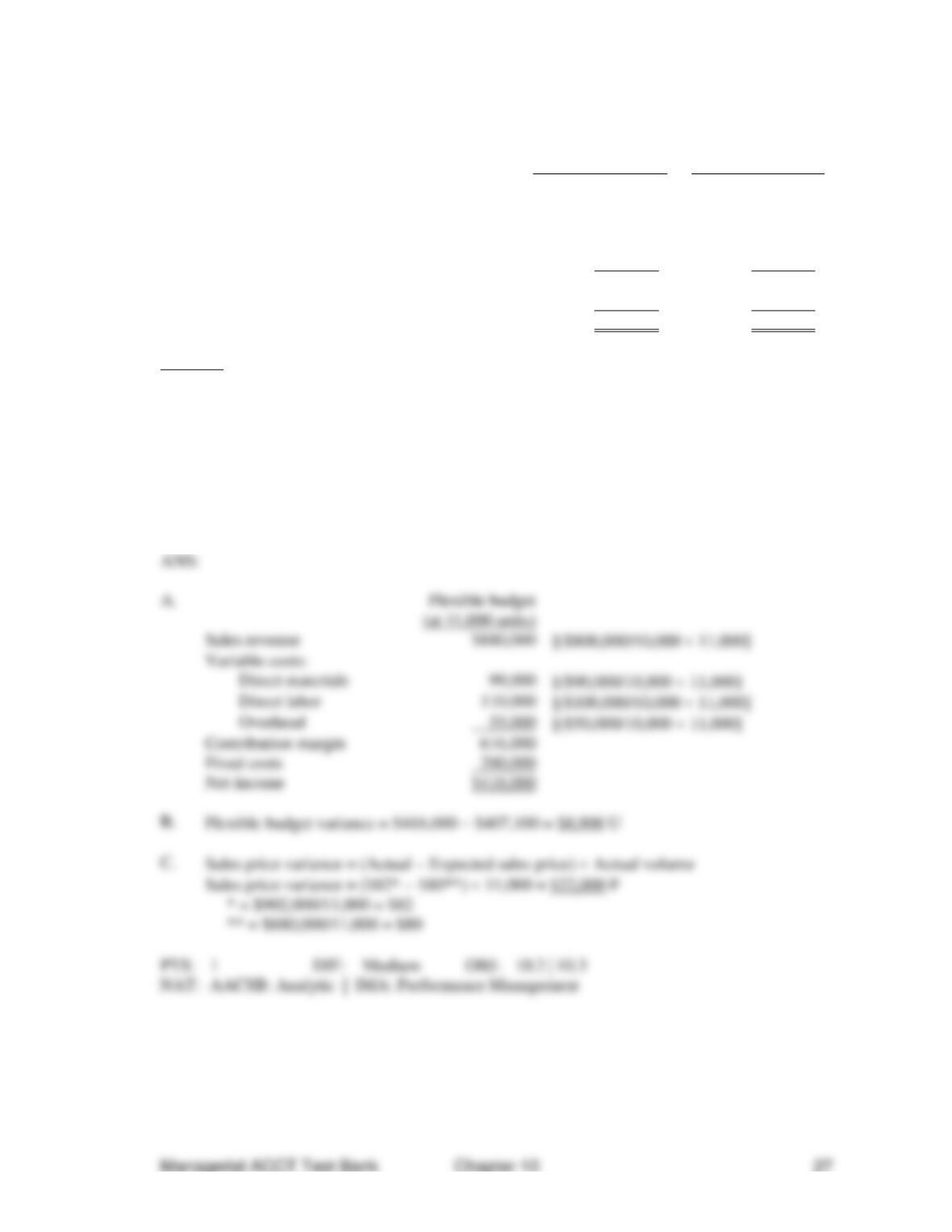
1. Jackie makes and sells handmade beaded jewelry. She anticipates selling 100 necklaces in March and
prepared the following static budget as a result:
at 100 units
Sales revenue
$3,500
Variable costs:
Direct materials
500
Direct labor
800
Overhead
300
Fixed costs
400
Net income
$1,500
During March, Jackie actually produced and sold 120 necklaces.
Required: Prepare a flexible budget for the month of March.
at 120 units
[($3,500/100) 120 units]
Variable costs:
[($500/100) 120 units]
[($800/100) 120 units]
[($300/100) 120 units]
Fixed costs
400
Net income
2. Unified Products Inc. makes and sells a unique product. At the beginning of the current year, the
company had anticipated selling 10,000 of these units; however, 11,000 units were actually produced
and sold. Below is the company’s static budget as well as actual results for the year:
(static budget)
(actual results)
at 10,000 units
at 11,000 units
Sales revenue
$800,000
$902,000
Variable costs:
Direct materials
90,000
103,400
Direct labor
100,000
121,000
Overhead
50,000
60,500
Contribution margin
560,000
617,100
Fixed costs
200,000
210,000
Net income
$360,000
$407,100
Required:
A.
Prepare a flexible budget for the year.
B.
Calculate the flexible budget variance for the year. Indicate whether it is favorable or
unfavorable.
C.
Calculate the sales price variance for the year. Indicate whether it is favorable or
unfavorable.
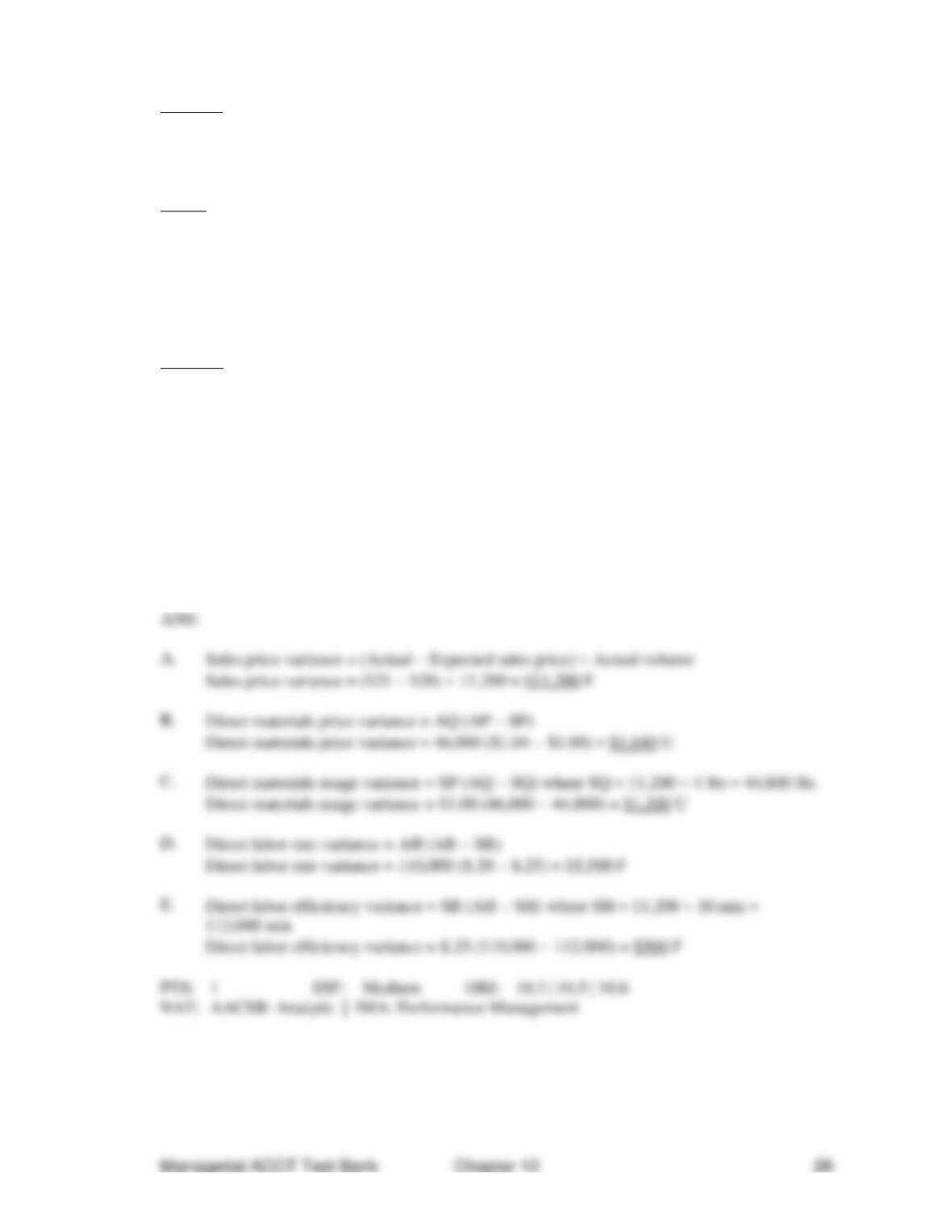
A.
[($800,000/10,000 11,000]
Variable costs:
[($90,000/10,000 11,000]
[($100,000/10,000 11,000]
[($50,000/10,000 11,000]
Contribution margin
Fixed costs
Net income
Flexible budget variance = $416,000 − $407,100 = $8,900 U
Sales price variance = (Actual − Expected sales price) Actual volume
Sales price variance = ($82* − $80**) 11,000 = $22,000 F
** = $880,000/11,000 = $80
3. In early 2009, Duncan Manufacturing Inc. had budgeted for the production and sale of 12,000 units at
a sales price of $20 per unit. The following information is available regarding the standard cost for
each unit:
Direct materials:
$4.00 (4 pounds at $1.00 per lb)
Direct labor:
$2.50 (10 minutes of assembly at $.25 per minute)
Actual results for 2009 were determined to be as follows:
Number of units produced
and sold:
11,200 units
Sales revenue:
$235,200 ($21 per unit)
Direct materials cost:
$47,840 (46,000 lbs purchased and used at $1.04 per lb)
Direct labor cost:
$22,000 (110,000 minutes at $.20 per minute)
Required: Compute each of the following variances. Indicate whether the variance is favorable (F) or
unfavorable (U).
A.
Sales price variance
B.
Direct materials price variance
C.
Direct materials usage variance
D.
Direct labor rate variance
E.
Direct labor efficiency variance
Sales price variance = (Actual − Expected sales price) Actual volume
Sales price variance = ($21 − $20) 11,200 = $11,200 F
Direct materials price variance = AQ (AP − SP)
Direct materials price variance = 46,000 ($1.04 − $1.00) = $1,840 U
Direct materials usage variance = SP (AQ − SQ) where SQ = 11,200 4 lbs = 44,800 lbs
Direct materials usage variance = $1.00 (46,000 − 44,800) = $1,200 U
Direct labor rate variance = AH (AR − SR)
Direct labor rate variance = 110,000 ($.20 − $.25) = $5,500 F
Direct labor efficiency variance = $.25 (110,000 − 112,000) = $500 F
Managerial ACCT Test Bank Chapter 10 29
4. Kincaid Ltd. produces and sells leather wallets. In the current year, the company budgeted for the
production and sale of 18,000 wallets; however, 21,000 wallets were actually produced and sold. Each
wallet has a standard requiring eight square inches of material at a cost of .20 per inch and ten minutes
of assembly time at a cost of $.15 per minute. Actual costs for the production of 21,000 wallets were
$36,080 for materials (164,000 inches purchased and used @ $.22 per inch) and $36,000 for labor
(225,000 minutes @ $.16 per minute).
Required: Compute each of the following variances. Indicate whether the variance is favorable (F) or
unfavorable (U).
A.
Direct materials price variance
B.
Direct materials usage variance
C.
Direct labor rate variance
D.
Direct labor efficiency variance
5. Gemma Products produces and sells a variety of domestic goods including sheets. In the current year,
the company budgeted for the production and sale of 10,000 sets; however, 12,000 sets were actually
produced and sold. Each set has a standard requiring 10 yards of material at a cost of $1.10 per yard
and 20 minutes of direct labor (for sewing, assembly, and inspection) at a cost of $.20 per minute.
Actual costs for the production of 12,000 sets were $138,240 for materials (128,000 yards purchased
and used @ $1.08 per yard) and $55,200 for labor (230,000 minutes @ $.24 per minute).
Required: Compute each of the following variances. Indicate whether the variance is favorable (F) or
unfavorable (U).
A.
Direct materials price variance
B.
Direct materials usage variance
C.
Direct labor rate variance
D.
Direct labor efficiency variance
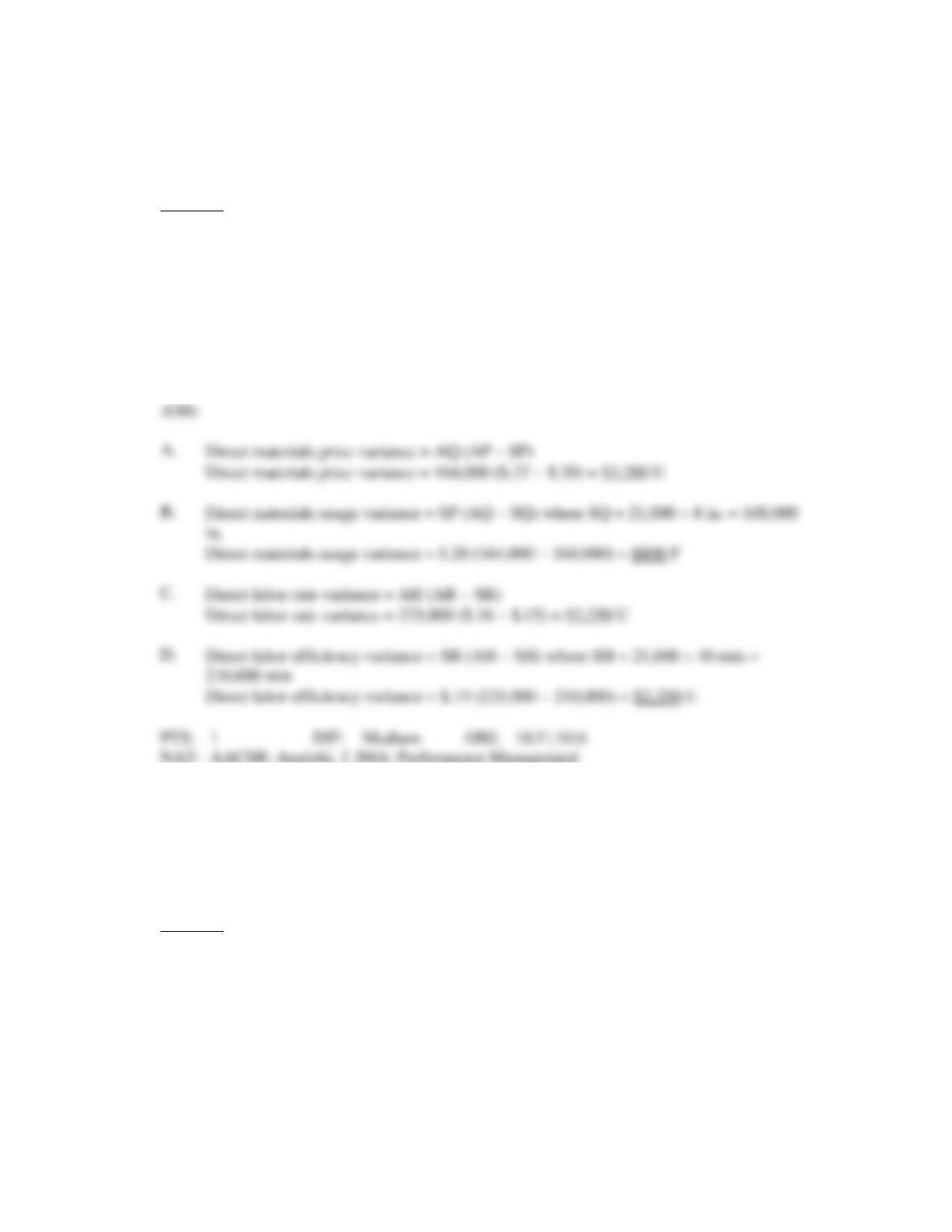
Direct materials price variance = AQ (AP − SP)
Direct materials price variance = 164,000 ($.22 − $.20) = $3,280 U
Direct materials usage variance = $.20 (164,000 − 168,000) = $800 F
Direct labor rate variance = AH (AR − SR)
Direct labor rate variance = 225,000 ($.16 − $.15) = $2,250 U
210,000 min
Direct labor efficiency variance = $.15 (225,000 − 210,000) = $2,250 U
Managerial ACCT Test Bank Chapter 10 30
6. Bayou Barbecue Inc. bottles and sells barbecue sauce. In the current year, the company had expected
to sell 500,000 bottles but actually bottled and sold 600,000 bottles. The standard direct materials cost
for each bottle is $.36 comprised of 12 ounces of material at a cost of $.03 per ounce. During the year,
7,800,000 ounces of material was purchased out of which 7,350,000 ounces were used at a cost of
$.035 per ounce.
Required: Compute each of the following variances. Indicate whether the variance is favorable (F) or
unfavorable (U).
A.
Direct materials price variance
B.
Direct materials usage variance
Direct materials price variance = 7,800,000 ($.035 − $.03) = $39,000 U
7,200,000 oz.
Direct materials usage variance = $.03 (7,350,000 − 7,200,000) = $4,500 U
7. Carolina Tile Company manufactures and installs industrial tile flooring. In the current year, the
company had anticipated producing and installing 80,000 tiles but actually produced installed 90,000
tiles. The standard direct materials cost for each square foot of tile is $6.30 comprised of 3 pounds of
material at a cost of $2.10 per pound. During the year, 300,000 pounds of material were purchased out
of which 280,000 pounds were used at a cost of $1.90 per pound.
Direct materials price variance = AQ (AP − SP)
Direct materials price variance = 128,000 ($1.08 − $1.10) = $2,560 F
Direct materials usage variance = $1.10 (128,000 − 120,000) = $8,800 U
Direct labor rate variance = AH (AR − SR)
Direct labor rate variance = 230,000 ($.24 − $.20) = $9,200 U
240,000 min
Direct labor efficiency variance = $.20 (230,000 − 240,000) = $2,000 F
Managerial ACCT Test Bank Chapter 10 31
Required: Compute each of the following variances. Indicate whether the variance is favorable (F) or
unfavorable (U).
A.
Direct materials price variance
B.
Direct materials usage variance
8. Henninger’s Nursery sells a variety of plants. Henninger sells most of its plants to local landscapers in
the community. These plants come in “flats” containing 12 plants each. In May of the current year,
Henninger had expected to sell 900 flats of petunias but produced and sold 940 flats instead. The
company expects each flat to require 25 minutes of labor at a cost of $.15 per minute. In addition,
variable overhead is applied at a rate of $.05 per minute.
Actual costs incurred during May for the production and sale of 940 flats was as follows:
Direct labor
$3,416 (24,400 minutes at $.14 per minute)
Variable overhead
1,200
Required: Compute each of the following variances. Indicate whether the variance is favorable (F) or
unfavorable (U).
A.
Direct labor rate variance
B.
Direct labor efficiency variance
C.
Variable overhead spending variance
D.
Variable overhead efficiency variance
Direct materials price variance = 300,000 ($1.90 − $2.10) = $60,000 F
Direct materials usage variance = $2.10 (280,000 − 270,000) = $21,000 U
Direct labor rate variance = AH (AR − SR)
Direct labor rate variance = 24,400 ($.14 − $.15) = $244 F
Direct labor efficiency variance = $.15 (24,400 − 23,500) = $135 U
Variable overhead spending variance = Actual variable overhead − (AH SVR)
Variable overhead spending variance = $1,200 (24,400 $.05) = $20 F
Variable overhead efficiency variance = $.05 (24,400 − 23,500) = $45 U
9. Gantt Textiles Inc. incurred actual variable overhead expenses of $50,000 in the current year for the
production of 6,000 units. Variable overhead was applied at a rate of $3.25 per direct labor hour and 2
direct labor hours were budgeted for each unit. The company used 16,000 direct labor hours for
production.
Required: Compute each of the following variances. Indicate whether the variance is favorable (F) or
unfavorable (U).
A.
Variable overhead spending variance
B.
Variable overhead efficiency variance
Variable overhead spending variance = Actual − (AH SVR)
Variable overhead spending variance = $50,000 − (16,000 $3.25) = $2,000 F
12,000 hrs
Variable overhead efficiency variance = $3.25 (16,000 − 12,000) = $13,000 U
10. Lancaster Ltd. produces a unique item. Lancaster’s management team wishes to perform a variance
analysis on its fixed overhead. Fixed overhead is applied to units produced using direct labor hours as
its cost driver. The company’s managerial accountant has compiled the following information:
Projected data:
Estimated direct labor hours
40,000 hours
Estimated fixed overhead
$90,000
Actual data:
Actual production
300,000 units
Actual direct labor hours used
50,000 hours
Actual fixed overhead
$100,000
Required:
A.
Compute the fixed overhead spending variance
B.
Compute the fixed overhead volume variance.
Fixed overhead spending variance = Actual fixed overhead − Budgeted fixed overhead
Fixed overhead spending variance = $100,000 − $90,000 = $10,000 U
Fixed overhead volume variance = Budgeted fixed overhead − Applied fixed overhead
Fixed overhead volume variance = $90,000 − $112,500 = $22,500