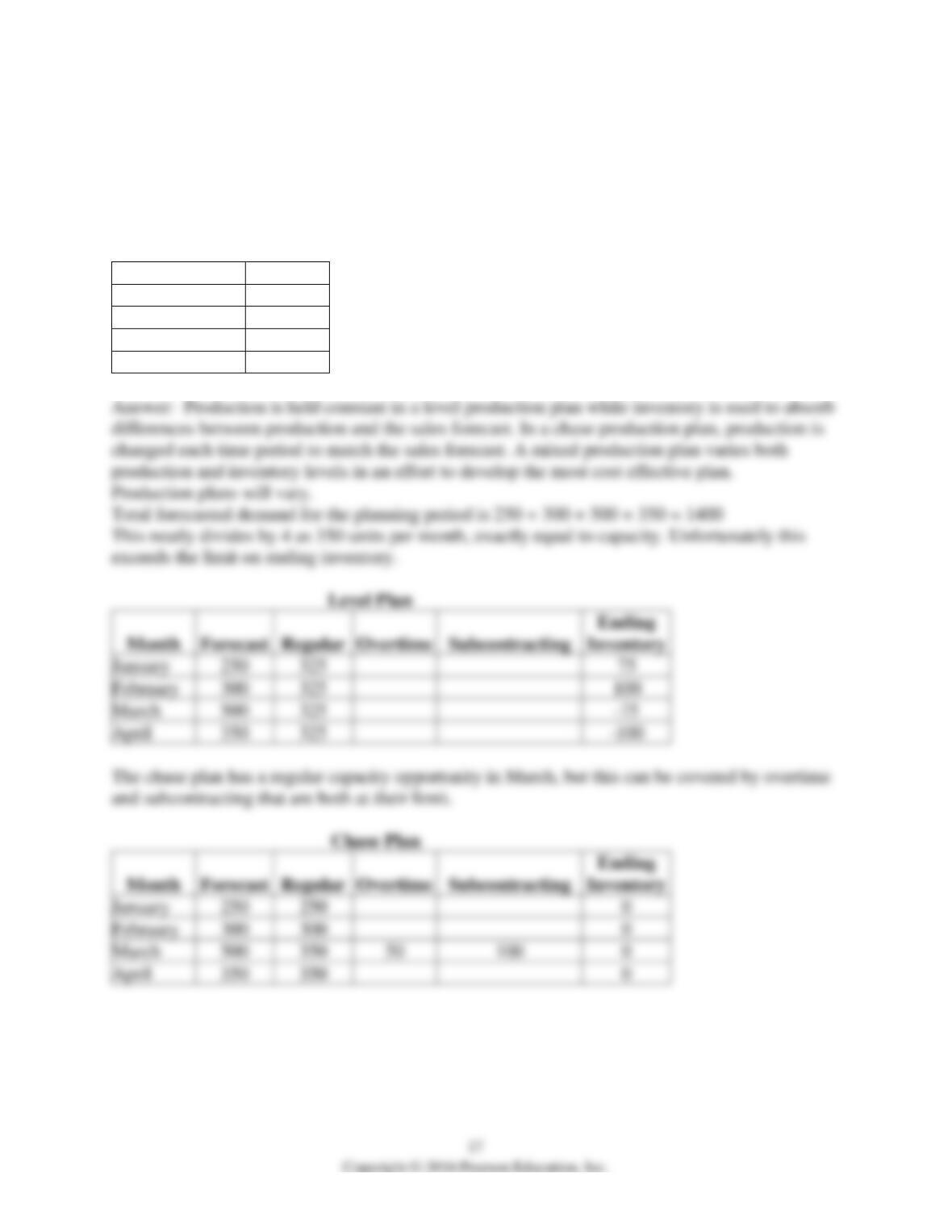
31) Describe the differences between level, chase, and mixed production plans. Use the forecast
in the table to show the differences by creating a plan of each type. There is no beginning
inventory and regular production capacity is 350 units. Overtime costs $10 extra and is limited to
50 units per month. Subcontracting is limited to 100 units per month and costs $15 per unit. Back
orders cost $40 per unit and there is a cost of $5 per month to hold a unit in inventory. There is
room for only 100 units in inventory.
Month
Forecast
January
250
February
300
March
500
April
350
January
February
March
April
Regular
January
February
March
April
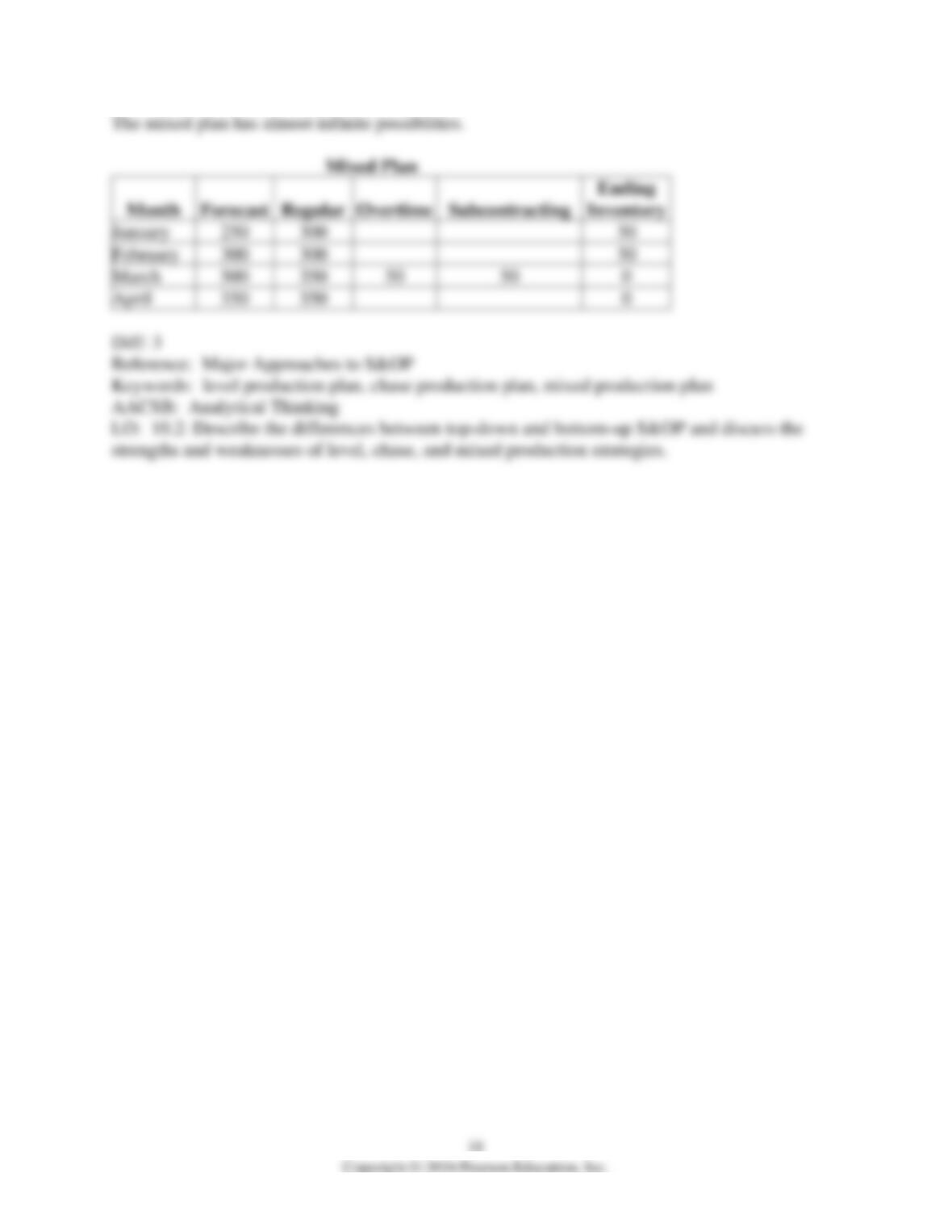
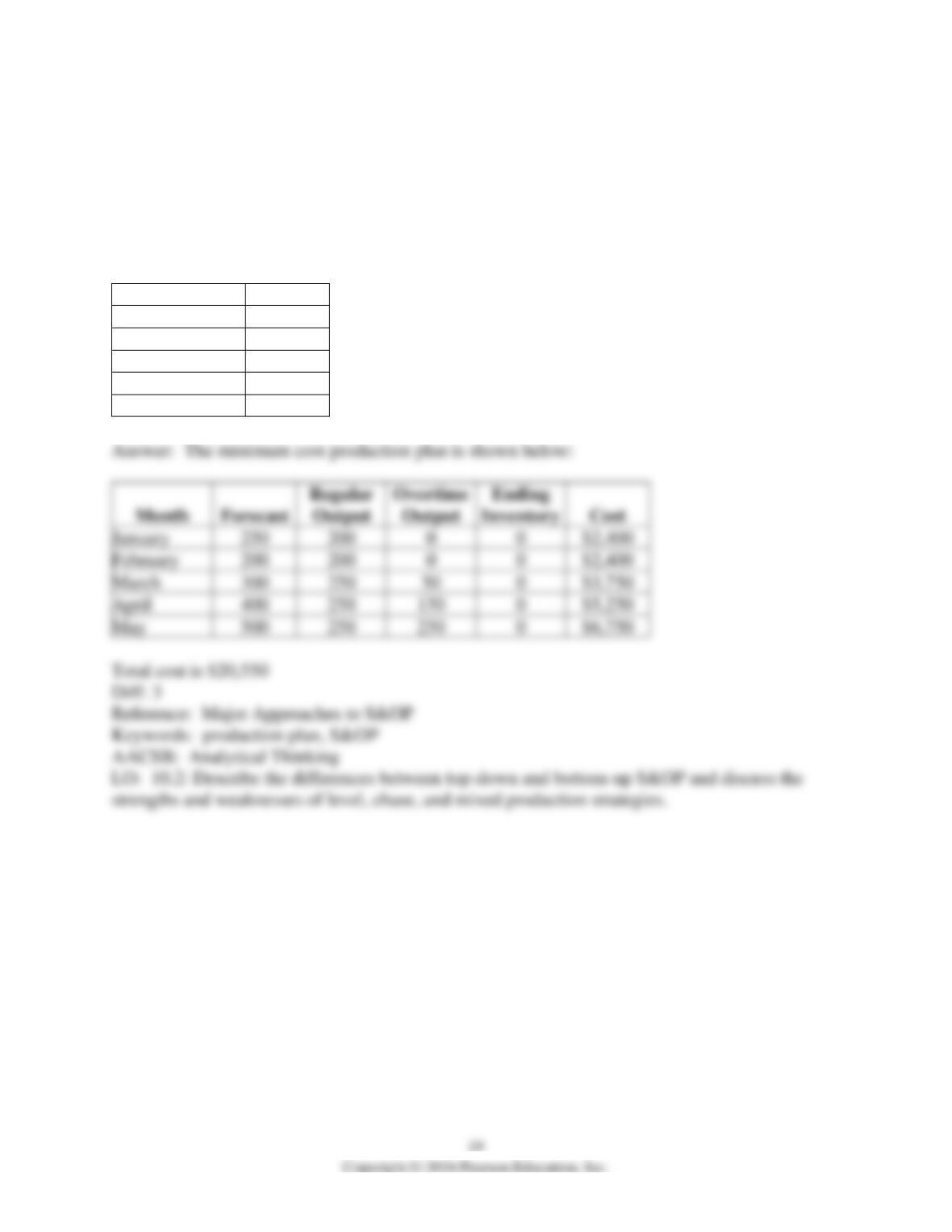
32) It costs $12 to make a single unit using regular production and $15 to make a single unit
using overtime production. Total overtime production is limited to 500 units for the five month
period. The manufacturing plant has a regular production capacity of 250 units per month and 50
units in inventory at the start of the planning period. There is a $5 per unit charge for holding
inventory at the end of each month and a limit of 250 units ending inventory for any period.
Develop a minimum cost production plan if the forecast must be met and costs must be
minimized.
Month
Forecast
January
250
February
200
March
300
April
400
May
500
Forecast
January
250
February
200
March
300
April
400
May
500
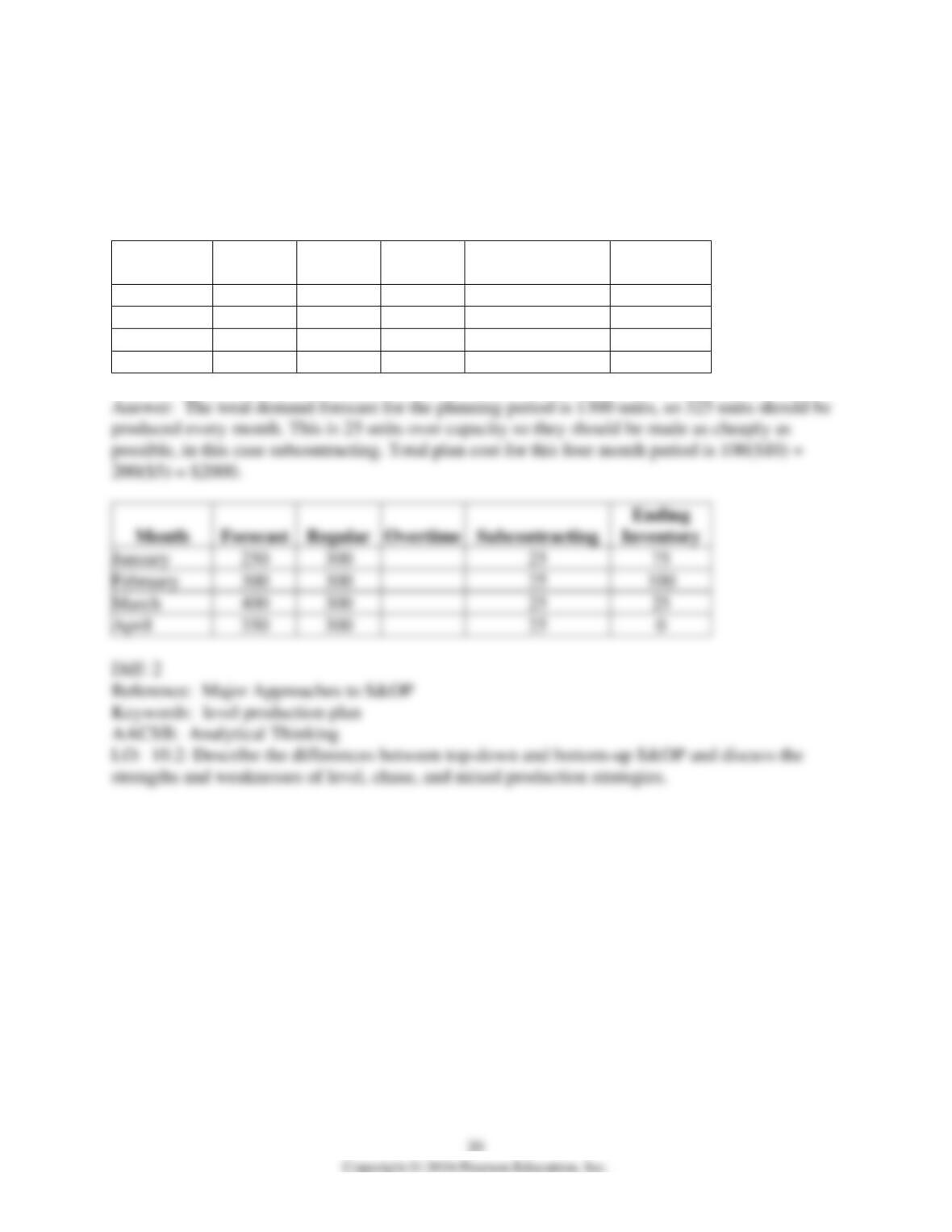
33) Create a level plan with a zero ending inventory for the forecast shown in the table. There is
no beginning inventory and regular production capacity is 300 units. Overtime costs $15 extra
and is limited to 25 units per month and subcontracting is limited to 60 units per month and costs
$10 per unit. Back orders cost $50 per unit and there is a cost of $5 per month to hold a unit in
inventory. What is the total plan cost?
Month
Forecast
Regular
Overtime
Subcontracting
Ending
Inventory
January
250
February
300
March
400
April
350
Regular
Overtime
Subcontracting
Ending
Inventory
January
250
300
75
February
300
300
March
400
300
25
April
350
300
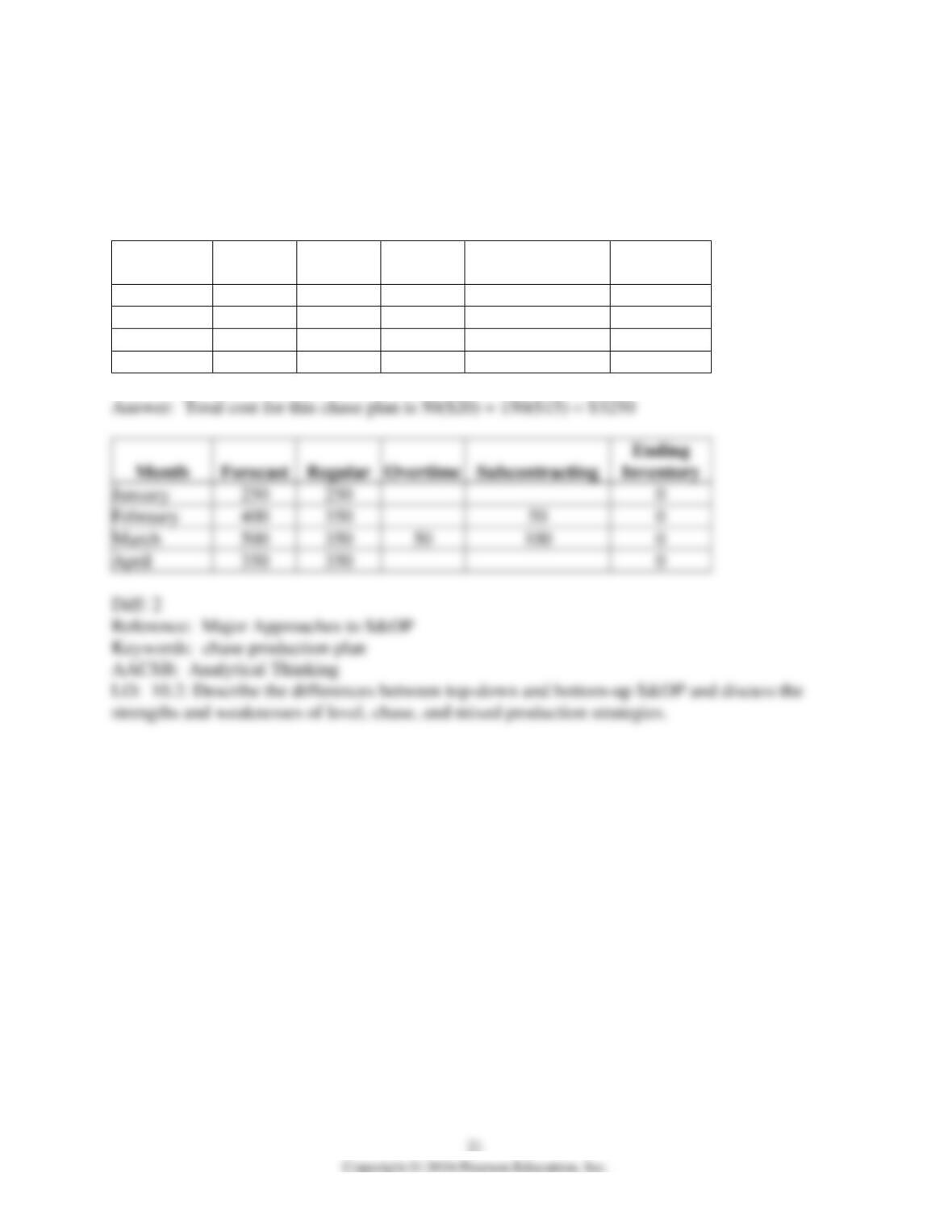
34) Create a minimum cost chase plan for the forecast shown in the table. There is no beginning
inventory and regular production capacity is 350 units. Overtime costs $20 extra and is limited to
50 units per month and subcontracting is limited to 100 units per month and costs $15 per unit.
Back orders cost $40 per unit and there is a cost of $5 per month to hold a unit in inventory.
There is room for only 100 units in inventory. What is the total plan cost?
Month
Forecast
Regular
Overtime
Subcontracting
Ending
Inventory
January
250
February
400
March
500
April
350
Month
Forecast
Regular
Overtime
Subcontracting
Ending
Inventory
January
250
250
February
400
350
March
500
350
April
350
350
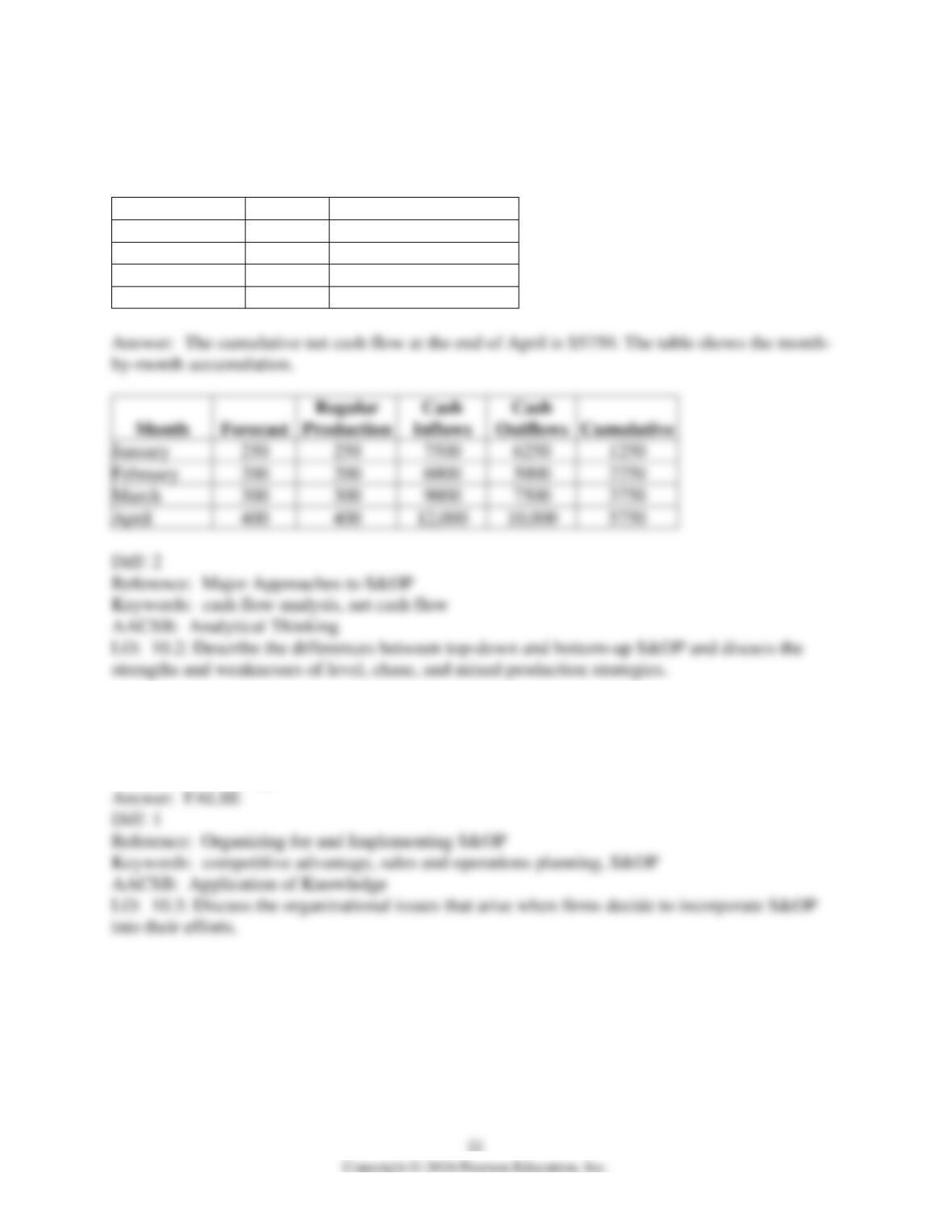
35) Regular production costs $25 per unit and selling a unit represents a cash inflow of $30 per
unit. Assume that all units reflected on the forecast will be sold. What is the cumulative net cash
flow at the end of April?
Month
Forecast
Regular Production
January
250
250
February
200
200
March
300
300
April
400
400
January
250
February
200
March
300
April
400
Learning Objective 10-3
1) Sales and operations planning is a necessary task for all companies, but is never a source of
competitive advantage.
2) Last month, the sales and operations plan showed projections from January through April.
This month, the sales and operations plan shows projections from February through May. This is
an example of a rolling planning horizon.
3) An organization has developed three alternate sales and operations plans for the coming six
months and now must choose between them. They should consider:
A) how their plan will impact supply chain partners.
B) what the cash flows are like.
C) how flexible the plan is.
D) All of these are useful criteria for a sales and operation plan.
4) Sales and operations plans must be updated as time progresses, so most firms establish a(n)
________.
5) There are three phases to sales and operations planning implementation. The first phase,
during which employees are trained, information systems implemented, and ideal products are
identified for initial efforts is called ________.
6) An organization with twenty people developing sales and operations plans might receive
twenty different proposals. What are some factors an organization might consider when deciding
among these alternative plans? Provide a ranking for your factors and support your ranking with
examples from recent business news media.
7) Your book describes three phases in the implementation of sales and operations planning in an
organization. What are the three phases and what takes place in each?
Learning Objective 10-4
1) A routine flight from LaGuardia Airport to Will Rogers Airport may have passengers that
have paid radically different ticket prices. These prices fluctuate based on an approach called
yield management.
2) A home improvement store adds several workers to the garden center in the summer in order
to meet the demands of do-it-yourselfers for their dazzling array of plants. Once gardening
season is over, both the workers’ jobs (and the plants they sold) will perish. The home
improvement store is following an offloading strategy.
3) The Super Bowl is right around the corner and Gowgem Hotels is aquiver with anticipation.
They’d like to price their rooms at their three city locations, next to the stadium, near the airport,
and in the suburbs, as high as possible but still achieve 100% occupancy. The approach they
should take to this opportunity is:
A) yield management.
B) a tiered workforce.
C) a load profile.
D) a chase plan.
4) As potato harvest season approaches, the number of year-round llama wranglers is insufficient
to meet the demand, so a few wranglers are hired just for the month it takes to haul the harvest
down from the mountains to the anxious potato-festival crowd. This approach to meeting the
labor requirements is called:
A) a tiered workforce.
B) offloading.
C) labor management.
D) yield management.
5) A major retailer has recently deployed self-checkout stands at the front of the store. As long as
you don’t have items like paint, cold medicine, beer, fruits, or vegetables in your shopping cart,
you can check out quickly in one of these lines. This retailer is providing a prime example of:
A) a tiered workforce.
B) the strategy of offloading.
C) the strategy of yield management.
D) a constraint.
6) A hotel using yield management would ________ prices if demand is higher than expected
only if the expected result is ________.
7) An organization that meets seasonal swings in demand by hiring and then laying off
temporary workers while maintaining a few full-time permanent workers is employing a(n)
________ strategy.
8) What are the possibilities for matching capacity to sales and vice versa when doing S&OP in a
service environment?
Learning Objective 10-5
1) Each entity in a supply chain should produce its own sales and operations plan independent of
the other members in order to improve the overall cost performance in a supply chain.
2) Sales and operations planning across a supply chain is similar in nature to collaborative
planning, forecasting, and replenishment.
3) Which of these is NOT an advantage of linking sales and operations planning throughout the
supply chain?
A) Increased sales revenue
B) Greater coordination
C) Improved productivity
D) Fewer disruptions in the flow of goods and services
4) How can and why should a firm link S&OP throughout the supply chain?
Learning Objective 10-6
1) The objective function of an optimization modeling approach to S&OP should not allow
available labor or equipment time to be exceeded.
2) A company that makes the rocket widget has one machine capable of producing this unique
item. The machine requires an attendant, who works 40 hours a week for $12 per hour and has
made himself available for a maximum of 8 hours of overtime. It costs $20 per hour to run the
machine and it is capable of producing 10,000 rocket widgets per hour. The widgets sell for $10
per hundred and cost $1 per hundred in materials. If the production manager wishes to develop a
sales and operations plans using an optimization model, which of the following statements is
valid?
A) The objective function should limit overtime to less than 8 hours per week.
B) The objective function should maximize the amount of rocket widgets produced.
C) The objective function should be to minimize costs.
D) None of these statements will help plan production using optimization modeling.
3) A company that makes the rocket widget has one machine capable of producing this unique
item. The machine requires an attendant, who works 40 hours a week for $12 per hour and has
made himself available for a maximum of 8 hours of overtime. It costs $20 per hour to run the
machine and it is capable of producing 10,000 rocket widgets per hour. The widgets sell for $10
per hundred and cost $1 per hundred in materials. If the production manager wishes to develop a
sales and operations plans using an optimization model, which of the following statements is
valid?
A) A constraint should limit overtime to less than 8 hours per week.
B) The objective function should maximize the amount of rocket widgets produced.
C) The objective function must be to minimize the overtime.
D) A constraint should limit the cost to run the machine to less than or equal to $20 per hour.
4) A company that makes the rocket widget has one machine capable of producing this unique
item. The machine requires an attendant, who works 40 hours a week for $12 per hour and has
made himself available for a maximum of 8 hours of overtime. It costs $20 per hour to run the
machine and it is capable of producing 10,000 rocket widgets per hour. It is possible to outsource
some production, as long as the total output is limited to less than ten percent of total output. The
widgets sell for $10 per hundred and cost $1 per hundred in materials. If the production manager
wishes to develop a sales and operations plans using an optimization model, which of the
following statements is valid?
A) A constraint should limit the cost of materials to less than or equal to $1.
B) A constraint should be to limit outsourced output to less than 10% of total output.
C) The objective function must be to produce at least 10,000 rocket widgets per hour.
D) A constraint should limit the cost to run the machine to less than or equal to $20 per hour.
5) A(n) ________ limits our ability to increase profits or cut costs by reducing the set of possible
solutions in an optimization model.
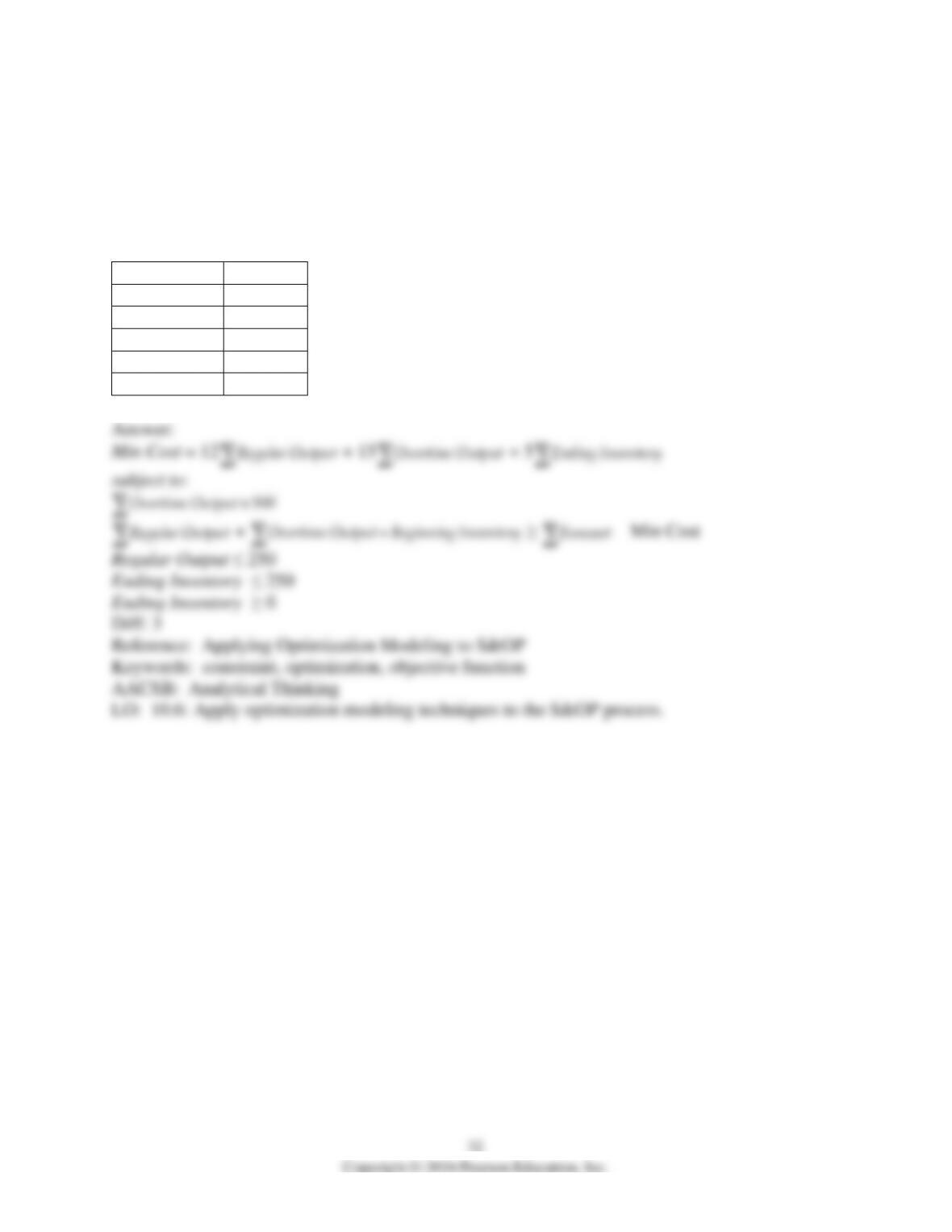
6) It costs $12 to make a single unit using regular production and $15 to make a single unit using
overtime production. Total overtime production is limited to 500 units for the five month period.
The manufacturing plant has a regular production capacity of 250 units per month and 50 units in
inventory at the start of the planning period. There is a $5 per unit charge for holding inventory
at the end of each month and a limit of 250 units ending inventory for any period. Develop an
objective function and constraints to solve this problem.
Month
Forecast
January
250
February
200
March
300
April
400
May
500