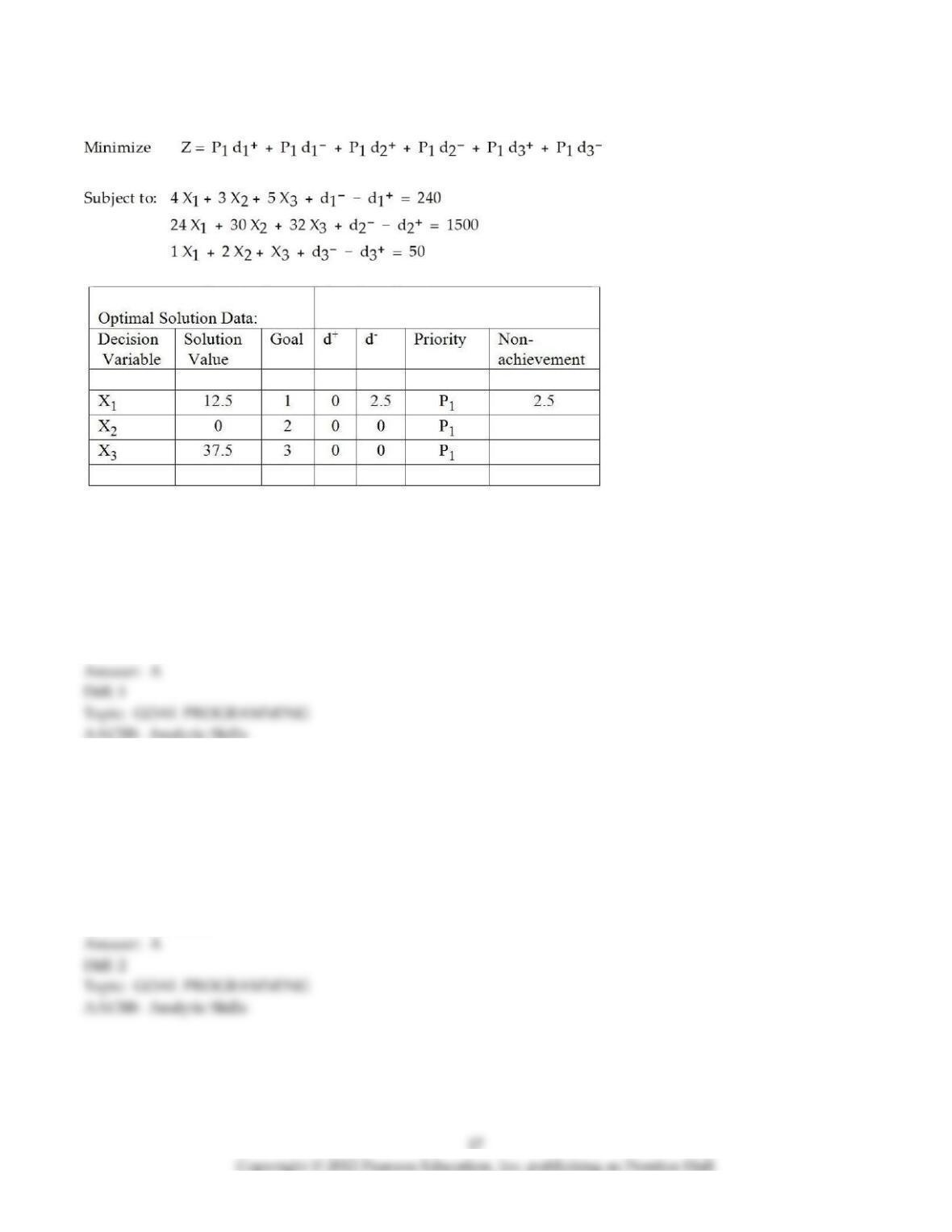
Table 10–5
63) Table 10–5 represents a solution to a goal programming problem. There are three goals (each represented by a
constraint). Which goals are only partly achieved?
A) number 1 only
B) number 1 and number 2
C) number 2 and number 3
D) number 1 and number 3
E) None of the above
64) Table 10–5 represents a solution to a goal programming problem. There are three goals (each represented by a
constraint). Goal number 3 represents a resource usage goal. How much of this resource would be used by this
solution?
A) 50 units
B) 70 units
C) 2500 units
D) 240 units
E) None of the above
65) Table 10–5 represents a solution to a goal programming problem. There are three goals (each represented by a
constraint). Which of the goals is assigned the highest priority?
A) goal 1
B) goal 2
C) goal 3
D) goals 2 and 3
E) All goals have the same priority.
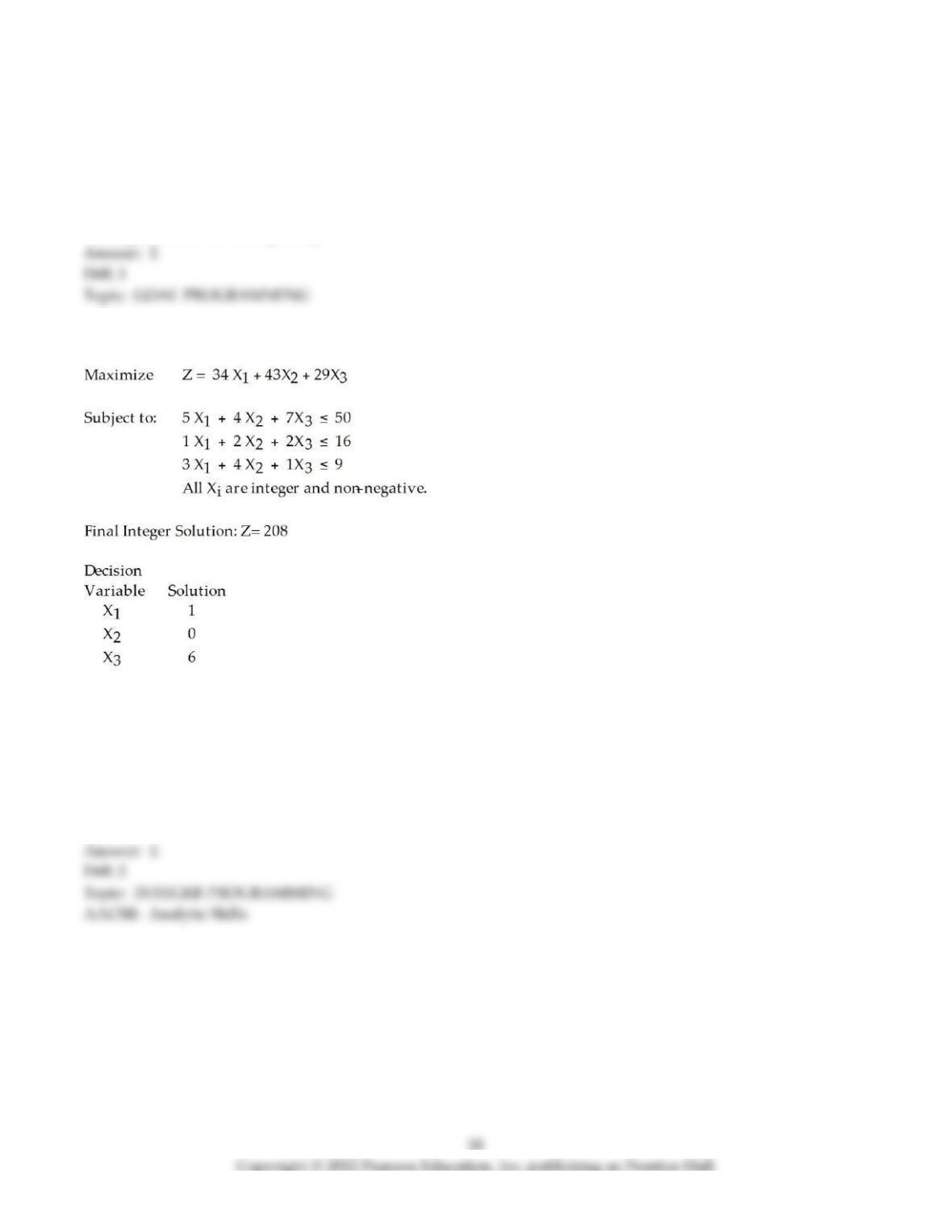
Table 10–6
66) Table 10–6 represents a solution for an integer programming problem. If this problem had been solved as a
simple linear programming problem, what would you expect the value of the objective function to be?
A) less than 208
B) greater than 208
C) exactly 208
D) A or C
E) B or C
67) Table 10–6 represents a solution for an integer programming problem. If one uses the optimal solution
presented, how much slack is there in the first equation?
A) 0 units
B) 5 units
C) 3 units
D) 2 units
E) None of the above
68) A model containing a linear objective function and requiring that one or more of the decision variables take on
an integer value in the final solution is called
A) an integer programming problem.
B) a goal programming problem.
C) a nonlinear programming problem.
D) a multiple objective LP problem.
E) insufficient information.
69) Goal programming and linear programming differ in that
A) in LP, the objective function is maximized or minimized, while in goal programming, the deviation between
goals and possible achievement is minimized.
B) slack variables are used in LP, while deviational variables are used in goal programming.
C) deviational variables have positive objective function coefficients in goal programming, but slack variables
have 0 coefficients in LP.
D) All of the above
E) None of the above
70) A goal programming problem had two goals (with no priorities assigned). Goal number 1 was to achieve a
cost of $3,600 and goal number 2 was to complete the task in 400 hours or fewer. The optimal solution to this
problem resulted in a cost of $3,600 and a completion time of 420 hours. What was the value for the objective
function for this goal programming problem?
A) 400
B) –400
C) 20
D) 0
E) None of the above
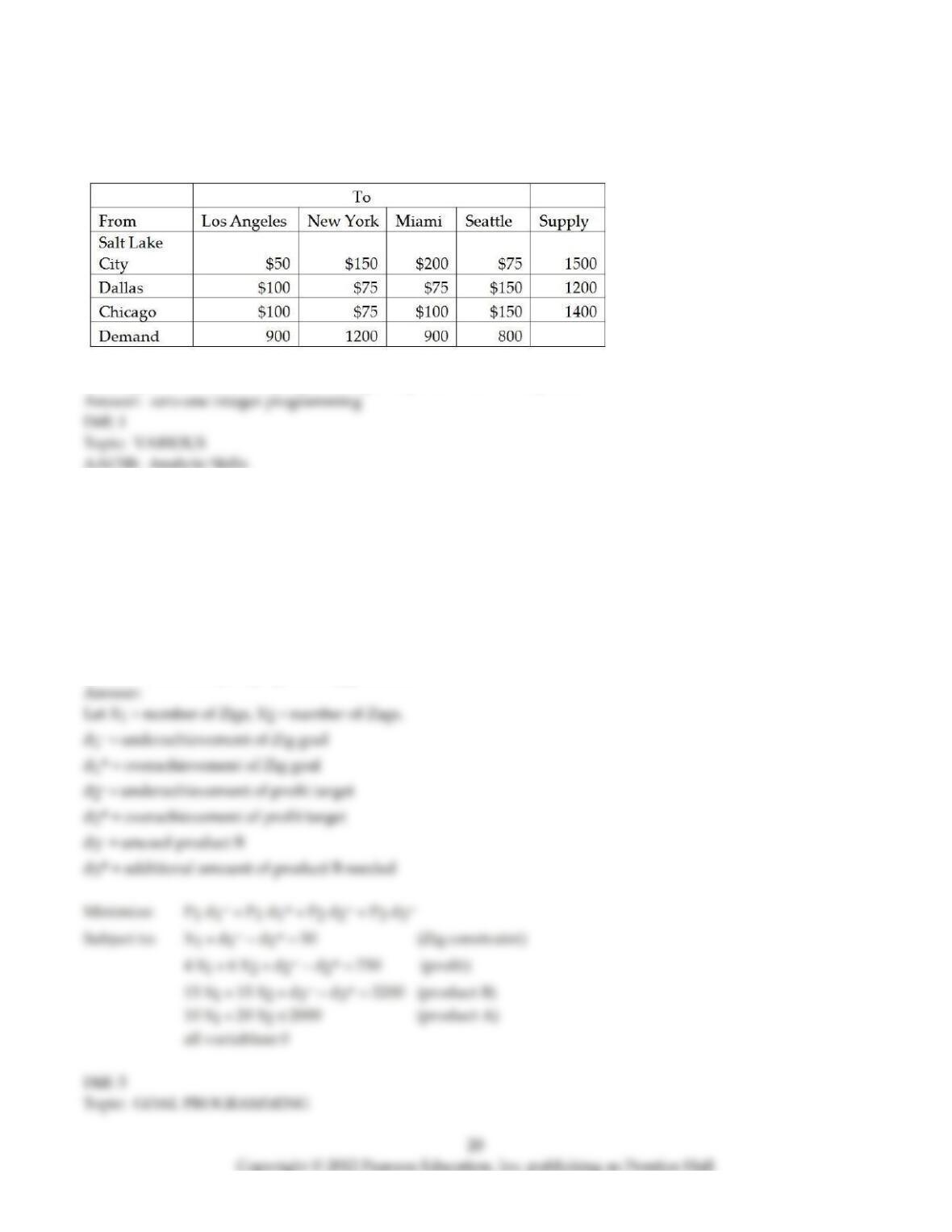
71) Agile Bikes has manufacturing plants in Salt Lake City, Dallas, and Chicago. The Bikes are shipped to retail
stores in Los Angeles, New York, Miami, and Seattle. Information on shipping costs, supply, and demand is given
in the following table:
What type of mathematical programming is required to solve this problem?
72) The Elastic Firm has two products coming on the market: Zigs and Zags. To make a Zig, the firm needs 10
units of product A and 15 units of product B. To make a Zag, they need 20 units of product A and 15 units of
product B. There are only 2,000 units of product A and 3,200 units of product B available to the firm. The profit
on a Zig is $4 and on a Zag it is $6. Management objectives in order of their priority are:
(1) Produce exactly 50 Zigs.
(2) Achieve a target profit of at least $750.
(3) Use all of the product B available.
Formulate this as a goal programming problem.
73) Classify the following problems as to whether they are pure–integer, mixed–integer, zero–one, goal, or
nonlinear programming problems.
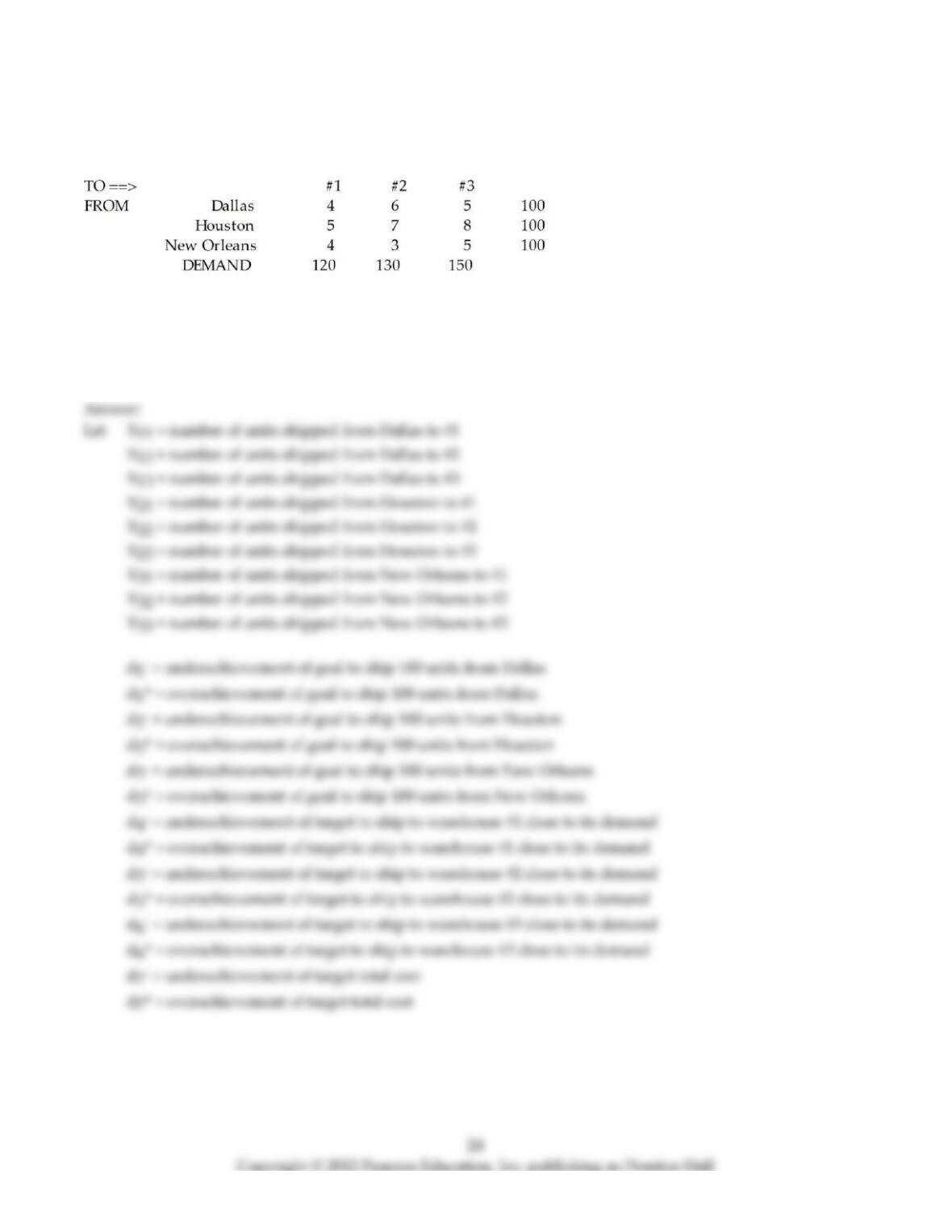
(a) Maximize Z = 5 X1 + 6 X1 X2 + 2 X2
Subject to: 3 X1 + 2 X2 ≥ 6
X1 + X2 ≤ 8
X1, X2 ≥ 0
(b) Minimize Z = 8 X1 + 6 X2
Subject to: 4 X1 + 5 X2 ≥ 10
X1 + X2 ≤ 3
X1, X2 ≥ 0
X1, X2 = 0 or 1
(c) Maximize Z = 10 X1 + 5 X2
Subject to: 8 X1 + 10 X2 = 10
4 X1 + 6 X2 ≥ 5
X1, X2 integer
(d) Minimize Z = 8 X12 + 4 X1 X2 + 12 X22
Subject to: 6 X1 + X2 ≥ 50
X1 + X2 ≥ 40
74) A package express carrier is considering expanding the fleet of aircraft used to transport packages. There is a
total of $220 million allocated for purchases. Two types of aircraft may be purchased – the C1A and the C1B. The
C1A costs $25 million, while the C1B costs $18 million. The C1A can carry 60,000 pounds of packages, while the
C1B can only carry 40,000 pounds of packages. The company needs at least eight new aircraft. In addition, the
firm wishes to purchase at least twice as many C1Bs as C1As. Formulate this as an integer programming problem
to maximize the number of pounds that may be carried.
75) Smalltime Investments Inc. is going to purchase new computers for most of the employees. There are ten
employees, and at least eight computers must be purchased. The cost of the basic personal computer with
monitor and disk drive is $2,000, while the deluxe version with VGA and advanced processor is $3,500. Due to
internal politics, the number of deluxe computers must be no more than half the number of regular computers,
but at least three deluxe computers must be purchased. The budget is $27,000. Formulate this as an integer
programming problem to maximize the number of computers purchased.
76) Smalltime Investments Inc. is going to purchase new computers. There are ten employees, and the company
would like one for each employee. The cost of the basic personal computer with monitor and disk drive is $2,000,
while the deluxe version with VGA and advanced processor is $3,500. Due to internal politics, the number of
deluxe computers should be less than half the number of regular computers, but at least three deluxe computers
must be purchased. The budget is $27,000, although additional money could be used if it were deemed
necessary. All of these are goals that the company has identified. Formulate this as a goal programming
problem.
77) Allied Manufacturing has three factories located in Dallas, Houston, and New Orleans. They each produce
the same product and ship to three regional warehouses: #1, #2, and #3. The cost of shipping one unit of each
product to each of the three destinations is given below.
There is no way to meet the demand for each warehouse. Therefore, the company has decided to set the
following goals: (1) the number shipped from each source should be as close to 100 units as possible (overtime
may be used if necessary), (2) the number shipped to each destination should be as close to the demand as
possible, (3) the total cost should be close to $1,400. Formulate this as a goal programming problem.
78) The Elastic Firm has two products coming on the market, Zigs and Zags. To make a Zig, the firm needs 10
units of product A and 15 units of product B. To make a Zag, they need 20 units of product A and 15 units of
product B. There are only 2,000 units of product A and 3,000 units of product B available to the firm. The profit
on a Zig is $4 and on a Zag it is $6. Management objectives in order of their priority are:
(1) Produce at least 40 Zags.
(2) Achieve a target profit of at least $750.
(3) Use all of the product A available.
(4) Use all of the product B available.
(5) Avoid the requirement for more product A.
Formulate this as a goal programming problem.
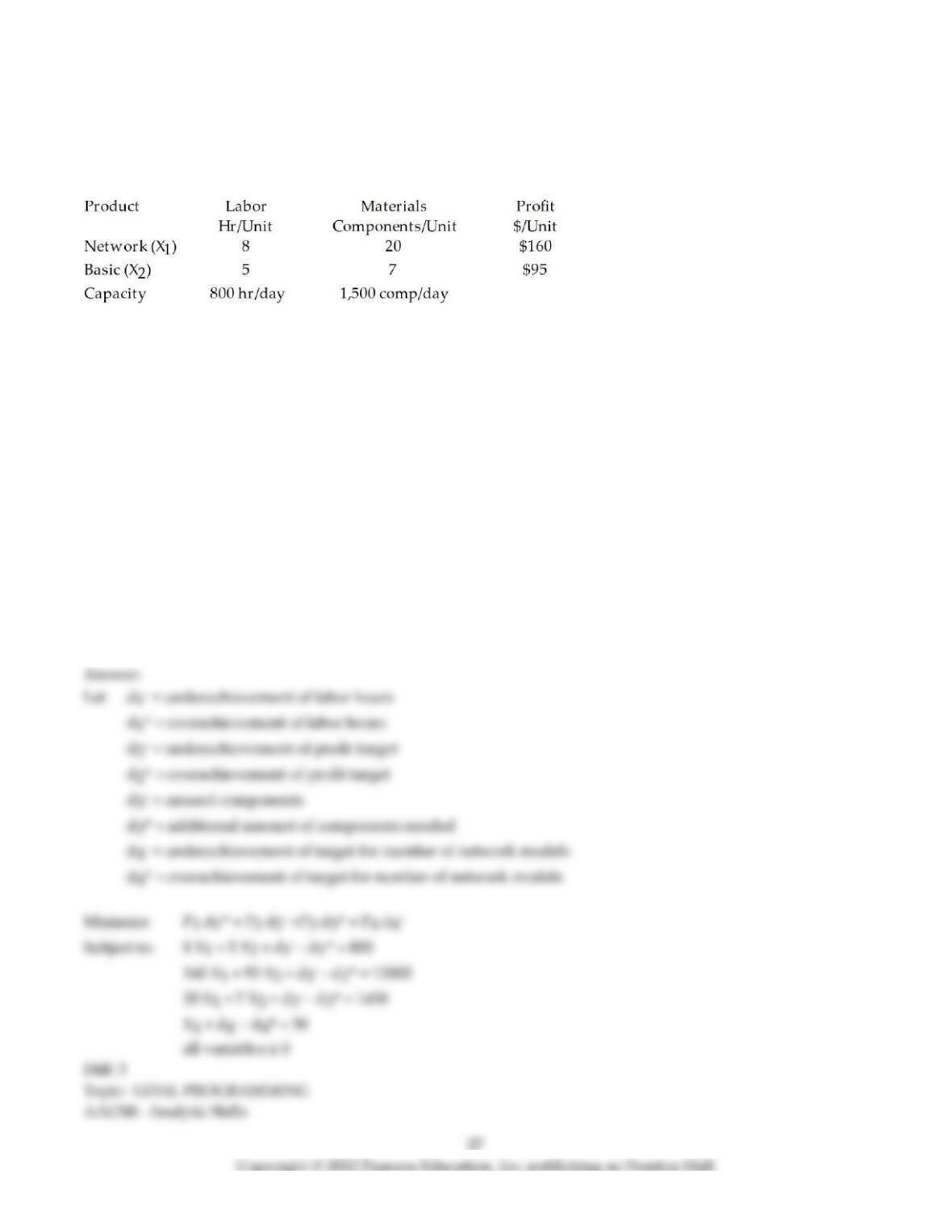
79) Data Equipment Inc. produces two models of a retail price scanner, a sophisticated model that can be
networked to a central processing unit and a stand–alone model for small retailers. The major limitations of the
manufacturing of these two products are labor and material capacities. The following table summarizes the
usages and capacities associated with each product.
The typical LP formulation for this problem is:
Maximize $160 X1 + $95 X2
Subject to: 8 X1 + 5 X2 ≤ 800
20 X1 + 7 X2 ≤ 1500
X1, X2 ≥ 0
However, the management of DEI has prioritized several goals that are to be attained by manufacturing:
(1) Since the labor situation at the plant is uneasy (i.e., there are rumors that a local union is considering an
organizing campaign), management wants to assure full employment of all its employees.
(2) Management has established a profit goal of $12,000 per day.
(3) Due to the high prices of components from nonroutine suppliers, management wants to minimize the
purchase of additional materials.
Given the above additional information, set this up as a goal programming problem.
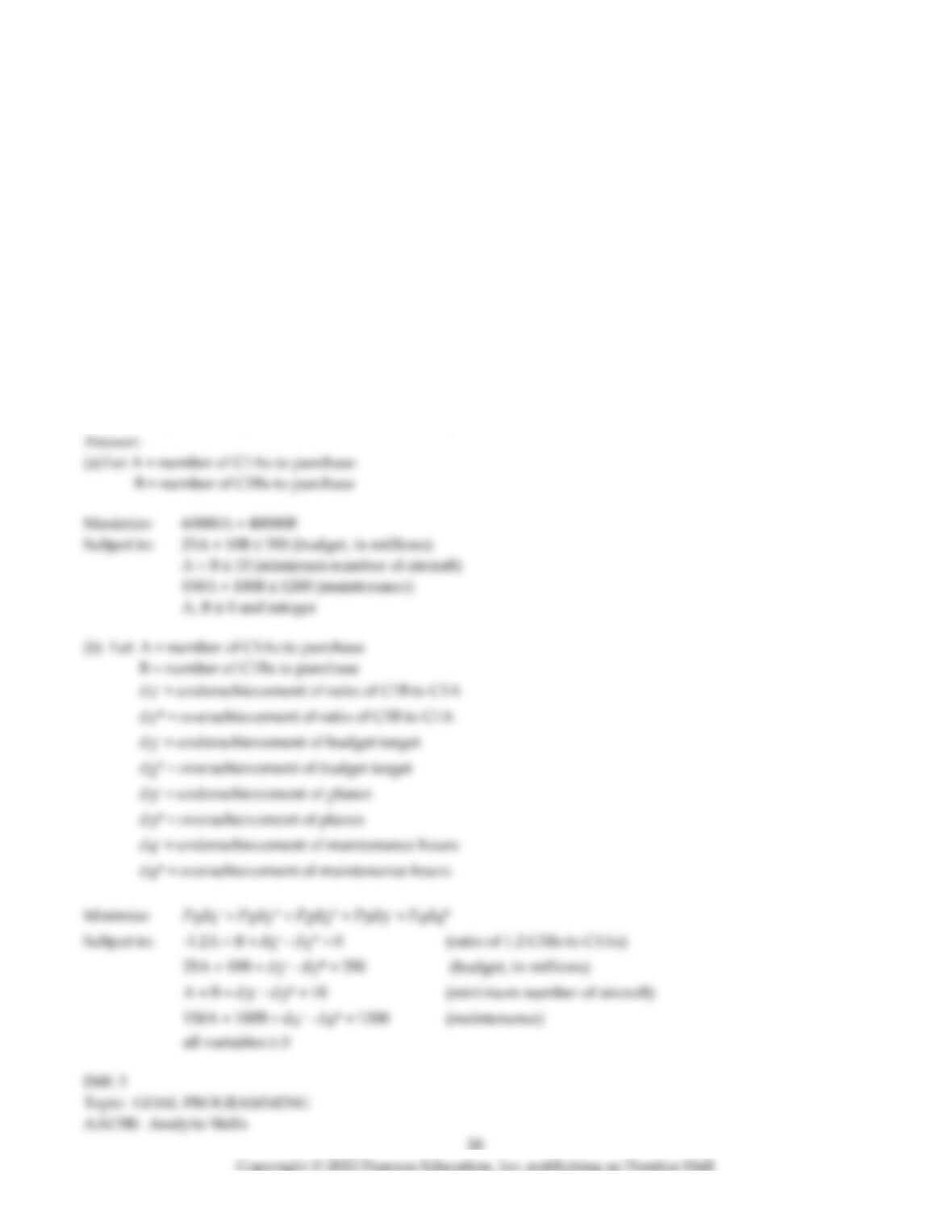
80) Data Equipment Inc. produces two models of a retail price scanner, a sophisticated model that can be
networked to a central processing unit and a stand–alone model for small retailers. The major limitations of the
manufacturing of these two products are labor and material capacities. The following table summarizes the
usages and capacities associated with each product.
The typical LP formulation for this problem is:
Maximize P = $160 X1 + $95 X2
Subject to: 8 X1 + 5 X2 ≤ 800
20 X1 + 7 X2 ≤ 1500
X1, X2 ≥ 0
However, the management of DEI has prioritized several goals that are to be attained by manufacturing:
(1) Management had decided to severely limit overtime.
(2) Management has established a profit goal of $15,000 per day.
(3) Due to the difficulty of obtaining components from non–routine suppliers, management wants to end
production with at least 50 units of each component remaining in stock.
(4) Management also believes that they should produce at least 30 units of the network model.
Given the above additional information, set this up as a goal programming problem.
81) A package express carrier is considering expanding the fleet of aircraft used to transport packages. Of primary
importance is that there is a total of $350 million allocated for purchases. Two types of aircraft may be purchased –
the C1A and the C1B. The C1A costs $25 million, while the C1B costs $18 million. The C1A can carry 60,000
pounds of packages, while the C1B can only carry 40,000 pounds of packages. Of secondary importance is that
the company needs at least 10 new aircraft. It takes 150 hours per month to maintain the C1A, and 100 hours to
maintain the C1B. The least level of importance is that there are a total of 1,200 hours of maintenance time
available per month.
(a) First, formulate this as an integer programming problem to maximize the number of pounds that may be
carried.
(b) Second, rework the problem differently than in part (a) to suppose the company decides that what is
most important to them is that they keep the ratio of C1Bs to C1As in their fleet as close to 1.2 as possible to allow
for flexibility in serving their routes. Formulate the goal programming representation of this problem, with the
other three goals having priorities P2, P3, and P4, respectively.
82) Bastille College is going to purchase new computers for both faculty and staff. There are a total of 50 people
who need new machines — 30 faculty and 20 staff. The cost of the basic personal computer with monitor and
disk drive is $2,000, while the deluxe version with VGA and advanced processor is $3,500. Due to internal
politics, the number of deluxe computers assigned to staff must be less than half the number of deluxe computers
assigned to faculty. The College feels that it must purchase at least 5 deluxe computers for the faculty; if possible,
it would like to purchase as many as 20 deluxe computers for the faculty. Staff members do feel somewhat “put
upon” by having a limit placed upon the number of deluxe machines purchased for their use, so the College
would like to purchase as many deluxe machines for the staff as possible (up to 10). The budget is $100,000.
Develop a goal programming formulation of this problem that treats each of the requirements stated above as an
equally weighted goal.
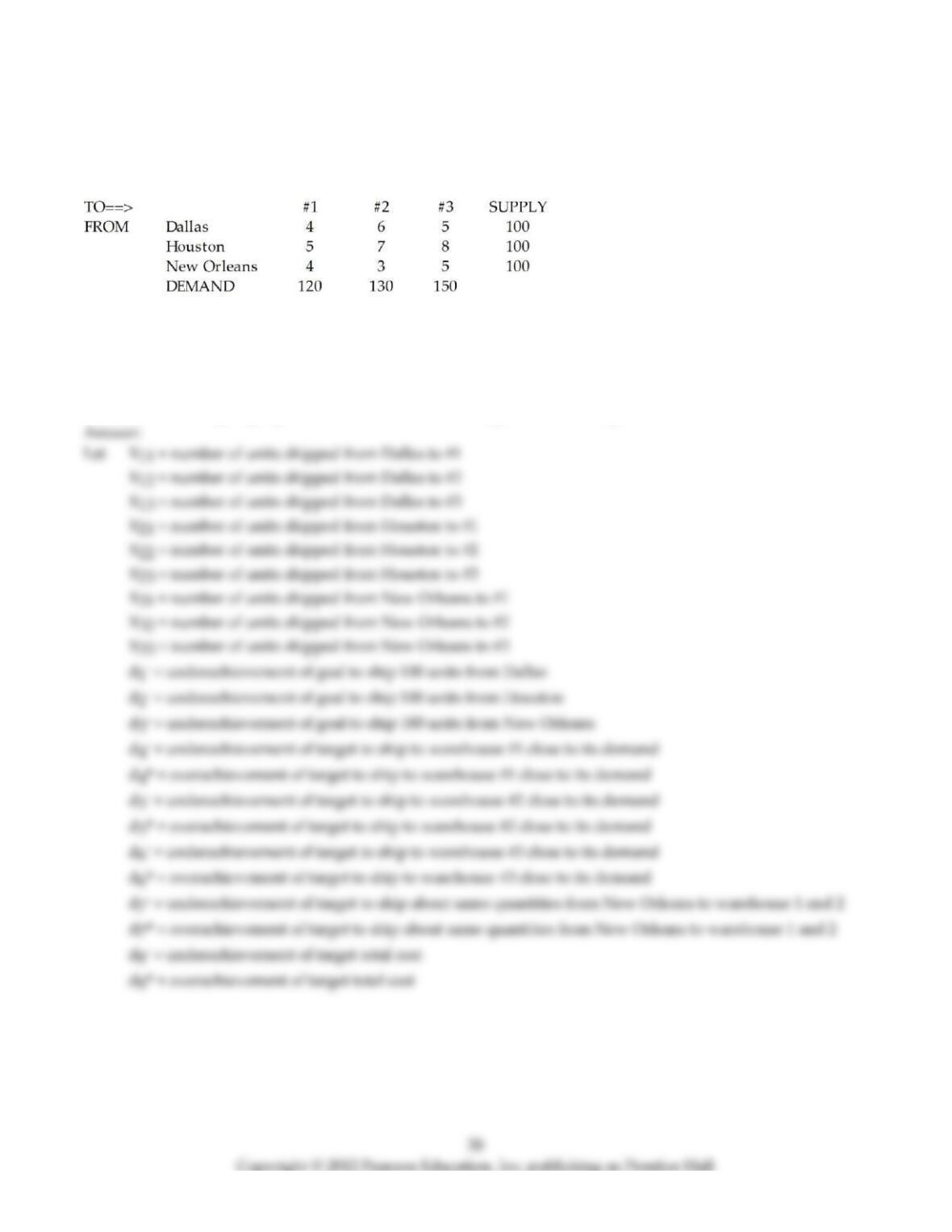
83) Allied Manufacturing has three factories located in Dallas, Houston, and New Orleans. They each produce
the same 281 products and ship to three regional warehouses – #1, #2, and #3. The cost of shipping one unit of
each product to each of the three destinations is given in the table below:
There is no way to meet the demand for each warehouse. Therefore, the company has decided to set the
following equally weighted goals: (1) each source should ship as much of its capacity as possible, (2) the number
shipped to each destination should be as close to the demand as possible, (3) the capacity of New Orleans should
be divided as evenly as possible between warehouses #1 and #2, and (4) the total cost should be less than $1,400.
Formulate this as a goal program, which includes a strict requirement that capacities cannot be violated.
84) A bakery produces muffins and doughnuts. Let x1 be the number of doughnuts produced and x2 be the
number of muffins produced. The profit function for the bakery is expressed by the following equation: profit =
4x1 + 2x2 + 0.3x12 + 0.4x22. The bakery has the capacity to produce 800 units of muffins and doughnuts combined
and it takes 30 minutes to produce 100 muffins and 20 minutes to produce 100 doughnuts. There is a total of 4
hours available for baking time. There must be at least 200 units of muffins and at least 200 units of doughnuts
produced. Formulate a nonlinear program representing the profit maximization problem for the bakery.
85) A bakery produces muffins and doughnuts. Let x1 be the number of doughnuts produced and x2 be the
number of muffins produced. The profit function for the bakery is expressed by the following equation: profit =
4x1 + 2x2 + 0.3x12 + 0.4x22. The bakery has the capacity to produce 800 units of muffins and doughnuts combined
and it takes 30 minutes to produce 100 muffins and 20 minutes to produce 100 doughnuts. There is a total of 4
hours available for baking time. There must be at least 200 units of muffins and at least 200 units of doughnuts
produced. How many doughnuts and muffins should the bakery produce in order to maximize profit?
86) Define deviational variables.
87) State the advantage of goal programming over linear programming.
88) Define quadratic programming.