49) Which of the following accurately describes steps of the northwest corner rule, after making the initial
allocation of units in the northwest cell?
A) Move down first, and then move right.
B) Move right first, and then move down.
C) Move right or down first, depending on whether the demand requirement or the supply capacity, respectively,
is exhausted first.
D) Move right or down first, depending on whether the supply capacity or the demand requirement, respectively,
is exhausted first.
E) Move diagonally first.
50) When using the stepping–stone method, what is the maximum amount that can be shipped on the new route?
A) the smallest number found in the squares with minus signs
B) the smallest number found in the squares with plus signs
C) the smallest number along the closed path
D) the minimum of the demand requirement for that column and the supply capacity for that row
E) the largest number found on the squares with minus signs
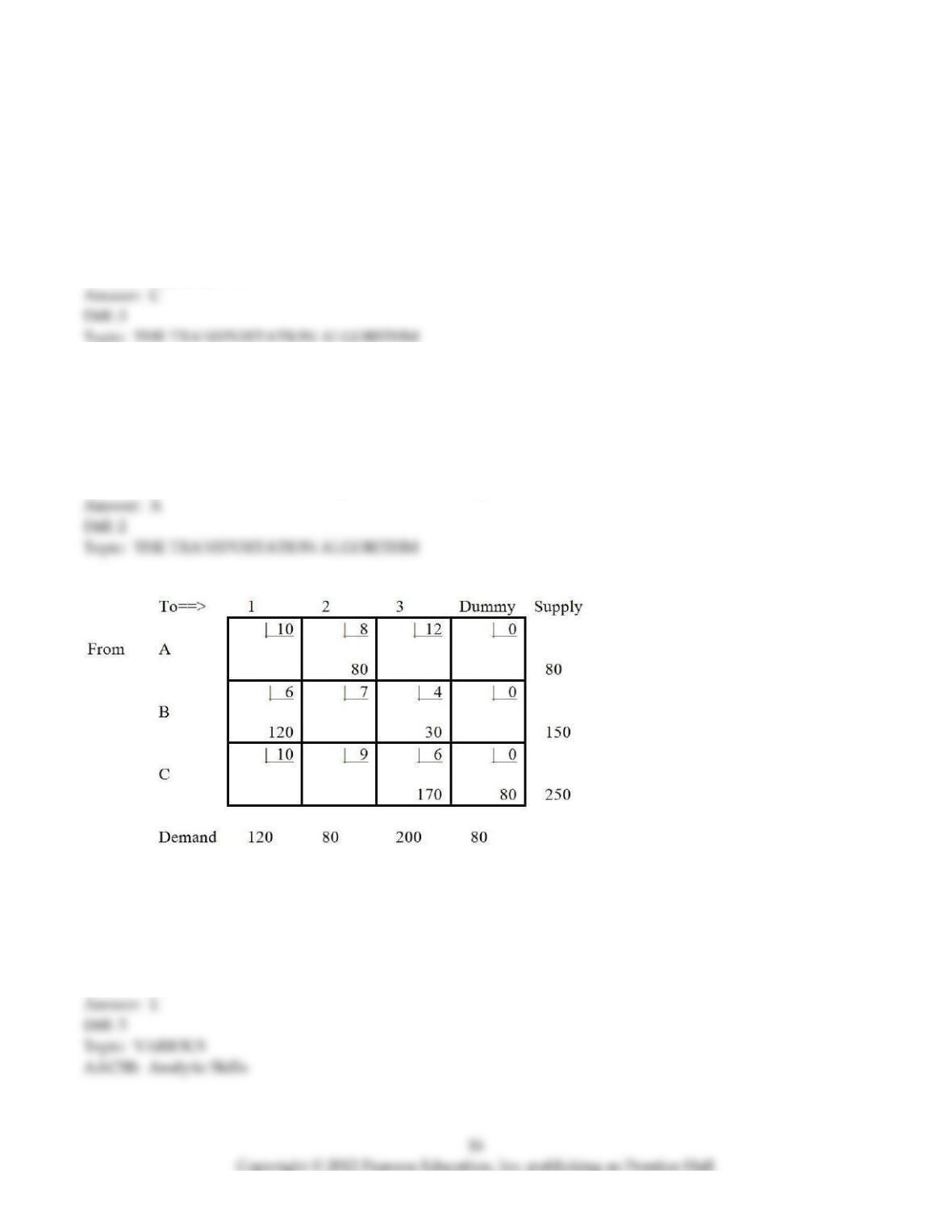
Table 9–14
51) The solution presented in Table 9–14 is
A) infeasible.
B) degenerate.
C) unbounded.
D) optimal.
E) Both B and D
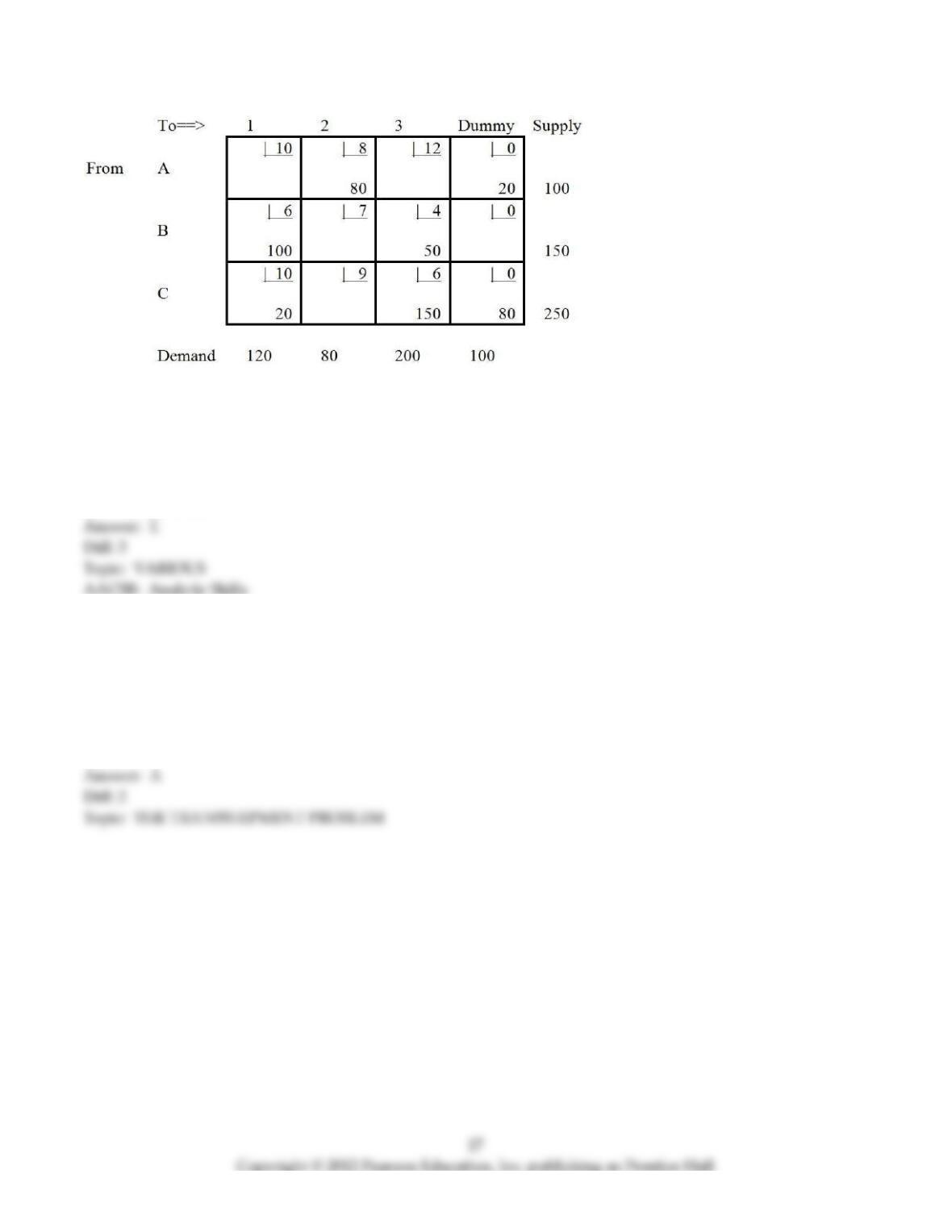
Table 9–15
52) The solution shown in Table 9–15 is
A) infeasible.
B) degenerate.
C) unbounded.
D) optimal.
E) None of the above
53) In a transshipment problem involving 3 origins, 2 intermediate points, and 4 final destinations, what is the
maximum number of decision variables?
A) 24
B) 9
C) 14
D) 7
E) 20
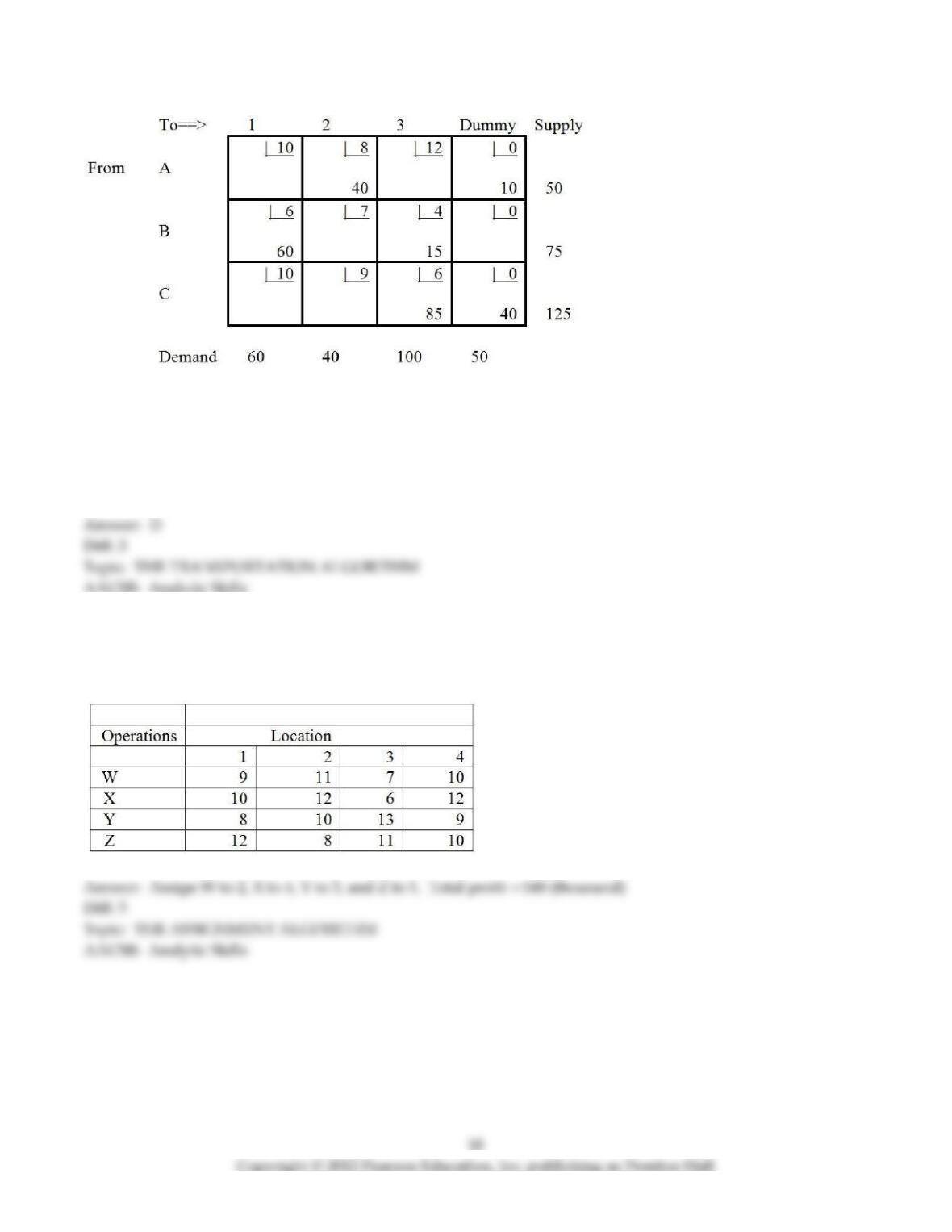
Table 9–16
54) The solution shown in Table 9–16 is
A) infeasible.
B) one of a number of alternate solutions.
C) unbounded.
D) optimal.
E) None of the above
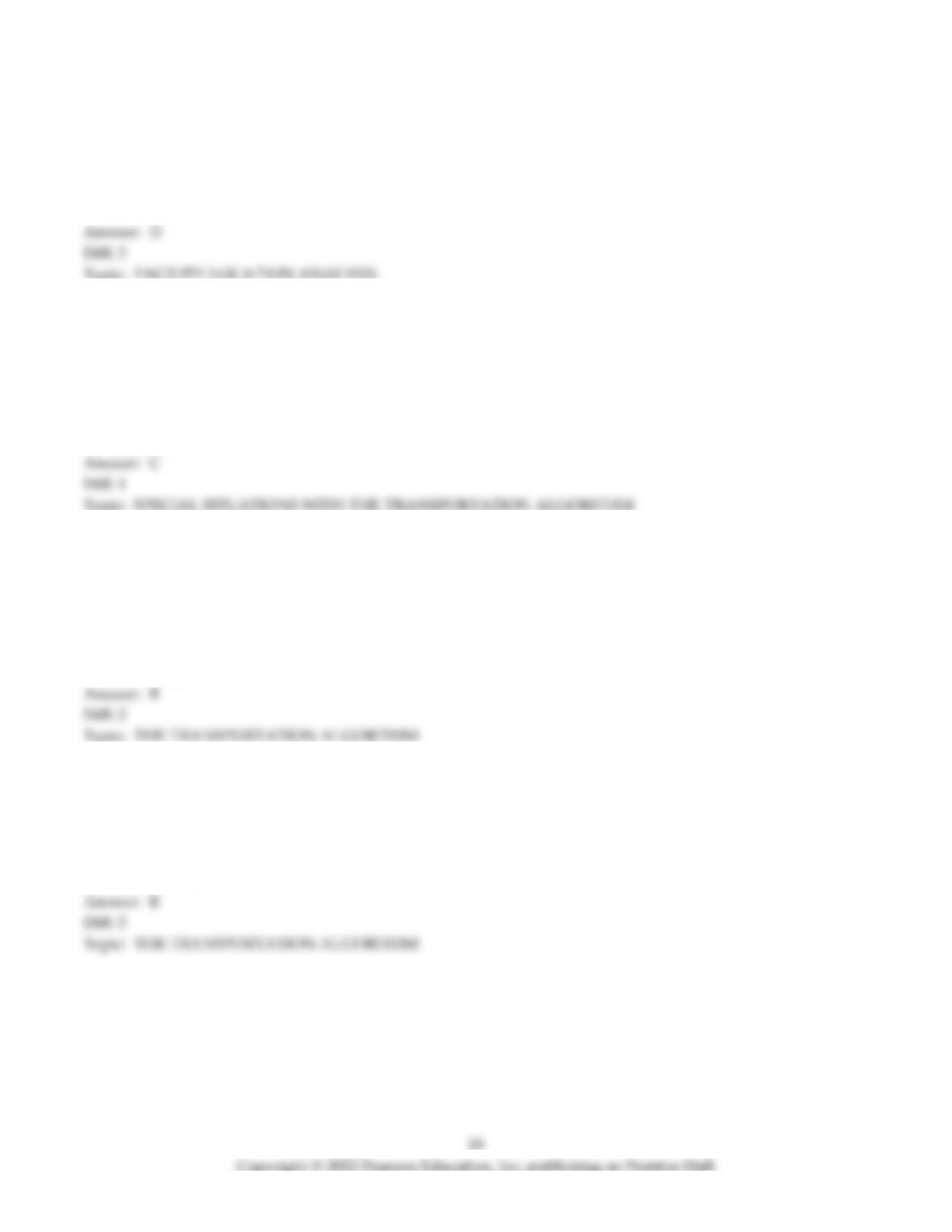
55) A certain firm has four different operations that must be assigned to four locations. The profit (in thousands
of dollars) associated with each operation at each location is presented below. The firm’s vice president would
like to assign the various operations so that the total profit is maximized. Find the appropriate assignments.
56) What is the overall objective in applying the transportation method to the facility location problem?
A) minimize the distance traveled
B) minimize the number of items shipped
C) maximize the value of items shipped
D) minimize the cost of the distribution system
E) None of the above
57) An artificial source added to a transportation table when total demand is greater than total supply is called
________.
A) excess source
B) filler source
C) dummy source
D) demand source
E) supply source
58) Which of the following techniques can be used for moving from an initial feasible solution to an optimal
solution in a transportation problem?
A) Hungarian method
B) stepping–stone method
C) northwest corner rule
D) Vogel’s approximation method
E) All of the above
59) Which of the following is an applicable characteristic in using the stepping–stone method?
A) Only an unoccupied square may be used as a “stepping–stone.”
B) Only an occupied square may be used as a “stepping–stone.”
C) Only the column and row with the highest factory capacity may be used as a “stepping–stone.”
D) All of the above
E) None of the above
60) After testing each unused cell by the stepping–stone method in the transportation problem and finding only
one cell with a negative improvement index,
A) once you make that improvement, you would definitely have an optimal solution.
B) you would make that improvement and then check all unused cells again.
C) you could stop because you already had the optimal solution.
D) you should check to be sure that you don’t have to add a dummy source or dummy destination.
E) None of the above
61) In the transportation problem, using the stepping–stone method,
A) you may not skip over an empty cell.
B) you may not skip over a used cell.
C) your path may not cross over itself.
D) if you have an optimal solution and get an improvement index of zero, there is another optimal solution.
E) None of the above
62) If we want to quickly arrive at a “feasible,” but not necessarily “optimal” solution to the transportation
problem, we will use the
A) stepping–stone method.
B) northwest corner rule.
C) Vogel’s approximation method.
D) MODI method.
E) Any of the above
63) If the total supply from the sources does not equal the total demand from the destinations in the
transportation problem,
A) and if supply is greater than demand, add a dummy source or factory.
B) the amount put in a dummy source or destination should make supply and demand equal.
C) and if demand is greater than supply, add a dummy destination or warehouse.
D) All of the above
E) None of the above
64) In a transportation problem, degeneracy occurs when
A) the number of used (or full) cells does not equal the number of rows plus columns minus one.
B) in an initial solution, both a row total and a column total are satisfied simultaneously.
C) during an improvement, two negative cells contain the same smallest amount.
D) All of the above
E) None of the above
65) Practically speaking, multiple optimal solutions ________.
A) are infeasible
B) are unbounded
C) are degenerate
D) are unbalanced
E) provide management with greater flexibility in selecting and using resources
66) Which of the following is not considered a special situation with the transportation algorithm?
A) unbalanced transportation problems
B) degeneracy
C) unconstrained transportation problems
D) more than one optimal solution
E) maximization transportation problems
67) Which of the following is not a step in the Hungarian method of assignment?
A) find the opportunity–cost table
B) test for an optimal assignment
C) enumerate all possible solutions
D) revise the opportunity–cost table
E) None of the above
68) Why don’t we want to use the transportation algorithm to solve the assignment problem?
A) It would likely lead to an unbounded solution.
B) It would likely lead to a degenerate solution.
C) It would likely lead to an infeasible solution.
D) It would likely lead to multiple optima.
E) It would likely lead to an unbalanced solution.
69) In an assignment problem
A) the number of rows and columns must be equal.
B) the number of rows must exceed the number of columns.
C) the number of rows must equal or exceed the number of columns.
D) the number of columns must equal or exceed the number of rows.
E) None of the above
70) In revising the opportunity cost table of the assignment problem, after drawing lines through all of the zeros,
A) the smallest uncovered number is added to all zeros.
B) the smallest uncovered number is added to all uncovered numbers.
C) the largest uncovered number is added to all uncovered numbers.
D) the smallest uncovered number is added to all numbers at the intersection of lines.
E) the largest uncovered number is added to all numbers at the intersection of lines.
71) Which of the following methods is used only with the assignment problem?
A) the Hungarian method
B) stepping–stone method
C) MODI method
D) Vogel’s approximation method
E) the simplex method
72) Objectives of the assignment problem can include
A) minimize total costs.
B) minimize total time to perform the tasks at hand.
C) minimize opportunity costs.
D) maximize profit.
E) All of the above
73) In solving maximization assignment problems,
A) just reverse all the decision rules used in the minimizing algorithm (if it says subtract, now add, and so on).
B) convert the problem to an equivalent minimization problem.
C) use the Australian transformation process and convert the data.
D) All of the above
E) None of the above
23
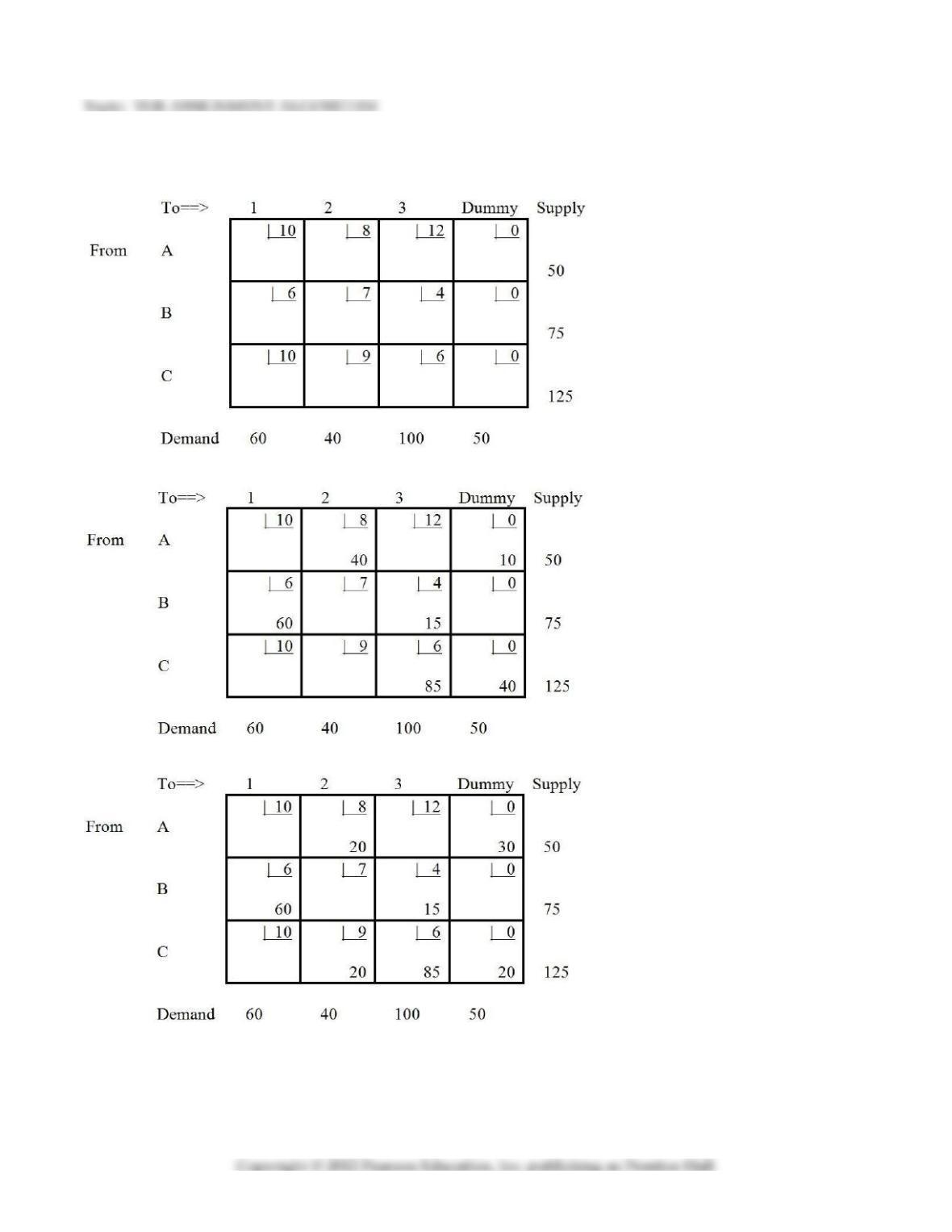
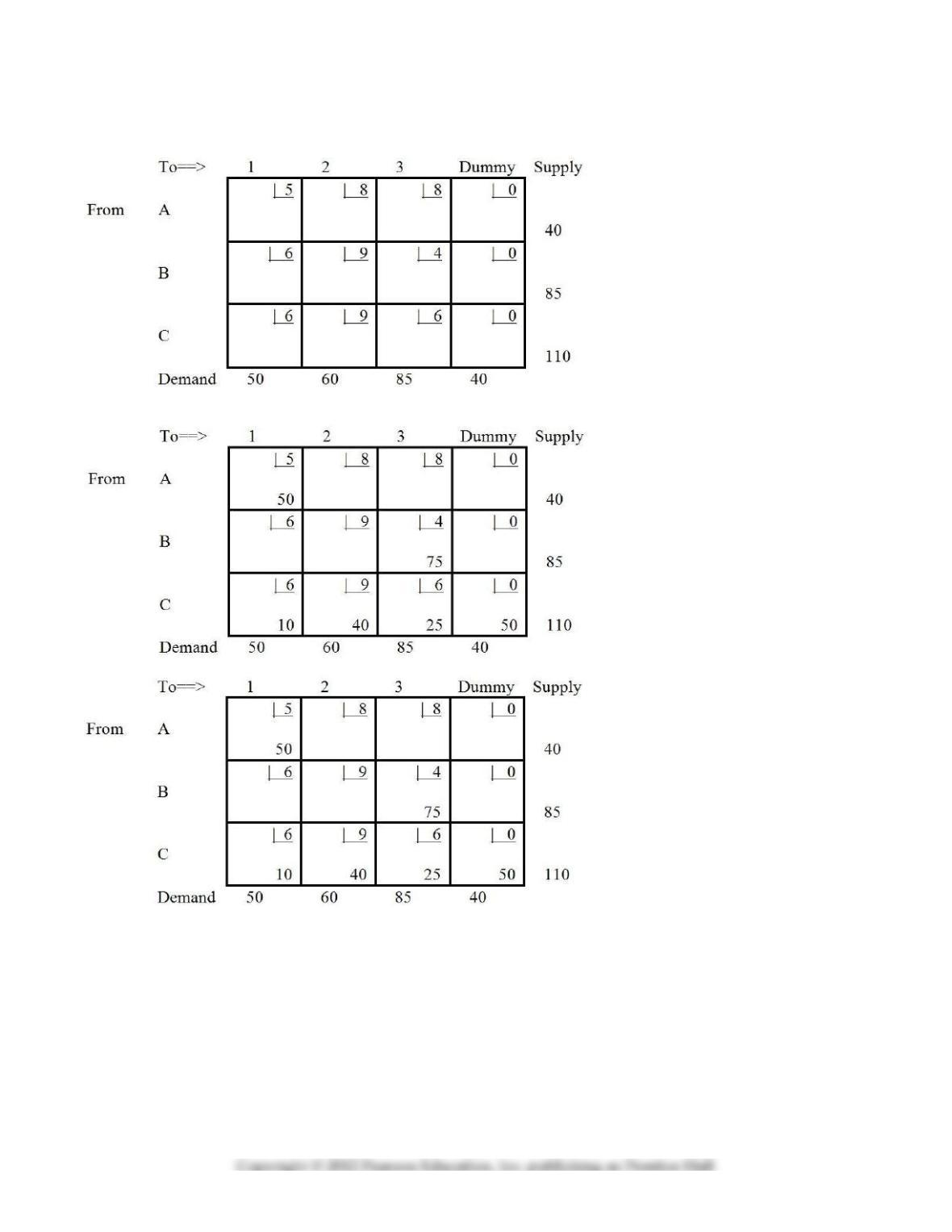
74) Which tableau is the solution to the transportation problem depicted below?
Table 9–17
A)
B)
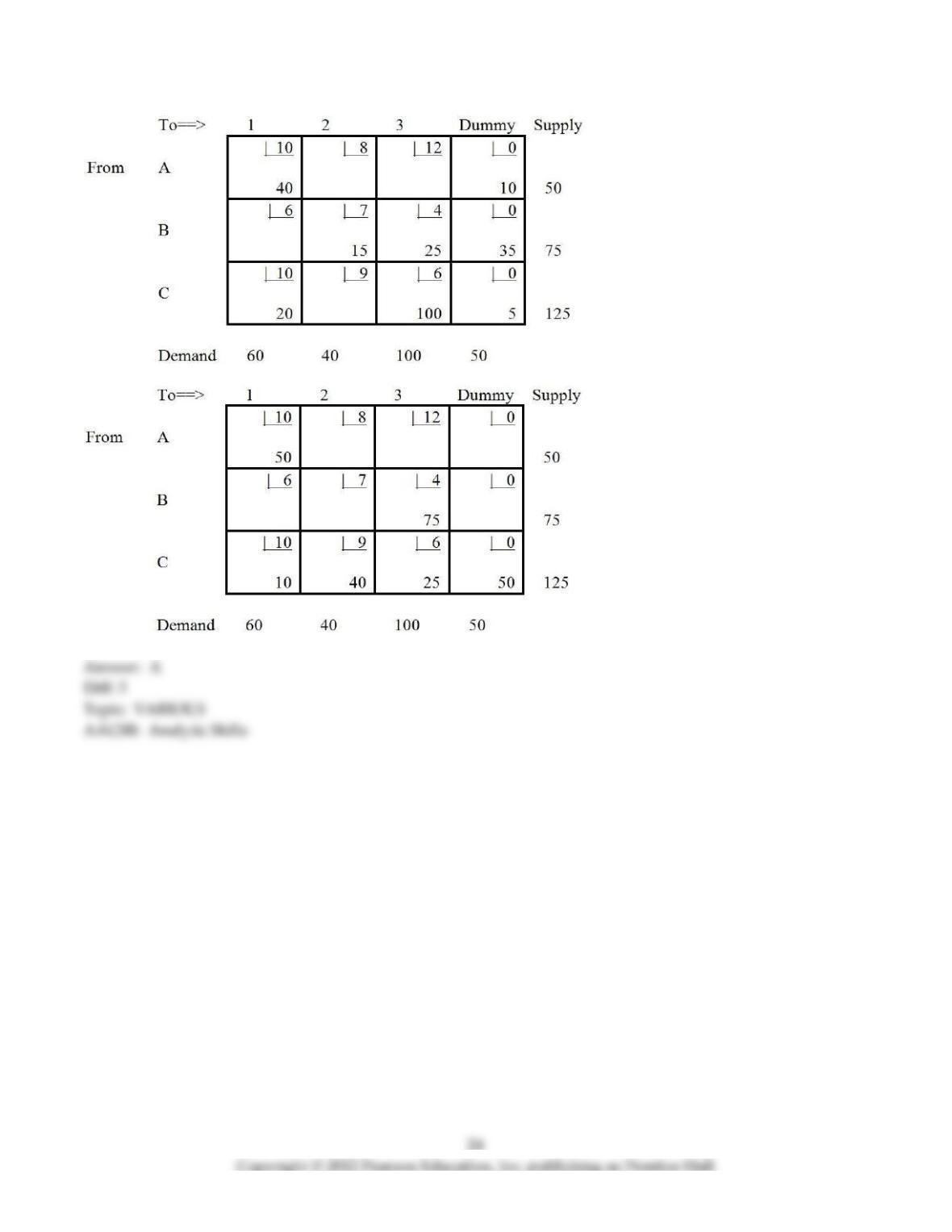
C)
D)
E) None of the above
25
75) Which tableau is the solution to the following transportation table?
Table 9–18
A)
B)
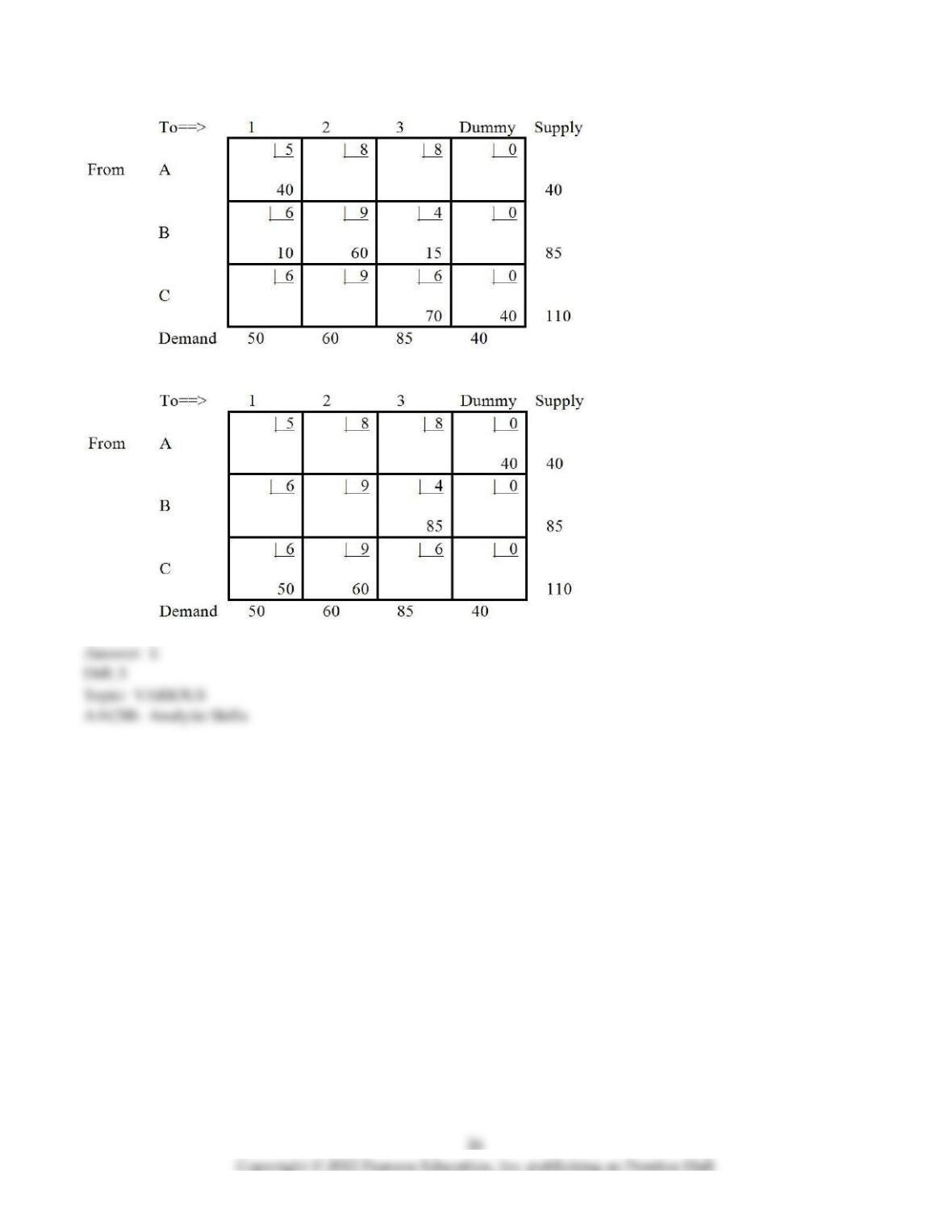
C)
D)
E) None of the above
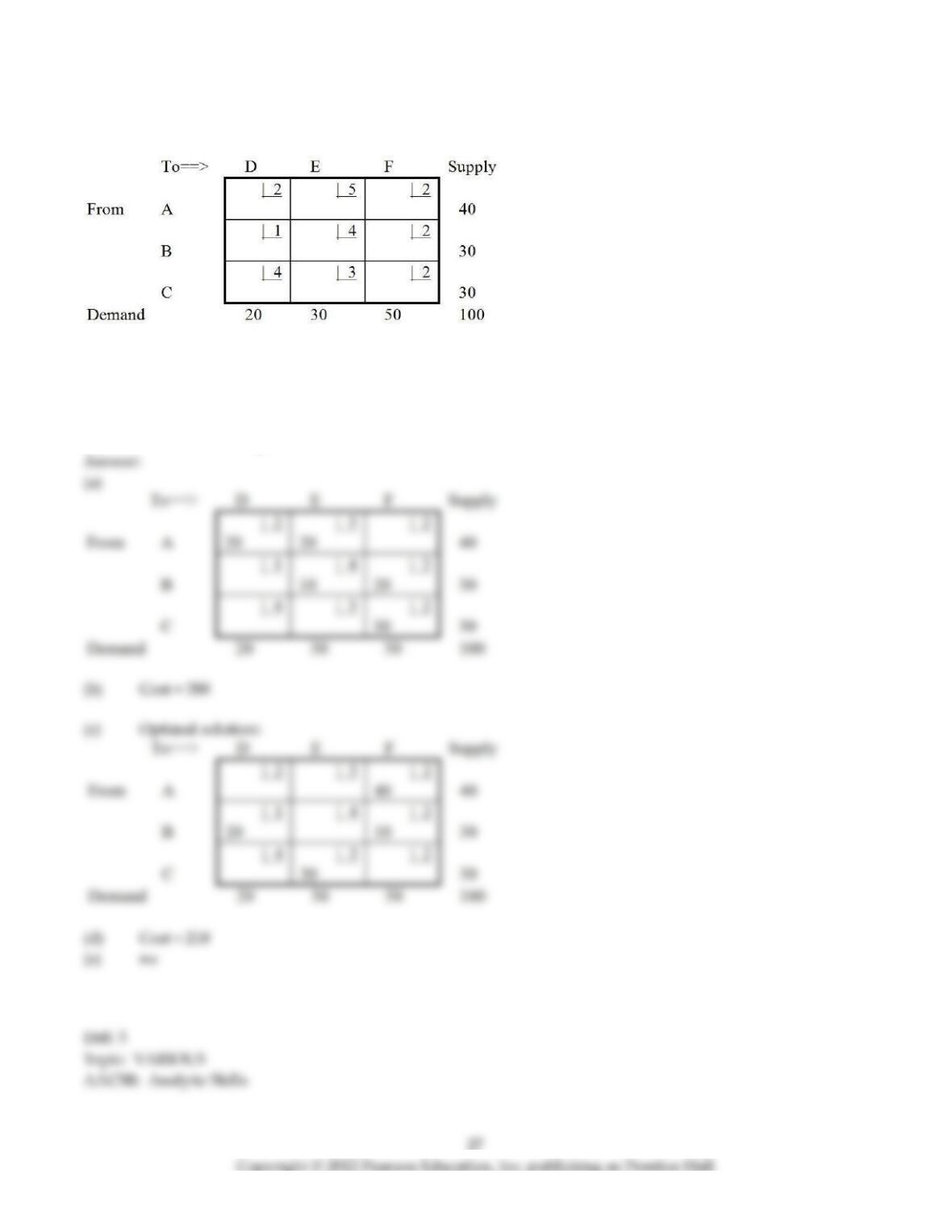
76) Table 9–19 describes a transportation problem:
Table 9–19
(a) Use the northwest corner method to get an initial solution.
(b) What is the cost of the initial solution?
(c) Use the stepping–stone method to find the optimal solution.
(d) What is the cost of the optimal solution?
(e) Is there an alternate optimal solution?
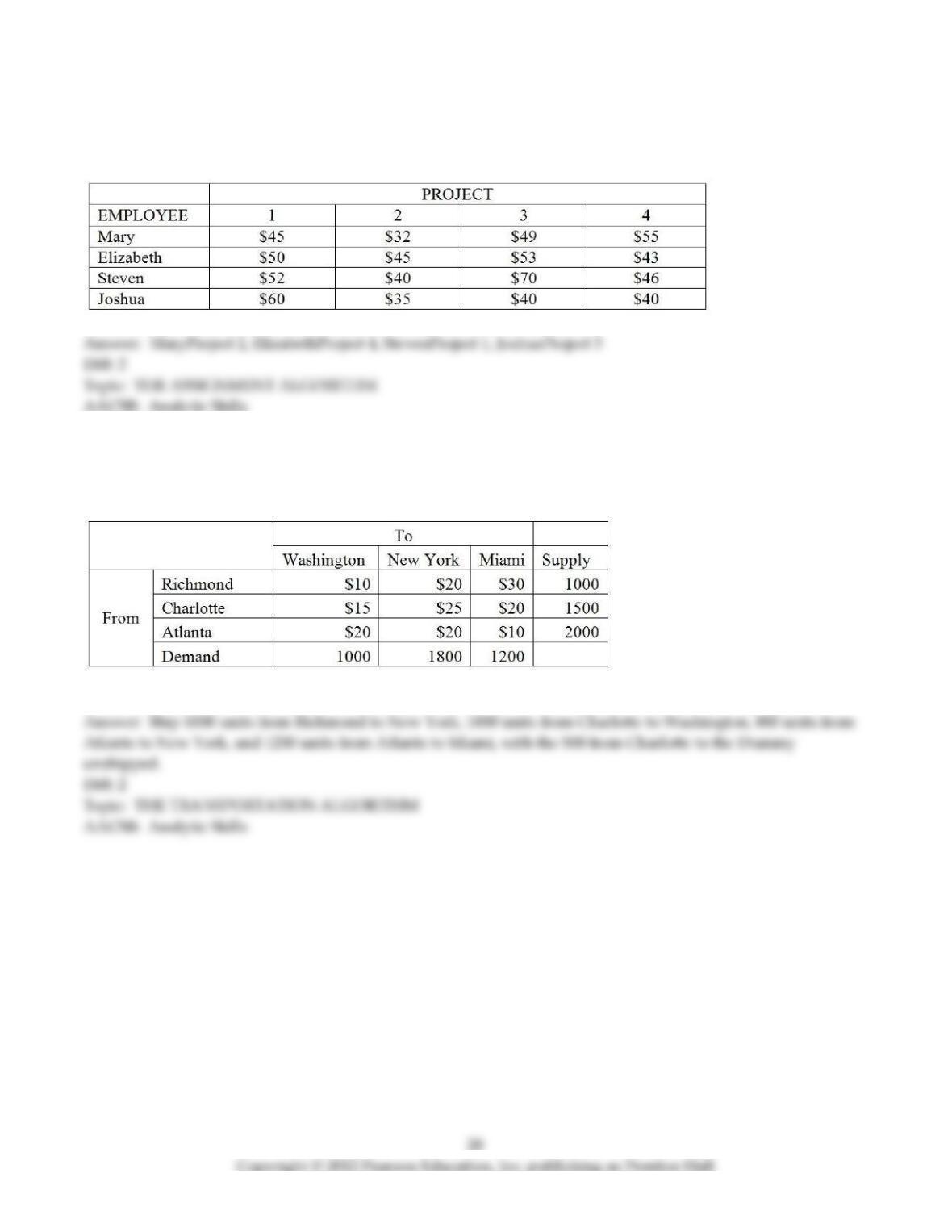
77) Four projects must be completed, and each of four employees will be assigned to work on exactly one of the
four projects. The table below presents an estimate of the cost that each employee would incur if working on the
respective projects. What is the minimum–cost assignment of workers to projects?
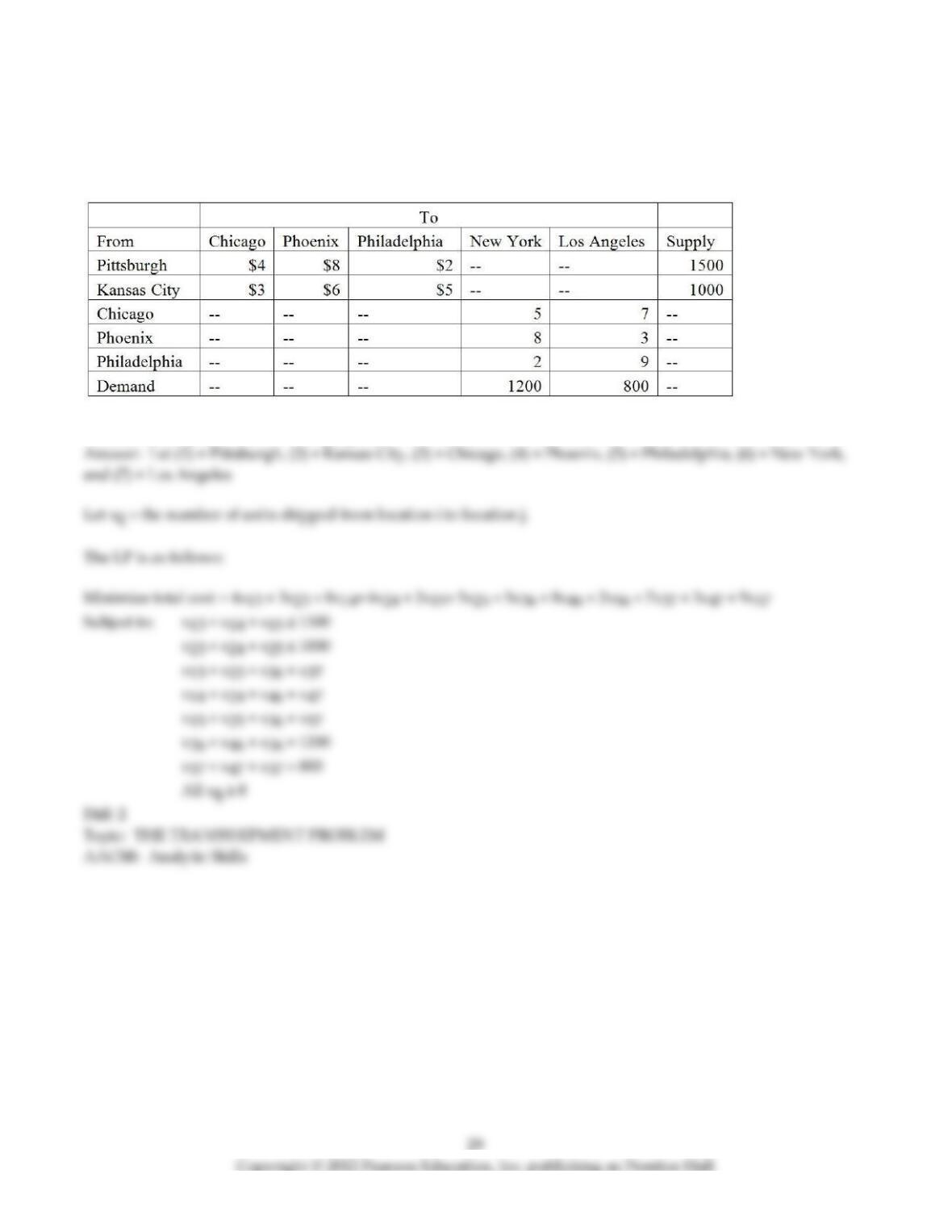
78) SE Appliances manufacturers refrigerators in Richmond, Charlotte, and Atlanta. Refrigerators then must be
shipped to meet demand in Washington, New York, and Miami. The table below lists the shipping costs, supply,
and demand information.
How many units should be shipped from each plant to each retail store in order to minimize shipping costs?
79) Neki Sports Company manufacturers treadmills in factories located in Pittsburgh and Kansas City. These are
shipped to regional distribution centers in Chicago, Phoenix, and Philadelphia. Ultimately they are delivered to
supply houses in New York and Los Angeles. The available supplies at the factories, demands at the final
destinations, and shipping costs are illustrated in the table below.
Formulate this problem as a linear program.
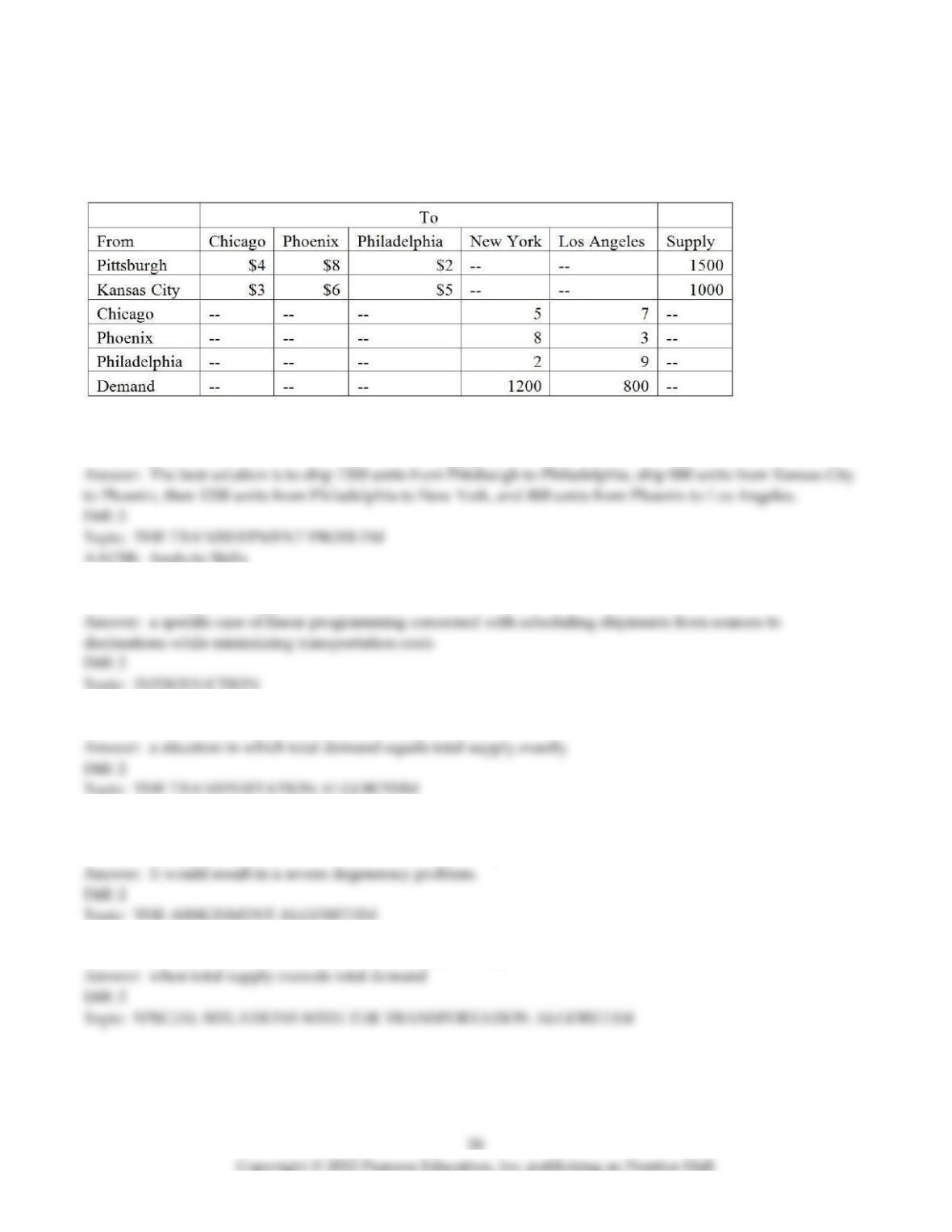
80) Neki Sports Company manufacturers treadmills in factories located in Pittsburgh and Kansas City. These are
shipped to regional distribution centers in Chicago, Phoenix, and Philadelphia. Ultimately they are delivered to
supply houses in New York and Los Angeles. The available supplies at the factories, demands at the final
destinations, and shipping costs are illustrated in the table below.
Determine how many units should be shipped for all possible origin and destination points (final or intermediate)
in the distribution network in order to minimize shipping costs.
81) Describe a general transportation problem.
82) What is meant by a balanced transportation problem?
83) The assignment problem is a special case of the transportation problem. So, then, why is it not recommended
to use the transportation algorithm to solve the assignment problem?
84) When is a dummy destination added to a transportation problem?