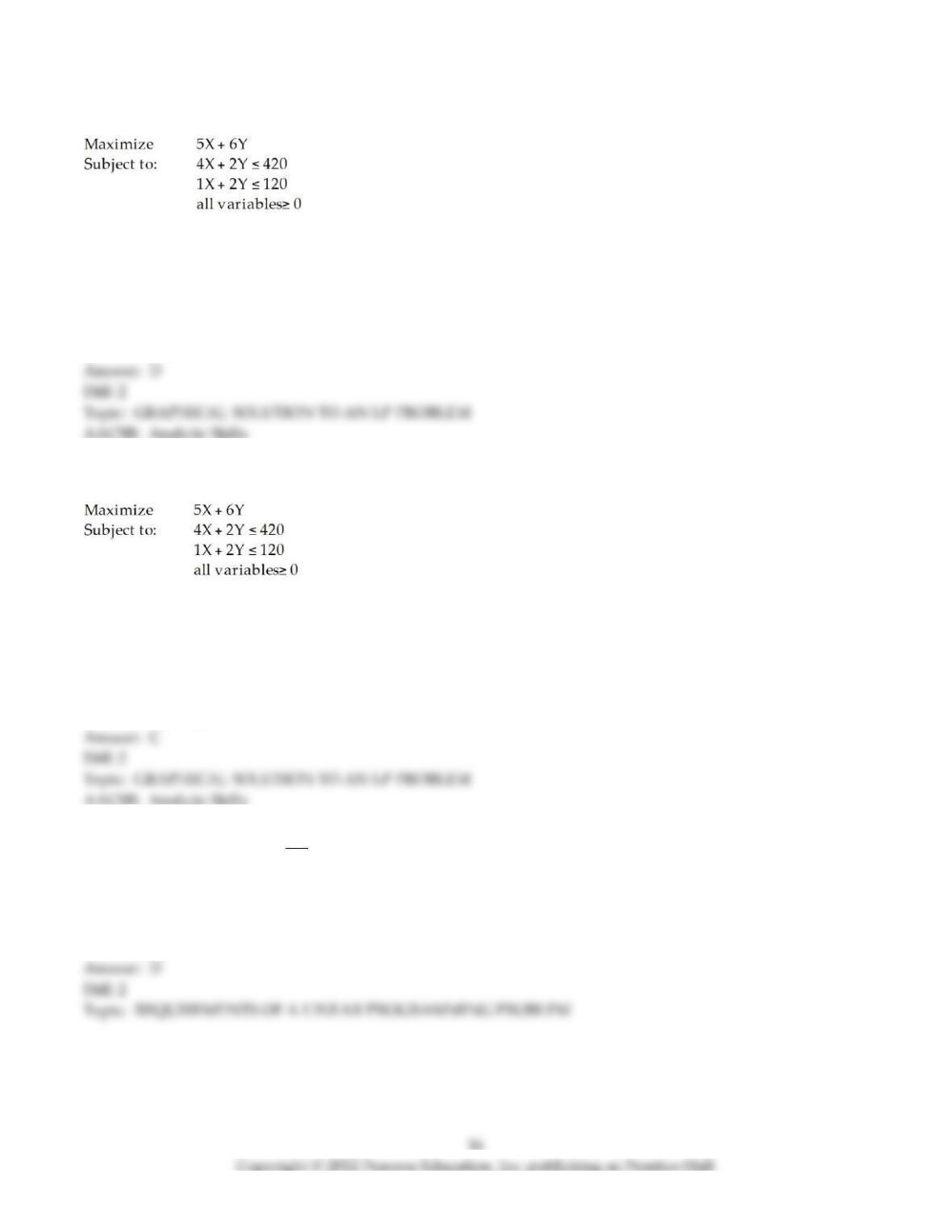
63) Consider the following linear programming problem:
Which of the following points (X,Y) is in the feasible region?
A) (30,60)
B) (105,5)
C) (0,210)
D) (100,10)
E) None of the above
64) Consider the following linear programming problem:
Which of the following points (X,Y) is feasible?
A) (50,40)
B) (30,50)
C) (60,30)
D) (90,20)
E) None of the above
65) Which of the following is not an assumption of LP?
A) certainty
B) proportionality
C) divisibility
D) multiplicativity
E) additivity
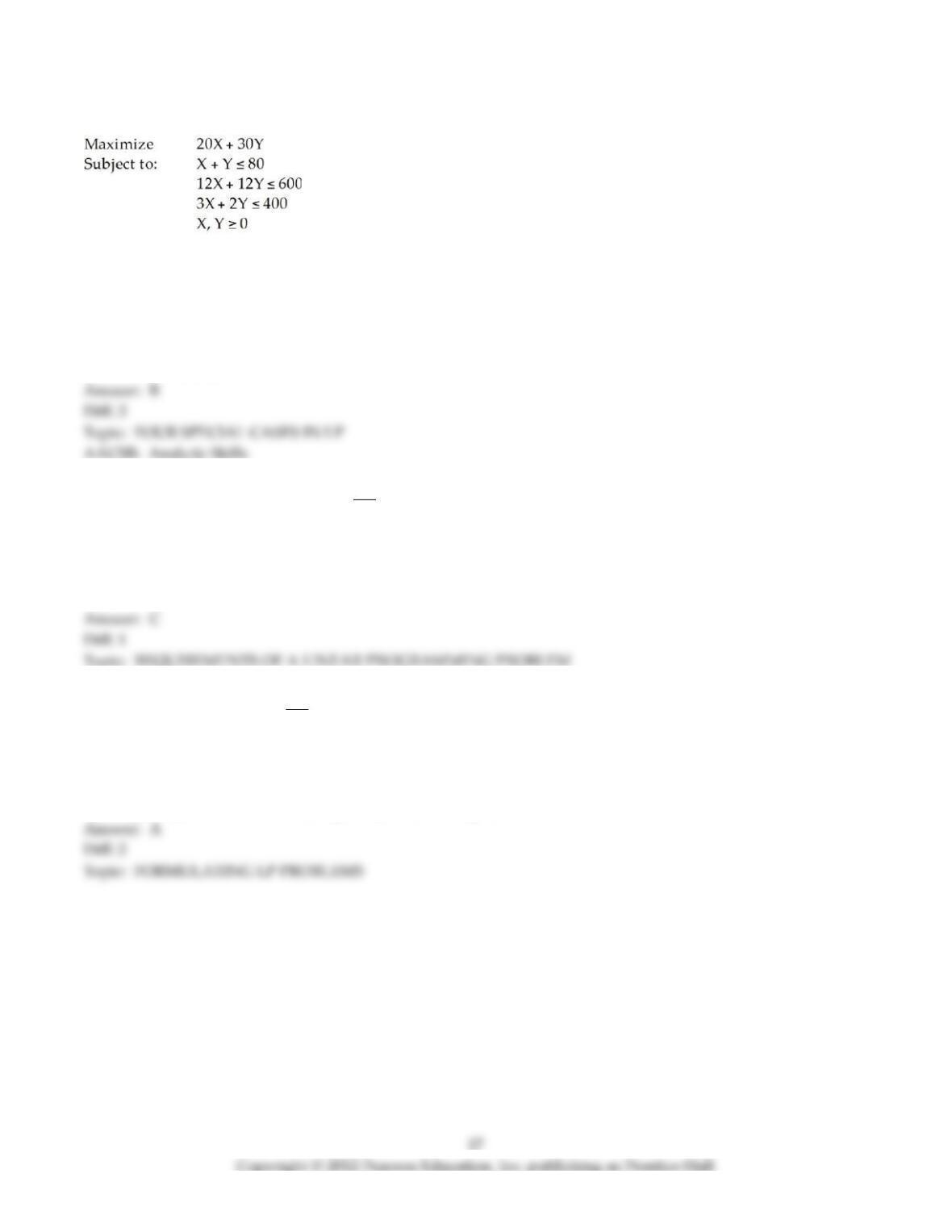
66) Consider the following linear programming problem:
This is a special case of a linear programming problem in which
A) there is no feasible solution.
B) there is a redundant constraint.
C) there are multiple optimal solutions.
D) this cannot be solved graphically.
E) None of the above
67) Which of the following functions is not linear?
A) 5X + 3Z
B) 3X + 4Y + Z – 3
C) 2X + 5YZ
D) Z
E) 2X – 5Y + 2Z
68) Which of the following is not one of the steps in formulating a linear program?
A) Graph the constraints to determine the feasible region.
B) Define the decision variables.
C) Use the decision variables to write mathematical expressions for the objective function and the constraints.
D) Identify the objective and the constraints.
E) Completely understand the managerial problem being faced.
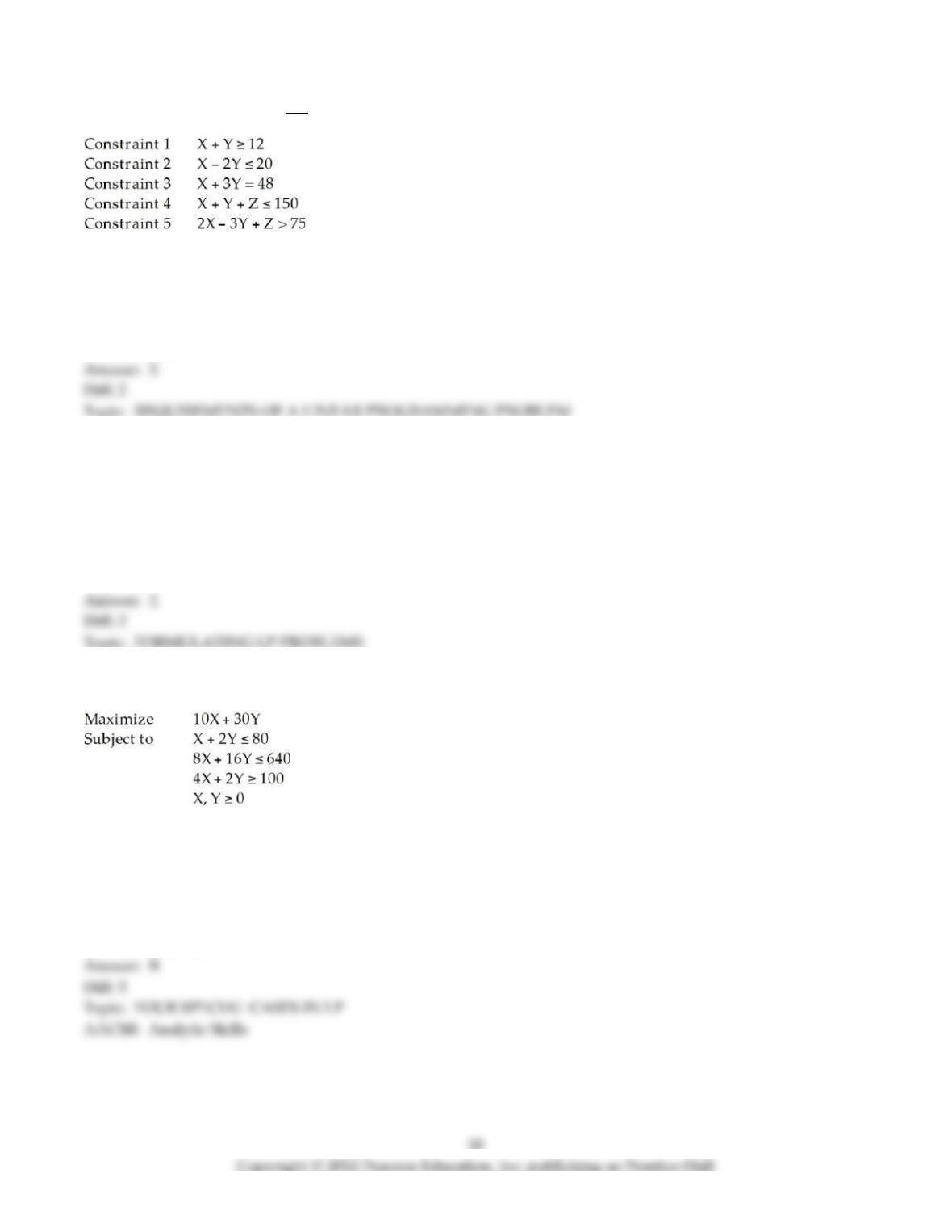
69) Which of the following is not acceptable as a constraint in a linear programming problem (minimization)?
A) Constraint 1
B) Constraint 2
C) Constraint 3
D) Constraint 4
E) Constraint 5
70) What type of problems use LP to decide how much of each product to make, given a series of resource
restrictions?
A) resource mix
B) resource restriction
C) product restriction
D) resource allocation
E) product mix
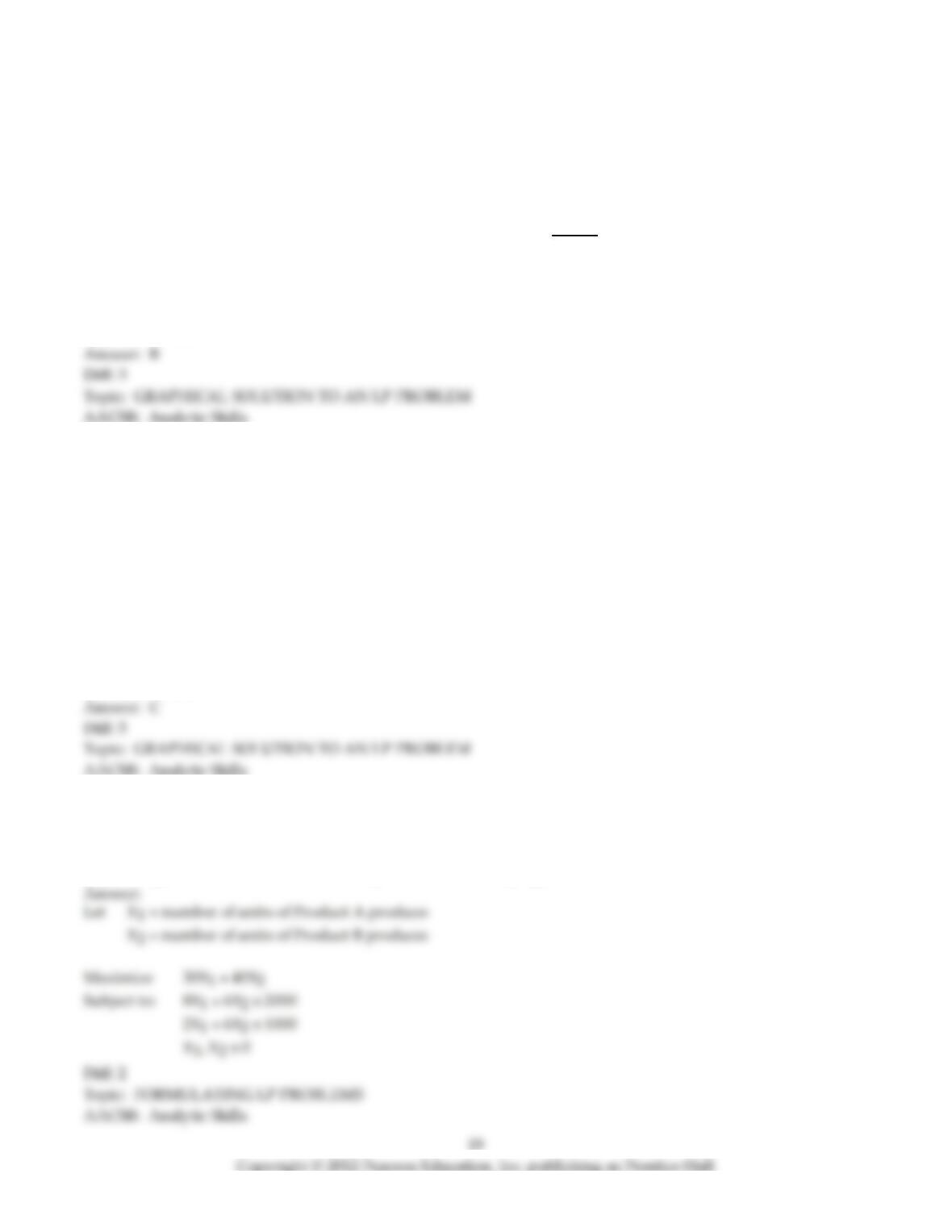
71) Consider the following linear programming problem:
This is a special case of a linear programming problem in which
A) there is no feasible solution.
B) there is a redundant constraint.
C) there are multiple optimal solutions.
D) this cannot be solved graphically.
E) None of the above
72) Consider the following constraints from a linear programming problem:
2X + Y ≤ 200
X + 2Y ≤ 200
X, Y ≥ 0
If these are the only constraints, which of the following points (X,Y) cannot be the optimal solution?
A) (0, 0)
B) (0, 200)
C) (0,100)
D) (100, 0)
E) (66.67, 66.67)
73) Consider the following constraints from a linear programming problem:
2X + Y ≤ 200
X + 2Y ≤ 200
X, Y ≥ 0
If these are the only constraints, which of the following points (X,Y) cannot be the optimal solution?
A) (0, 0)
B) (0, 100)
C) (65, 65)
D) (100, 0)
E) (66.67, 66.67)
74) A furniture company is producing two types of furniture. Product A requires 8 board feet of wood and 2 lbs
of wicker. Product B requires 6 board feet of wood and 6 lbs of wicker. There are 2000 board feet of wood
available for product and 1000 lbs of wicker. Product A earns a profit margin of $30 a unit and Product B earns a
profit margin of $40 a unit. Formulate the problem as a linear program.
75) As a supervisor of a production department, you must decide the daily production totals of a certain product
that has two models, the Deluxe and the Special. The profit on the Deluxe model is $12 per unit and the Special’s
profit is $10. Each model goes through two phases in the production process, and there are only 100 hours
available daily at the construction stage and only 80 hours available at the finishing and inspection stage. Each
Deluxe model requires 20 minutes of construction time and 10 minutes of finishing and inspection time. Each
Special model requires 15 minutes of construction time and 15 minutes of finishing and inspection time. The
company has also decided that the Special model must comprise at least 40 percent of the production total.
(a) Formulate this as a linear programming problem.
(b) Find the solution that gives the maximum profit.
76) The Fido Dog Food Company wishes to introduce a new brand of dog biscuits (composed of chicken and
liver–flavored biscuits) that meets certain nutritional requirements. The liver–flavored biscuits contain 1 unit of
nutrient A and 2 units of nutrient B, while the chicken–flavored ones contain 1 unit of nutrient A and 4 units of
nutrient B. According to federal requirements, there must be at least 40 units of nutrient A and 60 units of
nutrient B in a package of the new biscuit mix. In addition, the company has decided that there can be no more
than 15 liver–flavored biscuits in a package. If it costs 1 cent to make a liver–flavored biscuit and 2 cents to make a
chicken–flavored one, what is the optimal product mix for a package of the biscuits in order to minimize the firm’s
cost?
(a) Formulate this as a linear programming problem.
(b) Find the optimal solution for this problem graphically.
(c) Are any constraints redundant? If so, which one or ones?
(d) What is the total cost of a package of dog biscuits using the optimal mix?
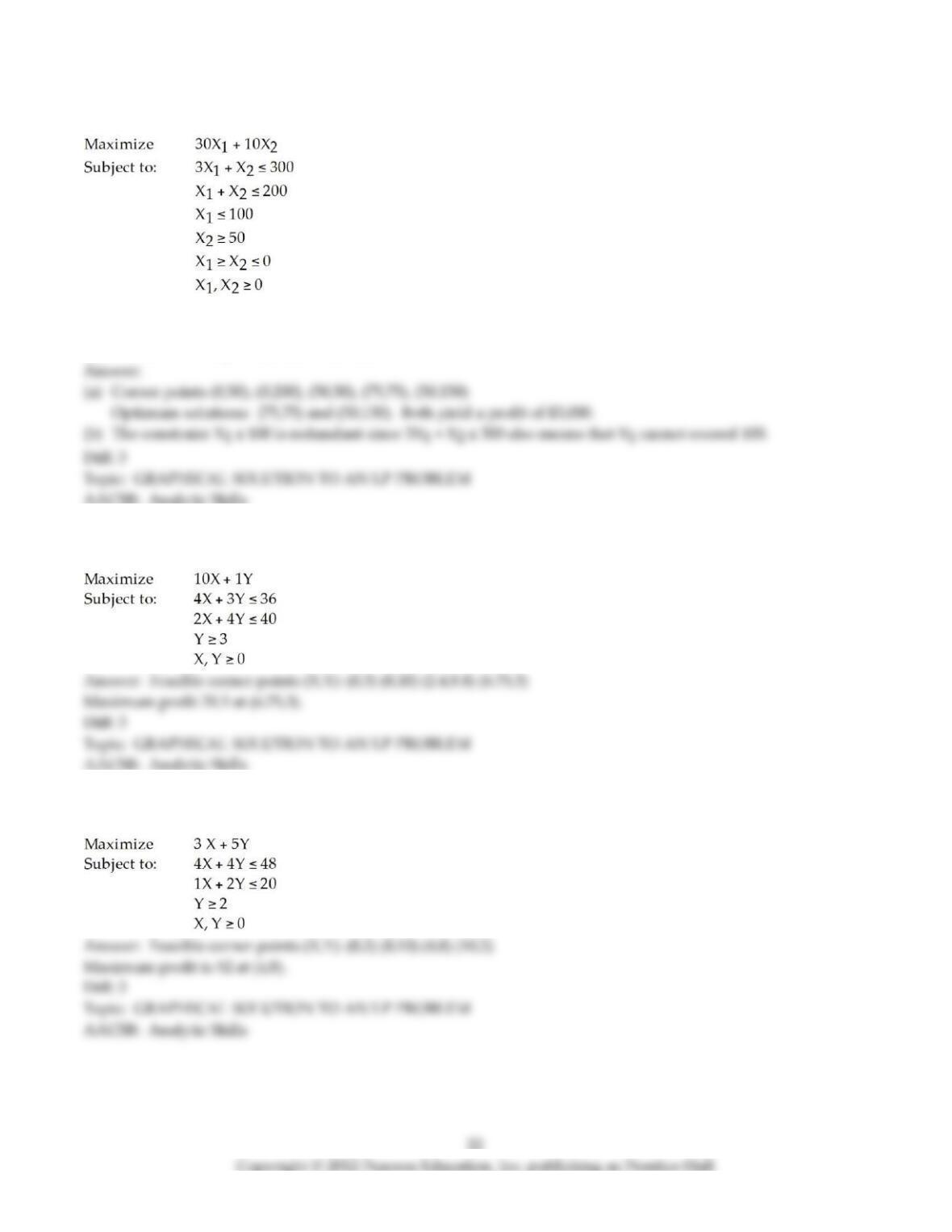
77) Consider the following linear program:
(a) Solve the problem graphically. Is there more than one optimal solution? Explain.
(b) Are there any redundant constraints?
78) Solve the following linear programming problem using the corner point method:
79) Solve the following linear programming problem using the corner point method:
80) Billy Penny is trying to determine how many units of two types of lawn mowers to produce each day. One of
these is the Standard model, while the other is the Deluxe model. The profit per unit on the Standard model is
$60, while the profit per unit on the Deluxe model is $40. The Standard model requires 20 minutes of assembly
time, while the Deluxe model requires 35 minutes of assembly time. The Standard model requires 10 minutes of
inspection time, while the Deluxe model requires 15 minutes of inspection time. The company must fill an order
for 6 Deluxe models. There are 450 minutes of assembly time and 180 minutes of inspection time available each
day. How many units of each product should be manufactured to maximize profits?
81) Two advertising media are being considered for promotion of a product. Radio ads cost $400 each, while
newspaper ads cost $600 each. The total budget is $7,200 per week. The total number of ads should be at least 15,
with at least 2 of each type. Each newspaper ad reaches 6,000 people, while each radio ad reaches 2,000 people.
The company wishes to reach as many people as possible while meeting all the constraints stated. How many ads
of each type should be placed?
82) Suppose a linear programming (minimization) problem has been solved and the optimal value of the objective
function is $300. Suppose an additional constraint is added to this problem. Explain how this might affect each of
the following:
(a) the feasible region,
(b) the optimal value of the objective function.
83) Upon retirement, Mr. Klaws started to make two types of children’s wooden toys in his shop Wuns and Toos.
Wuns yield a variable profit of $9 each and Toos have a contribution margin of $8 each. Even though his electric
saw overheats, he can make 7 Wuns or 14 Toos each day. Since he doesn’t have equipment for drying the lacquer
finish he puts on the toys, the drying operation limits him to 16 Wuns or 8 Toos per day.
(a) Solve this problem using the corner point method.
(b) For what profit ratios would the optimum solution remain the optimum solution?
84) Susanna Nanna is the production manager for a furniture manufacturing company. The company produces
tables (X) and chairs (Y). Each table generates a profit of $80 and requires 3 hours of assembly time and 4 hours
of finishing time. Each chair generates $50 of profit and requires 3 hours of assembly time and 2 hours of
finishing time. There are 360 hours of assembly time and 240 hours of finishing time available each month. The
following linear programming problem represents this situation.
Maximize 80X + 50Y
Subject to: 3X + 3Y ≤ 360
4X + 2Y ≤ 240
X, Y ≥ 0
The optimal solution is X = 0, and Y = 120.
(a) What would the maximum possible profit be?
(b) How many hours of assembly time would be used to maximize profit?
(c) If a new constraint, 2X + 2Y ≤ 400, were added, what would happen to the maximum possible profit?
85) As a supervisor of a production department, you must decide the daily production totals of a certain product
that has two models, the Deluxe and the Special. The profit on the Deluxe model is $12 per unit, and the Special’s
profit is $10. Each model goes through two phases in the production process, and there are only 100 hours
available daily at the construction stage and only 80 hours available at the finishing and inspection stage. Each
Deluxe model requires 20 minutes of construction time and 10 minutes of finishing and inspection time. Each
Special model requires 15 minutes of construction time and 15 minutes of finishing and inspection time. The
company has also decided that the Special model must comprise at most 60 percent of the production total.
Formulate this as a linear programming problem.
86) Determine where the following two constraints intersect.
5X + 23Y ≤ 1000
10X + 26Y ≤ 1600
87) Determine where the following two constraints intersect.
2X – 4Y = 800
−X + 6Y ≥ –200
88) Two advertising media are being considered for promotion of a product. Radio ads cost $400 each, while
newspaper ads cost $600 each. The total budget is $7,200 per week. The total number of ads should be at least 15,
with at least 2 of each type, and there should be no more than 19 ads in total. The company does not want the
number of newspaper ads to exceed the number of radio ads by more than 25 percent. Each newspaper ad
reaches 6,000 people, 50 percent of whom will respond; while each radio ad reaches 2,000 people, 20 percent of
whom will respond. The company wishes to reach as many respondents as possible while meeting all the
constraints stated. Develop the appropriate LP model for determining the number of ads of each type that should
be placed.
89) Suppose a linear programming (maximization) problem has been solved and the optimal value of the
objective function is $300. Suppose a constraint is removed from this problem. Explain how this might affect each
of the following:
(a) the feasible region.
(b) the optimal value of the objective function.
90) Consider the following constraints from a two–variable linear program.
(1) X ≥ 0
(2) Y ≥ 0
(3) X + Y ≤ 50
If the optimal corner point lies at the intersection of constraints (2) and (3), what is the optimal solution (X, Y)?
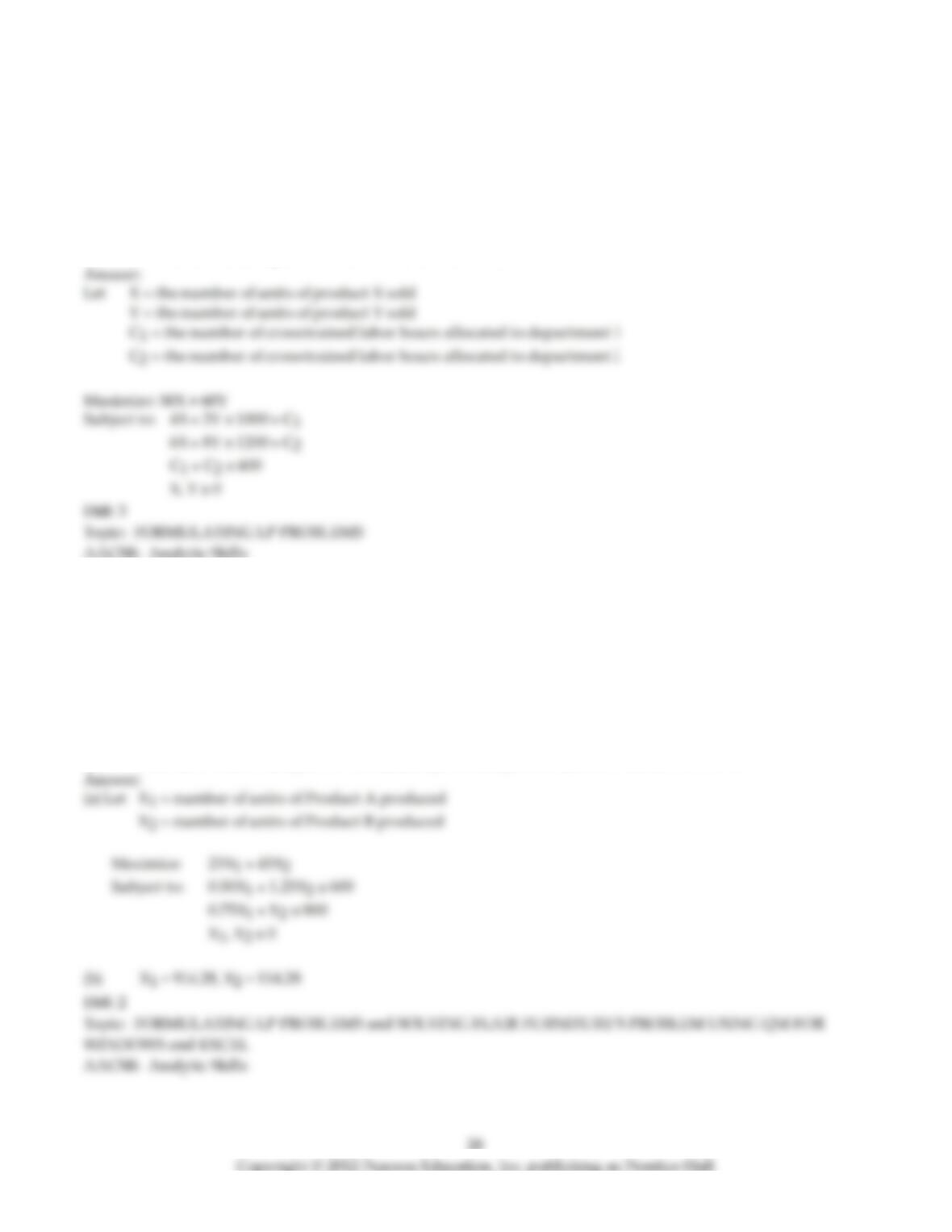
91) Consider a product mix problem, where the decision involves determining the optimal production levels for
products X and Y. A unit of X requires 4 hours of labor in department 1 and 6 hours a labor in department 2. A
unit of Y requires 3 hours of labor in department 1 and 8 hours of labor in department 2. Currently, 1000 hours of
labor time are available in department 1, and 1200 hours of labor time are available in department 2.
Furthermore, 400 additional hours of cross–trained workers are available to assign to either department (or split
between both). Each unit of X sold returns a $50 profit, while each unit of Y sold returns a $60 profit. All units
produced can be sold. Formulate this problem as a linear program. (Hint: Consider introducing other decision
variables in addition to the production amounts for X and Y.)
92) A plastic parts supplier produces two types of plastic parts used for electronics. Type 1 requires 30 minutes of
labor and 45 minutes of machine time. Type 2 requires 60 minutes of machine hours and 75 minutes of labor.
There are 600 hours available per week of labor and 800 machine hours available. The demand for custom molds
and plastic parts are identical. Type 1 has a profit margin of $25 a unit and Type 2 have a profit margin of $45 a
unit. The plastic parts supplier must choose the quantity of Product A and Product B to produce which
maximizes profit.
(a) Formulate this as a linear programming problem.
(b) Find the solution that gives the maximum profit using either QM for Windows or Excel.
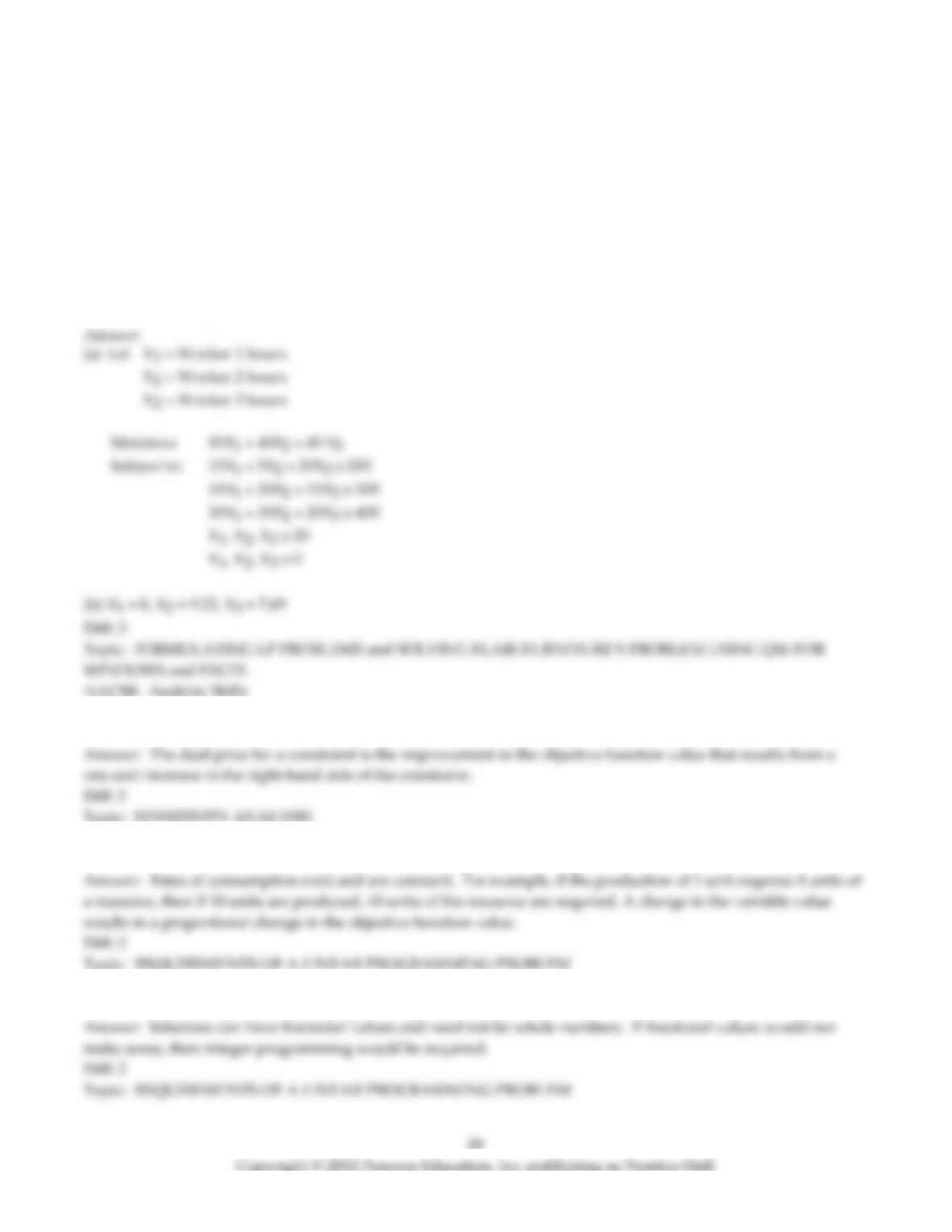
93) A company can decide how many additional labor hours to acquire for a given week. Subcontractor workers
will only work a maximum of 20 hours a week. The company must produce at least 200 units of product A, 300
units of product B, and 400 units of product C. In 1 hour of work, worker 1 can produce 15 units of product A, 10
units of product B, and 30 units of product C. Worker 2 can produce 5 units of product A, 20 units of product B,
and 35 units of product C. Worker 3 can produce 20 units of product A, 15 units of product B, and 25 units of
product C. Worker 1 demands a salary of $50/hr, worker 2 demands a salary of $40/hr, and worker 3 demands a
salary of $45/hr. The company must choose how many hours they should contract with each worker to meet their
production requirements and minimize labor cost.
(a) Formulate this as a linear programming problem.
(b) Find the optimal solution.
94) Define dual price.
95) One basic assumption of linear programming is proportionality. Explain its need.
96) One basic assumption of linear programming is divisibility. Explain its need.
97) Define infeasibility with respect to an LP solution.
98) Define unboundedness with respect to an LP solution.
99) Define alternate optimal solutions with respect to an LP solution.
100) How does the case of alternate optimal solutions, as a special case in linear programming, compare to the
two other special cases of infeasibility and unboundedness?