
The positive outcome of the awareness generated by unethical behavior in the business
world has been increased attention to the need for third-party guarantees of ethical
conduct and active commitments from the rest of the business world.
Answer:
The third stage of Kohlberg’s stages of ethical reasoning is law-and-order orientation.
Answer:
Which of the following isTRUE of Lawrence Kohlberg’s stages of ethical reasoning?
A. Kohlberg argues that we develop a reasoning process over time, moving through
four distinct stages as we are exposed to major influences in our lives.
B. At the postconventional stage, the lowest level of moral development, a person’s
response to the perception of right and wrong is initially directly linked to the
expectation of punishment or reward.

C. At the preconventional stage, the highest level of ethical reasoning, a person makes a
clear effort to define principles and moral values that reflect an individual value system
rather than simply reflecting a group position.
D. Stereotypical behavior is recognized, and conformity to that behavior develops in the
conventional stage of moral development.
Answer:
The Whistleblower Protection Act of 1989 introduced a new reward program for
whistle-blowers who report securities law violations to the Securities and Exchange
Commission (SEC) or the Commodity Futures Trading Commission (CFTC).
Answer:
The practice of making operations “carbon neutral” is a way to offset whatever damage
is being done to the environment due to greenhouse gas emissions by purchasing credits

from “carbon-positive” projects to balance out emissions.
Answer:
A value chain is composed of the key functional inputs that an organization provides in
the transformation of raw materials into a delivered product or service.
Answer:
Title IX of the Sarbanes-Oxley Act requires CEOs and CFOs to certify their periodic
reports and imposes penalties for certifying a misleading or fraudulent report.
Answer:

Profits are the main reason behind stretching the truth and bending the rules on a
regular occurrence in the workplace.
Answer:
In his Harvard Business Review article, Walter Salmon recommends that a good board
have three or more outside directors for every insider.
Answer:
Transparency is a major trend behind the corporate social responsibility phenomenon.
Answer:

Which of the following isTRUE of codes of ethics?
A. Fewer small businesses adopt a formal code of ethics now than they did in the past.
B. The codes are structured to empower employees to make effective decisions
confidently.
C. The codes prescribe appropriate courses of action for every business situation in
detail.
D. Fewer international organizations adopt a formal code of ethics now than in the past.
Answer:
Which of the following statements isTRUE of corporate social responsibility (CSR)?
A. The social contract approach to CSR states that the only obligation of a corporation
is to maximize profits for its shareholders.
B. Many companies awoke to CSR only after being surprised by public responses to
issues they had not previously thought were part of their business responsibilities.
C. The instrumental approach to CSR states that a corporation has an obligation to
society over and above the expectations of its shareholders.
D. An organization’s discovery of the significance of CSR is never intentional; it is
always a result of unexpected media attention.
Answer:

Friedman’s view of the corporate world supports the rights of individuals to make
money with their investments.
Answer:
Utilitarianism is a theory in ethics that advocates making choices that offer the greatest
good for the greatest number of people.
Answer:
The implications of vicarious liability are that the party charged is responsible for the
actions of his or her subordinates.

Answer:
Reactive ethical policies are policies that result when the company develops a clear
sense of what it stands for as an ethical organization.
Answer:
The human resource function of an organization can be divided into two distinct areas:
financial transactions and accounting function.
Answer:

The board of directors comprises a group of individuals who oversee the governance of
an organization.
Answer:
Which of the following isTRUE of business ethics?
A. The descriptive dimension of business ethics evaluates the degree to which the
observed customs, attitudes, and rules of a business are ethical.
B. Business ethics should ideally not reflect the ethical concepts of the society within
which an organization functions.
C. The normative dimension of business ethics is a summation of the customs, attitudes,
and rules that are observed within a business.
D. Business ethics should not be applied as a separate set of moral standards or ethical
concepts from general ethics.
Answer:

The Dodd-Frank Wall Street Reform and Consumer Protection Act Legislation was
established to expand the foreign trade sector.
Answer:
Typical markets represent federal, state, and local officials who simplify and reduce
rules and regulations, thus discouraging firms from hiring more people and paying more
taxes.
Answer:
The Sarbanes-Oxley Act of 2002 not only prohibits retaliation against whistle-blowers

but also encourages the act of whistle-blowing itself.
Answer:
If there are no clear local ethical standards, companies should revert to their own
domestic ethical policies rather than work in the absence of any standards.
Answer:
Every religion in the world shares the Golden Rule.
Answer:

Ethical Relativism arises when a multinational company comes up against a policy that
is banned both in its own country and in the country with which it’s doing business.
Answer:
Title VIII of the Sarbanes-Oxley Act imposes fines on employees for lying to other
employees regarding company benefits and pay.
Answer:

When a whistle-blower’s immediate supervisor does not act, the employee should
exhaust the company’s internal procedures and chain of command to the board of
directors.
Answer:
The OECD Guidelines for Multinational Enterprises were criticized because they failed
to address consumer interests.
Answer:
Under the federal Civil False Claims Act, whistle-blowers are referred to as “relators.”
Answer:

Corporate governance is the system by which business organizations are directed and
controlled.
Answer:
A company can be found in violation of the Foreign Corrupt Practices Act even if its
bribe is unsuccessful.
Answer:
Doing what’s in the best long-term interest of the customer invariably fails to achieve
what’s best for the company.

Answer:
One of the flaws in the board of directors of Enron was that many of the directors were
affiliated with organizations that benefited directly from Enron’s operations.
Answer:
Which of the following isTRUE of the King I report?
A. It took a less integrated approach to corporate governance than the Cadbury report.
B. It limited its scope to internal corporate governance.
C. It limited its scope to financial and regulatory accountability.
D. It considered corporations’ impact on the larger community.
Answer:

Enforcing a global ethical standard would require all parties involved to agree on
acceptable standards of behavior and appropriate consequences for failing to abide by
those standards.
Answer:
Corporate governance is the system by which businesses are directed and controlled.
Answer:
The CRAFTED principles of governance, offered by the European business school
INSEAD, recommend creating a culture and climate of consistency in an organization.

Answer:
Customer service calls and computer tech support are examples of services that cannot
be outsourced to another country.
Answer:
Which of the following is TRUE of the Federal Sentencing Guidelines for
Organizations (FSGO)?
A. The FSGO has a very narrow definition of an organization.
B. The FSGO cannot levy monetary fines on organizations that violate its stipulations.
C. The FSGO does not hold organizations responsible for their employees’ criminal
activities.
D. The FSGO includes an exhaustive list of covered business crimes.
Answer:

The board of directors of a company:
A. is not accountable to its stakeholders.
B. should ideally be elected by the CEO.
C. oversees the governance of the organization.
D. should ideally have less power than the CEO.
Answer:
The Cadbury report focused on:
A. environmental equilibrium.
B. corporate social responsibility.
C. internal governance.
D. the triple bottom line.
Answer:

Which of the following is TRUE of Walter Salmon’s checklist to assess the quality of
the board?
A. It recommends following an exclusive rather than an inclusive approach.
B. It recommends the consideration of a single bottom line of profitability.
C. It recommends that the roles of the CEO and chairperson of the board be merged.
D. It recommends that there be three or more outside directors for every insider.
Answer:
Andrew is informed by his company that he should be open to monitoring as a part of
the company’s plans to improve productivity. Because of his qualifications and work
experience, he knows that he would have no difficulty finding a similar position in
another company. Andrew agrees to the policy, knowing that he can switch jobs if the
new policy affects his job satisfaction. He has given his company _____ consent.
A. thick
B. forced
C. thin

D. tertiary
Answer:
Which of the following is TRUE of corporate whistle-blowing?
A. Corporate whistle-blowing is heavily discouraged by the Sarbanes-Oxley Act of
2002.
B. Corporate whistle-blowers are no longer protected by law from retaliatory behavior.
C. Corporate whistle-blowing has considerable potential for financial gain in some
areas.
D. Corporate whistle-blowers are assured safety by the Whistleblower Protection Act.
Answer:
_____ is the area of the Foreign Corrupt Practices Act that requires corporations to fully
reveal any and all transactions conducted with foreign officials and politicians, in line

with the Securities and Exchange Commission provisions.
A. Enclosure
B. Disclosure
C. Foreclosure
D. Exposure
Answer:
Marketing professionals abide by a code of ethics adapted by the _____.
A. Society for Marketing Resources
B. American Marketing Association
C. American Ethics Association
D. Marketers’ Ethics Resource Center
Answer:

Which of the following statements is TRUE of sustainable ethics?
A. In order to make ethical behavior sustainable, an organization requires commitment
only from the top management.
B. The audience for the code of ethics includes selected stakeholders.
C. In order for everyone to begin from the same starting point, the organization’s
commitment to ethical behavior must be documented in a code of ethics.
D. The audience for the code of ethics excludes investors, customers, and suppliers of
the organization.
Answer:
Over the last five decades, codes of ethics have matured from cosmetic public relations
documents into _____ documents.
A. profit-oriented
B. financial-assessment
C. performance-measurement
D. expenditure-maximization
Answer:

Under federal law, video surveillance is legal only if:
A. the camera focuses on publicly accessible areas.
B. the camera is placed in employee rest areas.
C. the cameras aren’t focused on customers.
D. the cameras aren’t focused on employees.
Answer:
According to the value chain of an organization, which of the following is classified as
a primary activity?
A. Human resources management
B. General administration
C. Systems development
D. Sales and marketing
Answer:

Which of the following is TRUE of technological advances over the last two decades?
A. They have not changed the work environment.
B. They have increased employees’ accessibility.
C. They have raised no new ethical issues.
D. They have limited the mobility of employees.
Answer:
Resolving the different perspectives on the issue of monitoring employee activity is
difficult because:
A. federal laws for video surveillance in public areas do not exist.
B. technological advances have had no impact on the workplace.
C. it is legal for employers to wiretap employees’ personal phones.
D. it is difficult to determine where work ends and personal life begins.

Answer:
Setting up a governance system that allows organizations to be directed and controlled:
A. leads to underpinning the integrity and efficiency of financial markets.
B. weakens a company’s potential and makes it less attractive to investors.
C. paves the way for financial difficulties and incidents of fraud.
D. makes managers and board members less accountable to shareholders.
Answer:
HP Chase Inc., an investment banking firm, has decided to make ethical behavior
sustainable for the organization. It has established the process of monitoring and
enforcement of ethical behavior by establishing a code of ethics. Which of the
following is the step that HP Chase Inc. is most likely to undertake next?
A. Reward ethical behavior demonstrated by the board of directors
B. Hire an ethics officer
C. Reward ethical behavior demonstrated by employees

D. Support the code of ethics with extensive training for every member of the
organization
Answer:
The _____ refers to legislation introduced to control bribery and other less obvious
forms of payment to overseas officials and politicians by American publicly traded
companies.
A. Comstock Act
B. Rehabilitation Act
C. Equal Opportunity Act
D. Foreign Corrupt Practices Act
Answer:
Globalization raises concerns about the:

A. restricted access multinational companies have to less-developed countries.
B. ethical behavior of economically advanced nations toward developing ones.
C. inability of multinational companies to reduce their production costs.
D. spread of socialism by multinational corporations in the Americas and Europe.
Answer:
In what way do bribes differ from grease payments under the FCPA?
A. Unlike grease payments, bribes induce officials to act in violation of their lawful
duty.
B. Unlike grease payments, bribes include donations to bona fide charitable
organizations.
C. Unlike grease payments, bribes are meant to secure a routine governmental action.
D. Unlike grease payments, bribes are used to facilitate processes approved of by law.
Answer:

The two types of whistle-blowing, internal and external, are categorized based on:
A. whom the whistle-blower chooses to inform.
B. the motivation of the whistle-blower.
C. the type of organizational misconduct.
D. the nationality of the whistle-blower.
Answer:
Which of the following explains why employers are in favor of monitoring and
restricting the actions of their employees?
A. The implications of vicarious liability for employers
B. The federal restrictions placed upon wiretapping
C. The reluctance of employees to give thick consent
D. The federal restrictions placed on cybersquatting
Answer:

Which of the following topics would be elaborated in a company’s code of ethics?
A. Salaries and performance incentives for employees
B. Policies for behavior in specific situations
C. Policies for claiming medical benefits
D. Leave policies for employees
Answer:
_____ serves as a support line function to key functional areas in an organization’s
value chain.
A. Technology
B. Manufacturing
C. Supply chain management
D. Distribution
Answer:

The formula used to calculate the total fine sentenced by the Federal Sentencing
Guidelines for Organizations (FSGO) is:
A. the base fine multiplied by the culpability score.
B. the base fine plus the culpability score.
C. the base fine minus the culpability score.
D. the base fine divided by the culpability score.
Answer:
The instrumental approach to corporate social responsibility (CSR) states that:
A. the only obligation of a corporation is to promote socialist economic planning.
B. a corporation has an obligation to society over and above the expectations of its
shareholders.
C. the only obligation of a corporation is to maximize profits for its shareholders.
D. a corporation has an obligation to the community and environment.
Answer:

The accounting profession is governed by a set of _____.
A. generally accepted accounting principles
B. laws for accounting
C. established legal precedents for accounting
D. universal ethics
Answer:
Business ethics can be approached from two different perspectives. The _____
perspective is a summation of the customs, attitudes, and rules that are observed within
a business.
A. descriptive
B. normative
C. preventative
D. prescriptive

Answer:
Happy Times (HT) is an alcohol manufacturing brand that manufactures and sells
several types of alcoholic beverages. HT uses social media for promoting the message
of responsible drinking. It sponsors the FreeTaxi program for customers with HT
membership on Christmas and New Year’s Eve. It has also initiated several community
welfare projects where a percentage of the profits go to the Hunger Relief Fund for
Children. Which of the following aspects of Happy Times is illustrated in this scenario?
A. Virtue ethics
B. Universal ethics
C. Corporate governance
D. Corporate citizenship
Answer:
The _____ principle for resolving an ethical dilemma considers what would happen if
everyone made the same decision as you.
A. rules-based
B. ends-based

C. Golden Rule
D. Volcker’s Rule
Answer:
Payments to foreign officials in order to expedite or secure the performance of a routine
governmental action are known as _____.
A. grease payments
B. induced payments
C. insulated payments
D. allurements
Answer:
A qui tam lawsuit is a lawsuit brought on behalf of the federal government by a
whistle-blower under the _____ of 1863.

A. Foreign Corrupt Practices Act
B. False Claims Act
C. National Emergency Act
D. Comstock Act
Answer:
Which of the following questions is identified by Arthur Dobrin to resolve an ethical
dilemma?
A. What do your feelings tell you?
B. What are the alternatives?
C. What can be done to resolve the problem?
D. What will people think of you if you don’t find a solution?
Answer:

Altra Partners (AP) believes that a company’s commitment to ethical behavior impacts
every managerial level and every department of the organization. It has recently
established a code of ethics and started an extensive training for every member of the
organization. Which of the following steps is most likely to be undertaken by AP next?
A. Hire an ethics officer
B. Promote ethical behavior among shareholders
C. Reward ethical behavior demonstrated by employees
D. Monitor ethical behavior of the employees
Answer:
According to Milton Friedman, it would be unethical for a corporation to do anything
other than deliver the profits for which its investors have entrusted it with their funds in
the purchase of shares in the corporation. This illustrates the _____ to corporate social
responsibility.
Answer:
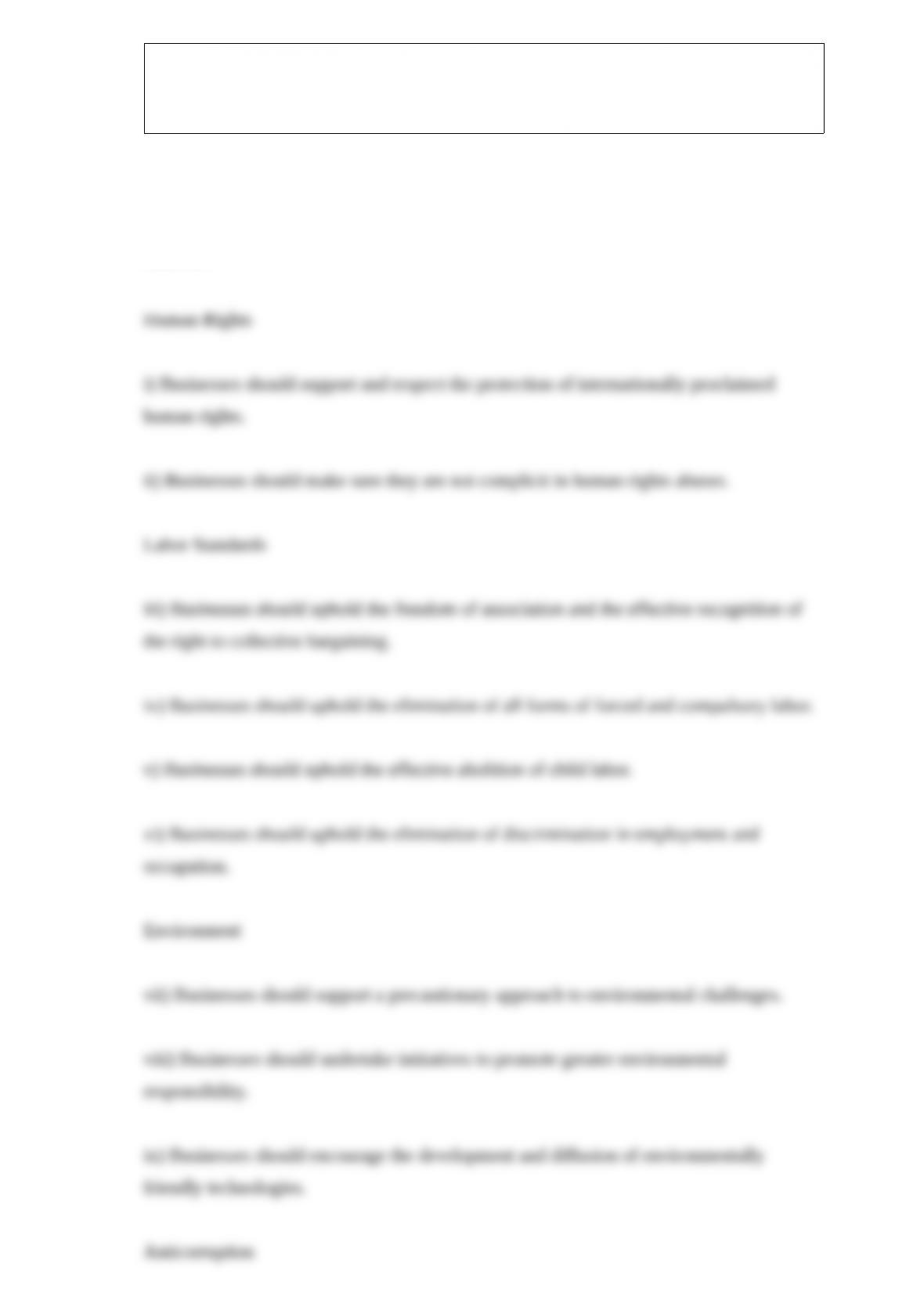
Summarize the 10 key principles of the UN Global Compact that address its four areas
of concern: Human Rights, Labor Standards, Environment, and Anticorruption.
Answer:

The first stage in the process of making ethical behavior sustainable for an organization
is to establish a _____.
Answer:
A(n) _____ is a senior executive responsible for monitoring an organization’s ethical
performance both internally and externally.
Answer:
The _____ is a private piece of a company’s network that is made available to
customers or vendor partners using secured access with a unique password.

Answer:
The first step in the three-step process for solving an ethical problem is to analyze the
_____.
Answer:
The _____ department incorporates customer feedback from market research,
competitive feedback from closely monitoring their competition, and strategic input
from the organization’s senior management team to develop a product design that,
hopefully, will allow the organization to capture and maintain a leading position in its
market.
Answer:

Why should whistle-blowing be the last resort?
Answer:
A situation in which one relationship or obligation places the individual or organization
in direct conflict with an existing relationship or obligation is referred to as a _____.
Answer:
The triple bottom line advocated by the King II report recognizes the economic,
environmental, and _____ aspects of a company’s activities.

Answer:
Critics have argued that, from an ethical perspective, _____ CSR is immoral since it
represents a violation of shareholder rights if they are not given the opportunity to vote
on the initiatives launched in the name of corporate social responsibility.
Answer:
Explain the differences between thin and thick consent.
Answer:

A(n)_____, such as happiness and health, is a good thing in itself and is pursued for its
own sake.
Answer:
The introduction of the _____ placed more effective controls over bribing practices and
less obvious forms of payment to foreign officials and politicians by American publicly
traded companies pursuing international growth.
Answer:
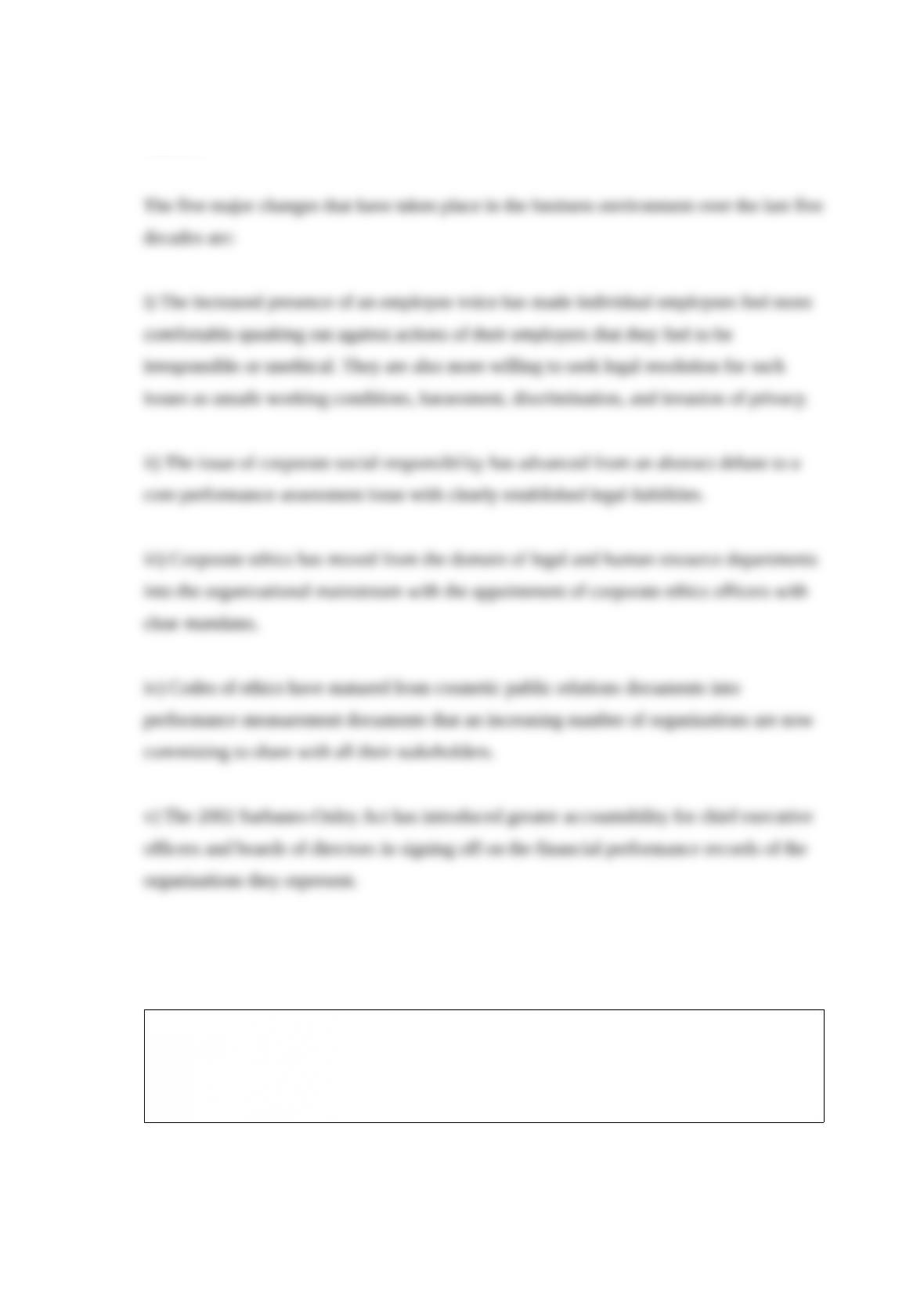
Discuss five major changes that have taken place in the business environment over the
last five decades.
Answer:
Corporate governance is about managers fulfilling a _____ responsibility to the owners
of their companies.
Answer:

Explain the “comply or explain” guideline. Why did the “comply or else” policy come
into force?
Answer:
Companies that rely on the deterrents of _____ and spot checks make headway in
discouraging unethical behavior.
Answer:

Under the Foreign Corrupt Practices Act, a _____ refers to any regular administrative
process or procedure, excluding any action taken by a foreign official in the decision to
award new or continuing business.
Answer: