Test Bank
Chapter 10: Language Disorders in Children
Multiple Choice
1. ___________________________ are the most prevalent type of communication impairment
affecting children.
a. Articulation disorders
b. Language disorders
c. Voice disorders
d. Executive function disorders
2. Children with late language emergence (LLE) are usually identified at about what age?
a. 6 months
b. 1 year
c. 2 years
d. 4 years
3. ___________________________ is a significant language impairment in the absence of any
other developmental difficulty.
a. Secondary language impairment
b. Late language emergence
c. Intellectual disability
d. Primary language impairment
4. ___________________________ include diagnosing language disorders and providing
treatment to children with disorders through clinical and educational interventions.
a. Direct services
b. Indirect services
c. Consultation services
d. Evidence-based services
5. _____________________________ are frequently the lead direct service providers for
children with language disorders.
a. Neuropsychologists
b. School psychologists
c. Speech-language pathologists
d. Special educators
6. ______________________________ have the important role of identifying children in
classrooms who may show signs of difficulty with language.
a. General educators
b. Special educators
c. School psychologists
d. Speech-language pathologists
7. The ______________________________ identifies strategies and approaches a general
educator may use to support a child’s language and communication skills in the classroom
environment.
a. Multifactored evaluation team
b. Individualized education plan team
c. Multidisciplinary evaluation team
d. Child study team
8. Nearly _____________ of children with disabilities in schools in the United States have
disabilities of speech and language.
a. 10%
b. 25%
c. 40%
d. 55%
9. _____________________________ often work in families’ homes to teach parents ways to
support their children’s language learning in the home environment.
a. General educators
b. Special educators
c. Early interventionists
d. Rehabilitation specialists
10. _____________________________ are close collaborators in the diagnosis and management
of language disorders that result from injury or illness of the ear, nose, or throat.
a. Audiologist
b. Otorhinolaryngologists
c. Voice specialists
d. Neurologists
11. One of the most common causes of hearing loss in children is:
a. Pressure-equalization tubes
b. Trauma to the tympanic membrane
c. Congenital deafness
d. Otitis media
12. About ______________ of kindergarteners with specific language impairment (SLI)
continue to exhibit SLI in 4th grade.
a. 10%
b. 30%
c. 50%
d. 60%
13. Individuals with ______________________________ show persistent difficulties in using
and understanding language in social context.
a. Autism spectrum disorder
b. Specific language impairment
c. Intellectual disability
d. Hearing loss
14. Children and adolescents who have ______________________________ typically produce
short sentences, use a fairly small expressive vocabulary, and exhibit a slowed rate of speech.
a. Autism spectrum disorder
b. Down syndrome
c. Hearing impairment
d. Traumatic brain injury
15. Which aspect of language is most frequently impaired after traumatic brain injury?
a. Syntax
b. Phonology
c. Semantics
d. Pragmatics
16. Damage to the inner ear or auditory nerve is called a(n):
a. Conductive loss
b. Age-related hearing loss
c. Sensorineural loss
d. Congenital hearing loss
17. A ________________________________ requires surgical implantation of a receiver-
stimulator and an electrode array that accompany external hardware worn by the user.
a. Cochlear implant
b. Hearing aid
c. FM system
d. Sound field amplifier
18. _________________________________ are the aspects of language addressed during
treatment.
a. Treatment techniques
b. Activities
c. Treatment strategies
d. Treatment targets
19. In a ________________________________ strategy, the child is instructed to pause
periodically to check whether the listener is following his or her instructions.
a. Language facilitation
b. Comprehension monitoring
c. Focused stimulation
d. Direct
Essay
1. Why is it important to accurately differentiate between language differences and language
disorders?
2. Name two common types of secondary language impairment.
3. Name four services that SLPs provide children with language impairments.
4. What is the least restrictive environment (LRE)?
5. What are two treatments that ENTs can use to treat otitis media?
6. Discuss the causes of SLI.
7. What is the link between parental age and children with autism spectrum disorder?
8. Which three populations have the highest risk of traumatic brain injury?
9. What is an auditory processing disorder?
10. What is the difference between a prelingual hearing loss and a postlingual hearing loss?
11. Why should treatment contexts include as many settings as possible?
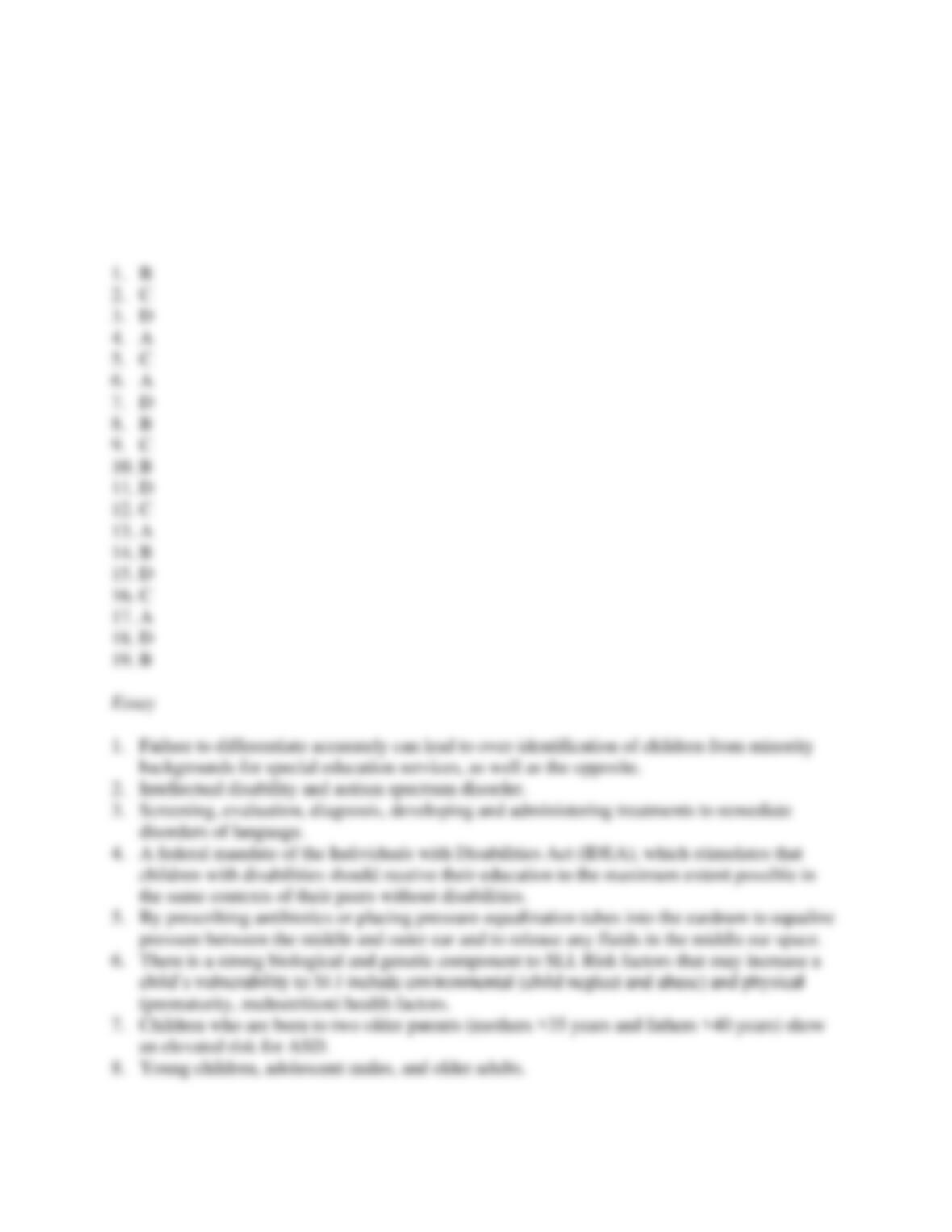
ANSWER KEY
Chapter 10: Language Disorders in Children
Multiple Choice