Version 1 1
Student name:__________
TRUE/FALSE – Write ‘T’ if the statement is true and ‘F’ if the statement is false.
1) The Supreme Court has ruled that journalists may accompany the police when they
execute search warrants, even if the property owners protest, because such press coverage assists
the public in understanding how law enforcement agencies operate.
⊚ true
⊚ false
2) A helicopter hovering above a person’s property at a very low altitude for a prolonged
period of time may constitute a trespass over that person’s property.
⊚ true
⊚ false
3) Plaintiffs’ attorneys are suing not just for how news is reported, but increasingly for how
news is gathered.
⊚ true
⊚ false
4) One of the numbered exemptions to the federal Freedom of Information Act exempts
from disclosure agency records that reveal trade secrets.
⊚ true
⊚ false
5) The U.S. Supreme Court ruled in 2011 in FCC v. AT&T, Inc. that FOIA Exemption
7(c) applies to corporate entities.
⊚ true
⊚ false
Version 1 2
6) In the 2018 case Electronic Privacy Information Center v. Internal Revenue
Service, the U.S. Court of Appeals for the District of Columbia rejected an attempt by the
Electronic Privacy Information Center to obtain President Donald Trump’s tax records from the
Internal Revenue Service through a FOIA request.
⊚ true
⊚ false
7) A growing consensus exists among courts that there is a First Amendment right to record
the police in public.
⊚ true
⊚ false
8) In the 2019 case Food Marketing Institute v. Argus Leader Media, the Supreme
Court expanded the type of “confidential” private business information that does not have to be
disclosed under Exemption 4 of FOIA.
⊚ true
⊚ false
MULTIPLE CHOICE – Choose the one alternative that best completes the statement or
answers the question.
9) Under the federal Freedom of Information Act, a government agency has how many
working or business days to respond to a request for records after it receives the request?
A) 5
B) 10
C) 15
D) 20
10) Records of which of the following are NOT subject to the federal Freedom of
Information Act?
Version 1 3
A) The U.S. Congress
B) The U.S. Supreme Court
C) Both the U.S. Congress and the U.S. Supreme Court
D) The Federal Communications Commission
11) The decision by the U.S. Supreme Court in 2004 in National Archives & Records
Administration v. Favish was about a dispute over access to
A) financial data.
B) death-scene photographs.
C) the military records of President George W. Bush.
D) the special operation forces in Iraq.
12) In making federal FOIA requests, representatives of the news media
A) are charged 50′ for each page that must be duplicated by the responding agency.
B) are not charged any amount for each page that must be duplicated by the responding
agency.
C) receive the first 100 pages of duplicated records free of charge, but then are charged
for each page duplicated after 100.
D) are charged 50′ for each page that must be duplicated by the responding agency, as
well as a reasonable fee for search time that is adjusted each year for inflation.
13) When it comes to journalists recording and taping telephone conversations, the vast
majority of states fall into the category of
A) no-party consent states.
B) one-party consent states.
C) all-party consent states.
D) multi-party consent states.
Version 1 4
14) In determining whether to award attorney fees to a plaintiff who has prevailed in a FOIA
lawsuit against a government agency, courts often consider
A) the wealth of the plaintiff prior to the lawsuit.
B) the commercial benefit to the plaintiff of obtaining the information.
C) both “a” and “b” are correct.
D) neither “a” nor “b” is correct.
15) Journalists who trespass are subject to
A) civil liability.
B) criminal prosecution.
C) both civil liability and criminal prosecution.
D) neither civil liability nor criminal prosecution.
16) Who may request records under the FOIA?
A) journalists
B) any citizen of the United States
C) any citizen or corporation of the United States
D) anyone
17) Which of the following is true about the FOIA?
A) There is no initial fee to file a FOIA request.
B) Despite the 20-day deadline for an agency to respond to a request, the FOIA
requesters frequently face long delays and many agencies fail to respond in 20 days.
C) Under the FOIA, you can make expedited requests.
D) All of the answers are correct.
18) Circuit Courts have
Version 1 5
A) ruled that there is a right of access that applies to information about drugs used in
executions.
B) ruled that there is no right of access that applies to information about drugs used in
executions.
C) come to different conclusions about whether there is a right of access to information
about drugs used in executions, and the U.S. Supreme Court has declined to rule on the issue.
D) ruled that there is a right for death row inmates to access information about drugs
used in executions, but this right does not extend to the press.
19) In 2014, the 10 th U.S. Circuit Court of Appeals held that employees of the NBC
Universal show “Dateline”
A) did not violate the Fourth Amendment rights of Tyrone Clark when they
surreptitiously filmed a seminar he conducted.
B) violated the Fourth Amendment rights of Tyrone Clark when they surreptitiously
filmed a seminar he conducted.
C) violated the privacy rights of Tyrone Clark when they surreptitiously filmed a
seminar he conducted.
D) did not violate the privacy rights of Tyrone Clark when they surreptitiously filmed a
seminar he conducted.
FILL IN THE BLANK. Write the word or phrase that best completes each statement or
answers the question.
20) The case of Wilson v. Layne illustrates the principle that when law enforcement
officials bring reporters during a ride-along inside a private home during an otherwise valid
search, they may violate the _____ Amendment.
21) The federal law adopted in 1974 that is designed to safeguard the privacy of students’
education records is known by the acronym _____.
22) The federal law and rules designed to protect the privacy of information of medical
patients is known by the acronym _____.
Version 1 6
23) The Office of _____ was created as part of the Open Government Act of 2007 to serve as
an ombudsperson and to mediate FOIA disputes as a nonexclusive alternative to litigation.
SHORT ANSWER. Write the word or phrase that best completes each statement or
answers the question.
24) In 2016, President Barrack Obama signed a bill that significantly reformed and improved
access to public records. What is the most important thing the bill accomplished?
25) As described in the textbook, define trespass.
26) Identify the four factors articulated by a federal judge in 2009 for determining whether a
government agency has sufficient “control” over a document to render it an “agency record” for
purposes of the federal Freedom of Information Act.
27) In general, explain how the courts have responded to the argument that the First
Amendment protects the right to gather news.
28) What is a Glomar response?
Version 1 7
Version 1 8
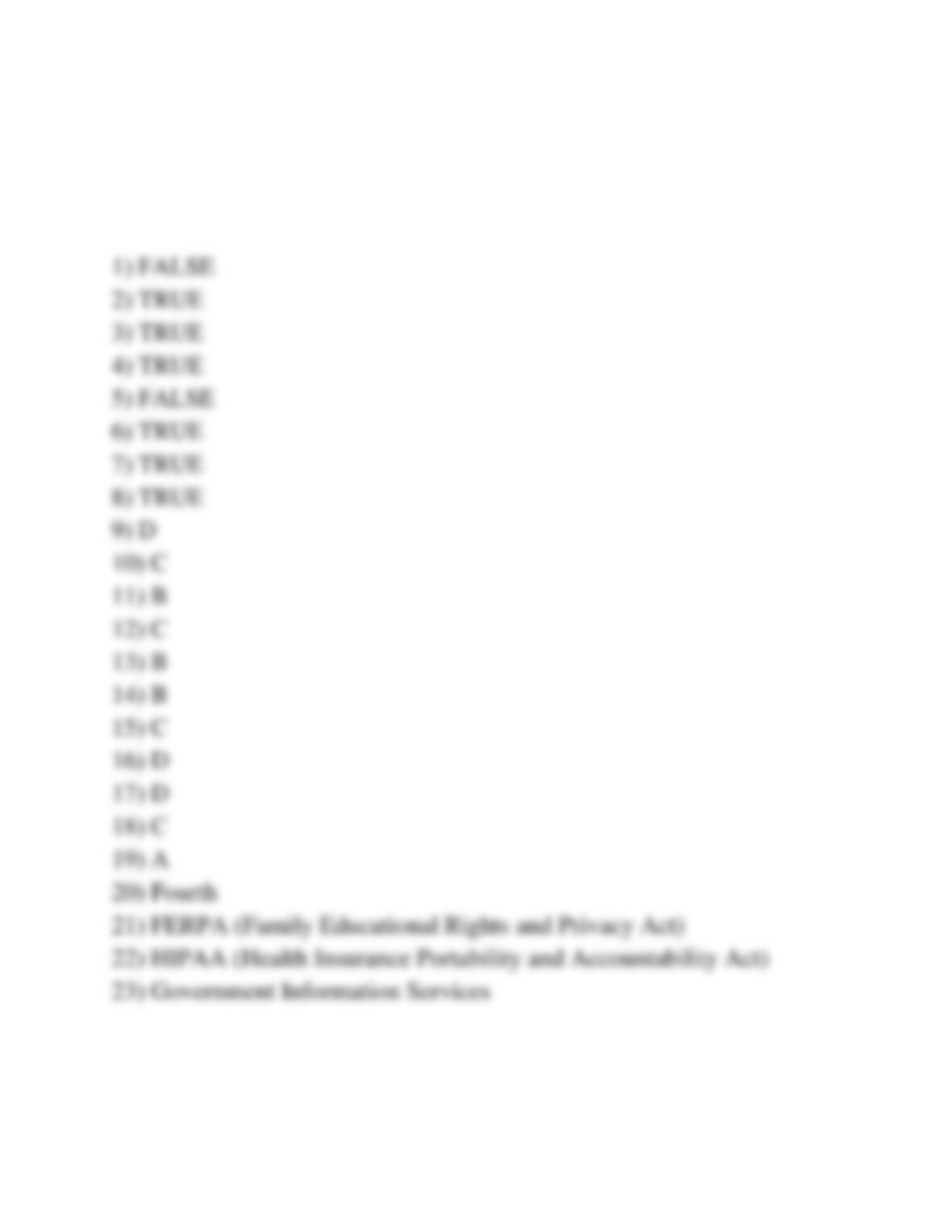
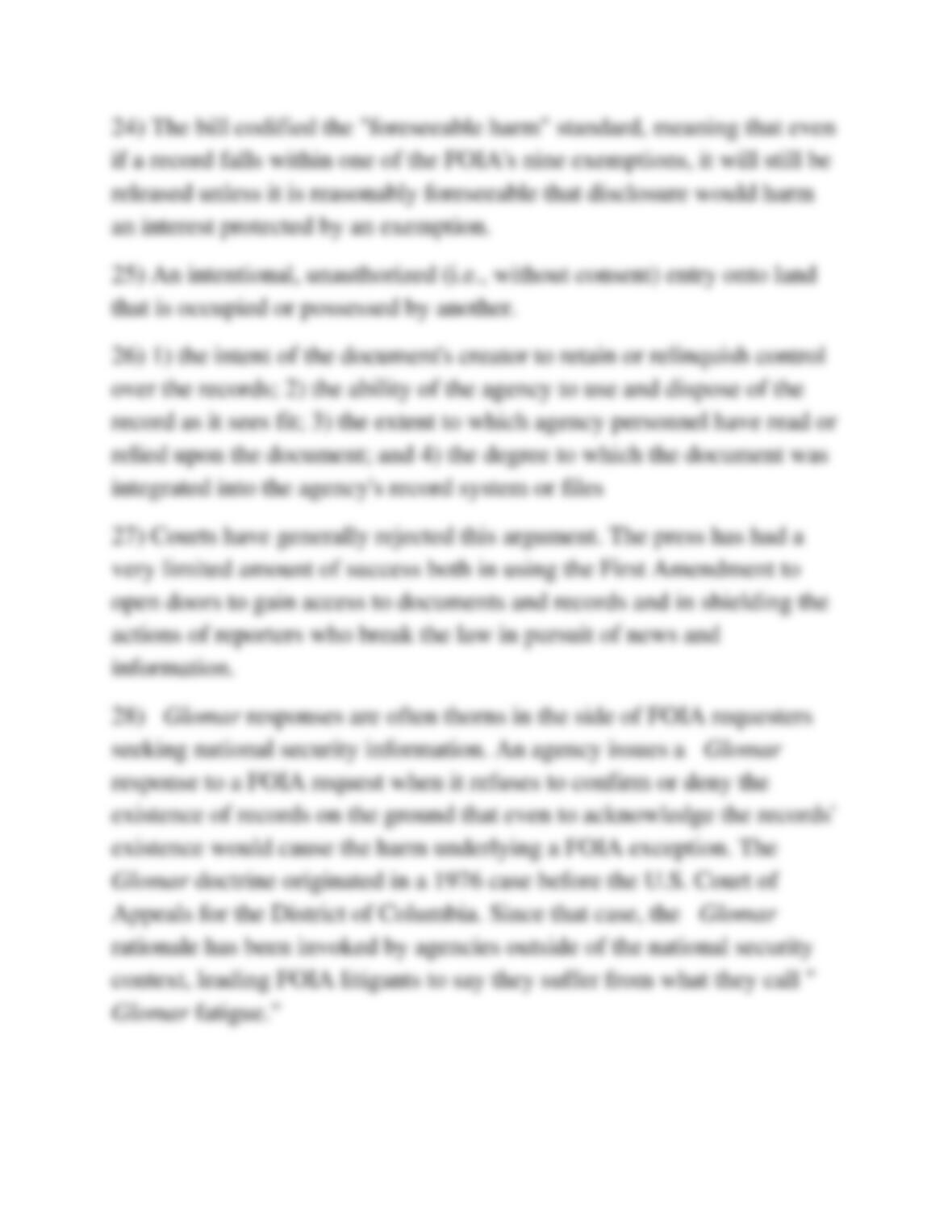
Answer Key
Test name: chapter 9
Version 1 9