Version 1 1
Student name:__________
TRUE/FALSE – Write ‘T’ if the statement is true and ‘F’ if the statement is false.
1) For the purposes of a libel suit, a statement on Facebook has not been “published.”
⊚ true
⊚ false
2) Comments made during a civil court proceeding are not protected by the defense of
qualified privilege.
⊚ true
⊚ false
3) The statute of limitations for libelous matter on the Internet begins the day the matter is
first accessed by a user.
⊚ true
⊚ false
4) The statute of limitations in most states is three years.
⊚ true
⊚ false
5) A First Amendment defense of opinion also protects false statements of fact contained in
an article that is mostly opinion.
⊚ true
⊚ false
6) The Supreme Court has barred the awarding of punitive damages in libel suits.
⊚ true
⊚ false
7) Presumed and punitive damages are typically larger than compensatory damages.
Version 1 2
⊚ true
⊚ false
8) If a plaintiff has consented to the publication of a defamatory statement, he or she cannot
later sue for damages because of that publication.
⊚ true
⊚ false
9) News stories based on inaccurate government reports will normally be protected by the
defense of qualified privilege.
⊚ true
⊚ false
10) In 2016, Congress passed a law that banned so-called “gag clauses” in contracts that
prevented costumers from publicly criticizing companies or imposing a penalty or fine on
customers who gave the business a bad review.
⊚ true
⊚ false
MULTIPLE CHOICE – Choose the one alternative that best completes the statement or
answers the question.
11) Under the statute of limitation for libel rules, the date of publication (when the time limit
begins) for an online publication is
A) the last time the website containing the defamatory content was viewed.
B) the date the defamatory content was published.
C) the date the libelous content was created, regardless of when it was published.
D) none of the answers is correct.
12) A difference between absolute privilege and qualified privilege is
Version 1 3
A) absolute privilege protects speakers in legislative forums, while qualified privilege
protects those who report communications in official government proceedings.
B) absolute privilege has roots in the Constitution, while qualified privilege developed
through the common law and state statutes.
C) qualified privilege only applies if a report is fair and accurate, while accuracy and
fairness do not apply to absolute privilege.
D) all of the answers are correct.
13) In defending a lawsuit based on statements of opinion, the defendant may win the case
A) by arguing that the statements are rhetorical hyperbole.
B) by arguing that the statements are protected by the First Amendment.
C) by arguing that the statements are fair comment and criticism.
D) all of the answers are correct.
14) Which of the following would NOT be covered by the defense of qualified privilege?
A) comments made by a protester on the steps of a police station
B) comments contained in a police blotter or jail register
C) statements made by a mayor during her annual state of the city address
D) all of the answers are correct.
15) The criteria of the Ollman test for libelous opinion include
A) the provability of the statement, the context of the remarks, and the ordinary meaning
of the words.
B) the provability of the statement, the context of the remarks, and the status of the
speaker.
C) the context of the remarks, the status of the speaker, and the nature of the audience.
D) all of the answers are correct.
Version 1 4
16) The libel defense of neutral reportage
A) protects journalists when they report on matters of private concern.
B) protects exaggerated opinion statements.
C) has been accepted by most state courts.
D) none of the answers is correct.
17) Defenses against libel actions, in addition to qualified privilege and the opinion defense,
include
A) consent and innocent action.
B) right of reply and innocent action.
C) consent.
D) innocent action and mitigating circumstances.
18) Which of the following is NOT likely to be an actionable statement under current law?
A) My professor is the worst media law professor.
B) LeBron James is the most overrated player in the history of the NBA.
C) The CEO of Exxon is raping our natural resources.
D) None of the answers is correct.
19) Which of the following is NOT a required element for the privilege for communications
of mutual interest?
A) The statement relates to a public controversy.
B) The speaker has an interest or duty in communicating the information.
C) The statement is made in protection of that interest or performance of that duty.
D) The listener has a corresponding interest or duty.
20) An unverifiable statement of opinion can lose its protection if it:
Version 1 5
A) implies the existence of false, defamatory but undisclosed facts
B) is based on disclosed but false or incomplete facts
C) is based on erroneous assessments of accurate information
D) All of the above.
21) Which of the following statements about damages is true?
A) Compensatory damages are designed to compensate the plaintiff for injuries.
B) Punitive damages are designed to punish the defendant
C) Actual damages are designed to compensate for intangible injuries of reputation
D) Special damages are specific items of monetary loss, such as lost wages, caused by
defamatory statements.
SHORT ANSWER. Write the word or phrase that best completes each statement or
answers the question.
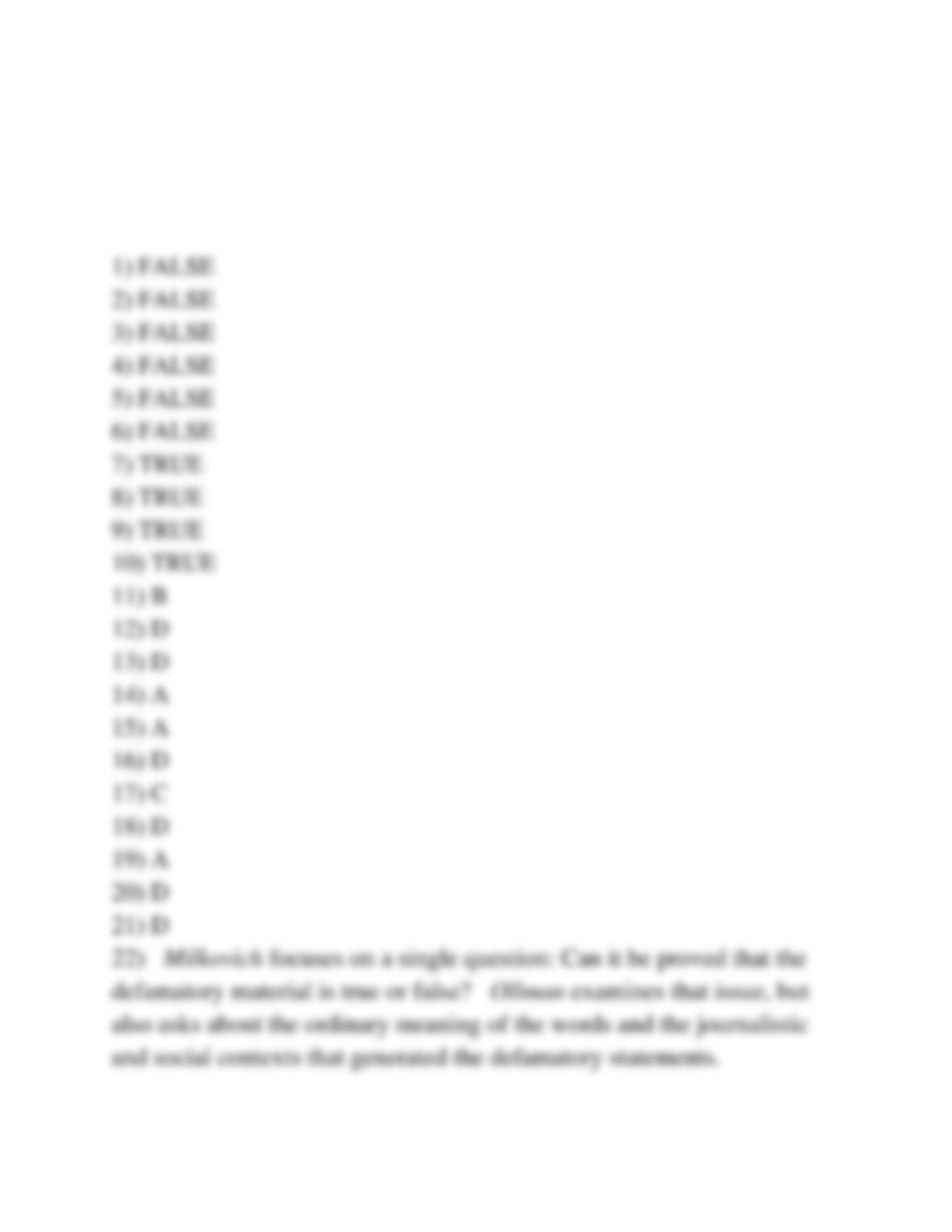
22) How does the Ollman test differ from the Milkovich test as a means of distinguishing
fact from opinion?
Version 1 6
Answer Key
Test name: chapter 6