Version 1 1
Student name:__________
TRUE/FALSE – Write ‘T’ if the statement is true and ‘F’ if the statement is false.
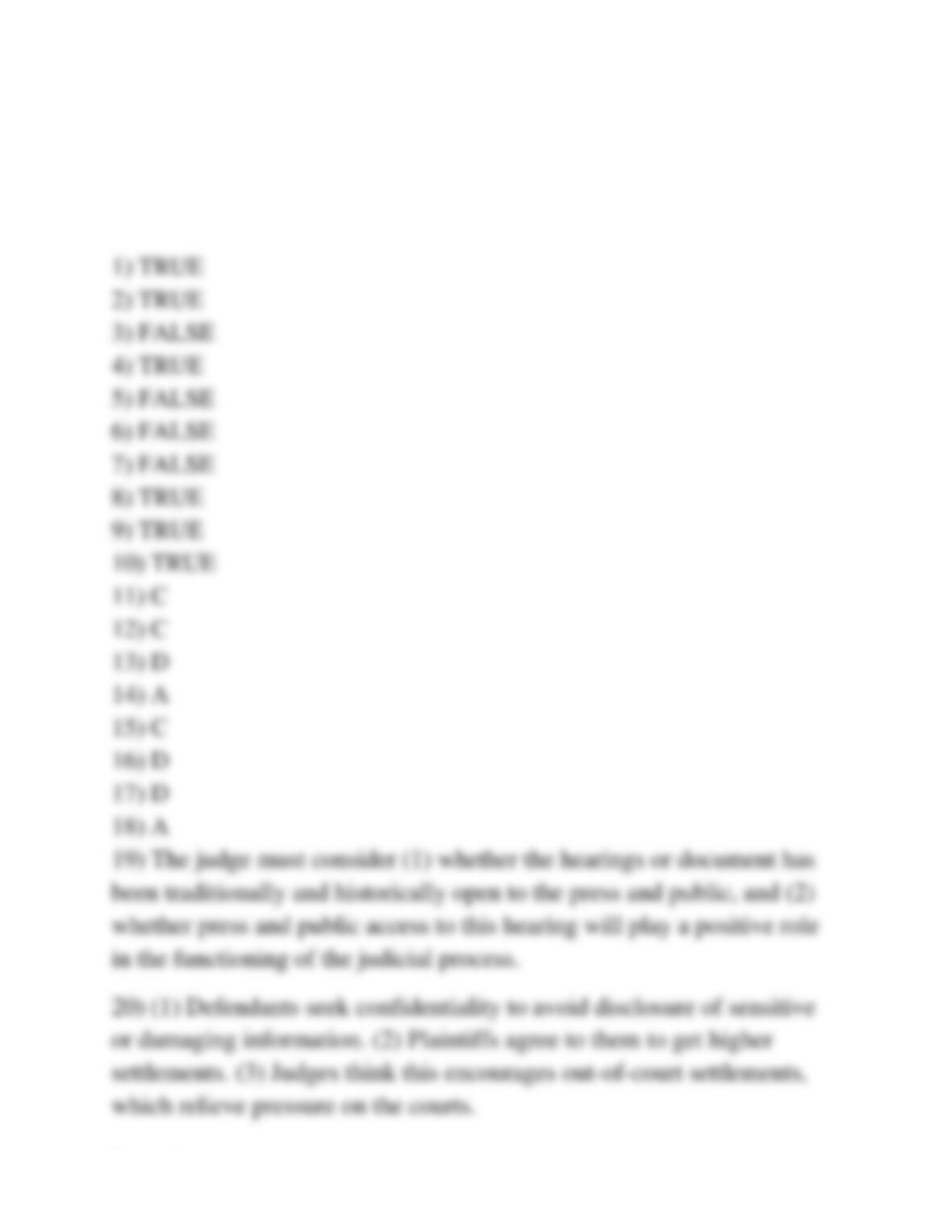
1) Even in controversial, highly publicized cases, jury verdicts are never sealed to protect
jurors from retribution.
⊚ true
⊚ false
2) There is both a common law and a First Amendment right to obtain judicial documents.
⊚ true
⊚ false
3) Although a judge may have difficulty closing a pretrial hearing today, most courts have
ruled that a trial judge may deny access to documents filed in connection with the hearing.
⊚ true
⊚ false
4) Different courts have different rules about using personal electronic devices during a
trial.
⊚ true
⊚ false
5) Broadcasters are now permitted to record and televise executions.
⊚ true
⊚ false
6) Even in states which permit the televising of trials, broadcasters must always get prior
approval from the trial judge before they can bring their cameras into the courtroom.
⊚ true
⊚ false
Version 1 2
7) If a judge orders a trial proceeding closed, only the litigants can formally object to the
order.
⊚ true
⊚ false
8) Most courts have ruled you have a First Amendment right of access to judicial documents
as well as judicial proceedings.
⊚ true
⊚ false
9) In order to close a judicial proceeding, a judge must find there is a substantial probability
that leaving the proceeding open would cause harm.
⊚ true
⊚ false
10) Some courts have ruled there is both a First Amendment right and common law right for
the press and the public to attend criminal trials.
⊚ true
⊚ false
MULTIPLE CHOICE – Choose the one alternative that best completes the statement or
answers the question.
11) In court rulings on whether trials are presumptively open or closed,
A) the Supreme Court has ruled that both criminal and civil trials are open.
B) the Supreme Court has ruled that criminal trials are open, but civil trials are closed.
C) the Supreme Court has ruled that criminal trials are open, and lower federal and state
courts have ruled that civil trials are open.
D) the Supreme Court has ruled that the civil trials are open but criminal trials should be
closed.
Version 1 3
12) Although the press may access many, maybe even most, documents filed in connection
with a trial, reporters are routinely denied access to
A) depositions and court docket sheets.
B) presentencing reports and plea agreements.
C) out-of-court settlements and records entered under a protective order.
D) search warrants and indictments.
13) When considering whether to permit the broadcast of evidence in a criminal case, a court
should consider
A) whether or not the material has been introduced into evidence in open court.
B) whether the broadcast could jeopardize the defendant’s right to a fair trial.
C) what kinds of persons (defendants, witnesses, innocent third parties) are on the video
or audio taped evidence.
D) all of the answers are correct.
14) The test used to determine if a court proceeding is presumptively open is called:
A) the history-and-logic test.
B) the time-and-reason test.
C) the fair trial test.
D) the bench-bar-press test.
15) The Press-Enterprise test is used by judges to determine
A) whether a libel plaintiff is a public figure.
B) whether the use of copyrighted material is permitted under fair use.
C) whether a pretrial proceeding will be open or closed.
D) none of the answers is correct.
Version 1 4
16) Some judges have refused to reveal the names and addresses of jurors sitting in a criminal
trial
A) to protect the jurors from outside pressure.
B) to protect the jurors from harassment by the mass media.
C) to help ensure the safety of the jurors if an unpopular verdict is handed down.
D) all of the answers are correct.
17) While cameras are generally permitted in almost all state courts,
A) they are barred from most federal courts.
B) in many states, the trial judge must still agree to their use in a particular trial.
C) they are not permitted at hearings at the U.S. Supreme Court.
D) all of the answers are correct.
18) The U.S. Supreme Court:
A) does not allow cameras.
B) releases audio recordings of all cases the day after oral arguments.
C) does not allow reporters to take notes during oral arguments.
D) allows reporters to use Twitter during oral arguments.
SHORT ANSWER. Write the word or phrase that best completes each statement or
answers the question.
19) In determining whether a judicial proceeding should be presumed to be open, a judge
must consider what two factors?
20) What are the three reasons that out-of-court settlement agreements are usually sealed?
Version 1 5
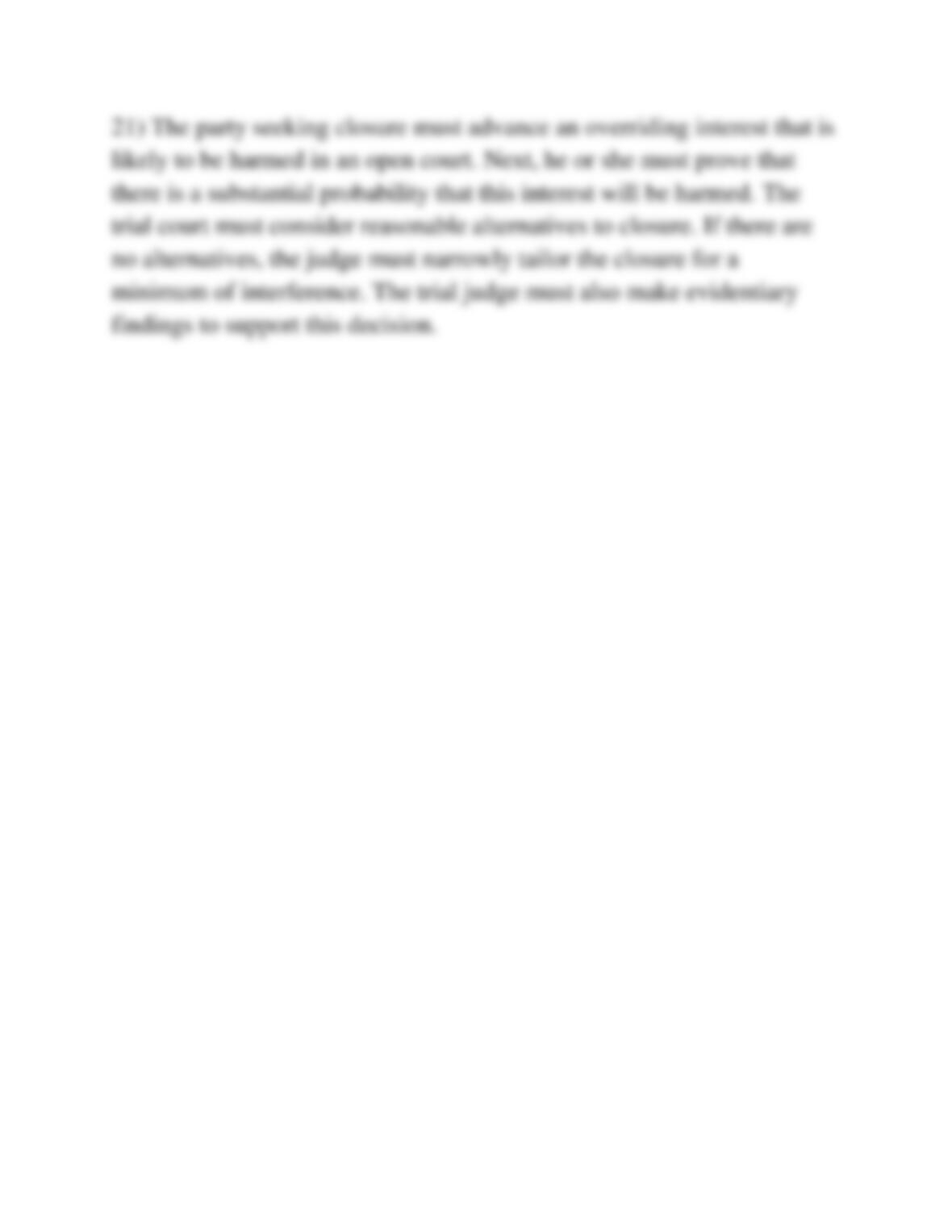
21) What are the steps taken to successfully close a presumptively open pretrial hearing?
Version 1 6
Answer Key
Test name: chapter 12
Version 1 7