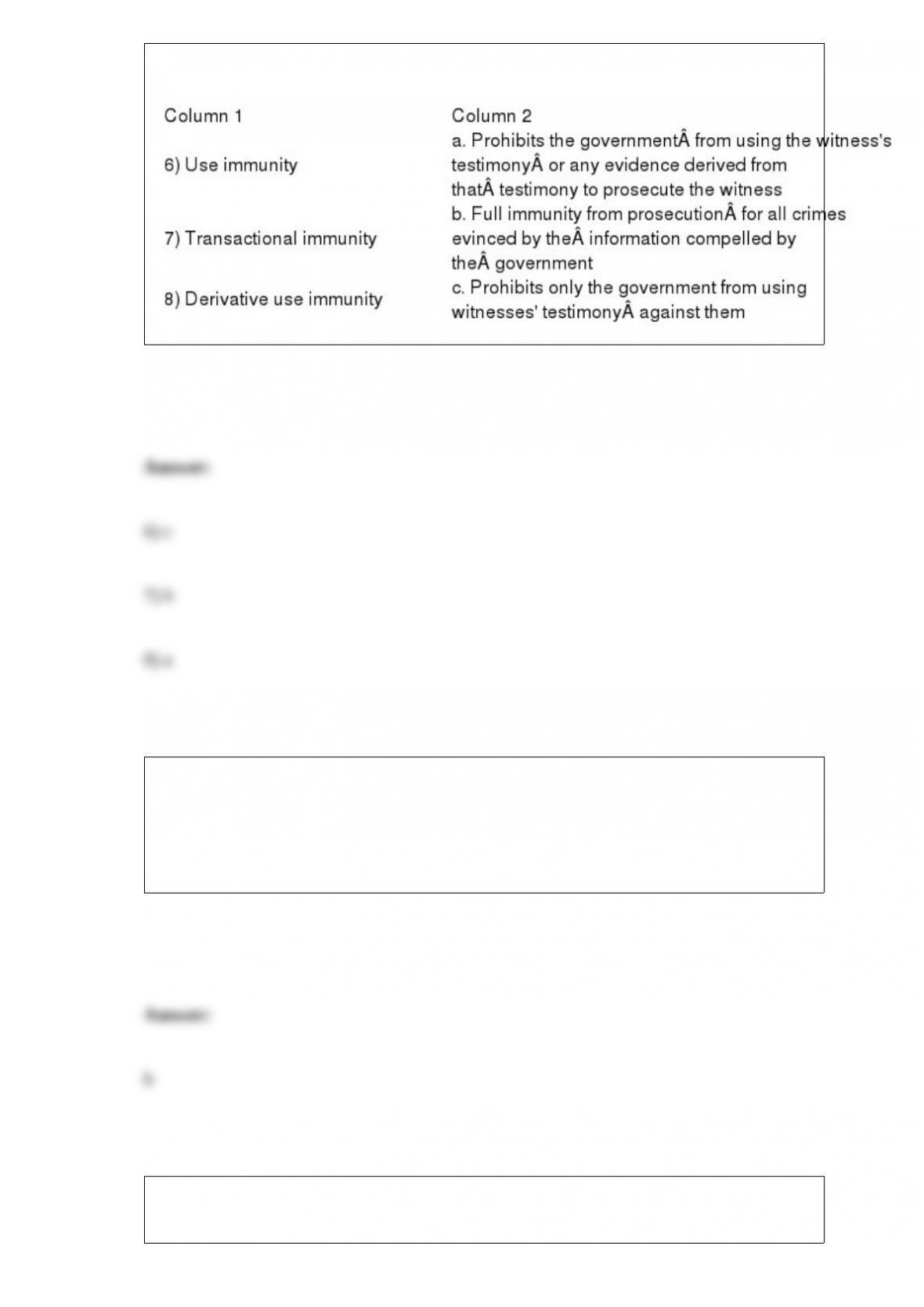
Match the type of immunity in Column 1 with the description in Column 2.
The plaintiff has a right to have a jury decide injunctive relief claims in 1983 cases.
a. True
b. False
A person’s interest in their good name and reputation is considered:

a. a protected liberty interest
b. a tangible property interest
c. a protected life interest
d. all of the above
Agencies may not interpret statutes unless expressly authorized to do so by Congress.
a. True
b. False
Constitutional rights designed to protect the rights of criminal defendants may
be recharacterized as civil wrongs, allowing agencies to exercise a quasi-adjudicative
role in the administration of justice.
a. True
b. False

Rulemaking:
a. concerns past conduct
b. concerns future conduct
c. can concern either past or future conduct
d. concerns only a single present specific conduct at a fixed point in time and neither
looks to the past or future
If an issue is purely legal, an agency may limit the party’s participation in a hearing to a
written submission arguing the law.
a. True
b. False
Notice of a hearing, in most cases, is accomplished by:
a. telephone call

b. e-mail
c. first-class or registered mail
d. subpoena
Written judicial opinions are published in:
a. reporters
b. codes
c. the Federal Register
d. compendiums
A legitimate expectation of receiving a benefit is called an entitlement.
a. True
b. False

An advisory opinion has the same effect as an order resulting from adjudications.
a. True
b. False
In Skinner v. Railway Labor Executive Ass’n, the court determined that:
a. drug and alcohol testing was not subject to Fourth Amendment requirements
because the governmental interest in protecting the public outweighs the privacy
interests of the tested employees
b. any time that a test is invasive of a person’s privacy, the Fourth
Amendment requirements must be adhered to
c. if testing is being conducted by a private party, the government is said not to
be involved and Fourth Amendment procedures are not required
d. the Fourth Amendment imposes probable cause requirements on searches whether
they are administrative or criminal in nature

During the 20th century, the number of federal government employees has:
a. increased in terms of the population
b. decreased in terms of the population
c. stayed relatively level in terms of the population
d. there are no statistics kept to illustrate this point
Article III judges enjoy a lifetime appointment to the bench.
a. True
b. False
Section 1983 actions arise from:
a. the Civil Rights Act of 1864
b. the Civil Rights Act of 1871
c. the Civil Rights Act of 1964
d. the Civil Rights Act of 1991

Under 1983, corporations are considered persons and therefore are entitled to sue and
seek redress for wrongs.
a. True
b. False
Section 1983 does not contain a specific statute of limitations.
a. True
b. False
If a statute provides for judicial review:
a. the statute is preempted by common law traditions
b. no other method may be used to establish a court’s authority to hear a case

c. the agency head nevertheless is authorized to choose the most efficient means
of review
d. the APA authorizes the agency head to reject the statute and utilize a different
method if that method can be proven to be faster and more economical
In most cases, informal agency actions are subject to:
a. de novo review
b. substantial evidence standard review
c. arbitrary, capricious, abuse of discretion standard review
d. none of the above; these decisions are not subject to review
Which of the following is likely to be ruled unconstitutional?
a. Limited delegations of criminal rulemaking to private agencies
b. Limited delegations of criminal rulemaking to public agencies
c. Limited delegations of criminal rulemaking to both private agencies and public
agencies would likely be unconstitutional.
d. None of the above; limited delegations of criminal rulemaking to both private

agencies and public agencies would likely be constitutional.
The Federal Trade Commission is an independent agency.
a. True
b. False
What is the name of the federal law that limits the issuance of declaratory orders to
situations in which a formal adjudication is required?
a. Declaratory Order Act
b. Administrative Procedures Act (APA)
c. Federal Arbitration Act
d. Declaratory Procedure Act

In Perry v. Sindermann, the court determined that college and university tenure
rules and requirements must be in writing and may not be informal or casually applied
for the faculty to have a legitimate interest or expectation.
a. True
b. False
The APA specifies that no hearing is necessary when adjudicative decisions are
based solely on any of the following except:
a. tests
b. elections
c. inspections
d. records
In most instances, the person who carries the burden of production in a case also carries
the burden of persuasion.
a. True
b. False

The standard of review in which a court gives the most significant deference to
the agency decision is called:
a. de novo review
b. substantial evidence standard review
c. arbitrary, capricious, abuse of discretion standard review
d. none of the above; all judicial review is required to offer an equally substantial level
of to the agency decision
Standing refers to:
a. who may sue
b. when suit must be brought
c. where suit must be brought
d. all of the above

ALJs are considered Article III judges.
a. True
b. False
A declaratory order has the same effect as an order resulting from adjudications.
a. True
b. False
When an agency has authority to choose between two or more alternatives, the
agency is said to have _____.
a. enablement
b. discretion
c. statutory prerogative
d. administrative privilege

Under the common law, standing required a showing of:
a. a violation of a legally protected right
b. personal injury
c. financial injury
d. a violation of a legally protected right and/or personal injury
e. personal injury and/or financial injury
Interpretive rules have the force of a statute.
a. True
b. False

A legislative veto is a mechanism used by the president to invalidate Congressional
enactments deemed procedurally unconstitutional.
a. True
b. False
Interpretive rules may not be used to fill in the gaps of legislation.
a. True
b. False
In Bowers v. City of Chattanooga, the court decided that because there was a clear
plan and policy of the state and city, the decision left to a bus driver on where to stop at
a particular intersection was:
a. executive
b. operational
c. discretionary
d. managerial

Explain why the nondelegation doctrine has less applicability in matters of foreign
affairs than it does in domestic affairs. Cite at least one case to support your answer.
A directive to a person or organization to appear to testify with specified documents is
called a subpoena _____.
Discuss how the Internal Revenue Service (IRS) uses advisory opinions.

In the case _____, the First Circuit Court of Appeals rejected a challenge to President
George W. Bush’s decision to wage war on Iraq.
A declaratory order is a(n) _____ equivalent of a judicial declaratory judgment.
_____ rulemaking is required only when a statute clearly commands that a rule be made
on the record after an opportunity for an agency hearing.

Article III of the U.S. Constitution requires an actual case or _____ before federal
courts have jurisdiction over a dispute.
The Fourth Amendment requires that a ____ authorizing a search be obtained before the
search is conducted.
In Clinton v. City of New York, the U.S. Supreme Court found that Congress violated the
separation of powers in passing the _____ Act, a law that delegated to the president the
power to strike individual expenditures from the congressionally enacted budget.
Generally, agencies are free to make rules without conducting hearings, whereas
hearing as usually required with adjudications. Discuss why hearings are not required
with informal rulemaking. Do you think that agencies should be required to conduct

hearings for all rulemaking? Explain your position.
Answer:Student answers will vary.
The U.S. Supreme Court has held that taxpayers may have ____ if a nexus between
the taxpayers’ status and the expenditure can be shown and it can be shown that the
statute exceeds a constitutional limitation.
____ is when a record producer is required to provide records to the agency.
Not all classifications are violative of equal protection. Discuss whether you think
sexual orientation should be considered a protected classification under the Equal
Protection Clause. Explain your position.
Answer:Student answers will vary.

The APA provides that an agency may issue a(n) _____ order to resolve questions of
law that have arisen but have not yet been contested.
In Schechter Poultry Corp. v. United States and Panama Refining Co. v. Ryan, the U.S.
Supreme Court invalidated two delegations created by Congress during the Great ____
to confront the serious economic crisis quickly.
In today’s world, there is a growing trend toward privatization of governmental
services. What are some of the benefits and detriments of privatization? What is your
position on privatization and why?
Time limitations established by Congress are _____enforced by federal courts.
The APA requires that parties be _____ informed of the time, place, and nature of the
hearing.