
Article II of the Constitution gives Congress the power to delegate the appointment of
inferior agency officers to agency heads.
a. True
b. False
Which type of administrative agency’s head answers to the president and may be
disciplined or terminated at the president’s will?
a. Independent agency
b. Executive agency
c. Public service agency
d. Social welfare agency
Which of the following is not an argument supporting privatization?
a. Government often lacks the expertise to perform certain necessary functions.
b. Privatization increases the size of government.
c. The government often lacks the proper resources to deal with certain emergencies.
d. Private companies are often more productive, reducing government costs.

The government must satisfy the Due Process and Equal Protection Clauses
when issuing, suspending, or revoking licenses.
a. True
b. False
Venue under the FOIA and Privacy Act permits a lawsuit in any of the following except:
a. where the records are located
b. where the complainant resides
c. the District of Columbia
d. where the incident or occurrence that the information pertains to occurred
Formal rulemaking procedures require a public hearing conducted before a jury.
a. True
b. False
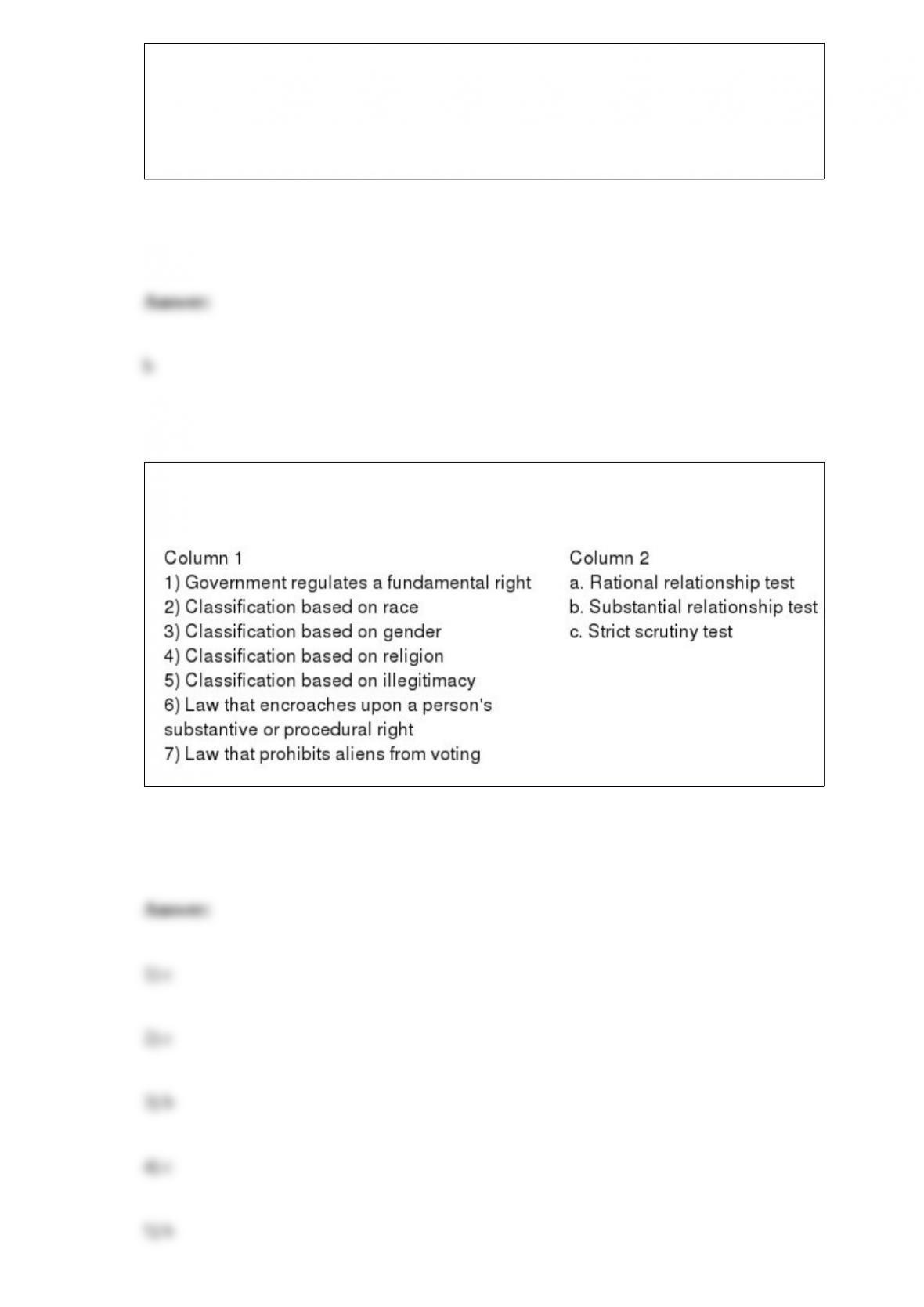
Match the type of government action in Column 1 to the appropriate standard of review
in Column 2.

If an individual speaks as a citizen on an issue of _____, the government can restrict
speech only to the extent necessary to ensure the efficient and effective operation of the
employer.
a. private matter
b. public concern
c. private matter and public concern
d. none of the above
A state law classifies people by gender. The strict scrutiny test will always be applied to
determine if the action is constitutional.
a. True
b. False

Through the privatization of prisons, as of 2001, approximately 20% of federal
and state prisoners were housed in private prisons.
a. True
b. False
Res judicata applies only to final decisions on the merits.
a. True
b. False
If it appears that a crime has been committed, the prosecutor is required to conduct
an investigation and may not selectively investigate or prosecute suspected criminals.
a. True
b. False

The highest officer of an executive agency is called a:
a. secretary
b. director
c. chairperson
d. principal
Regulations are subordinate to statutes but have equal weight when applied.
a. True
b. False
The Freedom of Information Act (FOIA) permits for _____examination of
records conducted by the presiding judge, usually in chambers outside the presence of
the public, to preserve the confidentiality of documents while giving the judge the
opportunity to review the records and make an informed decision.

Regulatory agencies exist at both the federal and state levels.
a. True
b. False
Mediation is also known as conciliation.
a. True
b. False
Which of the following is not a positive value attributable to the privacy issue related to
disclosure and nondisclosure of information?
a. It preserves trust, autonomy, and right to remain silent.
b. It preserves personal facts, control, personal independence, and dignity.
c. It preserves the rights of a few while sacrificing the public’s need to know.

d. It preserves freedom from coercion, excluded facts, and encourages trusting
communication.
In which of the following was a Congressional delegation of authority found improper?
a. Lichter v. United States
b. Arizona v. California
c. Panama Refining Co. v. Ryan
d. Crowell v. Benson
Which of the following is not an APA-recognized procedural form of rulemaking?
a. Formal rulemaking
b. Informal rulemaking
c. Exempted rulemaking
d. Hybrid rulemaking

Under the Privacy Act, any agency that proposes to establish or alter any system
of records must provide notice to:
a. Congress
b. the Office of Management and Budget
c. Congress and the Office of Management and Budget
d. none of the above; changes are published in the Federal Register and a hearing is
conducted to decide the appropriateness and legality of the changes
In most cases, where there is a conflict between an executive order and a statute, the
executive order will prevail.
a. True
b. False
In Chandler v. Miller, the Georgia legislature enacted a statute requiring candidates

for public office to submit to drug tests. The court determined:
a. the public’s interest in having drug-free political representatives outweighs
the candidate’s privacy rights, so the law was constitutional
b. the interest in having drug-free political officials did not constitute a special need,
so the law was unconstitutional
c. although the state’s interest did not constitute a special need, the symbolic need
was sufficient to validate the constitutionality of the statute
d. although political officials do not operate nuclear power plants, handle or sell
firearms, or operate equipment that directly affects the public, they regulate these and
other public safety-intensive industries, so they must be held to the same standards as
the regulated industry employees, making the statute constitutional
Which test does the United States Supreme Court require to be used when
examining laws involving illegitimate children?
a. The substantial relationship test
b. The strict scrutiny test
c. The reasonable relationship test
d. The rational relationship test

The U.S. Constitution expressly states all of the federal administrative agencies.
a. True
b. False
The APA encourages agencies to use alternative dispute resolution.
a. True
b. False
A condition that is permanent or outside a person’s control is called a/an:
a. immutable condition
b. integral condition
c. fundamental condition
d. primary condition

Which article in the U.S. Constitution contains the Necessary and Proper Clause, which
provides that Congress may enact all laws necessary and proper to carry out Congress’s
other enumerated powers?
a. Article I
b. Article II
c. Article III
d. Article IV
Which of the following is not a measure taken to assure ALJ independence?
a. All ALJs are paid the same salary by the government, adjusted only by years
of experience.
b. ALJs are selected from a list of qualified applicants by the Civil Service
Commission.
c. ALJs are assigned to cases using a rotation.
d. ALJs may be removed for good cause only.

Affirmative action programs encourage the use of quotas to attain hiring goals designed
to provide advantages to historically disadvantaged groups.
a. True
b. False
Criminal acts under the Privacy Act are felonies.
a. True
b. False
Interrogatories may include questions asking for both narrative and short factual
answers.
a. True
b. False