Foundations of Financial Management, 17e (Block)
Chapter 9 The Time Value of Money
1) An amount of money to be received in the future is worth less today than the stated present
value amount.
2) Discounting refers to devaluing the item from the higher future value amount to the present
value amount through the consideration of interest.
3) The process of earning more interest on a previous period’s interest is called future value.
4) Compounding refers to the growth process that turns $1 today into a greater value several
periods in the future.
5) The interest factor for the future value of a single sum is equal to (1 + n)i.
6) The time value of money is not a useful concept in determining the value of a bond or in
capital investment decisions.
7) If a single amount were put on deposit at a given interest rate and allowed to grow, its future
value could be determined by reference to a “future value of $1″ table.
8) The time value of money concept is fundamental to the analysis of cash inflow and outflow
decisions covering multiple periods of time.
9) The future value is the same concept as the way money grows in a bank account.
10) Time value of money considers many changes to the value of the dollar such as interest,
inflation, deflation, etc.
11) A major disadvantage to time value of money is that is only considers one item that changes
the value of the dollar such as interest.
4
12) Cash flow decisions that ignore time value of money will probably not be as accurate as
those decisions that do consider time value of money.
13) The present value of a positive future inflow can become negative as discount rates become
higher and higher.
14) The interest factor for a future value (FVIF) is equal to (1 + i)n.
15) The formula PV = FV(1 + n)i will determine the present value of $1.
16) Present value is the opposite of the future value.
17) The concept of present value is a sum payable in the present is worth less in the future than
in the stated amount today.
18) To determine the current worth of four annual payments of $1,000 at 4% annual interest, one
would refer to a time value of money table for the present value of $1.
19) As the interest rate increases, the interest factor (IF) for the present value of $1 increases.
20) The interest factor for the present value of a single amount is the reciprocal of the future
value interest factor.
21) The interest factor for the present value of a single sum is equal to (1 + i)/i.
22) Higher interest rates reduce the present value amount.
23) In determining the future value of an ordinary annuity, the final payment is not compounded
at all.
24) The future value of an ordinary annuity assumes that the payments are received at the end of
the year and that the last payment does not compound.
25) Time value of money can be calculated in a few different ways such as time value of money
tables, calculator, excel, and/or equation, which all come up with a very similar answer.
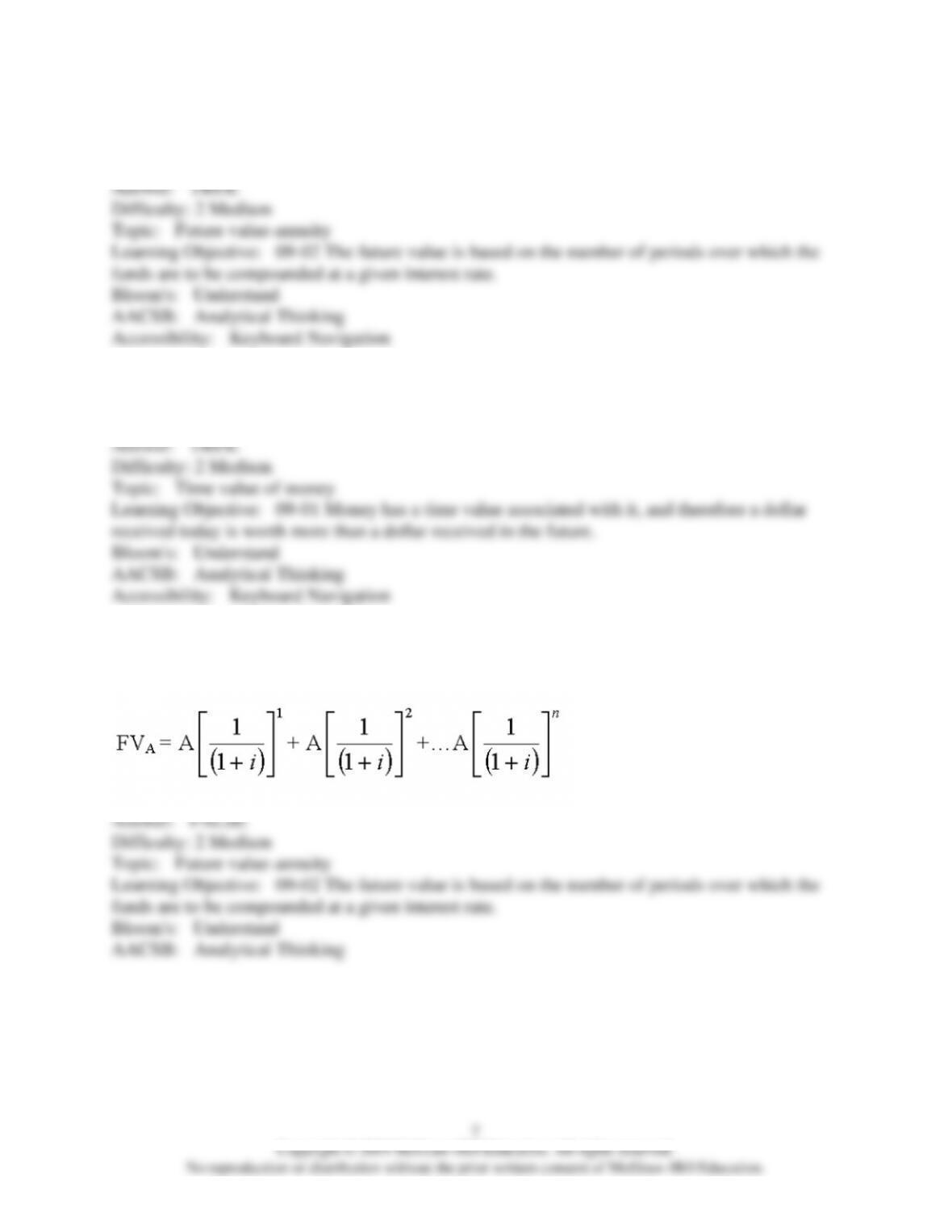
26) The future value of an annuity table provides a “shortcut” for calculating the future value of a
steady stream of payments, denoted as A. The same value can be calculated directly from the
following equation:
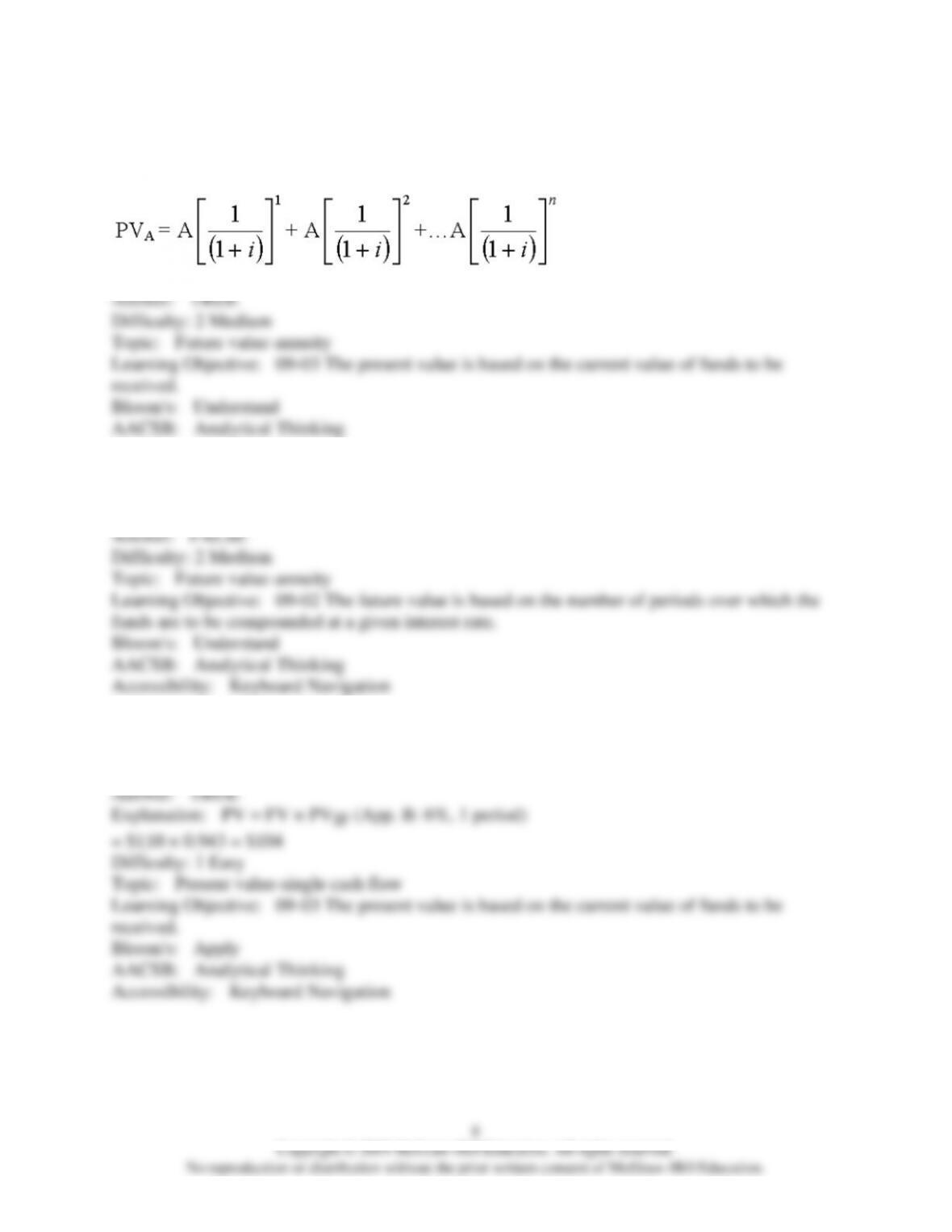
27) The present value of an annuity table provides a “shortcut” for calculating the present value
of a steady stream of payments, denoted as A. The same value can be calculated directly from
the following equation:
28) The amount of annual payments necessary to accumulate a desired future total can be found
by reference to the present value of an annuity table.
29) If an individual’s cost of capital were 6%, the person would prefer to receive $110 at the end
of one year rather than $100 right now.
30) In evaluating capital investment projects, current outlays must be judged against the current
value of future benefits.
31) The farther into the future any given amount is received, the larger its present value.
32) The interest factor for the future value of an annuity is simply the sum of the interest factors
for the future value using the same number of periods.
33) An annuity is a series of consecutive payments of equal amount.
34) Using semiannual compounding rather than annual compounding will increase the future
value of an annuity.
35) Compounding more than once a year (semiannually, quarterly, or monthly) will increase the
interest rate and number of periods used in the calculations.
36) When the inflation rate is zero, the present value of $1 is identical to the future value of $1.
37) The amount of annual payments necessary to repay a mortgage loan can be found by
reference to the present value of an annuity table.
38) In paying off a mortgage loan, the amount of the periodic payment that goes toward the
reduction of principal increases over the life of the mortgage.
39) The time value of money concept becomes less critical as the prime rate of lending increases.
40) Discounted at 6%, $1,000 received three years from now is worth less than $800 received
today.
41) Discounted at 10%, $1,000 received at the end of each year for three years is worth less than
$2,700 received today.
42) When adjusting for semiannual compounding of an annuity, the adjustments include
multiplying the periods and annuity payment amount by 2.
43) Calculation of the yield of an investment provides the total return over multiple years.
44) To calculate “Future or Present Values of an “Annuity Due,” we must assume that payments
happen twice as often.
45) Under what conditions must a distinction be made between money to be received today and
money to be received in the future?
A) A period of recession
B) When idle money can earn a positive return
C) When there is no risk of nonpayment in the future
D) When current interest rates are different from expected future rates
46) As the compounding rate becomes lower and lower, the future value of inflows approaches
A) 0.
B) the present value of the inflows.
C) infinity.
D) More information is needed to answer the question.
47) Time value of money considers which of the following item(s) that change the value of
money?
A) Inflation
B) Interest
C) Currency changes
D) All of the options are true
48) If you invest $10,000 today at 10% interest, how much will you have in 10 years?
A) $13,860
B) $25,940
C) $3,860
D) $80,712
49) In determining the future value of a single amount, one must consider
A) the periodic payments at a given interest rate and time.
B) the future value at a given interest rate and time.
C) the future periodic payments discounted at a given interest rate and time.
D) the present value at a given interest rate and time.
50) The concept of time value of money is important to financial decision making because
A) it emphasizes earning a return on invested capital.
B) it recognizes that earning a return makes $1 today worth more than $1 received in the future.
C) it can be applied to future cash flows in order to compare different streams of income.
D) All of these options are true.
51) As the discount rate becomes higher and higher, the present value of inflows approaches
A) 0.
B) minus infinity.
C) plus infinity.
D) More information is needed.
52) How much must you invest today at 8% interest in order to see your investment grow to
$8,000 in 10 years?
A) $3,070
B) $3,704
C) $3,105
D) $17,272
53) How much must you invest today at 10% interest in order to see your investment grow to
$5,000 in 3 years?
A) $3,050
B) $3,555
C) $7,105
D) $3,755
54) An annuity may best be defined as
A) a payment at a fixed interest rate.
B) a series of payments of unequal amount.
C) a series of yearly payments, regardless of amount.
D) a series of consecutive payments of equal amounts.
55) You are to receive $12,000 at the end of five years. The available yield on investments is
6%. Which table would you use to determine the value of that sum today?
A) Present value of an annuity of $1
B) Future value of an annuity of $1
C) Present value of $1
D) Future value of $1
56) You are to receive $12,000 at the end of each of five years. The available yield on
investments is 6%. Which table would you use to determine the value of that sum today?
A) Present value of an annuity of $1
B) Future value of an annuity of $1
C) Present value of $1
D) Future value of $1
57) As the interest rate increases, the present value
A) increases.
B) decreases.
C) remains the same.
D) Not enough information is given to tell.
58) As the time period until receipt increases, the present value
A) decreases.
B) remains the same.
C) increases.
D) Not enough information is given to tell.
59) A company wants to find the yield on an investment that requires a certain amount today in
which then returns a single amount some time in the future. Which time value of money table
would the company use?
A) the present value of $1 or the future value of $1.
B) the future value of an annuity of $1.
C) present value of an annuity of $1.
D) None of these are correct.
60) If a father and mother set aside a certain amount each year for their daughter’s college fund,
which table would be used to determine the amount necessary to be put away each year in order
to reach a certain goal once the daughter attends college?
A) The present value of $1
B) The future value of $1.
C) The future value of an annuity of $1.
D) Present value of an annuity of $1.
61) Shah sets aside $2,000 each year for five years. After five years, he then withdraws the funds
on an equal annual basis for the next four years. If Shah wishes to determine the amount of the
annuity to be withdrawn in years 6 through 9, he should use the following two tables in this
order:
A) present value of an annuity of $1; future value of an annuity of $1
B) future value of an annuity of $1; present value of an annuity of $1
C) future value of an annuity of $1; present value of $1
D) future value of an annuity of $1; future value of $1