Chapter 09 – The Capital Asset Pricing Model
9-1
Chapter 09
The Capital Asset Pricing Model
Multiple Choice Questions
1. In the context of the Capital Asset Pricing Model (CAPM) the relevant measure of risk is
A. unique risk.
Difficulty: Easy
2. In the context of the Capital Asset Pricing Model (CAPM) the relevant risk is
A. unique risk.
Difficulty: Easy
Chapter 09 – The Capital Asset Pricing Model
9-2
3. In the context of the Capital Asset Pricing Model (CAPM) the relevant risk is
A. unique risk.
Difficulty: Easy
4. According to the Capital Asset Pricing Model (CAPM) a well diversified portfolio’s rate of
return is a function of
D. reinvestment risk.
E. none of the above.
Difficulty: Easy
5. According to the Capital Asset Pricing Model (CAPM) a well diversified portfolio’s rate of
return is a function of
D. reinvestment risk.
E. none of the above.
Difficulty: Easy
Chapter 09 – The Capital Asset Pricing Model
9-3
6. According to the Capital Asset Pricing Model (CAPM) a well diversified portfolio’s rate of
return is a function of
D. reinvestment risk.
E. none of the above.
Difficulty: Easy
7. The market portfolio has a beta of
D. 0.5.
E. none of the above
Difficulty: Easy
8. The risk-free rate and the expected market rate of return are 0.06 and 0.12, respectively.
According to the capital asset pricing model (CAPM), the expected rate of return on security
X with a beta of 1.2 is equal to
A. 0.06.
B. 0.144.
Difficulty: Easy
Chapter 09 – The Capital Asset Pricing Model
9-4
9. The risk-free rate and the expected market rate of return are 0.056 and 0.125, respectively.
According to the capital asset pricing model (CAPM), the expected rate of return on a security
with a beta of 1.25 is equal to
D. 0.134
E. 0.117
Difficulty: Easy
10. Which statement is not true regarding the market portfolio?
A. It includes all publicly traded financial assets.
B. It lies on the efficient frontier.
Difficulty: Moderate
11. Which statement is true regarding the market portfolio?
A. It includes all publicly traded financial assets.
B. It lies on the efficient frontier.
Difficulty: Moderate
Chapter 09 – The Capital Asset Pricing Model
9-5
12. Which statement is not true regarding the Capital Market Line (CML)?
A. The CML is the line from the risk-free rate through the market portfolio.
Difficulty: Moderate
13. Which statement is true regarding the Capital Market Line (CML)?
A. The CML is the line from the risk-free rate through the market portfolio.
B. The CML is the best attainable capital allocation line.
Difficulty: Moderate
Chapter 09 – The Capital Asset Pricing Model
9-6
14. The market risk, beta, of a security is equal to
D. the variance of the security’s returns divided by the variance of the market’s returns.
E. none of the above.
Difficulty: Moderate
15. According to the Capital Asset Pricing Model (CAPM), the expected rate of return on any
security is equal to
A. Rf + [E(RM)].
Difficulty: Moderate
Chapter 09 – The Capital Asset Pricing Model
9-7
16. The Security Market Line (SML) is
A. the line that describes the expected return-beta relationship for well-diversified portfolios
only.
B. also called the Capital Allocation Line.
Difficulty: Moderate
17. According to the Capital Asset Pricing Model (CAPM), fairly priced securities
A. have positive betas.
Difficulty: Moderate
18. According to the Capital Asset Pricing Model (CAPM), under priced securities
A. have positive betas.
B. have zero alphas.
Difficulty: Moderate
Chapter 09 – The Capital Asset Pricing Model
9-8
19. According to the Capital Asset Pricing Model (CAPM), over priced securities
A. have positive betas.
B. have zero alphas.
Difficulty: Moderate
20. According to the Capital Asset Pricing Model (CAPM),
A. a security with a positive alpha is considered overpriced.
B. a security with a zero alpha is considered to be a good buy.
Difficulty: Moderate
21. According to the Capital Asset Pricing Model (CAPM), which one of the following
statements is false?
D. In equilibrium, all securities lie on the security market line.
E. All of the above statements are true.
Difficulty: Moderate
Chapter 09 – The Capital Asset Pricing Model
9-9
22. In a well diversified portfolio
A. market risk is negligible.
B. systematic risk is negligible.
Difficulty: Moderate
23. Empirical results regarding betas estimated from historical data indicate that
A. betas are constant over time.
B. betas of all securities are always greater than one.
Difficulty: Moderate
24. Your personal opinion is that a security has an expected rate of return of 0.11. It has a beta
of 1.5. The risk-free rate is 0.05 and the market expected rate of return is 0.09. According to
the Capital Asset Pricing Model, this security is
A. underpriced.
B. overpriced.
Difficulty: Moderate
Chapter 09 – The Capital Asset Pricing Model
9-10
25. The risk-free rate is 7 percent. The expected market rate of return is 15 percent. If you
expect a stock with a beta of 1.3 to offer a rate of return of 12 percent, you should
A. buy the stock because it is overpriced.
Difficulty: Moderate
26. You invest $600 in a security with a beta of 1.2 and $400 in another security with a beta
of 0.90. The beta of the resulting portfolio is
A. 1.40
B. 1.00
Difficulty: Moderate
27. A security has an expected rate of return of 0.10 and a beta of 1.1. The market expected
rate of return is 0.08 and the risk-free rate is 0.05. The alpha of the stock is
D. 5.5%.
E. none of the above.
Difficulty: Moderate
Chapter 09 – The Capital Asset Pricing Model
9-11
28. Your opinion is that CSCO has an expected rate of return of 0.13. It has a beta of 1.3. The
risk-free rate is 0.04 and the market expected rate of return is 0.115. According to the Capital
Asset Pricing Model, this security is
A. underpriced.
Difficulty: Moderate
29. Your opinion is that CSCO has an expected rate of return of 0.1375. It has a beta of 1.3.
The risk-free rate is 0.04 and the market expected rate of return is 0.115. According to the
Capital Asset Pricing Model, this security is
A. underpriced.
B. overpriced.
Difficulty: Moderate
30. Your opinion is that CSCO has an expected rate of return of 0.15. It has a beta of 1.3. The
risk-free rate is 0.04 and the market expected rate of return is 0.115. According to the Capital
Asset Pricing Model, this security is
D. cannot be determined from data provided.
E. none of the above.
Difficulty: Moderate
Chapter 09 – The Capital Asset Pricing Model
9-12
31. Your opinion is that Boeing has an expected rate of return of 0.112. It has a beta of 0.92.
The risk-free rate is 0.04 and the market expected rate of return is 0.10. According to the
Capital Asset Pricing Model, this security is
D. cannot be determined from data provided.
E. none of the above.
Difficulty: Moderate
32. Your opinion is that Boeing has an expected rate of return of 0.0952. It has a beta of 0.92.
The risk-free rate is 0.04 and the market expected rate of return is 0.10. According to the
Capital Asset Pricing Model, this security is
A. underpriced.
B. overpriced.
Difficulty: Moderate
33. Your opinion is that Boeing has an expected rate of return of 0.08. It has a beta of 0.92.
The risk-free rate is 0.04 and the market expected rate of return is 0.10. According to the
Capital Asset Pricing Model, this security is
A. underpriced.
B. overpriced.
Difficulty: Moderate

Chapter 09 – The Capital Asset Pricing Model
9-13
34. As a financial analyst, you are tasked with evaluating a capital budgeting project. You
were instructed to use the IRR method and you need to determine an appropriate hurdle rate.
The risk-free rate is 4 percent and the expected market rate of return is 11 percent. Your
company has a beta of 1.0 and the project that you are evaluating is considered to have risk
equal to the average project that the company has accepted in the past. According to CAPM,
the appropriate hurdle rate would be ______%.
A. 4
B. 7
Difficulty: Moderate
35. As a financial analyst, you are tasked with evaluating a capital budgeting project. You
were instructed to use the IRR method and you need to determine an appropriate hurdle rate.
The risk-free rate is 4 percent and the expected market rate of return is 11 percent. Your
company has a beta of 1.4 and the project that you are evaluating is considered to have risk
equal to the average project that the company has accepted in the past. According to CAPM,
the appropriate hurdle rate would be ______%.
D. 4
E. 1.4
Difficulty: Moderate
Chapter 09 – The Capital Asset Pricing Model
9-14
36. As a financial analyst, you are tasked with evaluating a capital budgeting project. You
were instructed to use the IRR method and you need to determine an appropriate hurdle rate.
The risk-free rate is 4 percent and the expected market rate of return is 11 percent. Your
company has a beta of 0.75 and the project that you are evaluating is considered to have risk
equal to the average project that the company has accepted in the past. According to CAPM,
the appropriate hurdle rate would be ______%.
A. 4
Difficulty: Moderate
37. As a financial analyst, you are tasked with evaluating a capital budgeting project. You
were instructed to use the IRR method and you need to determine an appropriate hurdle rate.
The risk-free rate is 4 percent and the expected market rate of return is 11 percent. Your
company has a beta of 0.67 and the project that you are evaluating is considered to have risk
equal to the average project that the company has accepted in the past. According to CAPM,
the appropriate hurdle rate would be ______%.
A. 4
Difficulty: Moderate
Chapter 09 – The Capital Asset Pricing Model
9-15
38. As a financial analyst, you are tasked with evaluating a capital budgeting project. You
were instructed to use the IRR method and you need to determine an appropriate hurdle rate.
The risk-free rate is 5 percent and the expected market rate of return is 10 percent. Your
company has a beta of 0.67 and the project that you are evaluating is considered to have risk
equal to the average project that the company has accepted in the past. According to CAPM,
the appropriate hurdle rate would be ______%.
A. 10
B. 5
Difficulty: Moderate
39. The risk-free rate is 4 percent. The expected market rate of return is 11 percent. If you
expect CAT with a beta of 1.0 to offer a rate of return of 10 percent, you should
A. buy stock X because it is overpriced.
Difficulty: Moderate
Chapter 09 – The Capital Asset Pricing Model
9-16
40. The risk-free rate is 4 percent. The expected market rate of return is 11 percent. If you
expect CAT with a beta of 1.0 to offer a rate of return of 11 percent, you should
A. buy stock X because it is overpriced.
B. sell short stock X because it is overpriced.
Difficulty: Moderate
41. The risk-free rate is 4 percent. The expected market rate of return is 11 percent. If you
expect CAT with a beta of 1.0 to offer a rate of return of 13 percent, you should
A. buy stock X because it is overpriced.
B. sell short stock X because it is overpriced.
Difficulty: Moderate
42. You invest 55% of your money in security A with a beta of 1.4 and the rest of your money
in security B with a beta of 0.9. The beta of the resulting portfolio is
A. 1.466
B. 1.157
Difficulty: Moderate
Chapter 09 – The Capital Asset Pricing Model
9-17
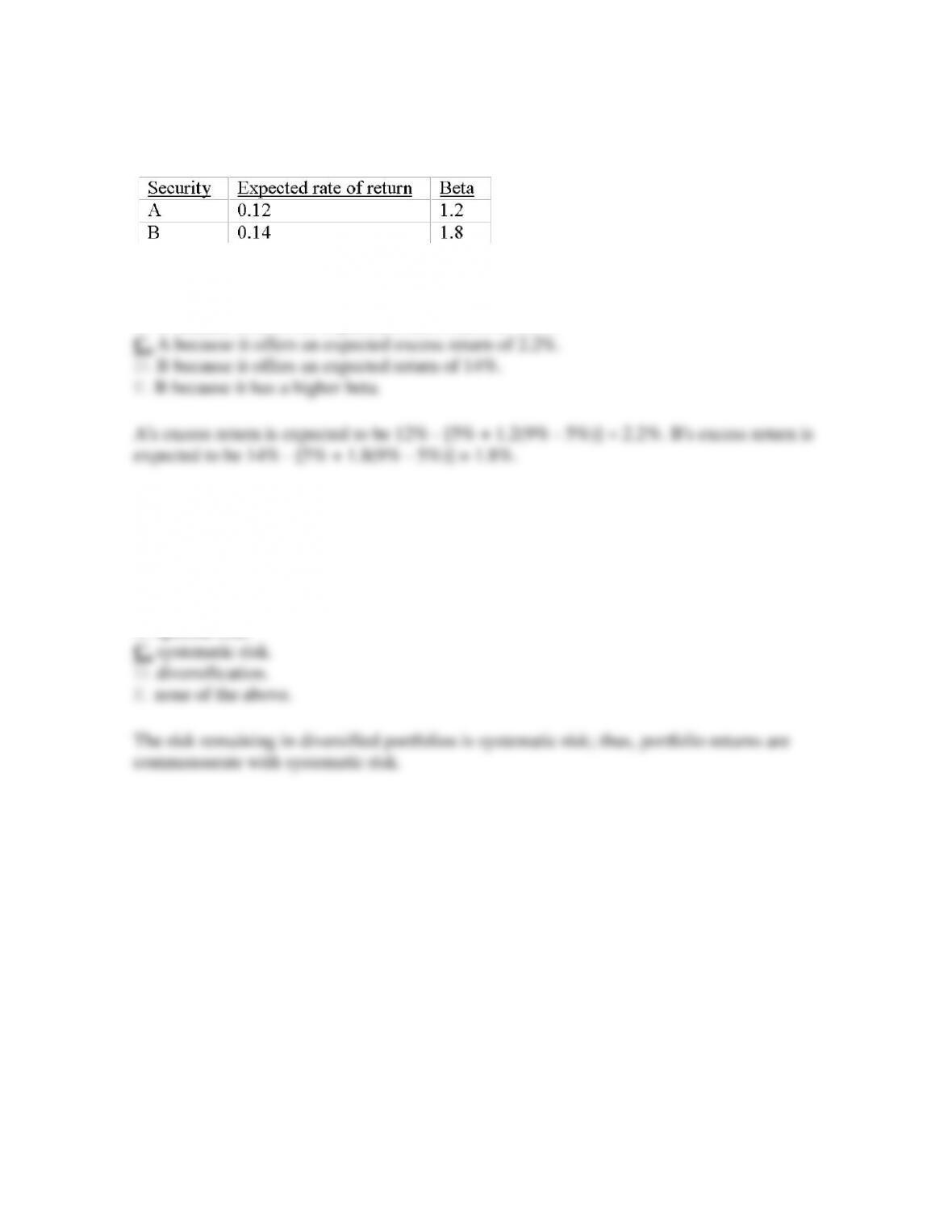
43. Given the following two stocks A and B
If the expected market rate of return is 0.09 and the risk-free rate is 0.05, which security
would be considered the better buy and why?
A. A because it offers an expected excess return of 1.2%.
B. B because it offers an expected excess return of 1.8%.
Difficulty: Moderate
44. Capital Asset Pricing Theory asserts that portfolio returns are best explained by:
A. economic factors.
B. specific risk.
Difficulty: Easy