35.
As a financial analyst, you are tasked with evaluating a capital budgeting project. You
were instructed to use the IRR method and you need to determine an appropriate hurdle
rate. The risk-free rate is 4% and the expected market rate of return is 11%. Your company
has a beta of 1.4 and the project that you are evaluating is considered to have risk equal to
the average project that the company has accepted in the past. According to CAPM, the
appropriate hurdle rate would be
36.
As a financial analyst, you are tasked with evaluating a capital budgeting project. You
were instructed to use the IRR method and you need to determine an appropriate hurdle
rate. The risk-free rate is 4% and the expected market rate of return is 11%. Your company
has a beta of 0.75 and the project that you are evaluating is considered to have risk equal
to the average project that the company has accepted in the past. According to CAPM, the
appropriate hurdle rate would be
37.
As a financial analyst, you are tasked with evaluating a capital budgeting project. You
were instructed to use the IRR method and you need to determine an appropriate hurdle
rate. The risk-free rate is 4% and the expected market rate of return is 11%. Your company
has a beta of 0.67 and the project that you are evaluating is considered to have risk equal
to the average project that the company has accepted in the past. According to CAPM, the
appropriate hurdle rate would be
38.
As a financial analyst, you are tasked with evaluating a capital budgeting project. You
were instructed to use the IRR method and you need to determine an appropriate hurdle
rate. The risk-free rate is 5% and the expected market rate of return is 10%. Your company
has a beta of 0.67 and the project that you are evaluating is considered to have risk equal
to the average project that the company has accepted in the past. According to CAPM, the
appropriate hurdle rate would be
39.
The risk-free rate is 4%. The expected market rate of return is 11%. If you expect CAT with
a beta of 1.0 to offer a rate of return of 10%, you should
40.
The risk-free rate is 4%. The expected market rate of return is 11%. If you expect CAT with
a beta of 1.0 to offer a rate of return of 11%, you should
41.
The risk-free rate is 4%. The expected market rate of return is 11%. If you expect CAT with
a beta of 1.0 to offer a rate of return of 13%, you should
42.
You invest 55% of your money in security A with a beta of 1.4 and the rest of your money
in security B with a beta of 0.9. The beta of the resulting portfolio is
43.
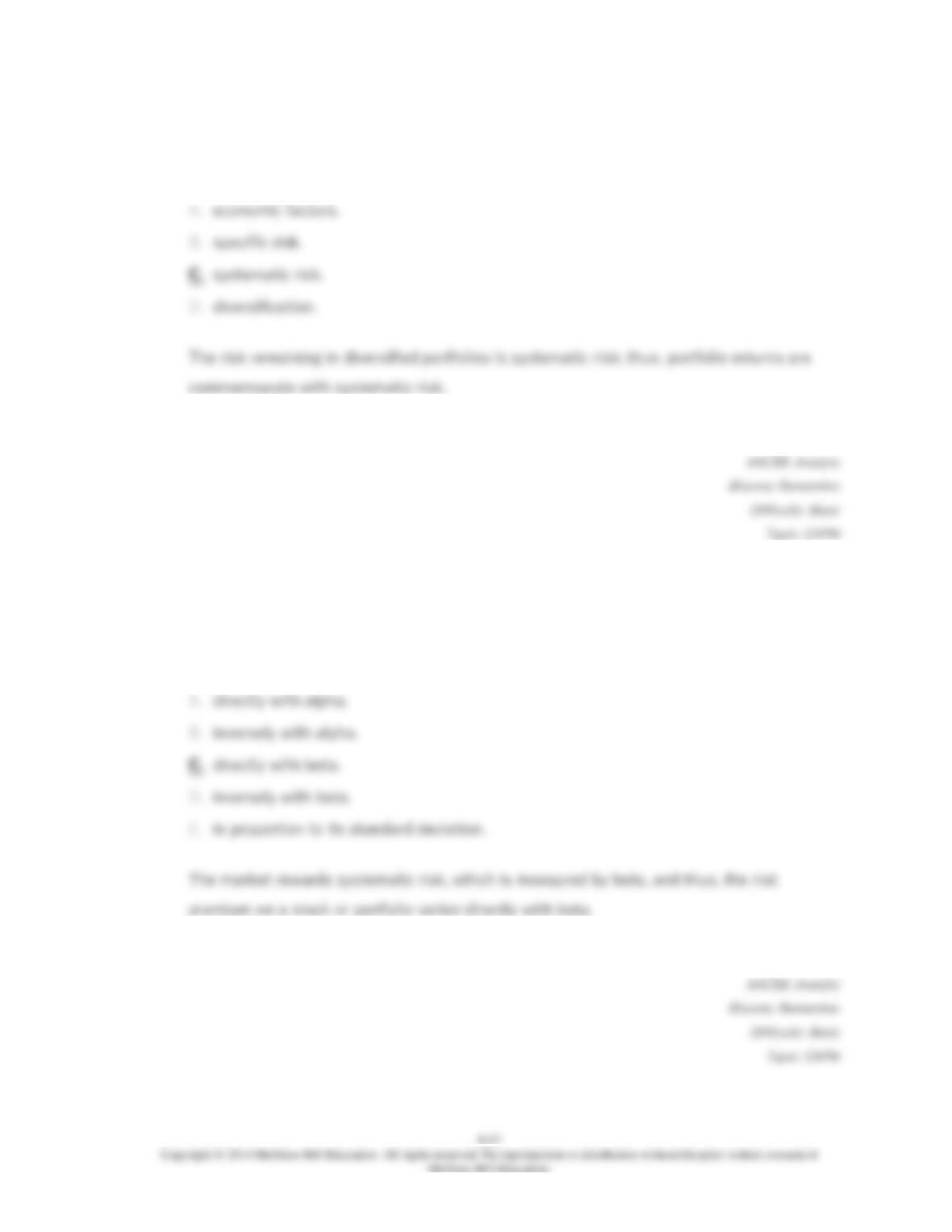
Given are the following two stocks A and B:
If the expected market rate of return is 0.09 and the risk-free rate is 0.05, which security
would be considered the better buy and why?
44.
Capital asset pricing theory asserts that portfolio returns are best explained by
45.
According to the CAPM, the risk premium an investor expects to receive on any stock or
portfolio increases
46.
What is the expected return of a zero-beta security?
47.
Standard deviation and beta both measure risk, but they are different in that beta
measures
48.
The expected return-beta relationship
49.
The security market line (SML)
50.
Research by Jeremy Stein of MIT resolves the dispute over whether beta is a sufficient
pricing factor by suggesting that managers should use beta to estimate
51.
Studies of liquidity spreads in security markets have shown that
52.
An underpriced security will plot
53.
An overpriced security will plot
54.
The risk premium on the market portfolio will be proportional to
55.
In equilibrium, the marginal price of risk for a risky security must be
56.
The capital asset pricing model assumes
57.
The capital asset pricing model assumes
58.
The capital asset pricing model assumes
59.
The capital asset pricing model assumes
60.
If investors do not know their investment horizons for certain,