Topic: Index Models
62.
Assume that stock market returns do not resemble a single-index structure. An investment
fund analyzes 40 stocks in order to construct a mean-variance efficient portfolio
constrained by 40 investments. They will need to calculate _____________ expected returns
and ___________ variances of returns.
Topic: Index Models
63.
Assume that stock market returns do not resemble a single-index structure. An investment
fund analyzes 40 stocks in order to construct a mean-variance efficient portfolio
constrained by 40 investments. They will need to calculate ____________ covariances.
64.
Assume that stock market returns do follow a single-index structure. An investment fund
analyzes 60 stocks in order to construct a mean-variance efficient portfolio constrained by
60 investments. They will need to calculate ________ estimates of expected returns and
________ estimates of sensitivity coefficients to the macroeconomic factor.
65.
Consider the single-index model. The alpha of a stock is 0%. The return on the market
index is 10%. The risk-free rate of return is 3%. The stock earns a return that exceeds the
risk-free rate by 11%, and there are no firm-specific events affecting the stock
performance. The β of the stock is
66.
Suppose you held a well-diversified portfolio with a very large number of securities, and
that the single index model holds. If the σ of your portfolio was 0.25 and σ
M
was 0.21, the
β of the portfolio would be approximately ________.
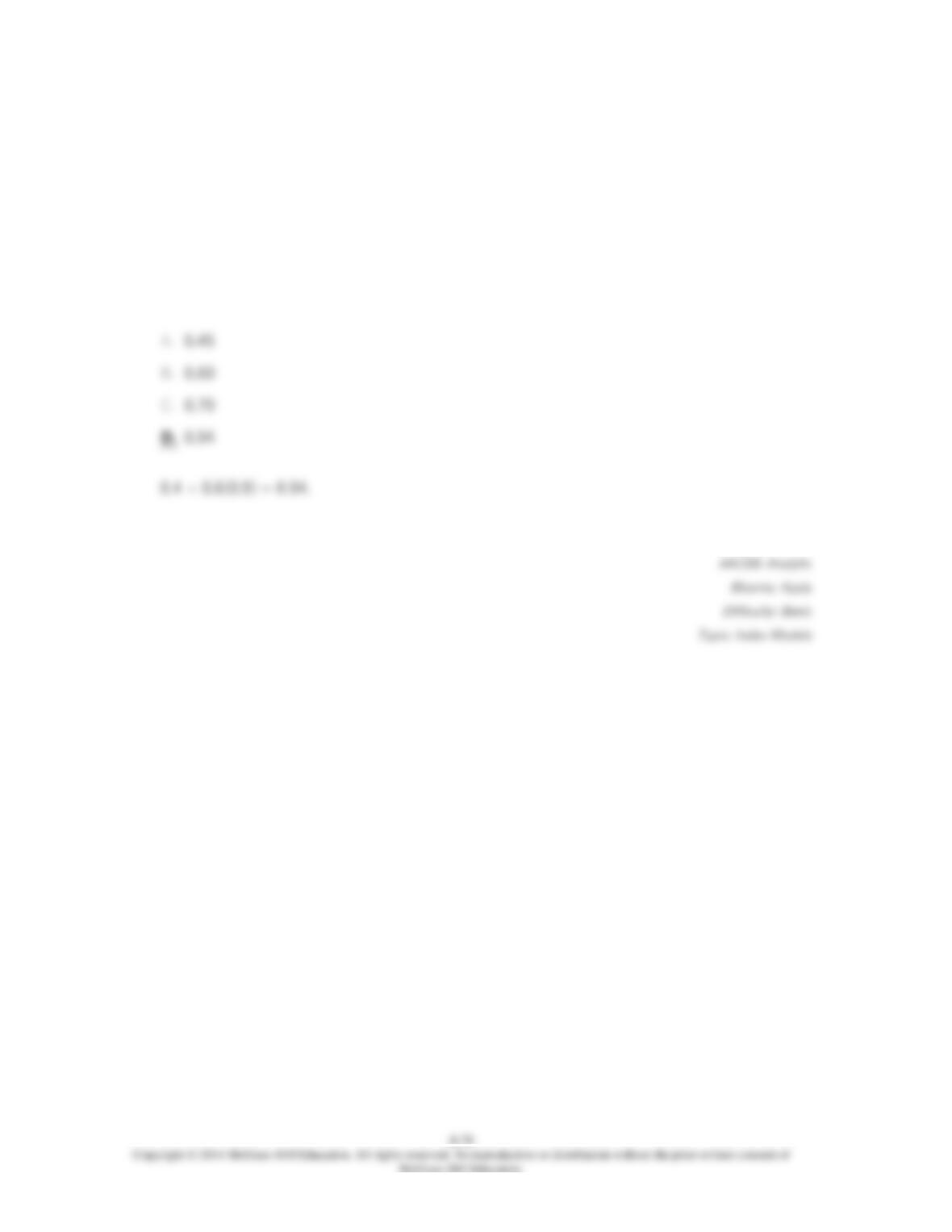
67.
Suppose you held a well-diversified portfolio with a very large number of securities, and
that the single index model holds. If the σ of your portfolio was 0.18 and σ
M
was 0.22, the
β of the portfolio would be approximately
68.
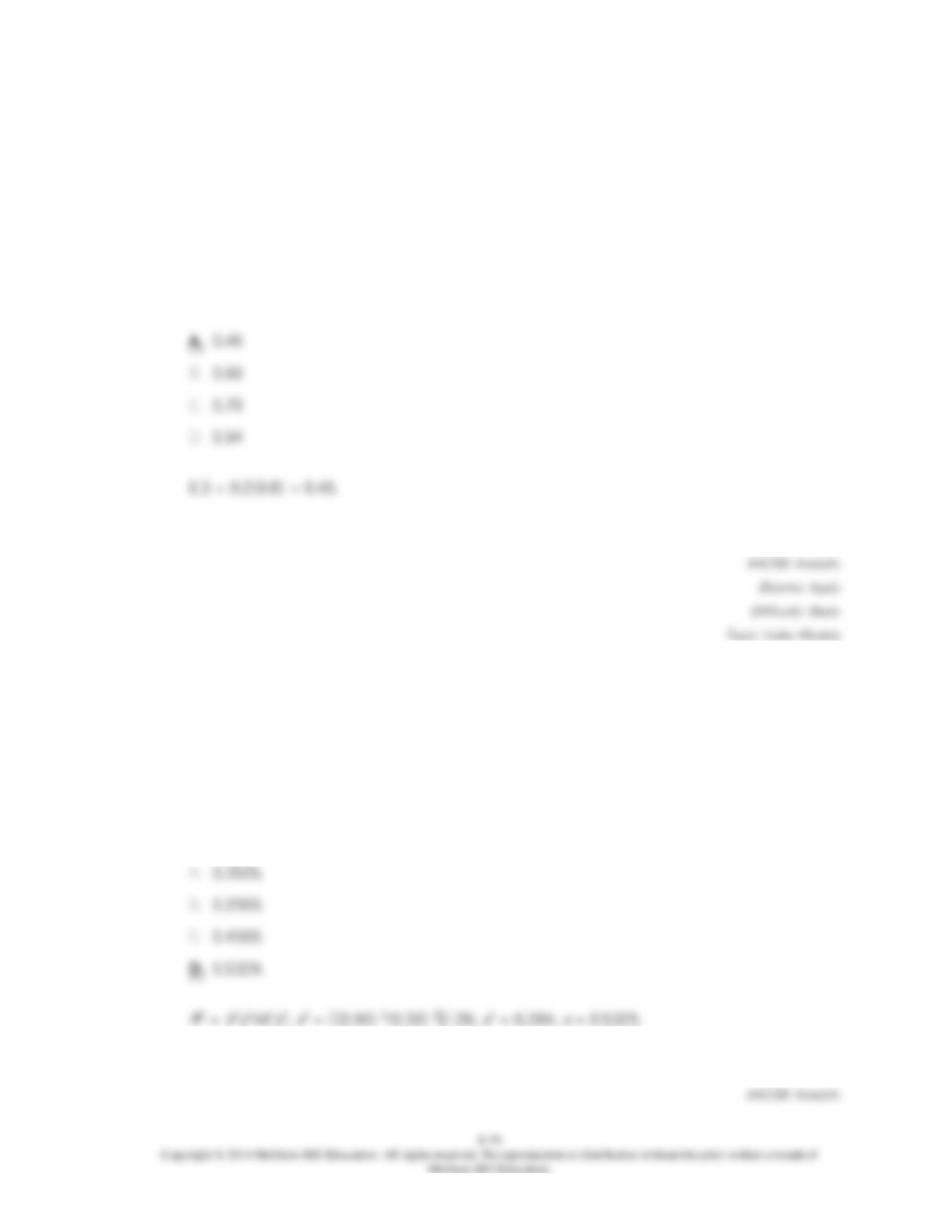
Suppose the following equation best describes the evolution of β over time:
β
t
= 0.4 + 0.6β
t
– 1.
If a stock had a β of 0.9 last year, you would forecast the β to be _______ in the coming
year.
69.
Suppose the following equation best describes the evolution of β over time:
β
t
= 0.3 + 0.2β
t
– 1
If a stock had a β of 0.8 last year, you would forecast the β to be _______ in the coming
year.
70.
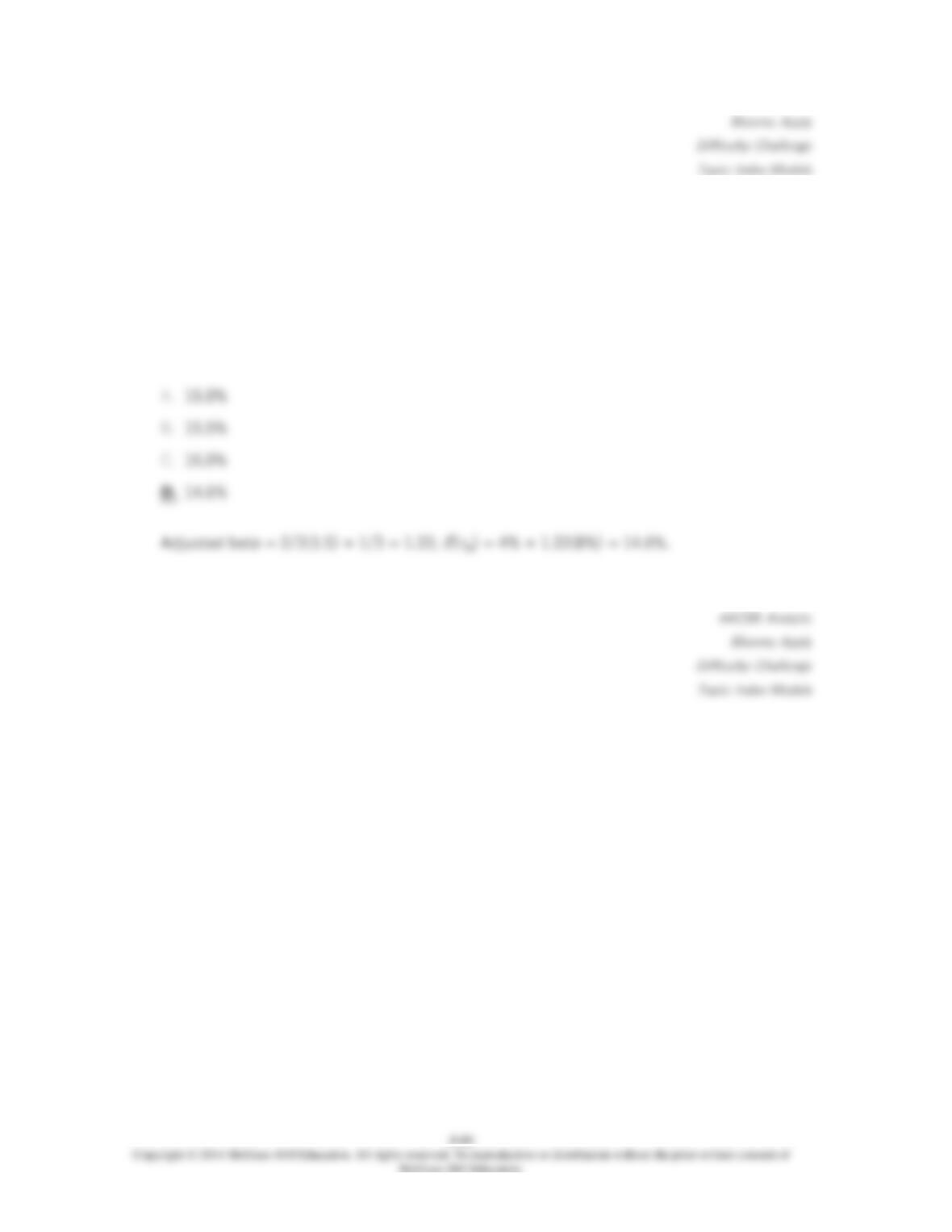
The index model for stock A has been estimated with the following result:
RA
= 0.01 + 0.94
RM
+
eA
If σ
M
= 0.30 and
R
2
A
= 0.28, the standard deviation of return of stock A is
71.
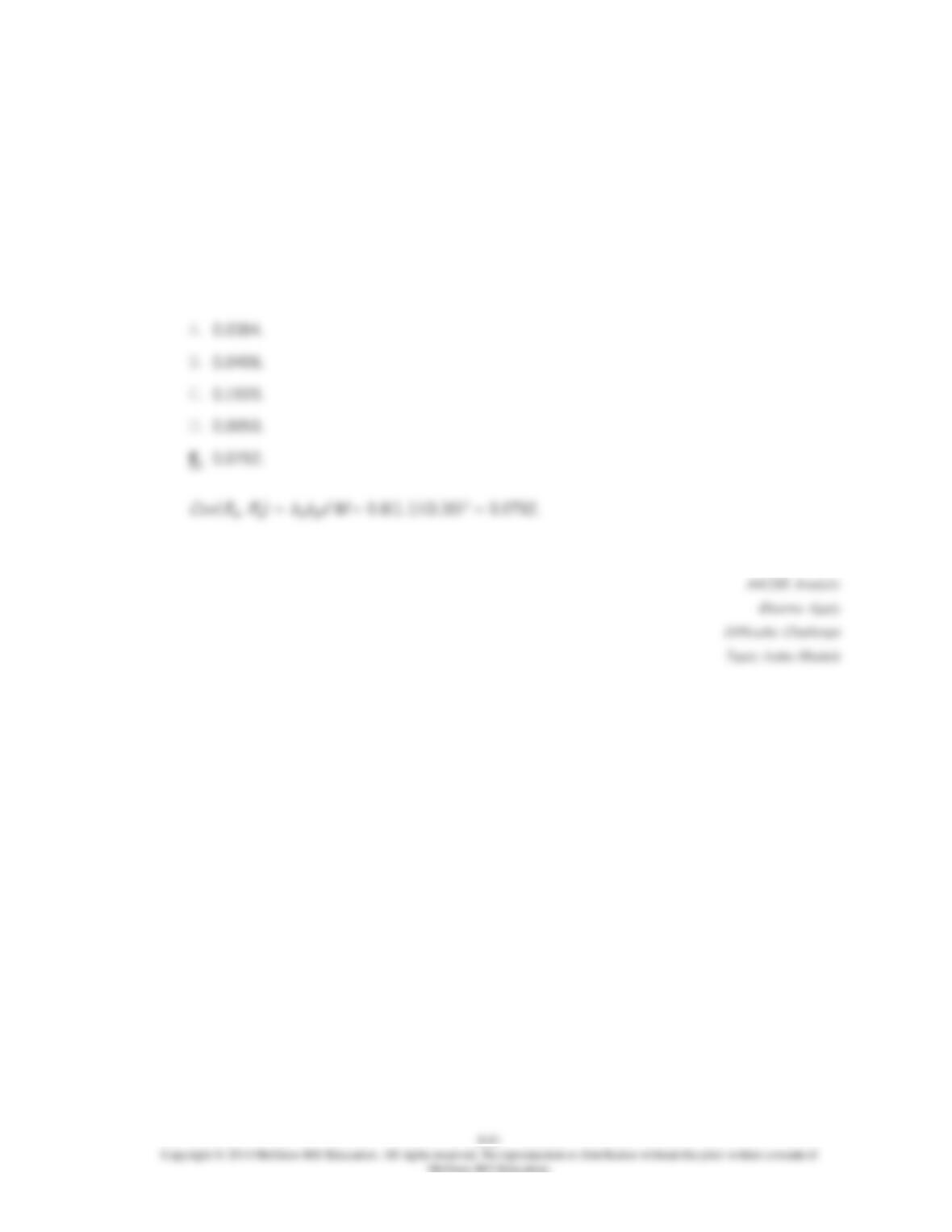
Suppose you forecast that the market index will earn a return of 12% in the coming year.
Treasury bills are yielding 4%. The unadjusted β of Mobil stock is 1.50. A reasonable
forecast of the return on Mobil stock for the coming year is _________ if you use a common
method to derive adjusted betas.
72.
The index model has been estimated for stocks A and B with the following results:
RA
= 0.01 + 0.8
RM
+
eA
.
RB
= 0.02 + 1.1R
M
+
eB
.
σ
M
= 0.30 σ(
eA
) = 0.20 σ(
eB
) = 0.10.
The covariance between the returns on stocks A and B is
73.
If a firm’s beta was calculated as 1.35 in a regression equation, a commonly used
adjustment technique would provide an adjusted beta of
74.
The beta of a stock has been estimated as 1.4 using regression analysis on a sample of
historical returns. A commonly used adjustment technique would provide an adjusted beta
of
8-83
Topic: Index Models
75.
Topic: Index Models
The beta of a stock has been estimated as 0.85 using regression analysis on a sample of
historical returns. A commonly used adjustment technique would provide an adjusted beta
of
76.
Assume that stock market returns do not resemble a single-index structure. An investment
fund analyzes 125 stocks in order to construct a mean-variance efficient portfolio
constrained by 125 investments. They will need to calculate _____________ expected
returns and ___________ variances of returns.
77.
Assume that stock market returns do not resemble a single-index structure. An investment
fund analyzes 125 stocks in order to construct a mean-variance efficient portfolio
constrained by 125 investments. They will need to calculate ____________ covariances.
78.
Assume that stock market returns do not resemble a single-index structure. An investment
fund analyzes 132 stocks in order to construct a mean-variance efficient portfolio
constrained by 132 investments. They will need to calculate ____________ covariances.
79.
Assume that stock market returns do follow a single-index structure. An investment fund
analyzes 217 stocks in order to construct a mean-variance efficient portfolio constrained
by 217 investments. They will need to calculate ________ estimates of expected returns
and ________ estimates of sensitivity coefficients to the macroeconomic factor.
80.
Assume that stock market returns do follow a single-index structure. An investment fund
analyzes 750 stocks in order to construct a mean-variance efficient portfolio constrained
by 750 investments. They will need to calculate ________ estimates of firm-specific
variances and ________ estimate/estimates for the variance of the macroeconomic factor.
81.
Consider the single-index model. The alpha of a stock is 0%. The return on the market
index is 10%. The risk-free rate of return is 5%. The stock earns a return that exceeds the
risk-free rate by 5%, and there are no firm-specific events affecting the stock
performance. The β of the stock is
82.
Suppose you held a well-diversified portfolio with a very large number of securities and
that the single index model holds. If the σ of your portfolio was 0.24 and σ
M
was 0.18, the
β of the portfolio would be approximately
83.
Suppose you held a well-diversified portfolio with a very large number of securities and
that the single index model holds. If the σ of your portfolio was 0.14 and σ
M
was 0.19, the
β of the portfolio would be approximately
84.
Suppose the following equation best describes the evolution of β over time:
β
t
= 0.30 + 0.70β
t –
1
If a stock had a β of 0.82 last year, you would forecast the β to be _______ in the coming
year.

8-90
Short Answer Questions
85.
Discuss the advantages of the single-index model over the Markowitz model in terms of
numbers of variable estimates required and in terms of understanding risk
relationships.
86.
Discuss the security characteristic line (SCL).
87.
Discuss a commonly used adjustment technique to provide an adjusted beta.