93) Commercial paper is very popular with many firms because
A) it can usually be issued below the prime rate.
B) it satisfies the firm’s need for long-term funds.
C) there are no required lines of credit at the bank.
D) it is very simple to roll over (refinance) in times of economic turmoil.
94) The Truth in Lending law is primarily designed to protect
A) corporate borrowers.
B) banks.
C) consumers.
D) investors in municipal bonds.
95) Commercial paper offers which of the following advantages to the issuer?
A) It may be issued below the prime rate.
B) It requires no compensating balances.
C) It is secured by corporate assets to protect the buyer.
D) It may be issued below the prime rate and requires no compensating balances.
96) Which of the following is NOT a characteristic of commercial paper?
A) It is issued by large firms.
B) It has a one- to two-year maturity.
C) Its rates are usually below prime rates on business loans.
D) All of these options are commercial paper characteristics.
97) Which of the following is NOT a category of commercial paper?
A) finance companies
B) commercial companies
C) asset-backed
D) All of these options are commercial paper categories
98) Commercial paper that is sold without going through a broker or dealer is known as
A) direct paper.
B) dealer paper.
C) a book-entry transaction.
D) term paper.
99) Commercial paper that is sold without the use of an actual paper certificate is known as
A) finance paper.
B) dealer paper.
C) book-entry paper.
D) term paper.
100) Which of the following is not a true statement about commercial paper?
A) Finance paper is sold directly to the lender by the finance company.
B) Finance paper is also referred to as direct paper.
C) Dealer paper is sold directly to the lender by a finance company.
D) Industrial companies, utility firms, or finance companies too small to sell direct paper sell
dealer paper instead.
101) Multinational firms have found that they can lower borrowing costs
A) by borrowing Eurodollars at a lower rate than the U.S. Prime Rate.
B) by borrowing foreign currencies through foreign subsidiaries at rates lower than the U.S.
prime rate and then converting these foreign loans into dollars.
C) by using more bankers’ acceptances.
D) by borrowing Eurodollars at a lower rate than the U.S. prime rate and by borrowing foreign
currencies through foreign subsidiaries at rates lower than the U.S. prime rate and then
converting these foreign loans into dollars.
102) Accounts receivable may be used as a source of financing by
A) pledging the receivables as loan collateral.
B) “factoring” the receivables to a finance company.
C) selling securities backed by the receivables.
D) All of these options are correct.
103) Which of the following best describes the benefits to the borrower of selling asset-backed
securities?
A) Due to the portfolio effect, the borrower can package up low-quality accounts receivable and
sell them for a premium price.
B) The borrower trades future cash flows for current cash flows.
C) The asset-backed security is likely to carry a high credit rating of AA or better.
D) The borrower trades future cash flows for current cash flows and the asset-backed security is
likely to carry a high credit rating of AA or better.
104) Which of the following is associated with the recession of 2007-2009?
A) Hundreds of bank failures occurred.
B) The Federal Reserve and the Federal Deposit Insurance Corporation forced large banks at risk
of collapse to be taken over by healthy banks.
C) Commercial banks and investment banks were allowed to merge.
D) All of these options are correct.
105) The extent to which inventory financing may be used depends on the
A) marketability of pledged goods.
B) price stability of goods.
C) perishability of goods.
D) all of these options are correct.
106) Which of the following is NOT a method for lenders to control pledged inventory?
A) Factoring
B) Blanket inventory liens
C) Trust receipts
D) Warehousing
107) Which method of controlling pledged inventory provides the greatest degree of security to
the lender?
A) Overall inventory liens
B) Warehousing
C) Trust receipts
D) Blanket inventory liens
108) Which of the following is NOT a method for controlling pledged inventory?
A) Blanket inventory liens
B) Floor planning
C) Public warehousing
D) Each of the above is an inventory control method.
109) Hedging refers to
A) avoiding high-risk investment opportunities.
B) a transaction that reduces risk exposure.
C) the same thing as asset diversification.
D) avoiding the financial futures market.
110) The “financial futures market”
A) is a place in Chicago where future stocks are traded.
B) allows for the delivery of financial instruments at a future point in time.
C) is of particular value to small investors in managing their portfolios.
D) is a place in Chicago where future stocks are traded and is of particular value to small
investors in managing their portfolios
111) Firms exposed to the risk of interest rate changes may reduce that risk by
A) obtaining a Eurodollar loan.
B) hedging in the commodities market.
C) hedging in the financial futures market.
D) pledging or factoring accounts receivable.
112) If a firm has invested in corporate bonds, it may engage in a financial futures contract in
order to protect itself from
A) declining interest rates.
B) rising interest rates.
C) inflation.
D) changes in hedging activities.
113) The effective rate on a loan with a 7% stated rate and 15% compensating balance is
approximately ________.
A) 11%
B) 7.2%
C) 8.2%
D) 1.1%
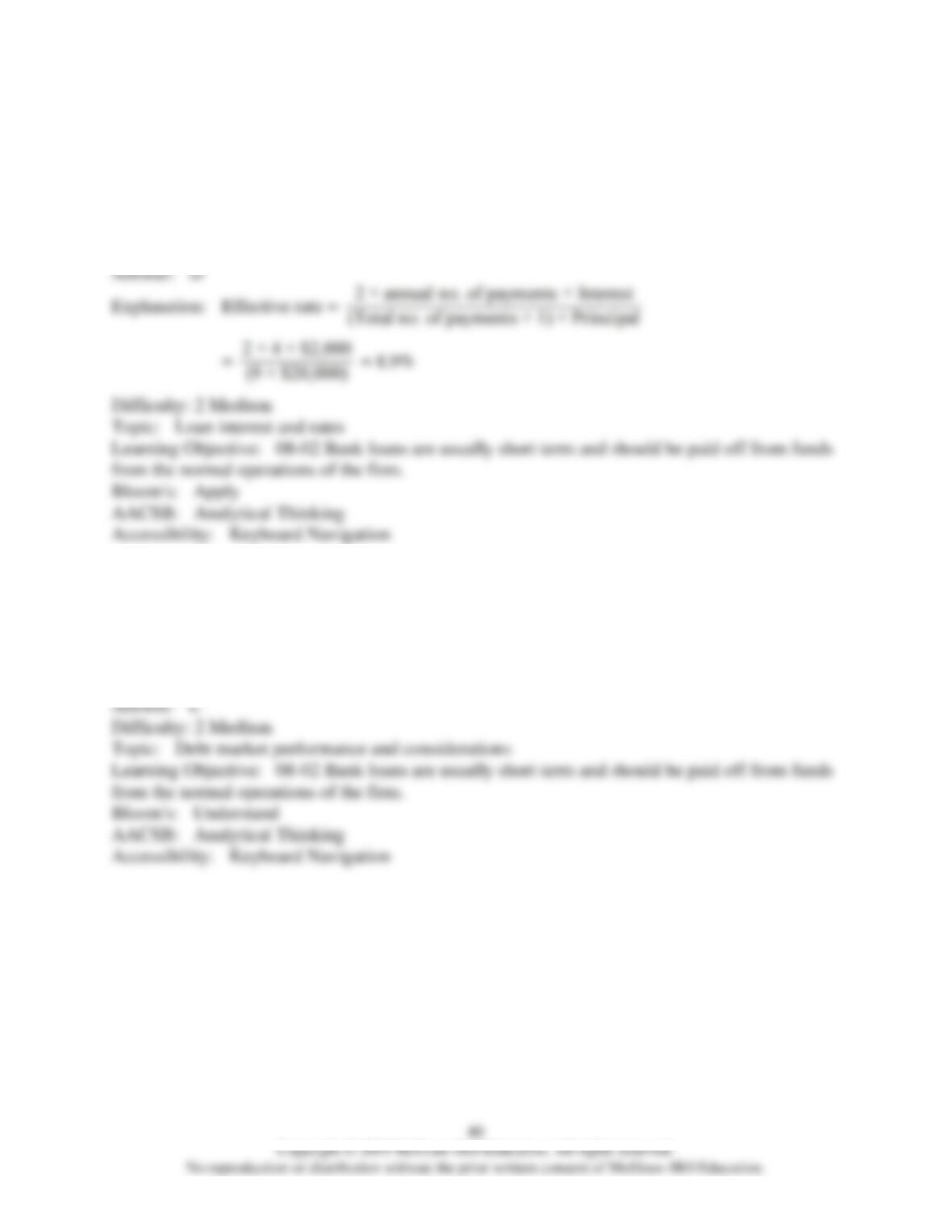
114) The effective rate on a $20,000 installment loan with quarterly payments and $2,000 in total
interest for two years is approximately ________.
A) 16%
B) 7.4%
C) 29.5%
D) 8.9%
115) Which of the following is NOT evident during a credit crunch?
A) The Fed tightens the money supply.
B) There are higher business requirements for funds.
C) A decrease in interest rates occurs.
D) Massive withdrawals from savings deposits occur.
116) Which of the following is NOT a benefit of commercial paper to a corporation?
A) It is often issued at below the prime interest rate.
B) There are no compensating balance requirements.
C) It is less risky.
D) It provides prestige to the issuer.
117) Which of the following is NOT a reason why a company may choose to pledge accounts
receivable?
A) A lower interest rate.
B) The borrowing capacity fluctuates with accounts receivable.
C) It provides another source of financing for companies with lower credit ratings.
D) All of these are reasons for pledging accounts receivable.