Chapter 08 – Index Models
8-1
Chapter 08
Index Models
Multiple Choice Questions
1. As diversification increases, the total variance of a portfolio approaches ____________.
A. 0
B. 1
Difficulty: Easy
2. As diversification increases, the standard deviation of a portfolio approaches
____________.
A. 0
B. 1
C. infinity
Difficulty: Easy
Chapter 08 – Index Models
8-2
3. As diversification increases, the firm-specific risk of a portfolio approaches
____________.
E. none of the above
Difficulty: Easy
4. As diversification increases, the unsystematic risk of a portfolio approaches
____________.
A. 1
Difficulty: Easy
Chapter 08 – Index Models
8-3
5. As diversification increases, the unique risk of a portfolio approaches ____________.
A. 1
Difficulty: Easy
6. The index model was first suggested by ____________.
A. Graham
B. Markowitz
Difficulty: Easy
7. A single-index model uses __________ as a proxy for the systematic risk factor.
D. the unemployment rate
E. none of the above
Difficulty: Easy
Chapter 08 – Index Models
8-4
8. The Security Risk Evaluation book published by Merrill Lynch relies on the __________
most recent monthly observations to calculate regression parameters.
A. 12
B. 36
Difficulty: Easy
9. The Security Risk Evaluation book published by Merrill Lynch uses the __________ as a
proxy for the market portfolio.
A. Dow Jones Industrial Average
B. Dow Jones Transportation Average
Difficulty: Easy
10. According to the index model, covariances among security pairs are
A. due to the influence of a single common factor represented by the market index return
B. extremely difficult to calculate
Difficulty: Easy
Chapter 08 – Index Models
8-5
11. The intercept calculated by Merrill Lynch in the regression equations is equal to
A. in the CAPM
B. + rf(1 + )
Difficulty: Moderate
12. Analysts may use regression analysis to estimate the index model for a stock. When doing
so, the slope of the regression line is an estimate of ______________.
A. the of the asset
Difficulty: Moderate
Chapter 08 – Index Models
8-6
13. Analysts may use regression analysis to estimate the index model for a stock. When doing
so, the intercept of the regression line is an estimate of ______________.
D. the of the asset
E. none of the above
Difficulty: Moderate
14. In a factor model, the return on a stock in a particular period will be related to
_________.
A. firm-specific events
B. macroeconomic events
Difficulty: Moderate
15. Rosenberg and Guy found that __________ helped to predict a firm’s beta.
A. the firm’s financial characteristics
B. the firm’s industry group
Difficulty: Moderate
Chapter 08 – Index Models
8-7
16. If the index model is valid, _________ would be helpful in determining the covariance
between assets GM and GE.
A. GM
B. GE
Difficulty: Moderate
17. If the index model is valid, _________ would be helpful in determining the covariance
between assets HPQ and KMP.
A. HPQ
B. KMP
Difficulty: Moderate
18. If the index model is valid, _________ would be helpful in determining the covariance
between assets K and L.
A. k
Difficulty: Moderate
Chapter 08 – Index Models
8-8
19. Rosenberg and Guy found that ___________ helped to predict firms’ betas.
A. debt/asset ratios
B. market capitalization
Difficulty: Moderate
20. If a firm’s beta was calculated as 0.6 in a regression equation, Merrill Lynch would state
the adjusted beta at a number
A. less than 0.6 but greater than zero.
Difficulty: Moderate
21. If a firm’s beta was calculated as 0.8 in a regression equation, Merrill Lynch would state
the adjusted beta at a number
A. less than 0.8 but greater than zero.
Difficulty: Moderate
Chapter 08 – Index Models
8-9
22. If a firm’s beta was calculated as 1.3 in a regression equation, Merrill Lynch would state
the adjusted beta at a number
A. less than 1.0 but greater than zero.
Difficulty: Moderate
23. The beta of Exxon stock has been estimated as 1.6 by Merrill Lynch using regression
analysis on a sample of historical returns. The Merrill Lynch adjusted beta of Exxon stock
would be ___________.
A. 1.20
Difficulty: Moderate
24. The beta of Apple stock has been estimated as 2.3 by Merrill Lynch using regression
analysis on a sample of historical returns. The Merrill Lynch adjusted beta of Exxon stock
would be ___________.
A. 2.20
Difficulty: Moderate
Chapter 08 – Index Models
8-10
25. The beta of JCP stock has been estimated as 1.2 by Merrill Lynch using regression
analysis on a sample of historical returns. The Merrill Lynch adjusted beta of Exxon stock
would be ___________.
A. 1.20
B. 1.32
Difficulty: Moderate
26. Assume that stock market returns do not resemble a single-index structure. An investment
fund analyzes 150 stocks in order to construct a mean-variance efficient portfolio constrained
by 150 investments. They will need to calculate _____________ expected returns and
___________ variances of returns.
D. 22500, 22500
E. none of the above
Difficulty: Moderate
Chapter 08 – Index Models
8-11
27. Assume that stock market returns do not resemble a single-index structure. An investment
fund analyzes 100 stocks in order to construct a mean-variance efficient portfolio constrained
by 100 investments. They will need to calculate _____________ expected returns and
___________ variances of returns.
D. 4950, 4950
E. none of the above
Difficulty: Moderate
28. Assume that stock market returns do not resemble a single-index structure. An investment
fund analyzes 150 stocks in order to construct a mean-variance efficient portfolio constrained
by 150 investments. They will need to calculate ____________ covariances.
A. 12
B. 150
Difficulty: Moderate
Chapter 08 – Index Models
8-12
29. Assume that stock market returns do not resemble a single-index structure. An investment
fund analyzes 125 stocks in order to construct a mean-variance efficient portfolio constrained
by 125 investments. They will need to calculate ____________ covariances.
A. 125
Difficulty: Moderate
30. Assume that stock market returns do not resemble a single-index structure. An investment
fund analyzes 100 stocks in order to construct a mean-variance efficient portfolio constrained
by 100 investments. They will need to calculate ____________ covariances.
A. 45
B. 100
Difficulty: Moderate
Chapter 08 – Index Models
8-13
31. Assume that stock market returns do follow a single-index structure. An investment fund
analyzes 200 stocks in order to construct a mean-variance efficient portfolio constrained by
175 investments. They will need to calculate ________ estimates of expected returns and
________ estimates of sensitivity coefficients to the macroeconomic factor.
A. 175; 15,225
Difficulty: Moderate
32. Assume that stock market returns do follow a single-index structure. An investment fund
analyzes 200 stocks in order to construct a mean-variance efficient portfolio constrained by
125 investments. They will need to calculate ________ estimates of expected returns and
________ estimates of sensitivity coefficients to the macroeconomic factor.
A. 125; 15,225
B. 15,625; 125
Difficulty: Moderate
Chapter 08 – Index Models
8-14
33. Assume that stock market returns do follow a single-index structure. An investment fund
analyzes 200 stocks in order to construct a mean-variance efficient portfolio constrained by
200 investments. They will need to calculate ________ estimates of expected returns and
________ estimates of sensitivity coefficients to the macroeconomic factor.
A. 200; 19,900
Difficulty: Moderate
34. Assume that stock market returns do follow a single-index structure. An investment fund
analyzes 500 stocks in order to construct a mean-variance efficient portfolio constrained by
500 investments. They will need to calculate ________ estimates of firm-specific variances
and ________ estimates for the variance of the macroeconomic factor.
E. 250,000; 500
Difficulty: Moderate
Chapter 08 – Index Models
8-15
35. Consider the single-index model. The alpha of a stock is 0%. The return on the market
index is 16%. The risk-free rate of return is 5%. The stock earns a return that exceeds the risk-
free rate by 11% and there are no firm-specific events affecting the stock performance. The
of the stock is _______.
A. 0.67
Difficulty: Moderate
36. Suppose you held a well-diversified portfolio with a very large number of securities, and
that the single index model holds. If the of your portfolio was 0.20 and M was 0.16, the
of the portfolio would be approximately ________.
A. 0.64
B. 0.80
Difficulty: Difficult
Chapter 08 – Index Models
8-16
37. Suppose you held a well-diversified portfolio with a very large number of securities, and
that the single index model holds. If the of your portfolio was 0.22 and M was 0.19, the
of the portfolio would be approximately ________.
A. 1.34
Difficulty: Difficult
38. Suppose you held a well-diversified portfolio with a very large number of securities, and
that the single index model holds. If the of your portfolio was 0.18 and M was 0.24, the
of the portfolio would be approximately ________.
D. 1.03
E. none of the above
Difficulty: Difficult
Chapter 08 – Index Models
8-17
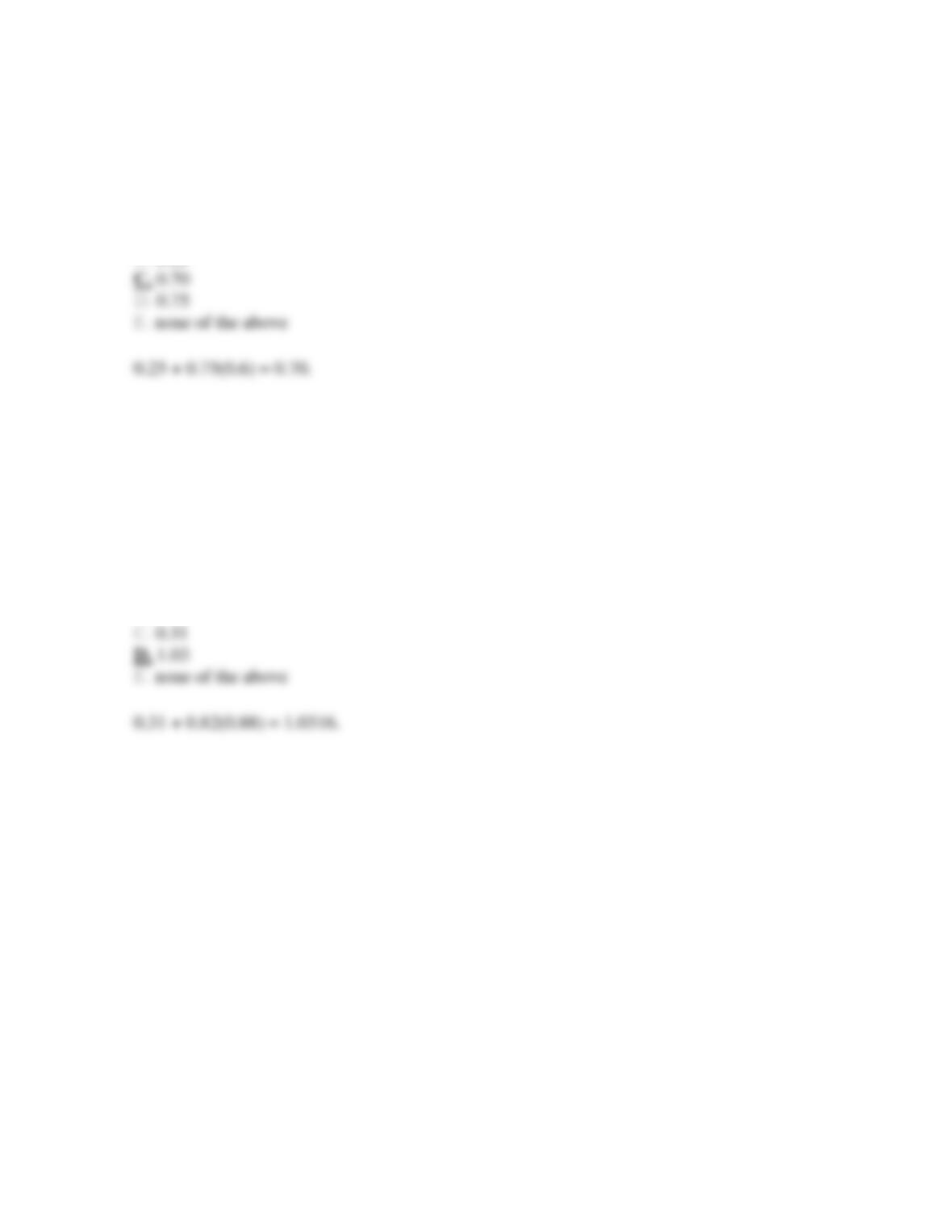
39. Suppose the following equation best describes the evolution of over time:
t = 0.25 + 0.75t-1
If a stock had a of 0.6 last year, you would forecast the to be _______ in the coming year.
A. 0.45
B. 0.60
Difficulty: Easy
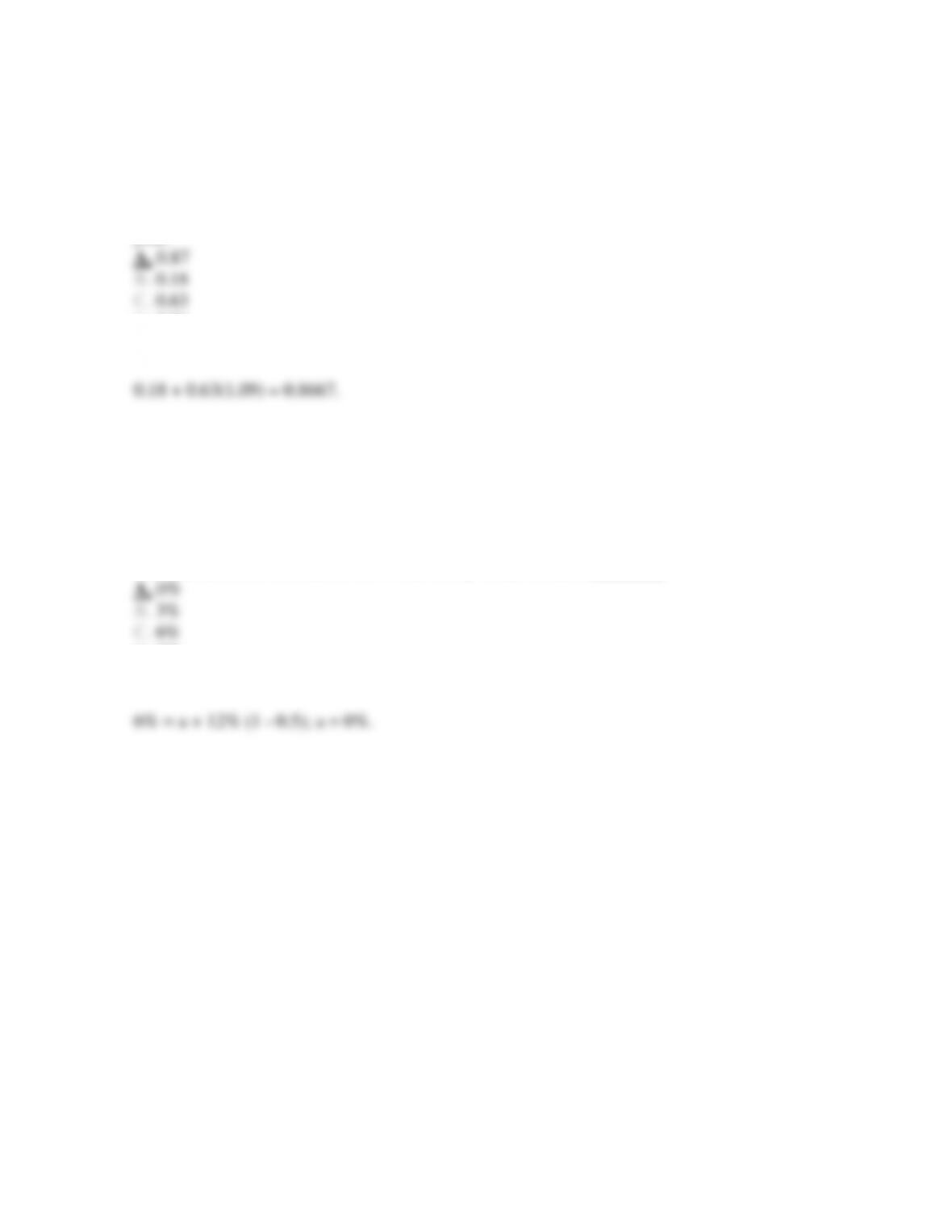
40. Suppose the following equation best describes the evolution of over time:
t = 0.31 + 0.82t-1
If a stock had a of 0.88 last year, you would forecast the to be _______ in the coming
year.
A. 0.88
B. 0.82
Difficulty: Easy
Chapter 08 – Index Models
8-18
41. Suppose the following equation best describes the evolution of over time:
t = 0.18 + 0.63t-1
If a stock had a of 1.09 last year, you would forecast the to be _______ in the coming
year.
D. 0.81
E. none of the above
Difficulty: Easy
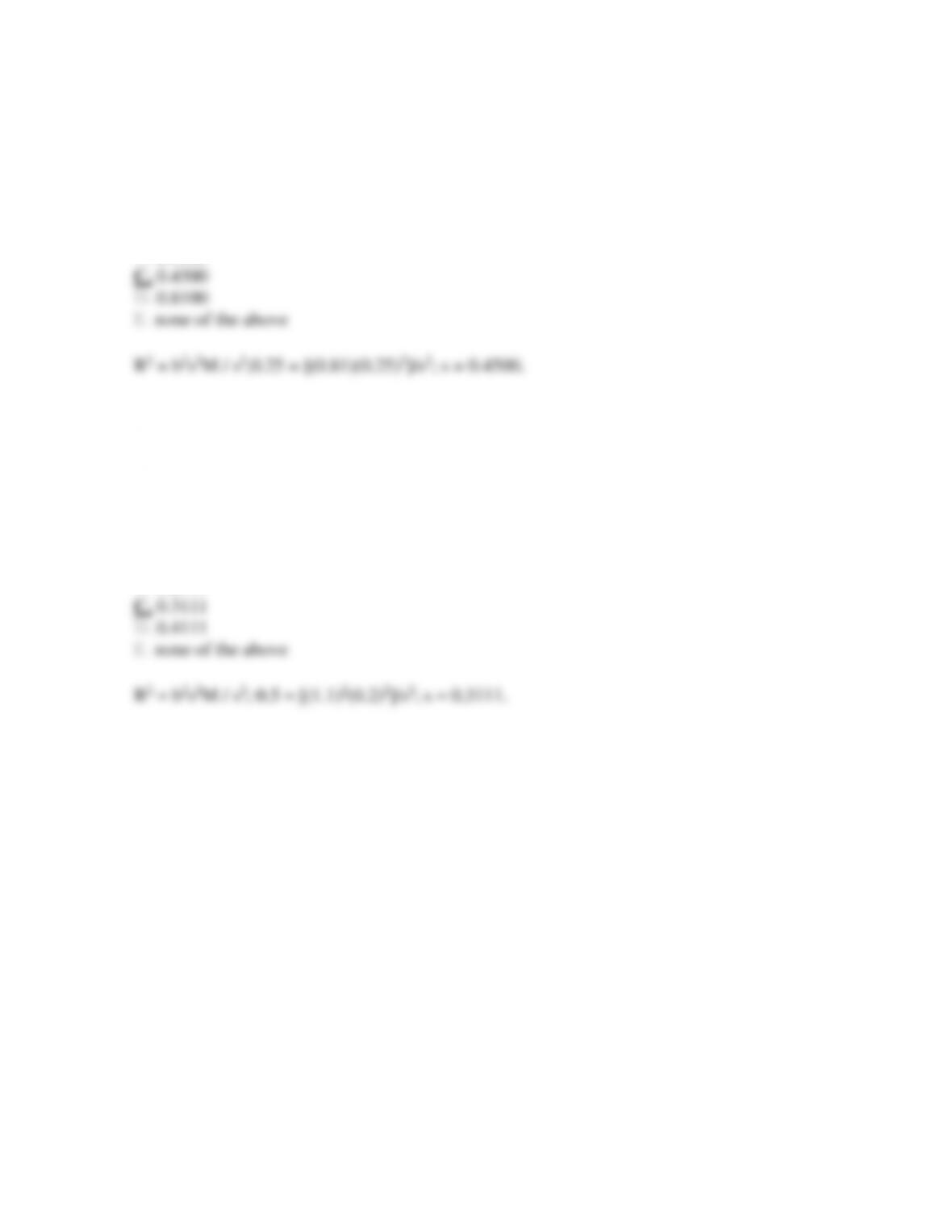
42. Merrill Lynch estimates the index model for a stock using regression analysis involving
total returns. They estimated the intercept in the regression equation at 6% and the at 0.5.
The risk-free rate of return is 12%. The true of the stock is ________.
D. 9%
E. none of the above
Difficulty: Difficult
Chapter 08 – Index Models
8-19
43. The index model for stock A has been estimated with the following result:
RA = 0.01 + 0.9RM + eA
If M = 0.25 and R2A = 0.25, the standard deviation of return of stock A is _________.
A. 0.2025
B. 0.2500
Difficulty: Difficult
44. The index model for stock B has been estimated with the following result:
RB = 0.01 + 1.1RM + eB
If M = 0.20 and R2B = 0.50, the standard deviation of the return on stock B is _________.
A. 0.1111
B. 0.2111
Difficulty: Difficult
Chapter 08 – Index Models
8-20
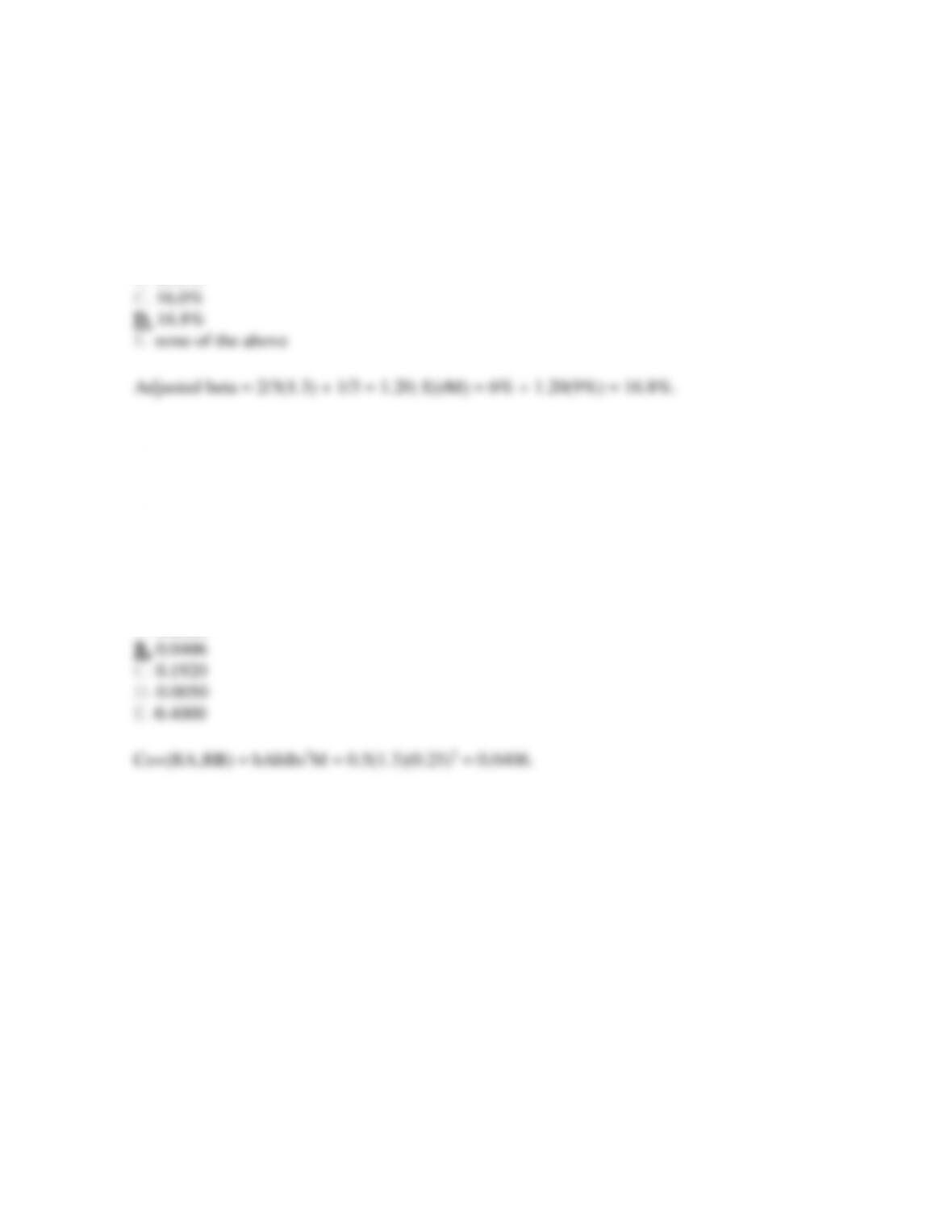
45. Suppose you forecast that the market index will earn a return of 15% in the coming year.
Treasury bills are yielding 6%. The unadjusted of Mobil stock is 1.30. A reasonable forecast
of the return on Mobil stock for the coming year is _________ if you use Merrill Lynch
adjusted betas.
A. 15.0%
B. 15.5%
Difficulty: Difficult
46. The index model has been estimated for stocks A and B with the following results:
RA = 0.01 + 0.5RM + eA
RB = 0.02 + 1.3RM + eB
M = 0.25 (eA) = 0.20 (eB) = 0.10
The covariance between the returns on stocks A and B is ___________.
A. 0.0384
Difficulty: Difficult