Foundations of Financial Management, 17e (Block)
Chapter 8 Sources of Short-Term Financing
1) The largest source of short-term funds for most companies is suppliers (trade credit).
2) Larger firms tend to be net users of trade credit, rather than net providers.
3) Small companies finance a relatively greater proportion of their assets through trade credit
than do larger firms.
4) The cost of not taking a 2/10, net 30 cash discount is usually less than the prime rate.
5) Accounts payable is a spontaneous source of funds that usually grows as the business expands.
6) The cost of NOT taking a discount is higher for terms of 2/10, net 60 than for 2/10, net 30.
7) “Stretching the payment period” refers to the practice of trying to take a trade discount after
the discount period.
8) On 2/10, net 30 trade terms, if the discount is not taken, the buyer is said to receive 20 days of
free credit.
9) Firms can almost always increase the amount of time they take to pay for purchases without
incurring problems.
10) Approximately 40% of all short-term financing is in the form of accounts payable or trade
credit.
11) Approximately 40% of all short-term financing is in the form of loans from the bank.
12) Trade credit is usually extended for periods of one year or more.
13) Attempting to “stretch the payment period” to receive additional short-term financing is an
acceptable form of financing as long as it is not carried out to an abusive extent. (i.e. going from
a 30- to a 35-day average payment).
14) A cash discount calls for a reduction in price if payment cannot be made within a specified
time period.
15) Leontief’s Wigs can take a cash discount but has to borrow money from the bank to do so.
The bank offers a 16% interest rate. The terms of the cash discount are 2/10, net 60. Because of
this, Leontief’s should borrow from the bank to take the discount.
16) Myrdal Boots can take a cash discount but has to borrow money from the bank to do so. The
bank offers a 12% interest rate. The terms of the cash discount are 3/10, net 90. Because of this,
Myrdal Boots should borrow from the bank to take the discount.
17) Even during slack loan periods, banks will never loan out money at an interest rate lower
than the prime rate because the prime rate is their best rate.
18) The lender’s primary concern is whether the borrower’s capacity to generate accounts
receivables is sufficient to liquidate the loan as it comes due.
19) The London Interbank Offered Rate (LIBOR) is used to set a base lending rate for some U.S.
domestic corporate loans.
20) Although the prime rate is the rate that U.S. banks charge their most credit-worthy
customers, the prime rate is normally higher than the London Interbank Offered Rate (LIBOR).
21) Compensating balances are important for banks because their existence allows them to make
loans at lower quoted rates.
22) A compensating balance will be lower in periods of tight money than in periods of credit
easing.
23) Compensating balances are a way for banks to recover the cost of corporate services
provided, but not directly charged.
24) Compensating balances represent unfair hidden costs of borrowing.
25) Monthly installment loans usually increase the effective interest rate of borrowing by
approximately 2 times the stated interest rate.
26) The annual percentage rate (APR) is a measure of the effective rate of interest on a loan on
an annualized basis.
27) The annual percentage rate requires the use of the actuarial method of compounded interest
when calculating the APR.
28) The term “credit crunch” refers to a period in which the interest rate on credit is so high that
firms cannot afford to borrow money.
29) Commercial paper is an unsecured short-term IOU from a large financially secure company.
30) It is easier for small firms to obtain financing through bank loans than through the
commercial paper market.
31) Small businesses frequently find commercial paper a useful means of obtaining funds when
it is not possible to raise funds by other means.
32) Commercial paper represents secured short-term borrowing by large companies.
33) Issuers of commercial paper can be divided into finance paper or direct paper, dealer paper,
and asset-backed commercial paper.
34) One major advantage of commercial paper is that it can always be “rolled over” (reissued)
when it matures.
35) All commercial paper involves the physical transfer of actual paper certificates.
36) Firms using commercial paper are generally required to maintain commercial bank lines of
credit equal to the amount of the paper outstanding.
37) The commercial paper market is available to all New York Stock Exchange companies.
38) One major disadvantage of commercial paper is that if the company’s credit quality declines,
refinancing existing commercial paper might be impossible to achieve through a new issue of
commercial paper.
39) Finance paper usually carries a higher rate of interest than direct paper.
40) Finance paper, unlike commercial paper, represents a long-term, unsecured promissory note.
41) One advantage to an issuer of commercial paper is that the issuer eliminates the need for
maintaining compensating balances and credit lines with a commercial bank.
42) Factoring accounts receivable, unlike pledging accounts receivable, typically passes the risk
of loss on the accounts receivable to the buyer.
43) One major advantage of factoring accounts receivable is that the selling firm receives money
from its accounts receivable faster than if it waited until the customers paid.

44) Eurodollar loans are similar to U.S. bank loans in that they are usually short-term to
intermediate-term in nature.
45) A Eurodollar loan is a loan denominated in dollars and made by a foreign bank holding
dollar deposits.
46) In times of tight credit in the United States, Eurodollar loans become difficult to obtain.
47) It is difficult to acquire a loan in U.S. dollars outside the United States.
48) The sale of securities backed by the receivables of large credit-worthy firms is a large and
growing source of financing.
49) General Motors Acceptance Corporation (GMAC) is one of the biggest issuers of asset-
backed securities.
50) The biggest categories of asset-backed securities are home equity loans, automobile
receivables, and credit card receivables.
51) The sale of asset-backed securities can sometimes enable the issuing firm to acquire lower-
cost funds than it normally would receive from a bank loan or bond offering.
52) A blanket inventory lien is where items are not identified or tagged, and there is no physical
transfer of control of the inventory by the borrower.
53) A trust receipt acknowledges that the lender trusts the borrower to repay the loan before any
dividends are paid.
54) The movement of the exchange rate between two currencies can increase the total cost of a
loan by making the principal repayment require more money than the original amount of the
loan.
55) The most common form of short-term financing is a bank loan.
56) The higher the cost of bank financing, the more beneficial it is to take the cash discount.
57) A self-liquidating loan is preferable to a bank because it generally provides them with a
higher return.
58) At historically low interest rate levels, compensating balances increase.
59) A term loan is less risky to the bank, thus they provide a fixed rate to the customer.
60) The annual percentage rate (APR) is generally lower than the interest rate stated by the bank.
61) Hedging refers to a transaction that avoids any financial risks.
62) Companies can use hedging to eliminate all or some foreign currency risk.
63) What is generally the largest source of short-term credit for small firms?
A) Bank loans
B) Commercial paper
C) Installment loans
D) Trade credit
64) Trade credit may be used to finance a major part of a firm’s working capital when
A) the firm extends less liberal credit terms than the supplier.
B) the firm extends more liberal credit terms than the supplier.
C) the firm and the supplier both extend the same credit terms.
D) neither the firm nor the supplier extends credit.
65) Trade credit is considered what type of loan?
A) when a firm owes money to a supplier.
B) when a firm owes money to a customer.
C) when a firm owes money to a bank.
D) all of the answers are true.
66) A large manufacturing firm has been selling on a 3/10, net 30 basis. The firm changes its
credit terms to 2/20, net 90. What change might be expected on the balance sheets of the
manufacturing firm?
A) Decreased receivables
B) Increased receivables
C) Increased payables
D) Decreased payables
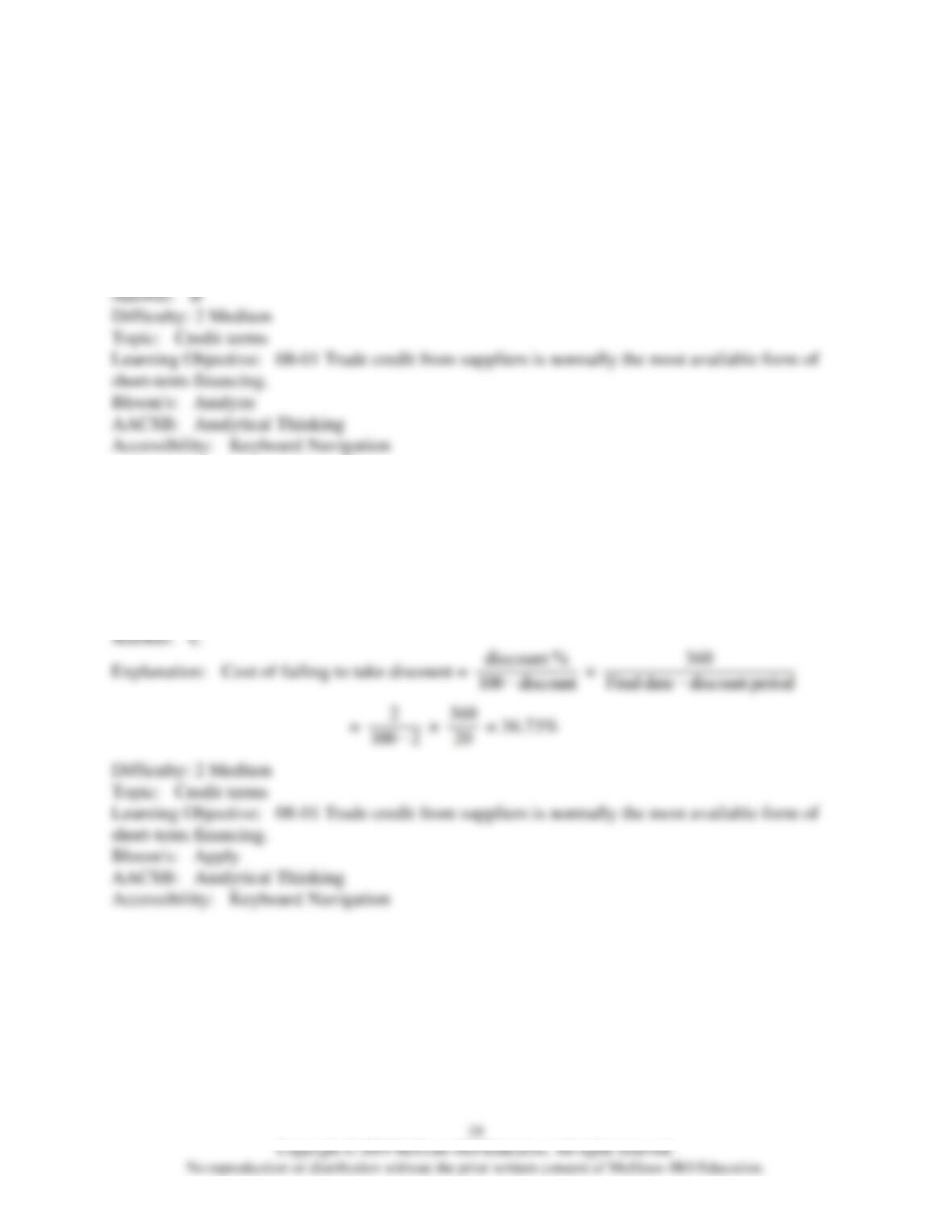
67) The cost of not taking the discount on trade credit of 2/10, net 30 is approximately
________.
A) 44.54%
B) 43.20%
C) 36.73%
D) None of these options are true
68) Large firms tend to be
A) net users of trade credit.
B) net suppliers of trade credit.
C) firms with high levels of profitability.
D) firms with low levels of inventory turnover and accounts receivable turnover.
69) From the banker’s point of view, short-term bank credit is an excellent way of financing
A) fixed assets.
B) permanent working capital needs.
C) repayment of long-term debt.
D) seasonal bulges in inventory and receivables.