Chapter 07 Optimal Risky Portfolios Answer Key
Multiple Choice Questions
1.
Market risk is also referred to as
2.
Systematic risk is also referred to as
3.
Nondiversifiable risk is also referred to as
4.
Diversifiable risk is also referred to as
5.
Unique risk is also referred to as
6.
Firm-specific risk is also referred to as
Difficulty: Basic
Topic: Diversification
w
7.
Nonsystematic risk is also referred to as
Topic: Diversification
8.
The risk that can be diversified away is
9.
The risk that cannot be diversified away is
10.
The variance of a portfolio of risky securities
11.
The standard deviation of a portfolio of risky securities is
12.
The expected return of a portfolio of risky securities
13.
Other things equal, diversification is most effective when
14.
The efficient frontier of risky assets is
15.
The capital allocation line provided by a risk-free security and
N
risky securities is
16.
Consider an investment opportunity set formed with two securities that are perfectly
negatively correlated. The global minimum variance portfolio has a standard deviation that
is always

Difficulty: Challenge
Topic: Markowitz Model
17.
Which of the following statement(s) is(are) true regarding the variance of a portfolio of
two risky securities?
I) The higher the coefficient of correlation between securities, the greater the reduction in
the portfolio variance.
II) There is a linear relationship between the securities’ coefficient of correlation and the
portfolio variance.
III) The degree to which the portfolio variance is reduced depends on the degree of
correlation between securities.

18.
Which of the following statement(s) is(are) false regarding the variance of a portfolio of
two risky securities?
I) The higher the coefficient of correlation between securities, the greater the reduction in
the portfolio variance.
II) There is a linear relationship between the securities’ coefficient of correlation and the
portfolio variance.
III) The degree to which the portfolio variance is reduced depends on the degree of
correlation between securities.
19.
Efficient portfolios of
N
risky securities are portfolios that

20.
Which of the following statement(s) is(are) true regarding the selection of a portfolio from
those that lie on the capital allocation line?
I) Less risk-averse investors will invest more in the risk-free security and less in the
optimal risky portfolio than more risk-averse investors.
II) More risk-averse investors will invest less in the optimal risky portfolio and more in the
risk-free security than less risk-averse investors.
III) Investors choose the portfolio that maximizes their expected utility.
21.
Which of the following statement(s) is(are) false regarding the selection of a portfolio
from those that lie on the capital allocation line?
I) Less risk-averse investors will invest more in the risk-free security and less in the
optimal risky portfolio than more risk-averse investors.
II) More risk-averse investors will invest less in the optimal risky portfolio and more in the
risk-free security than less risk-averse investors.
III) Investors choose the portfolio that maximizes their expected utility.
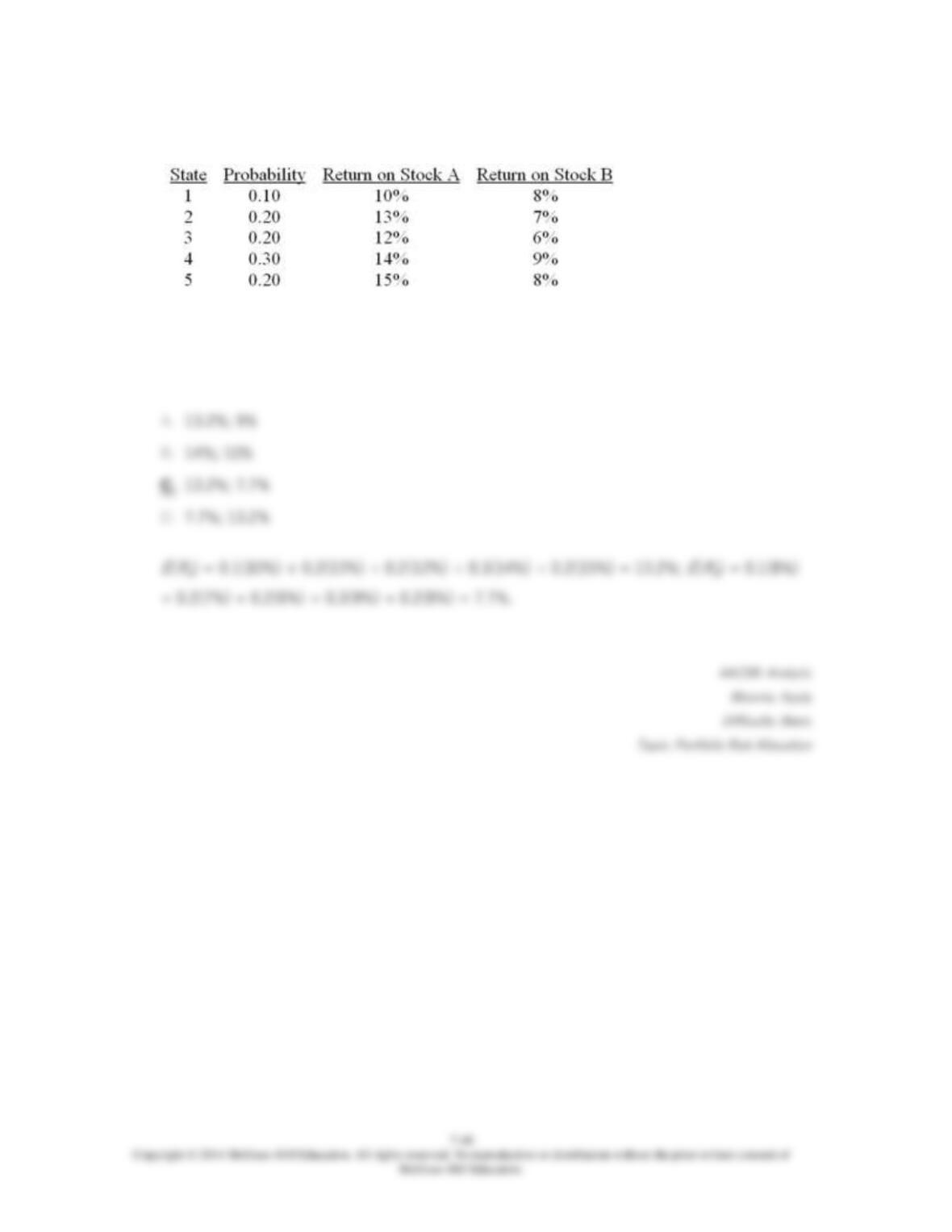
22.
Consider the following probability distribution for stocks A and B:
The expected rates of return of stocks A and B are _____ and _____, respectively.
7-49
Copyright © 2014 McGraw-Hill Education. All rights reserved. No reproduction or distribution without the prior written consent of
McGraw-Hill Education.
23.
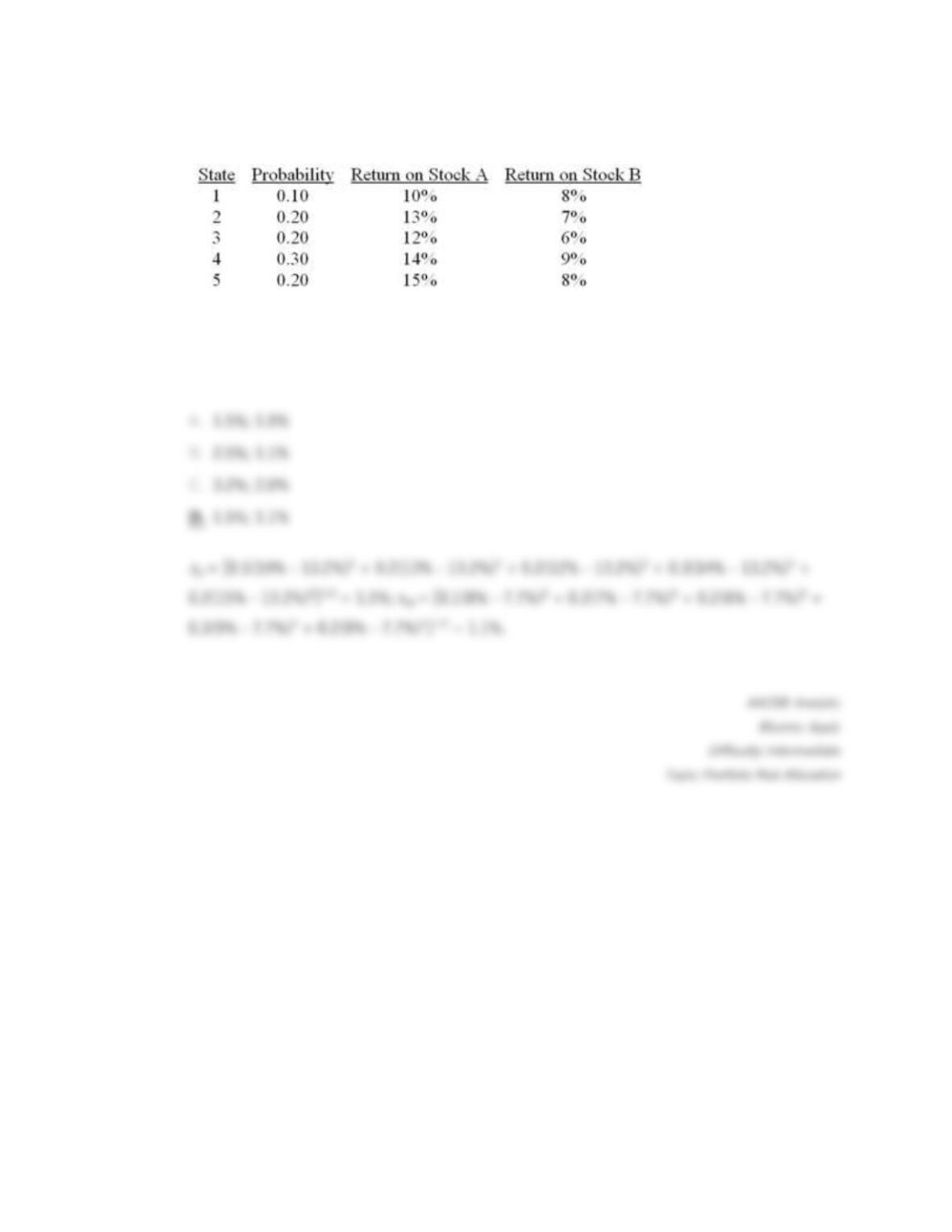
Consider the following probability distribution for stocks A and B:
The standard deviations of stocks A and B are _____ and _____, respectively.
24.
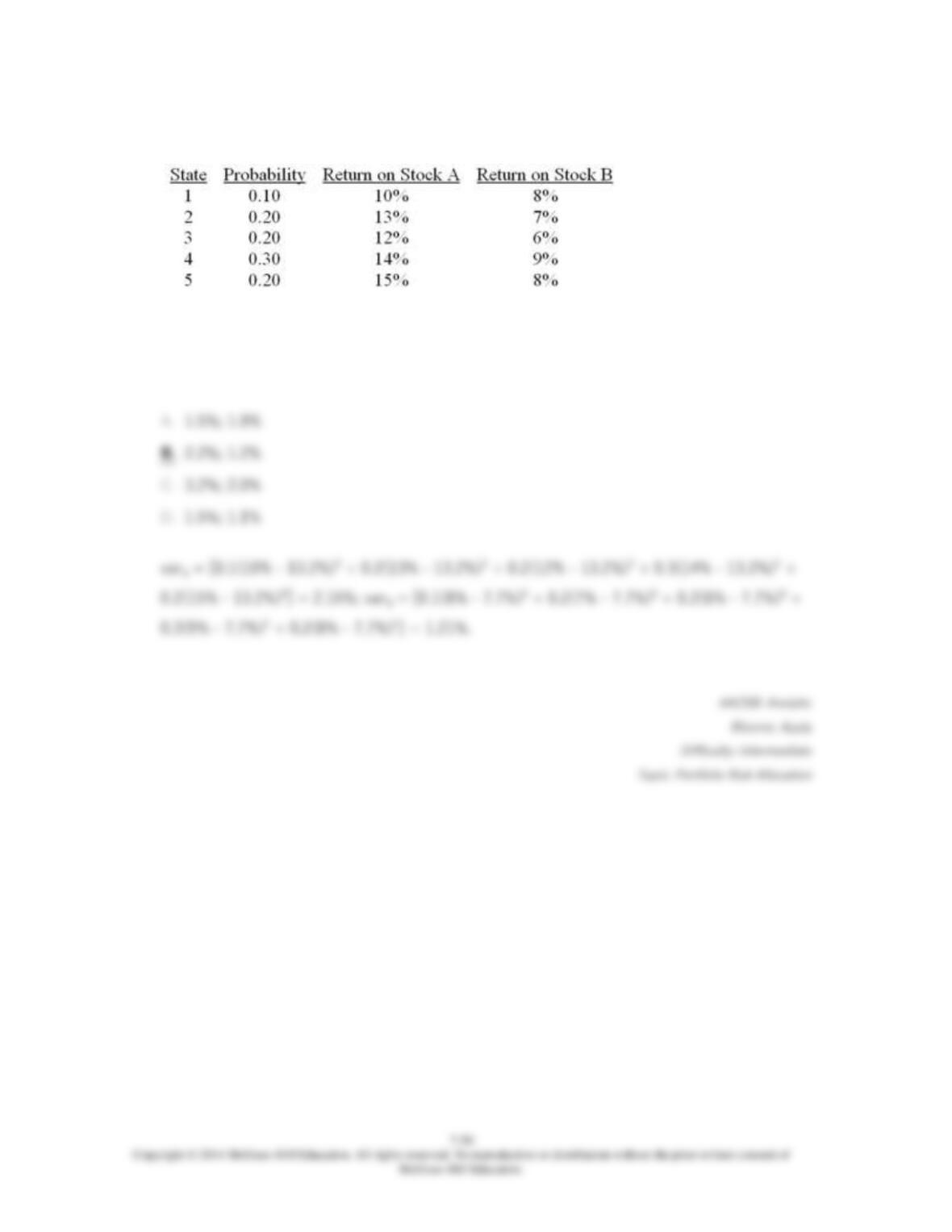
Consider the following probability distribution for stocks A and B:
The variances of stocks A and B are _____ and _____, respectively.
25.
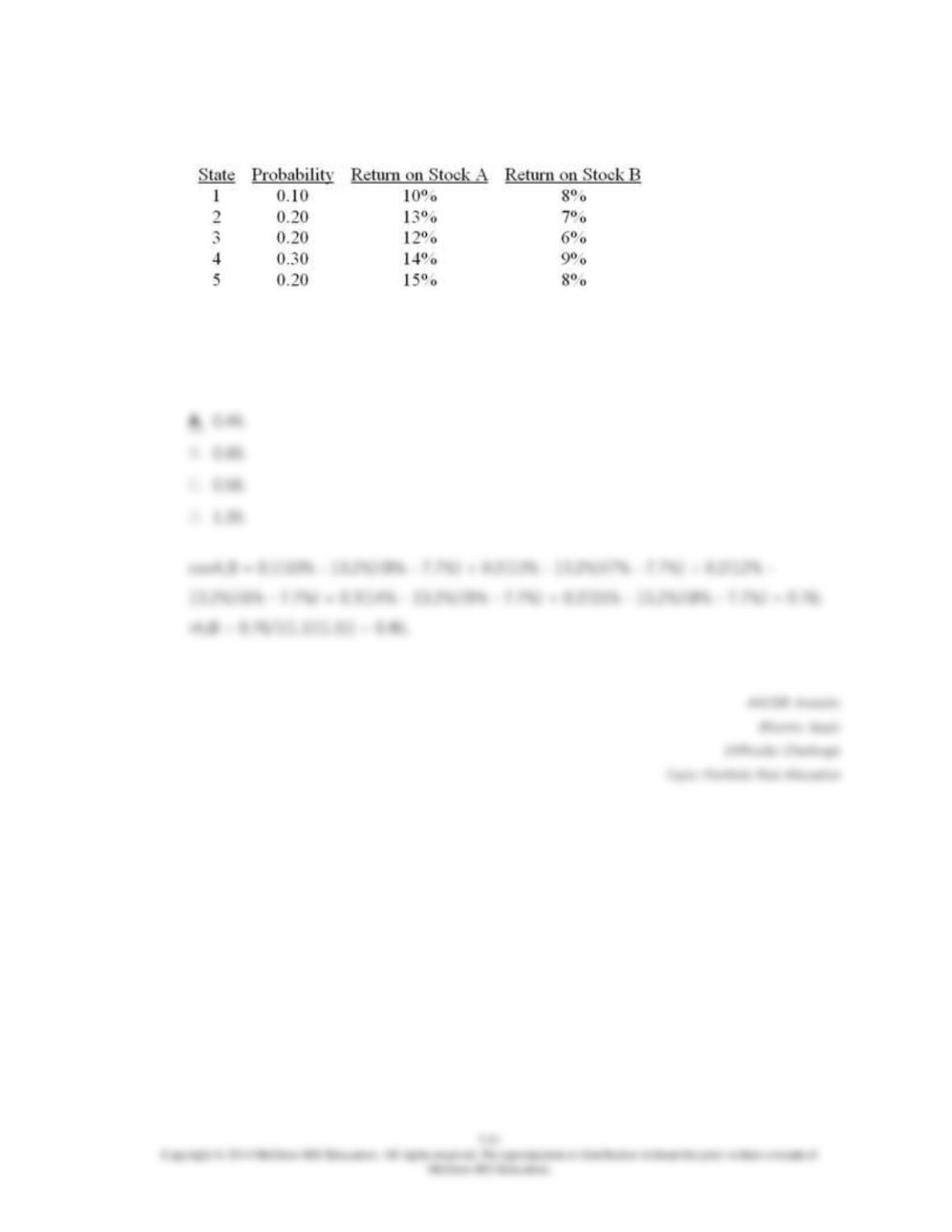
Consider the following probability distribution for stocks A and B:
The coefficient of correlation between A and B is
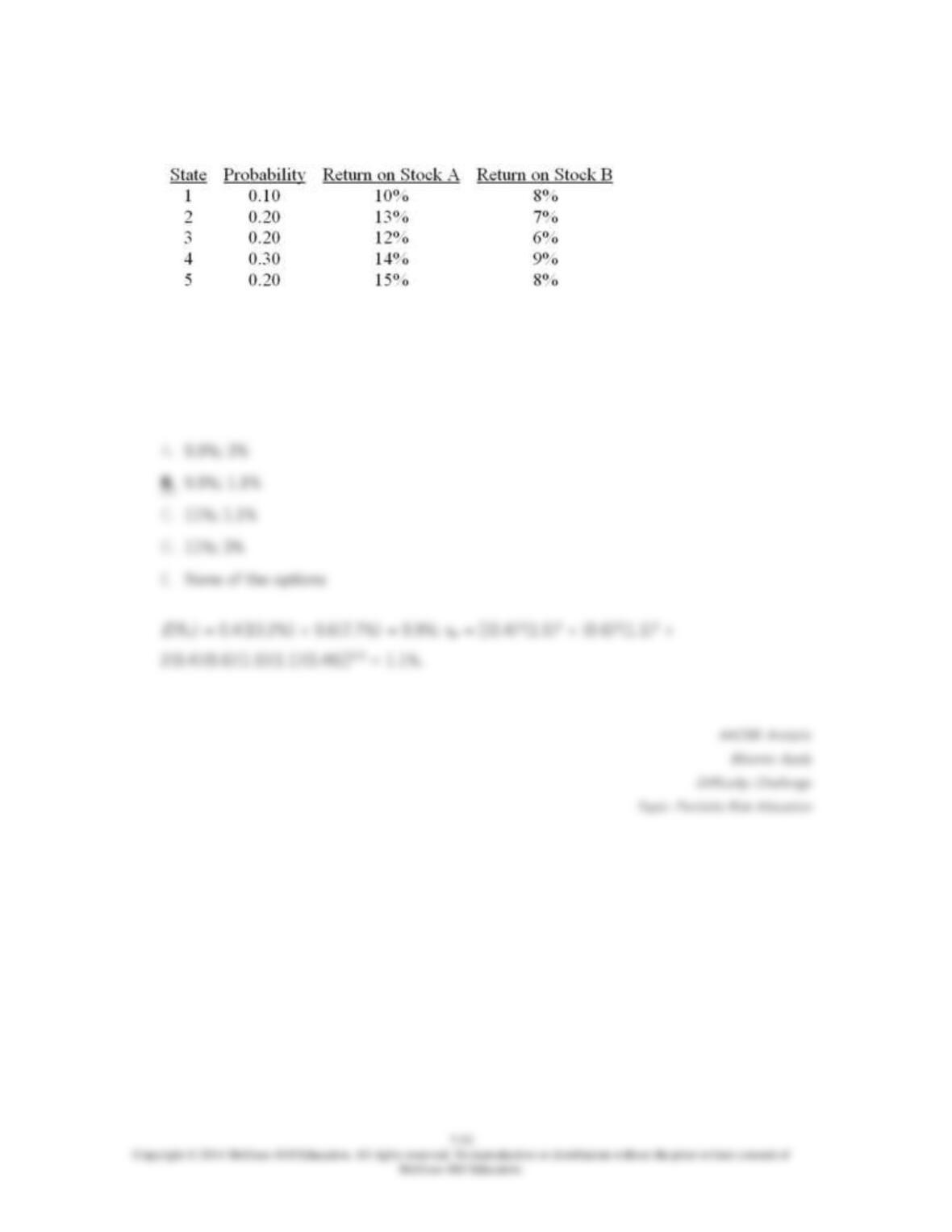
26.
Consider the following probability distribution for stocks A and B:
If you invest 40% of your money in A and 60% in B, what would be your portfolio’s
expected rate of return and standard deviation?