Chapter 07 – Optimal Risky Portfolios
7-1
Chapter 07
Optimal Risky Portfolios
Multiple Choice Questions
1. Market risk is also referred to as
A. systematic risk, diversifiable risk.
Difficulty: Easy
2. Systematic risk is also referred to as
D. unique risk, diversifiable risk.
E. none of the above.
Difficulty: Easy
Chapter 07 – Optimal Risky Portfolios
7-2
3. Nondiversifiable risk is also referred to as
A. systematic risk, unique risk.
Difficulty: Easy
4. Diversifiable risk is also referred to as
A. systematic risk, unique risk.
B. systematic risk, market risk.
Difficulty: Easy
5. Unique risk is also referred to as
A. systematic risk, diversifiable risk.
B. systematic risk, market risk.
Difficulty: Easy
Chapter 07 – Optimal Risky Portfolios
7-3
6. Firm-specific risk is also referred to as
A. systematic risk, diversifiable risk.
Difficulty: Easy
7. Non-systematic risk is also referred to as
A. market risk, diversifiable risk.
B. firm-specific risk, market risk.
Difficulty: Easy
8. The risk that can be diversified away is
D. market risk.
E. none of the above.
Difficulty: Easy
Chapter 07 – Optimal Risky Portfolios
7-4
9. The risk that cannot be diversified away is
A. firm-specific risk.
Difficulty: Easy
10. The variance of a portfolio of risky securities
A. is a weighted sum of the securities’ variances.
B. is the sum of the securities’ variances.
Difficulty: Moderate
11. The standard deviation of a portfolio of risky securities
A. the square root of the weighted sum of the securities’ variances.
B. the square root of the sum of the securities’ variances.
Difficulty: Moderate
Chapter 07 – Optimal Risky Portfolios
7-5
12. The expected return of a portfolio of risky securities
D. A and C.
E. none of the above.
Difficulty: Easy
13. Other things equal, diversification is most effective when
A. securities’ returns are uncorrelated.
Difficulty: Moderate
Chapter 07 – Optimal Risky Portfolios
7-6
14. The efficient frontier of risky assets is
D. the set of portfolios that have zero standard deviation.
E. both A and B are true.
Difficulty: Moderate
15. The Capital Allocation Line provided by a risk-free security and N risky securities is
A. the line that connects the risk-free rate and the global minimum-variance portfolio of the
risky securities.
B. the line that connects the risk-free rate and the portfolio of the risky securities that has the
highest expected return on the efficient frontier.
Difficulty: Moderate
Chapter 07 – Optimal Risky Portfolios
7-7
16. Consider an investment opportunity set formed with two securities that are perfectly
negatively correlated. The global minimum variance portfolio has a standard deviation that is
always
A. greater than zero.
Difficulty: Difficult
17. Which of the following statements is (are) true regarding the variance of a portfolio of
two risky securities?
A. The higher the coefficient of correlation between securities, the greater the reduction in the
portfolio variance.
B. There is a linear relationship between the securities’ coefficient of correlation and the
Difficulty: Moderate
Chapter 07 – Optimal Risky Portfolios
7-8
18. Which of the following statements is (are) false regarding the variance of a portfolio of
two risky securities?
A. The higher the coefficient of correlation between securities, the greater the reduction in the
portfolio variance.
Difficulty: Moderate
19. Efficient portfolios of N risky securities are portfolios that
A. are formed with the securities that have the highest rates of return regardless of their
standard deviations.
Difficulty: Moderate
Chapter 07 – Optimal Risky Portfolios
7-9
20. Which of the following statement(s) is (are) true regarding the selection of a portfolio
from those that lie on the Capital Allocation Line?
A. Less risk-averse investors will invest more in the risk-free security and less in the optimal
risky portfolio than more risk-averse investors.
Difficulty: Moderate
21. Which of the following statement(s) is (are) false regarding the selection of a portfolio
from those that lie on the Capital Allocation Line?
D. A and B.
E. A and C.
Difficulty: Moderate
Chapter 07 – Optimal Risky Portfolios
7-10
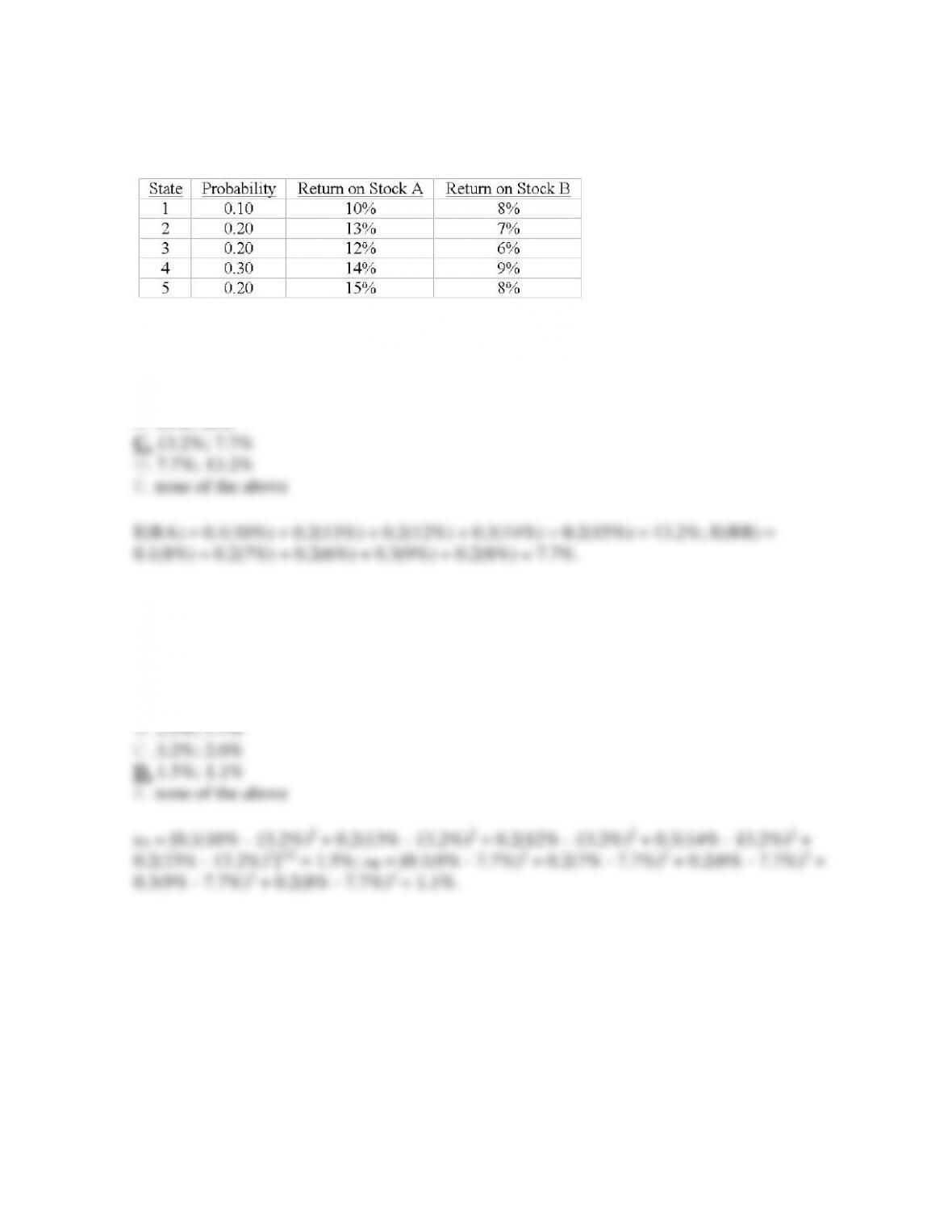
Consider the following probability distribution for stocks A and B:
22. The expected rates of return of stocks A and B are _____ and _____ , respectively.
A. 13.2%; 9%
B. 14%; 10%
Difficulty: Easy
23. The standard deviations of stocks A and B are _____ and _____, respectively.
A. 1.5%; 1.9%
Difficulty: Moderate
Chapter 07 – Optimal Risky Portfolios
7-11
24. The variances of stocks A and B are _____ and _____, respectively.
A. 1.5%; 1.9%
Difficulty: Moderate
25. The coefficient of correlation between A and B is
D. 1.20.
E. none of the above.
Difficulty: Difficult
26. If you invest 40% of your money in A and 60% in B, what would be your portfolio’s
expected rate of return and standard deviation?
A. 9.9%; 3%
Difficulty: Difficult
Chapter 07 – Optimal Risky Portfolios
7-12
27. Let G be the global minimum variance portfolio. The weights of A and B in G are
__________ and __________, respectively.
A. 0.40; 0.60
B. 0.66; 0.34
Difficulty: Difficult
28. The expected rate of return and standard deviation of the global minimum variance
portfolio, G, are __________ and __________, respectively.
A. 10.07%; 1.05%
Difficulty: Moderate
Chapter 07 – Optimal Risky Portfolios
7-13
29. Which of the following portfolio(s) is (are) on the efficient frontier?
A. The portfolio with 20 percent in A and 80 percent in B.
B. The portfolio with 15 percent in A and 85 percent in B.
Difficulty: Difficult
Consider two perfectly negatively correlated risky securities A and B. A has an expected rate
of return of 10% and a standard deviation of 16%. B has an expected rate of return of 8% and
a standard deviation of 12%.
30. The weights of A and B in the global minimum variance portfolio are _____ and _____,
respectively.
A. 0.24; 0.76
Difficulty: Moderate
Chapter 07 – Optimal Risky Portfolios
7-14
31. The risk-free portfolio that can be formed with the two securities will earn _____ rate of
return.
A. 8.5%
B. 9.0%
Difficulty: Difficult
32. Which of the following portfolio(s) is (are) most efficient?
A. 45 percent in A and 55 percent in B.
B. 65 percent in A and 35 percent in B.
Difficulty: Difficult
Chapter 07 – Optimal Risky Portfolios
7-15
33. An investor who wishes to form a portfolio that lies to the right of the optimal risky
portfolio on the Capital Allocation Line must:
A. lend some of her money at the risk-free rate and invest the remainder in the optimal risky
portfolio.
Difficulty: Moderate
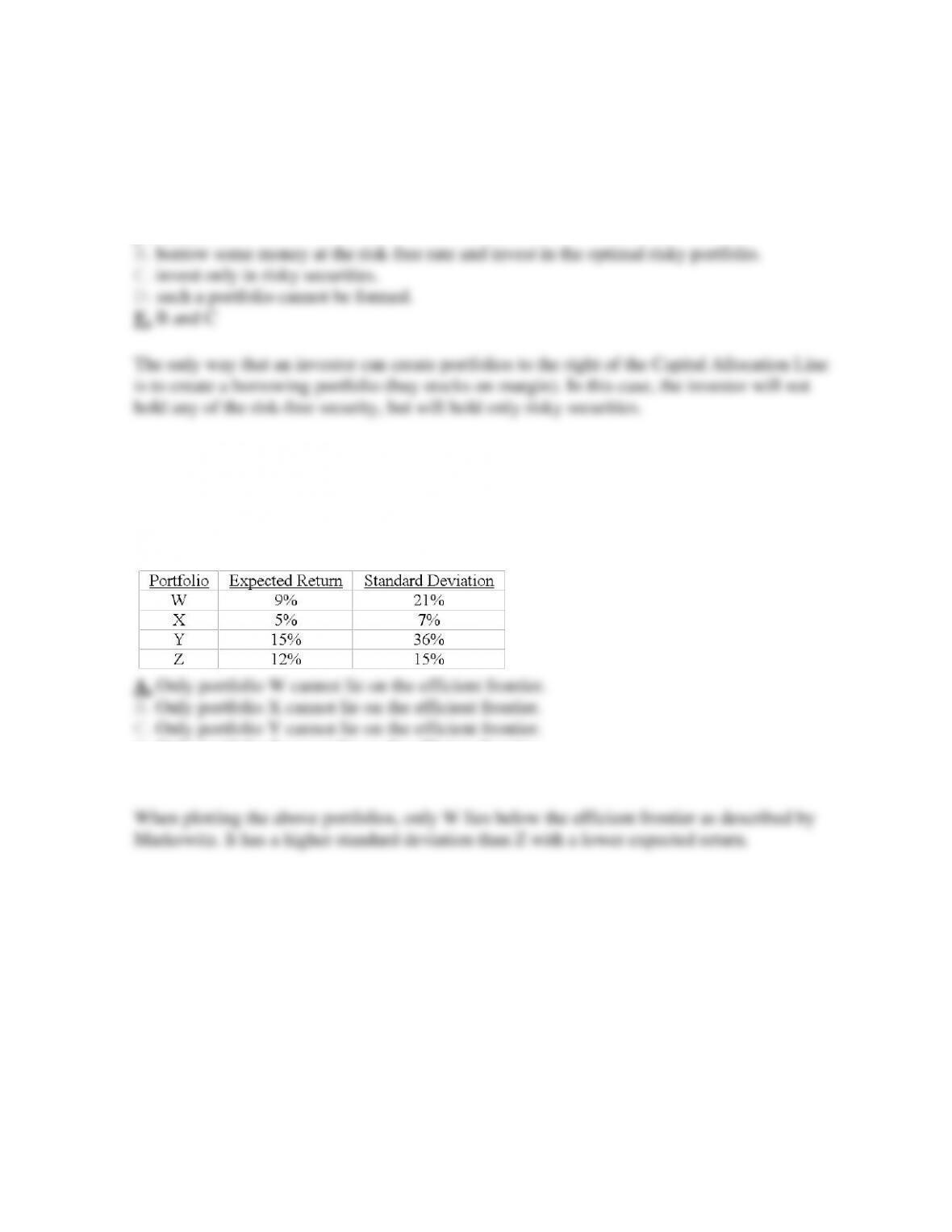
34. Which one of the following portfolios cannot lie on the efficient frontier as described by
Markowitz?
D. Only portfolio Z cannot lie on the efficient frontier.
E. Cannot tell from the information given.
Difficulty: Moderate
Chapter 07 – Optimal Risky Portfolios
7-16
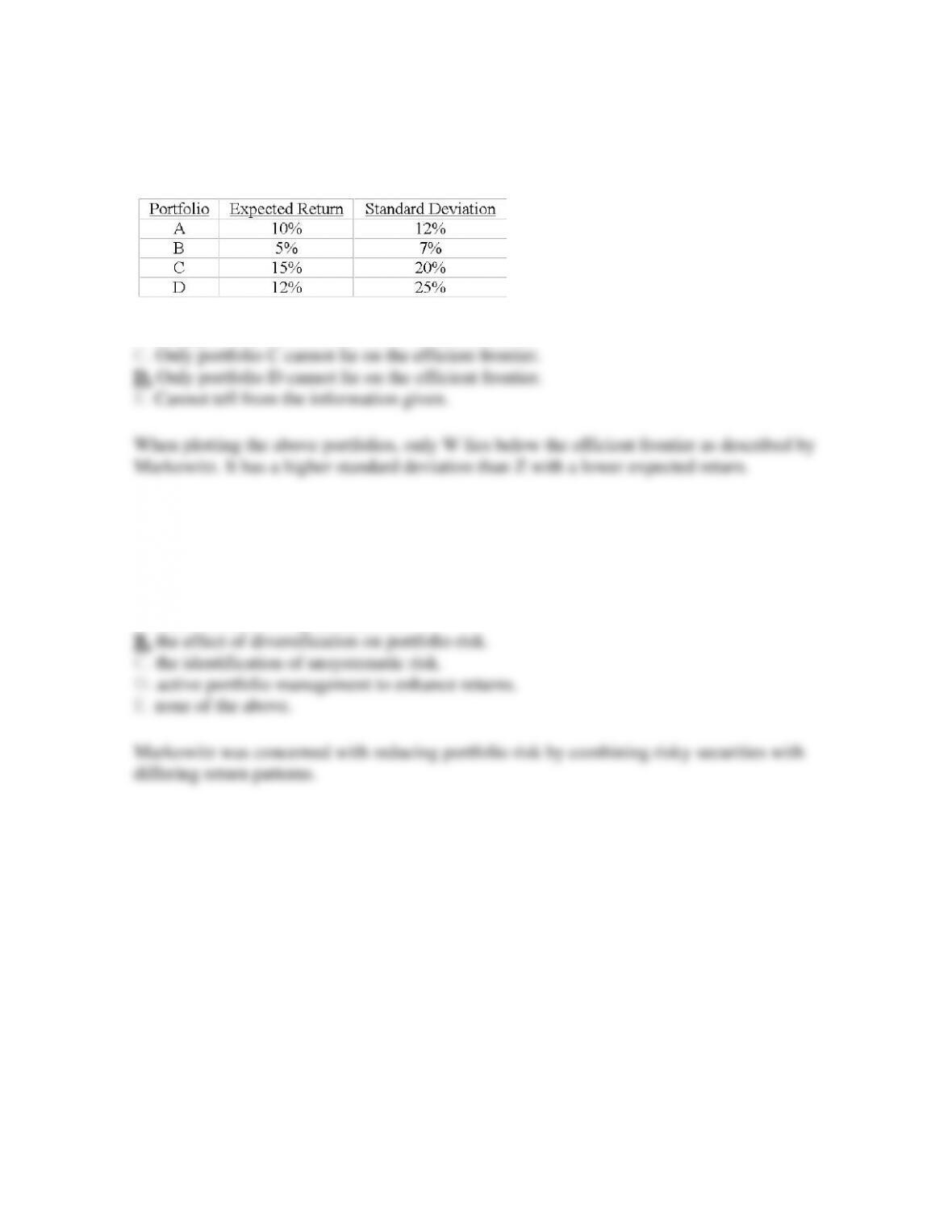
35. Which one of the following portfolios cannot lie on the efficient frontier as described by
Markowitz?
A. Only portfolio A cannot lie on the efficient frontier.
B. Only portfolio B cannot lie on the efficient frontier.
Difficulty: Moderate
36. Portfolio theory as described by Markowitz is most concerned with:
A. the elimination of systematic risk.
Difficulty: Moderate
Chapter 07 – Optimal Risky Portfolios
7-17
37. The measure of risk in a Markowitz efficient frontier is:
A. specific risk.
Difficulty: Moderate
38. A statistic that measures how the returns of two risky assets move together is:
A. variance.
B. standard deviation.
Difficulty: Moderate
39. The unsystematic risk of a specific security
A. is likely to be higher in an increasing market.
Difficulty: Moderate
Chapter 07 – Optimal Risky Portfolios
7-18
40. Which statement about portfolio diversification is correct?
A. Proper diversification can reduce or eliminate systematic risk.
B. The risk-reducing benefits of diversification do not occur meaningfully until at least 50-60
individual securities have been purchased.
Difficulty: Moderate
41. The individual investor’s optimal portfolio is designated by:
D. The point of the highest reward to variability ratio in the indifference curve.
E. None of the above.
Difficulty: Moderate