110) The three primary policy variables to consider when extending credit include all of the
following except
A) credit standards.
B) the level of inflation.
C) the terms of trade.
D) collection policy.
111) The most subjective and also significant segment of the 5 Cs of credit for giving final
approval is
A) capacity.
B) collateral.
C) character.
D) conditions.
112) Dun & Bradstreet is known for providing
A) interest rate information to cash managers.
B) credit scoring reports that rank a company’s payment habits relative to its peer group.
C) cash management systems to corporate treasurers.
D) consumer credit reports to credit card companies.
113) When developing a credit scoring report, many variables would be considered. Which of
the following best represents the major factors Dun & Bradstreet would examine?
A) The age of the management team, the dollar amount of sales, net profits, and long-term debt.
B) The age of the company, the number of employees, and the level of current assets.
C) The financial statements, satisfactory or slow payment experiences, and negative public
records (suits, liens, judgments, and bankruptcies).
D) The company’s cash balances, return on equity, and its average tax rates.
114) Which of the following is not a valid quantitative measure for accounts receivable
collection policies?
A) Average collection period
B) Aging of accounts receivables
C) Ratio of debt to equity
D) Ratio of bad debts to credit sales
115) Variables important to credit scoring models include
A) age of company in years.
B) negative public records.
C) facility ownership.
D) All of the options are true.
116) Inventory is usually divided into three basic categories except
A) projected sales.
B) work in process.
C) finished goods.
D) raw materials.
117) Which of the following is generally considered to be the least liquid of current assets?
A) Accounts receivable
B) Inventory
C) Marketable securities
D) Cash equivalents
118) Companies that are mostly influenced by seasonal sales have to make a choice between
A) level production and inventory buildup.
B) seasonal production and an uneven workforce.
C) a stable workforce and a fluctuating workforce.
D) All of the options are true.
119) The costs of carrying inventory do not include
A) the interest on funds tied up in inventory.
B) the cost of warehouse space.
C) ordering costs.
D) insurance and handling costs.
120) For a given firm, holding other factors constant, ordering costs per unit generally
A) decline as average inventory increases.
B) increase in proportion to increases in inventory.
C) are considered fixed costs.
D) are negotiated.
121) Use of the economic order quantity
A) determines the reorder point.
B) provides the lowest overall inventory costs.
C) determines the safety stock.
D) All of the options are true.
122) The economic order quantity
A) assumes that inventory usage is seasonal.
B) assumes that delivery times of each order are consistent.
C) considers stock-outs.
D) All of the options are true.
123) When using the economic order quantity model
A) ordering costs increase as the level of inventory increases.
B) carrying costs decrease as the level of inventory increases.
C) costs are minimized when total carrying costs and total ordering costs are equal.
D) None of the options are true.
124) The amount of safety stock that a firm carries depends upon
A) the predictability of inventory usage.
B) the time period necessary to fill inventory orders.
C) the riskiness of the storage facility.
D) the predictability of inventory usage and the time period necessary to fill inventory orders.
125) A Just-In-Time (JIT) inventory management program has all but which of the following
requirements?
A) Quality production
B) Large safety stocks
C) Close ties between suppliers, manufacturers, and customers
D) Minimizing inventory levels
126) Cost savings from Just-In-Time (JIT) inventory management include(s)
A) reduced overhead expenses.
B) lower inventory financing costs.
C) greater productivity.
D) All of the options are true.
127) All of the following are benefits of just-in-time inventory ordering systems except that JIT
A) reduces warehouse space.
B) saves utility and manpower costs.
C) reduces inventory costs.
D) prevents stock outs.
128) If average daily remittances are $6 million, and “extended disbursement float” adds two
days to the disbursement schedule, how much should the firm be willing to pay for a cash
management system if the firm earns 7% on excess funds?
A) $420,000
B) $1,200,000
C) $0
D) $840,000
129) Price Corp. is considering selling to a group of new customers and creating new annual
sales of $90,000. Five percent will be uncollectible. The collection cost on all accounts is 3% of
new sales, the cost of producing and selling is 80% of sales, and the firm is in the 21% tax
bracket. What is the profit on new sales?
A) $8,532
B) $9,660
C) $7,245
D) $10,710
130) Waldron Inc. is considering selling to a group of new customers that will bring in credit
sales of $24,000 with a return on sales of 5%. The only new investment will be in accounts
receivable. Waldron has a turnover ratio of 6 to 1 between sales and accounts receivable. What is
Waldron Inc.’s expected return on investment?
A) 30%
B) 25%
C) 5%
D) 0.8%
131) Modos Company has deposited $3,500 in checks received from customers. It has written
$1,400 in checks to its suppliers. The initial bank and book balance was $600. If $1,600 of its
customers’ checks have cleared, but only $600 of its own, calculate its float.
A) $1,200
B) $1,100
C) $300
D) $700
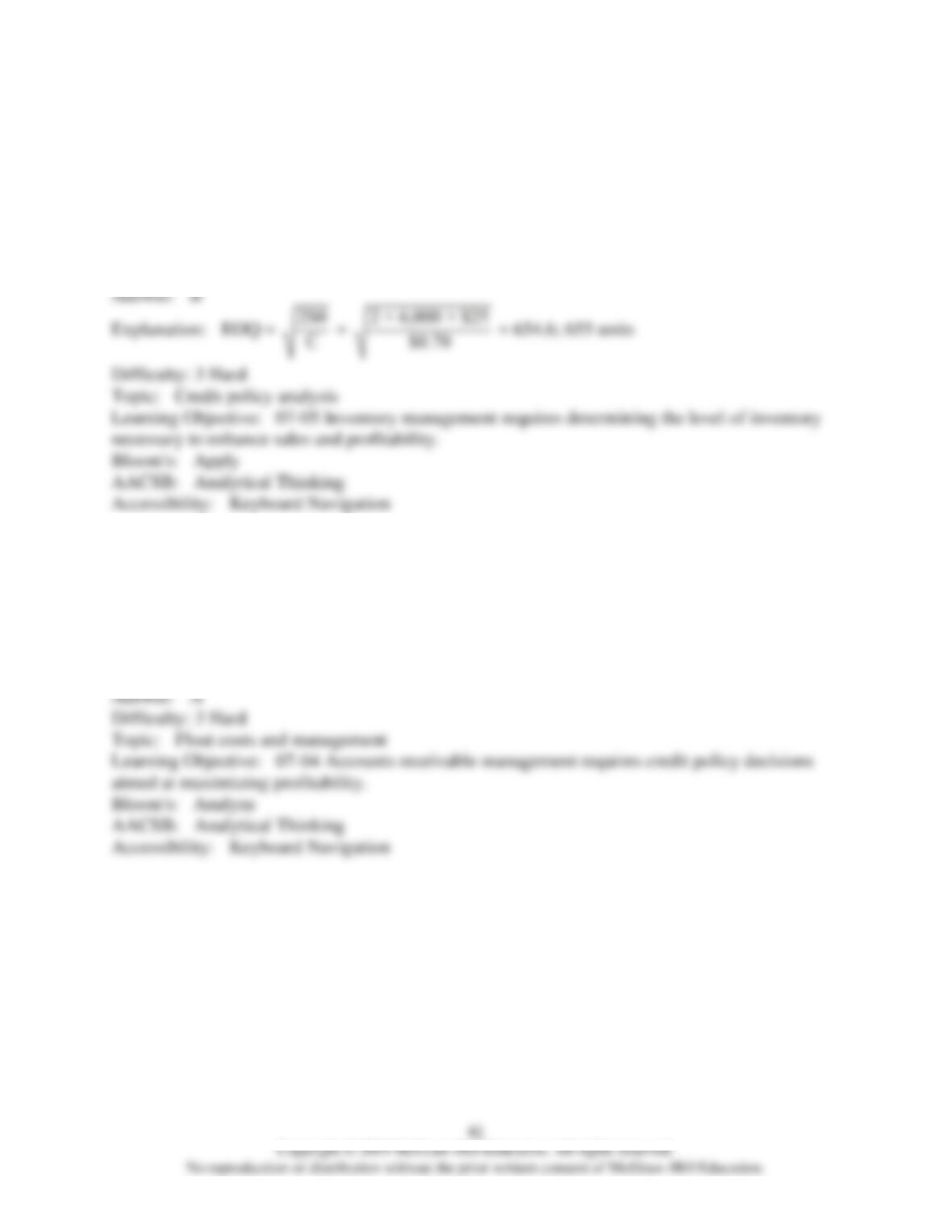
132) Massa Machine Tool expects total sales of $60,000. The price per unit is $10. The firm
estimates an ordering cost of $25 per order, with an inventory cost of $0.70 per unit. What is the
optimum order size?
A) 327 units
B) 655 units
C) 447 units
D) 207 units
133) Assuming that we can earn a 10% return on accounts receivable, which of the following
strategies to finance an increase in our accounts receivable balance would be optimal?
A) An increase in bank loans that would cost us 8%
B) A decrease in inventories that are earning a 16% return
C) A reduction in marketable securities that are earning a return of 14%
D) An increase in accounts payable that would cost our firm 15%
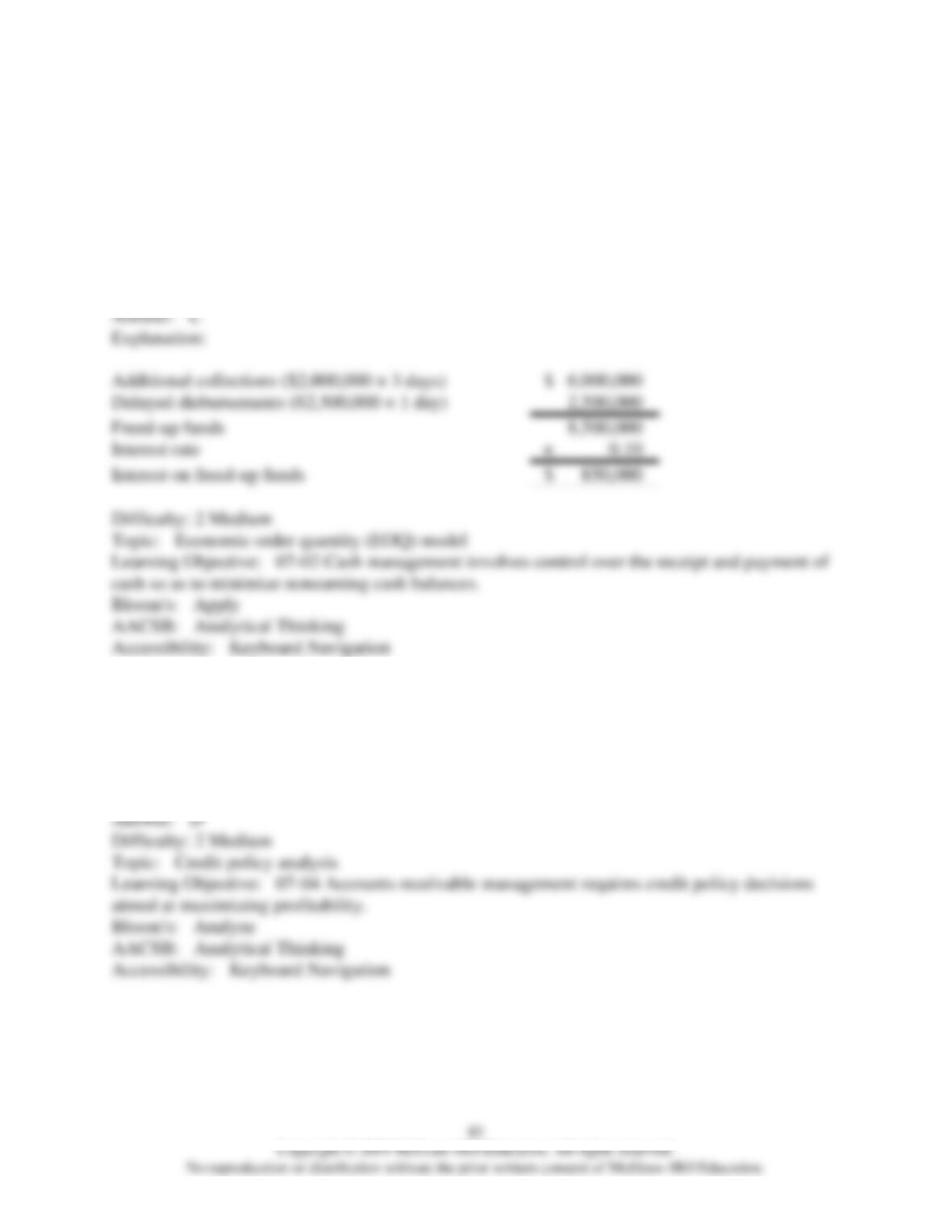
134) If a company can implement cash management systems and save three days by reducing
remittance time and one day by increasing disbursement time based on $2,000,000 in average
daily remittances and $2,500,000 in average daily disbursements and its return on freed-up funds
is 10%, what is the maximum that it should spend on the system?
A) $2,000,000
B) $650,000
C) $850,000
D) $1,000,000
135) All of the following are methods of controlling receivables except
A) offering a cash discount.
B) reducing net terms.
C) using DBIS.
D) reducing cash sales.
136) Level production offers all of the following benefits except
A) lower overtime usage.
B) maximum efficiency.
C) greater storage space.
D) higher use of capacity.
137) We expect that we can receive annual incremental income after taxes of $25,000, including
an adjustment for uncollectible accounts. What is the maximum commitment to A/R that we
should be willing to assume if our firm’s minimum required after-tax return is 8%?
A) $36,000
B) $312,500
C) $168,000
D) $180,000
138) All of the following are examples of carrying costs except
A) interest expense.
B) warehouse space.
C) shipping costs.
D) insurance premiums.
139) The inventory decision model provides which type of information?
A) Optimal total inventory
B) Optimal safety stock
C) Optimal order size
D) Optimal carrying cost per unit
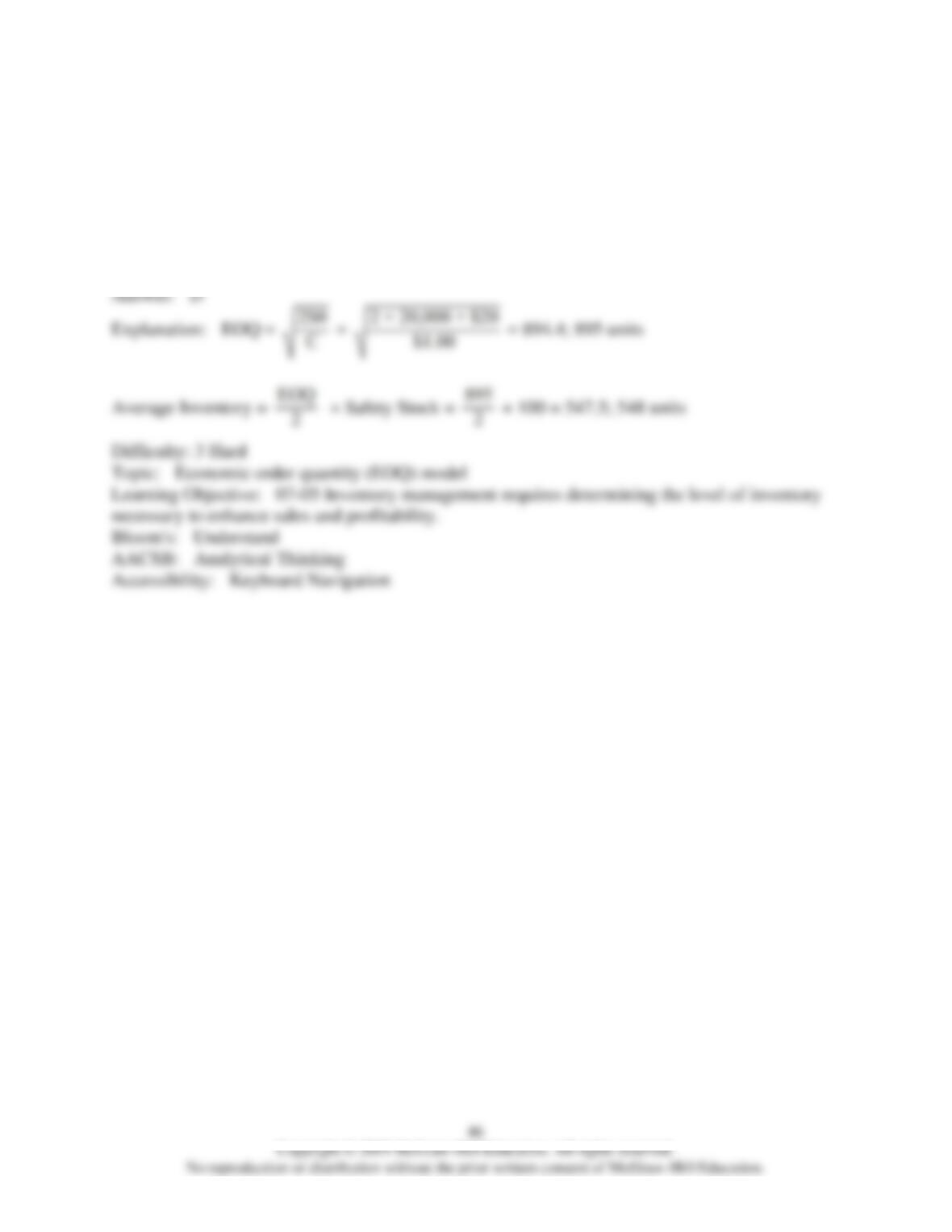
140) Warren Enterprises expects 20,000 unit sales, has ordering costs of $20 per order, carrying
costs of $1.00 per unit, and desires to keep 100 units in safety stock. Assuming level production,
what should be its average inventory?
A) 200-300
B) 301-400
C) 401-500
D) 501-600