27.
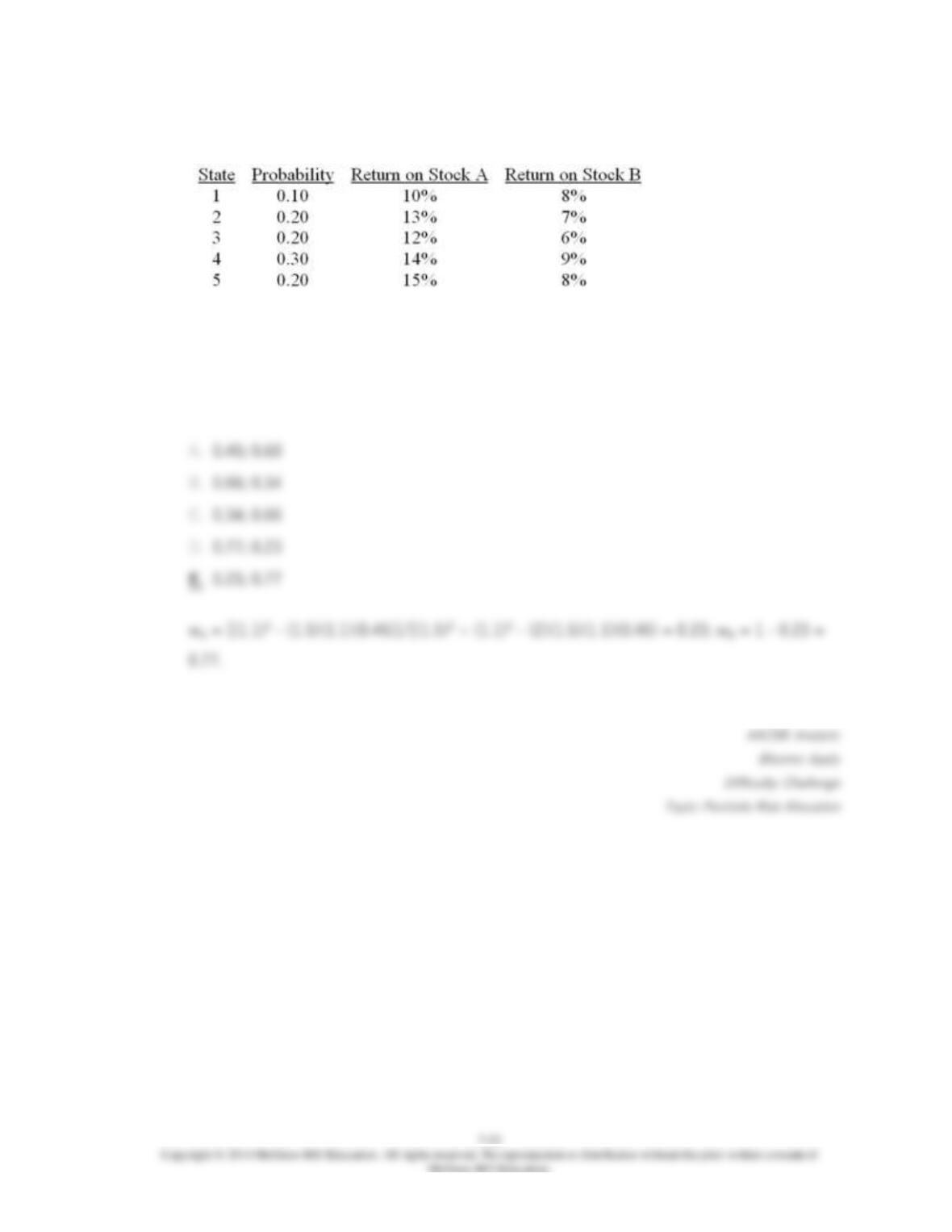
Consider the following probability distribution for stocks A and B:
Let G be the global minimum variance portfolio. The weights of A and B in G are
__________ and __________, respectively.
28.
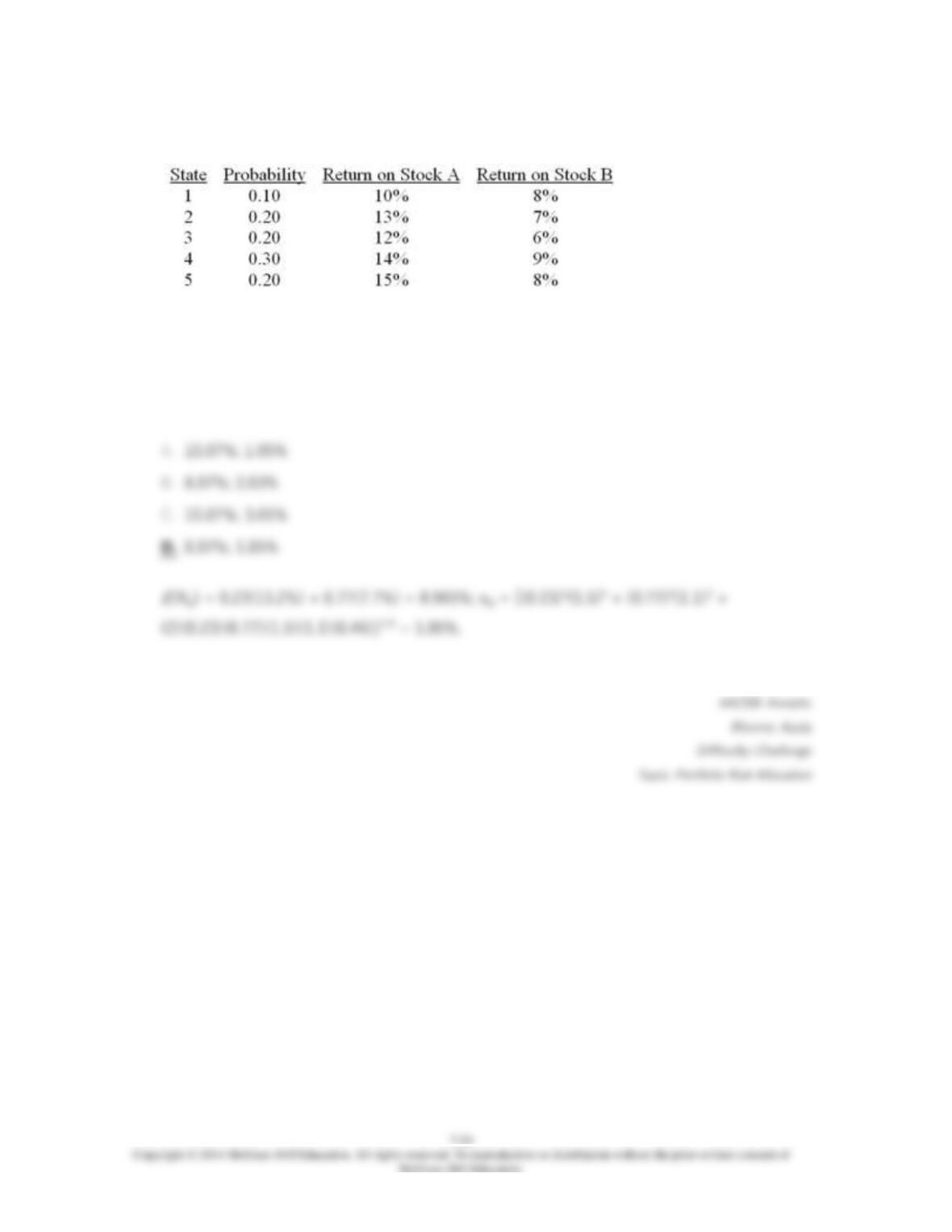
Consider the following probability distribution for stocks A and B:
The expected rate of return and standard deviation of the global minimum variance
portfolio, G, are __________ and __________, respectively.
29.
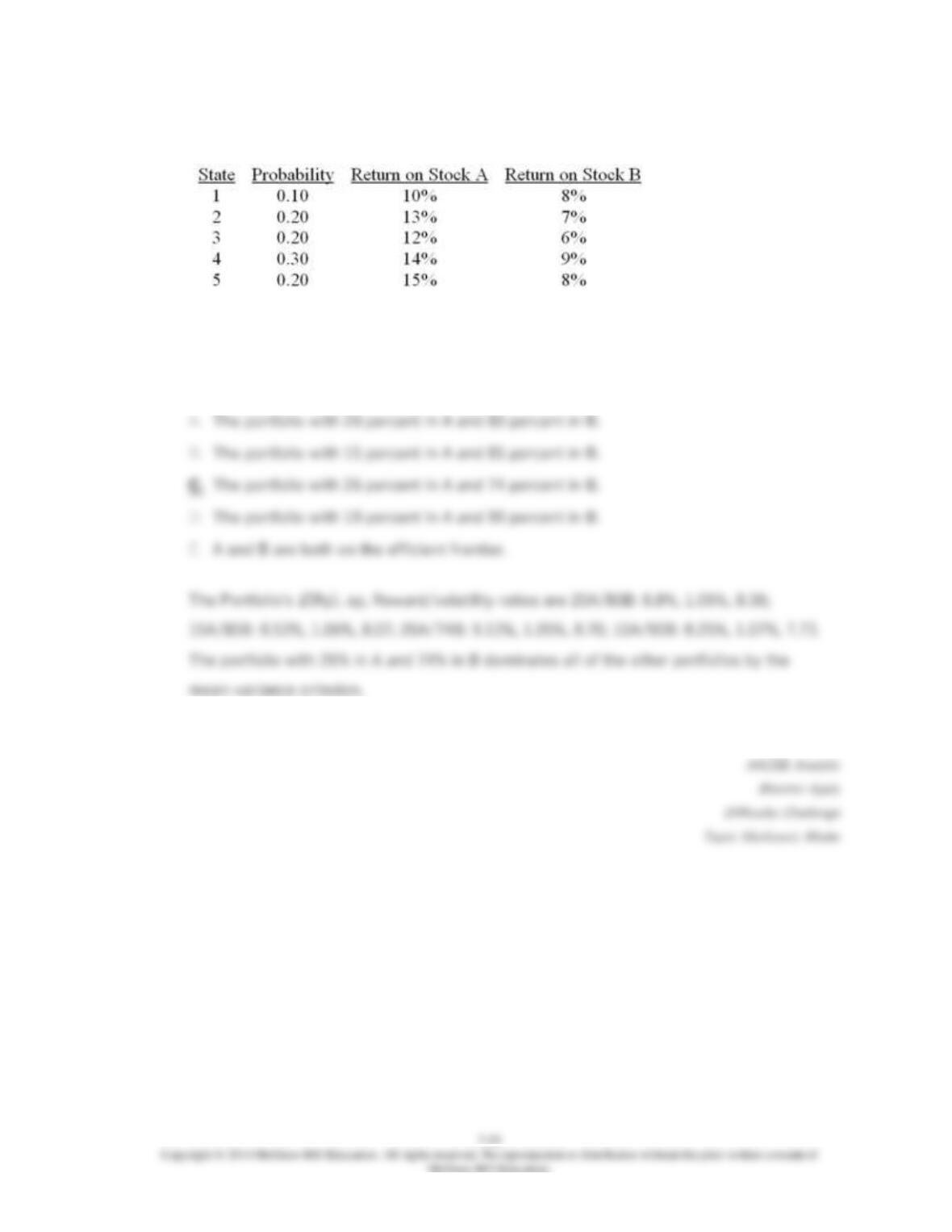
Consider the following probability distribution for stocks A and B:
Which of the following portfolio(s) is(are) on the efficient frontier?
30.
Consider two perfectly negatively correlated risky securities A and B. A has an expected
rate of return of 10% and a standard deviation of 16%. B has an expected rate of return of
8% and a standard deviation of 12%.
The weights of A and B in the global minimum variance portfolio are _____ and _____,
respectively.
31.
Consider two perfectly negatively correlated risky securities A and B. A has an expected
rate of return of 10% and a standard deviation of 16%. B has an expected rate of return of
8% and a standard deviation of 12%.
The risk-free portfolio that can be formed with the two securities will earn _____ rate of
return.
32.
Given an optimal risky portfolio with expected return of 6% and standard deviation of 23%
and a risk free rate of 3%, what is the slope of the best feasible CAL?
33.
An investor who wishes to form a portfolio that lies to the right of the optimal risky
portfolio on the capital allocation line must:
34.
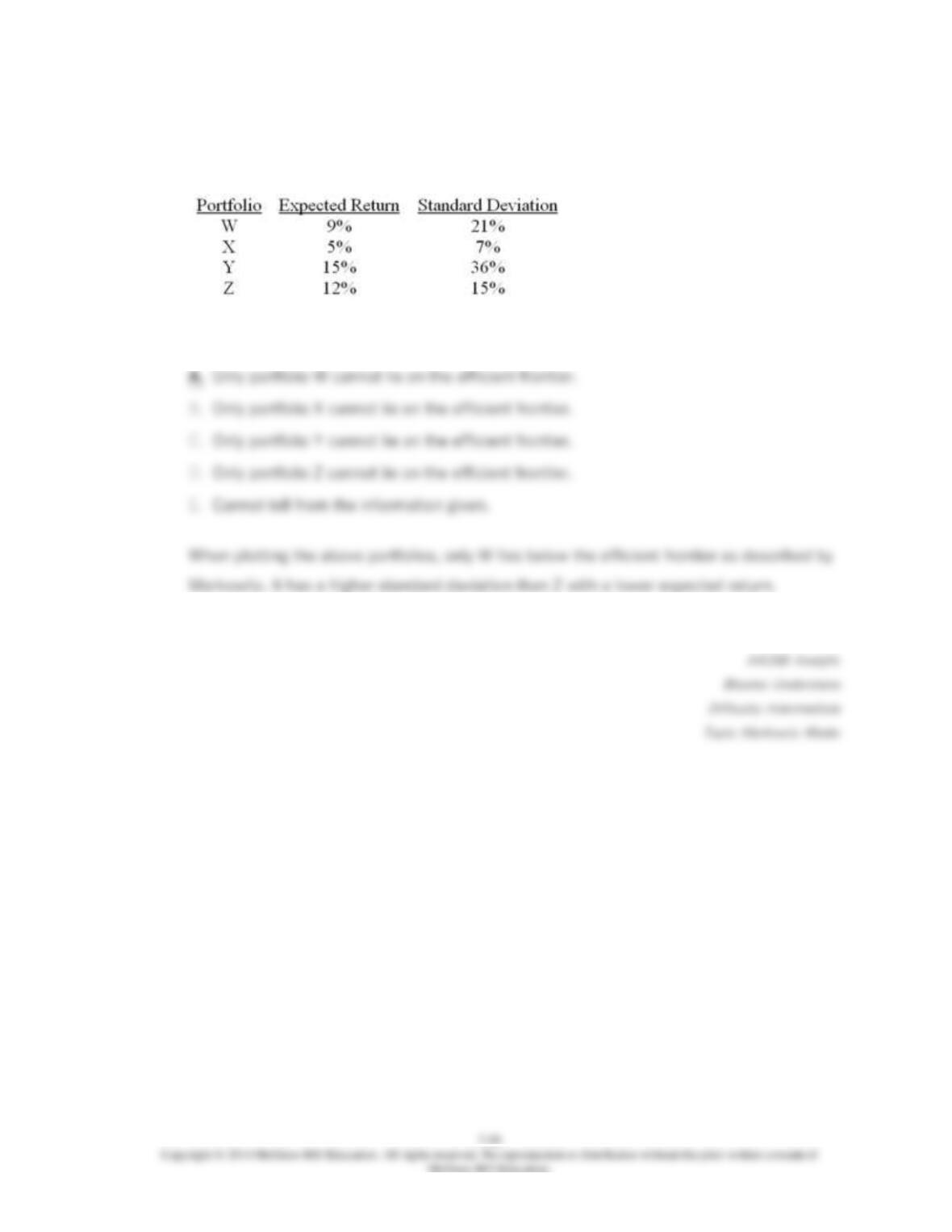
Which one of the following portfolios cannot lie on the efficient frontier as described by
Markowitz?
35.
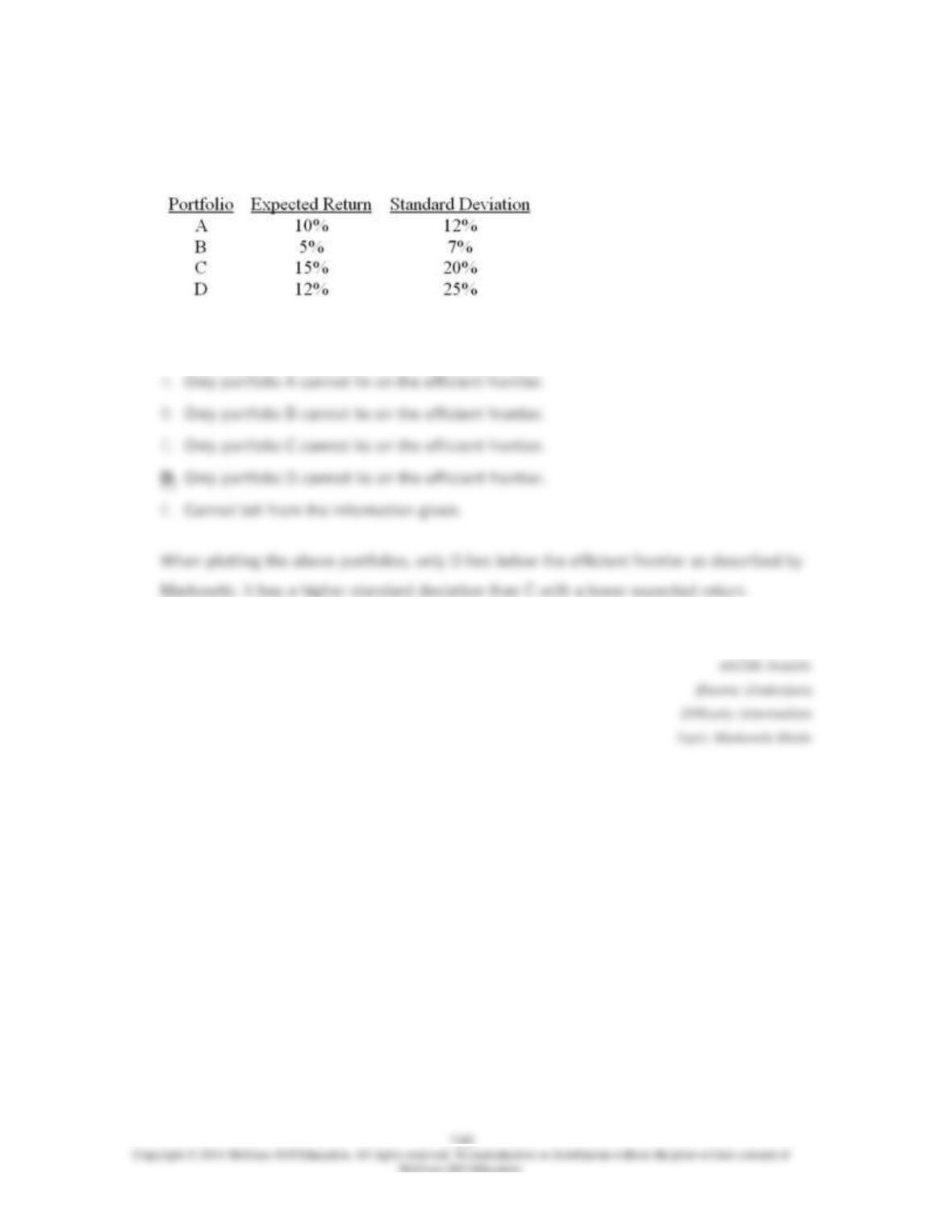
Which one of the following portfolios cannot lie on the efficient frontier as described by
Markowitz?
36.
Portfolio theory as described by Markowitz is most concerned with:
37.
The measure of risk in a Markowitz efficient frontier is:
38.
A statistic that measures how the returns of two risky assets move together is:
39.
The unsystematic risk of a specific security
40.
Which statement about portfolio diversification is correct?
41.
The individual investor’s optimal portfolio is designated by:
42.
For a two-stock portfolio, what would be the preferred correlation coefficient between the
two stocks?
43.
In a two-security minimum variance portfolio where the correlation between securities is
greater than -1.0
44.
Which of the following is not a source of systematic risk?
45.
The global minimum variance portfolio formed from two risky securities will be riskless
when the correlation coefficient between the two securities is
46.
Security X has expected return of 12% and standard deviation of 18%. Security Y has
expected return of 15% and standard deviation of 26%. If the two securities have a
correlation coefficient of 0.7, what is their covariance?
47.
When two risky securities that are positively correlated but not perfectly correlated are
held in a portfolio,
48.
The line representing all combinations of portfolio expected returns and standard
deviations that can be constructed from two available assets is called the
49.
Given an optimal risky portfolio with expected return of 12% and standard deviation of 26%
and a risk free rate of 5%, what is the slope of the best feasible CAL?
50.
Given an optimal risky portfolio with expected return of 20% and standard deviation of 24%
and a risk free rate of 7%, what is the slope of the best feasible CAL?
51.
The risk that can be diversified away in a portfolio is referred to as ___________.
I) diversifiable risk
II) unique risk
III) systematic risk
IV) firm-specific risk
52.
As the number of securities in a portfolio is increased, what happens to the average
portfolio standard deviation?