29.
An investor invests 30% of his wealth in a risky asset with an expected rate of return of
0.13 and a variance of 0.03 and 70% in a T-bill that pays 6%. His portfolio’s expected
return and standard deviation are __________ and __________, respectively.
30.
An investor invests 40% of his wealth in a risky asset with an expected rate of return of
0.17 and a variance of 0.08 and 60% in a T-bill that pays 4.5%. His portfolio’s expected
return and standard deviation are __________ and __________, respectively.
31.
An investor invests 70% of his wealth in a risky asset with an expected rate of return of
0.15 and a variance of 0.04 and 30% in a T-bill that pays 5%. His portfolio’s expected
return and standard deviation are __________ and __________, respectively.
32.
You invest $100 in a risky asset with an expected rate of return of 0.12 and a standard
deviation of 0.15 and a T-bill with a rate of return of 0.05.
What percentages of your money must be invested in the risky asset and the risk-free
asset, respectively, to form a portfolio with an expected return of 0.09?
33.
You invest $100 in a risky asset with an expected rate of return of 0.12 and a standard
deviation of 0.15 and a T-bill with a rate of return of 0.05.
What percentages of your money must be invested in the risk-free asset and the risky
asset, respectively, to form a portfolio with a standard deviation of 0.06?
34.
You invest $100 in a risky asset with an expected rate of return of 0.12 and a standard
deviation of 0.15 and a T-bill with a rate of return of 0.05.
A portfolio that has an expected outcome of $115 is formed by
35.
You invest $100 in a risky asset with an expected rate of return of 0.12 and a standard
deviation of 0.15 and a T-bill with a rate of return of 0.05.
The slope of the capital allocation line formed with the risky asset and the risk-free
asset is equal to
36.
Consider a T-bill with a rate of return of 5% and the following risky securities:
Security A:
E
(
r
) = 0.15; Variance = 0.04
Security B:
E
(
r
) = 0.10; Variance = 0.0225
Security C:
E
(
r
) = 0.12; Variance = 0.01
Security D:
E
(
r
) = 0.13; Variance = 0.0625
From which set of portfolios, formed with the T-bill and any one of the four risky
securities, would a risk-averse investor always choose his portfolio?
37.
You are considering investing $1,000 in a T-bill that pays 0.05 and a risky portfolio,
P
,
constructed with two risky securities,
X
and
Y
. The weights of
X
and
Y
in
P
are 0.60
and 0.40, respectively.
X
has an expected rate of return of 0.14 and variance of 0.01,
and
Y
has an expected rate of return of 0.10 and a variance of 0.0081.
If you want to form a portfolio with an expected rate of return of 0.11, what
percentages of your money must you invest in the T-bill and
P
, respectively?
38.
You are considering investing $1,000 in a T-bill that pays 0.05 and a risky portfolio,
P
,
constructed with two risky securities,
X
and
Y
. The weights of
X
and
Y
in
P
are 0.60
and 0.40, respectively.
X
has an expected rate of return of 0.14 and variance of 0.01,
and
Y
has an expected rate of return of 0.10 and a variance of 0.0081.
If you want to form a portfolio with an expected rate of return of 0.10, what
percentages of your money must you invest in the T-bill,
X
, and
Y
, respectively, if you
keep
X
and
Y
in the same proportions to each other as in portfolio
P
?
39.
You are considering investing $1,000 in a T-bill that pays 0.05 and a risky portfolio,
P
,
constructed with two risky securities,
X
and
Y
. The weights of
X
and
Y
in
P
are 0.60
and 0.40, respectively.
X
has an expected rate of return of 0.14 and variance of 0.01,
and
Y
has an expected rate of return of 0.10 and a variance of 0.0081.
What would be the dollar values of your positions in
X
and
Y
, respectively, if you decide
to hold 40% of your money in the risky portfolio and 60% in T-bills?
40.
You are considering investing $1,000 in a T-bill that pays 0.05 and a risky portfolio,
P
,
constructed with two risky securities,
X
and
Y
. The weights of
X
and
Y
in
P
are 0.60
and 0.40, respectively.
X
has an expected rate of return of 0.14 and variance of 0.01,
and
Y
has an expected rate of return of 0.10 and a variance of 0.0081.
What would be the dollar value of your positions in
X
,
Y
, and the T-bills, respectively, if
you decide to hold a portfolio that has an expected outcome of $1,120?
41.
A reward-to-volatility ratio is useful in
42.
The change from a straight to a kinked capital allocation line is a result of
43.
The first major step in asset allocation is
44.
Based on their relative degrees of risk tolerance
45.
Asset allocation may involve
46.
In the mean-standard deviation graph, the line that connects the risk-free rate and the
optimal risky portfolio,
P
, is called
47.
Treasury bills are commonly viewed as risk-free assets because
48.
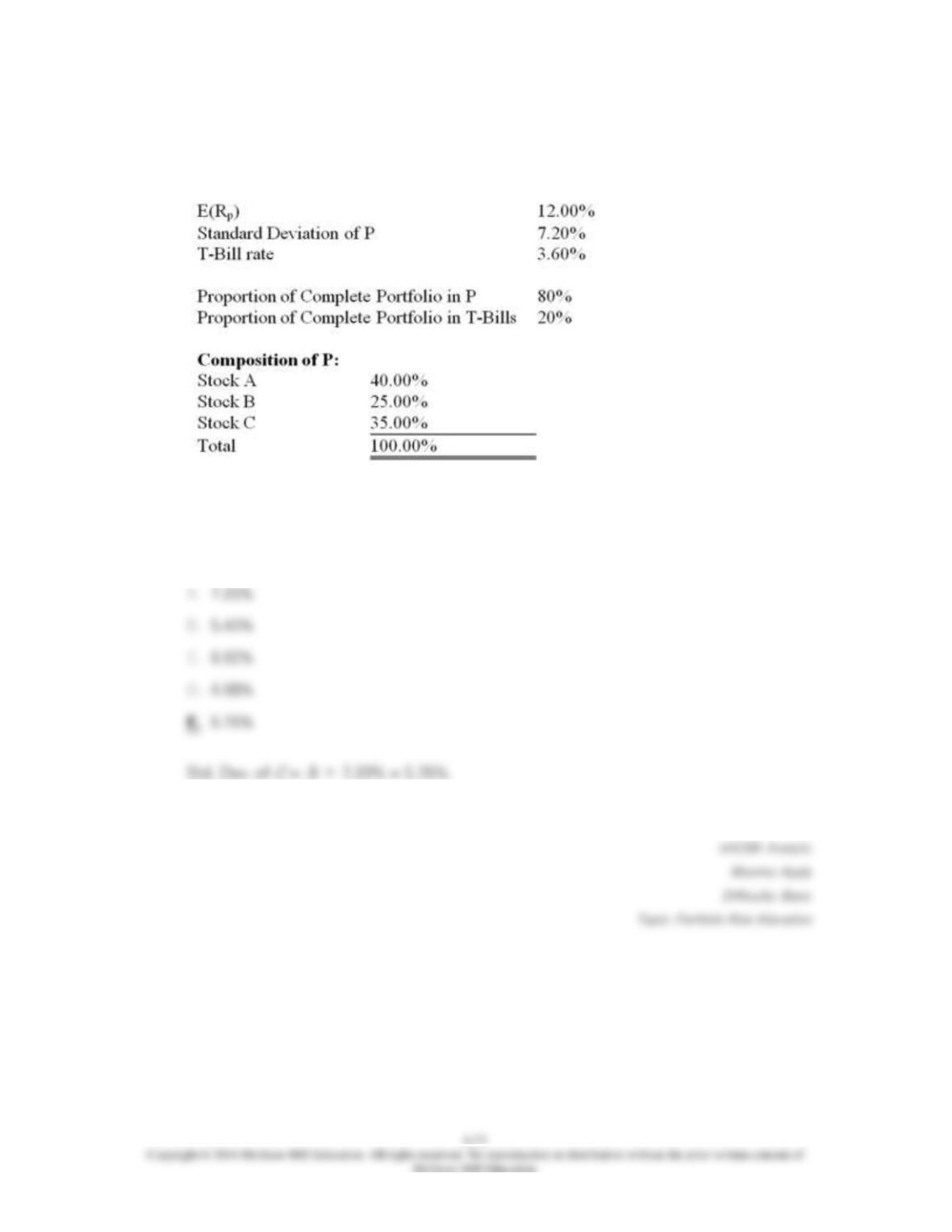
Your client, Bo Regard, holds a complete portfolio that consists of a portfolio of risky
assets (
P
) and T-Bills. The information below refers to these assets.
What is the expected return on Bo’s complete portfolio?
49.
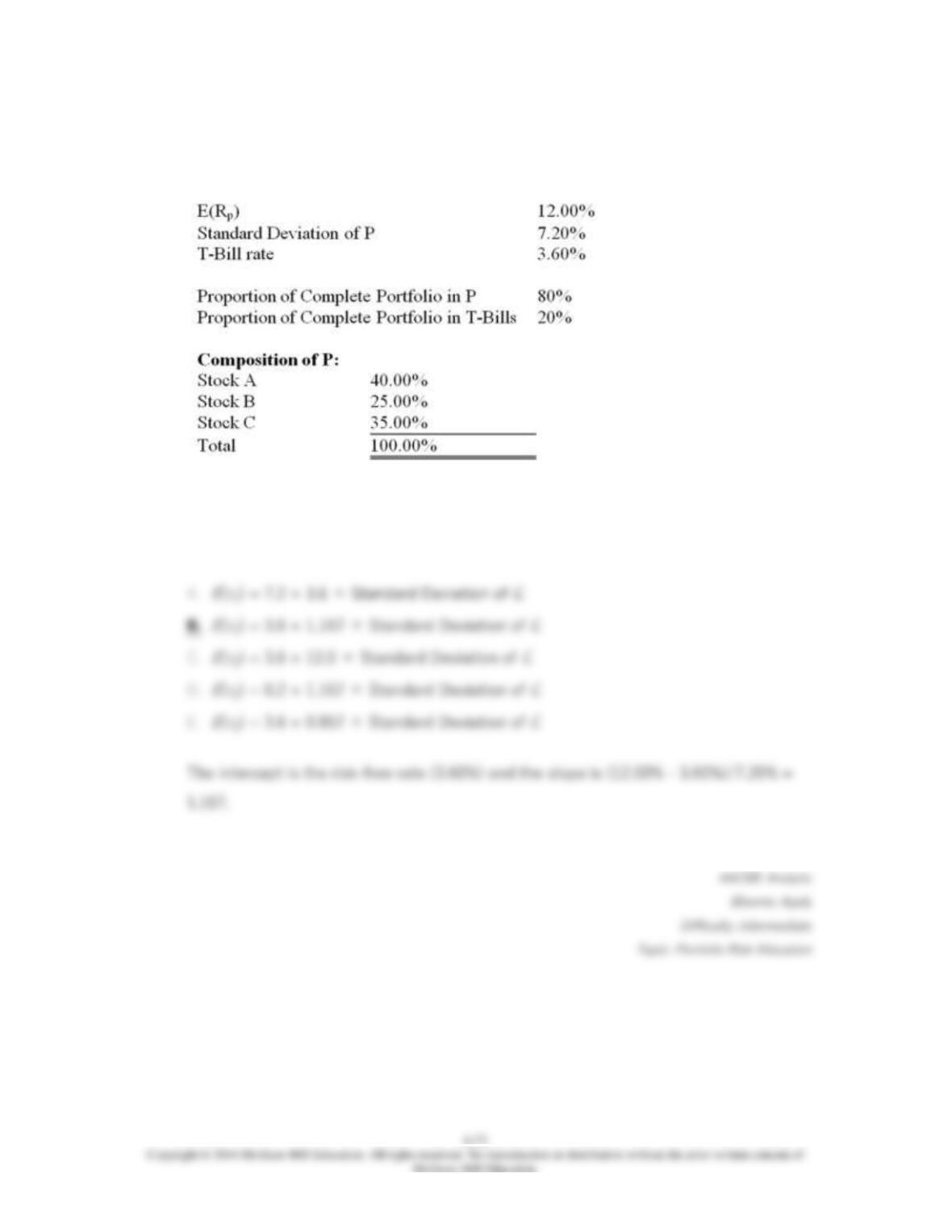
Your client, Bo Regard, holds a complete portfolio that consists of a portfolio of risky
assets (
P
) and T-Bills. The information below refers to these assets.
What is the standard deviation of Bo’s complete portfolio?
50.
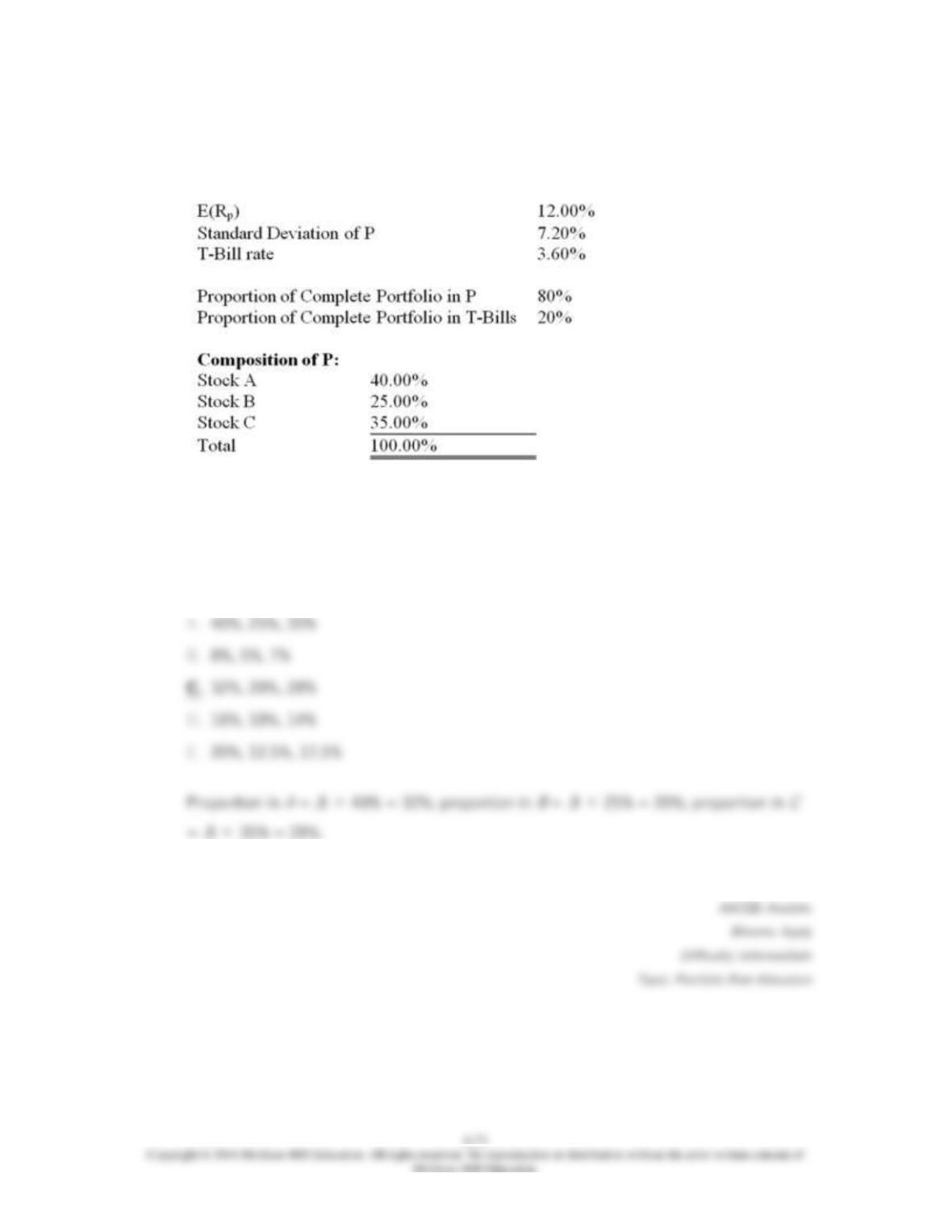
Your client, Bo Regard, holds a complete portfolio that consists of a portfolio of risky
assets (
P
) and T-Bills. The information below refers to these assets.
What is the equation of Bo’s capital allocation line?
51.
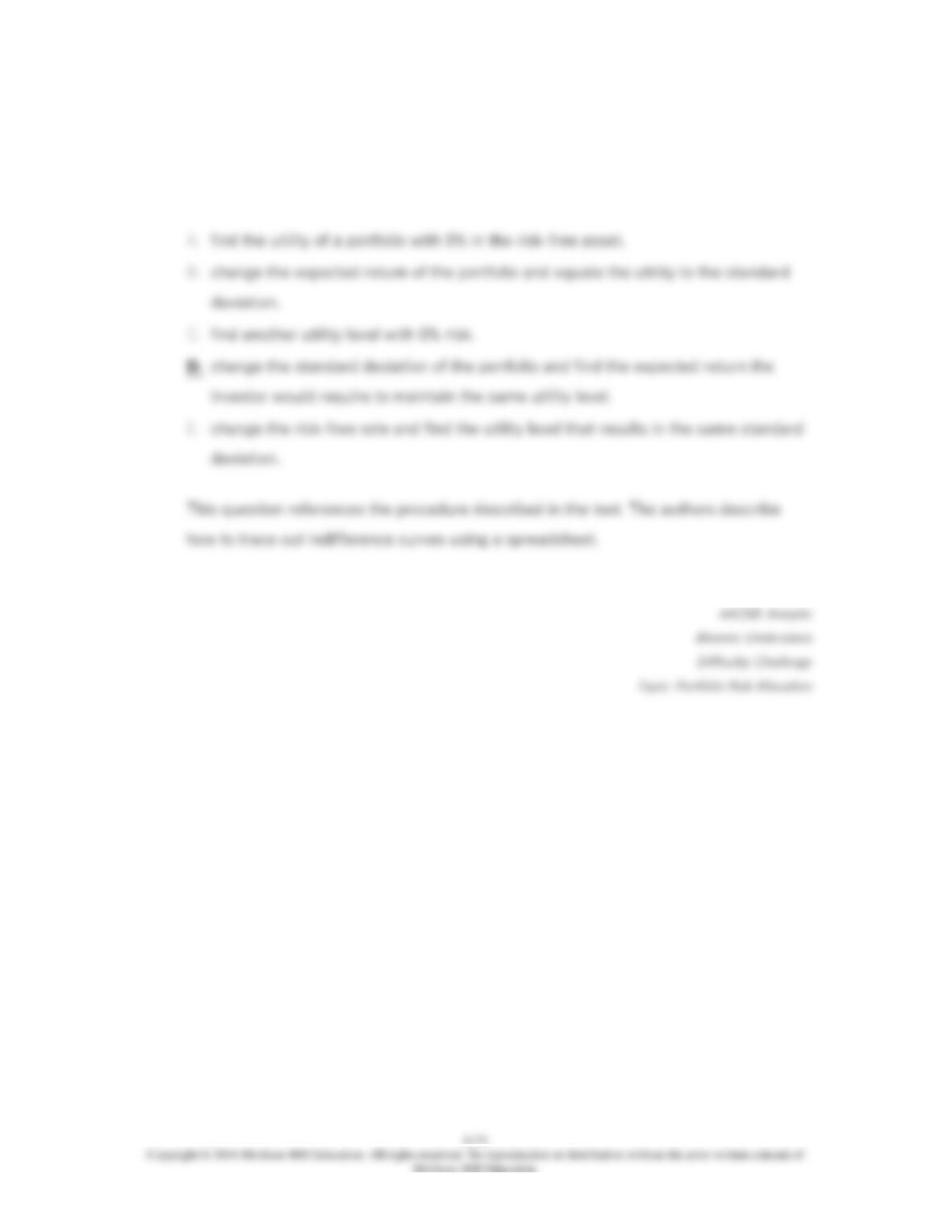
Your client, Bo Regard, holds a complete portfolio that consists of a portfolio of risky
assets (
P
) and T-Bills. The information below refers to these assets.
What are the proportions of stocks A, B, and C, respectively, in Bo’s complete
portfolio?
52.
To build an indifference curve we can first find the utility of a portfolio with 100% in
the risk-free asset, then