Chapter 06 – Risk Aversion and Capital Allocation to Risky Assets
6-18
39. What would be the dollar values of your positions in X and Y, respectively, if you decide
to hold 40% percent of your money in the risky portfolio and 60% in T-bills?
A. $240; $360
B. $360; $240
Difficulty: Moderate
40. What would be the dollar value of your positions in X, Y, and the T-bills, respectively, if
you decide to hold a portfolio that has an expected outcome of $1,200?
A. Cannot be determined
Difficulty: Difficult
41. A reward-to-volatility ratio is useful in:
A. measuring the standard deviation of returns.
Difficulty: Moderate
Chapter 06 – Risk Aversion and Capital Allocation to Risky Assets
6-19
42. The change from a straight to a kinked capital allocation line is a result of:
A. reward-to-volatility ratio increasing.
Difficulty: Difficult
43. The first major step in asset allocation is:
D. identifying market anomalies.
E. none of the above.
Difficulty: Moderate
44. Based on their relative degrees of risk tolerance
A. investors will hold varying amounts of the risky asset in their portfolios.
B. all investors will have the same portfolio asset allocations.
Difficulty: Easy
Chapter 06 – Risk Aversion and Capital Allocation to Risky Assets
6-20
45. Asset allocation
A. may involve the decision as to the allocation between a risk-free asset and a risky asset.
Difficulty: Easy
46. In the mean-standard deviation graph, the line that connects the risk-free rate and the
optimal risky portfolio, P, is called ______________.
A. the Security Market Line
Difficulty: Moderate
47. Treasury bills are commonly viewed as risk-free assets because
A. their short-term nature makes their values insensitive to interest rate fluctuations.
Difficulty: Easy
Chapter 06 – Risk Aversion and Capital Allocation to Risky Assets
6-21
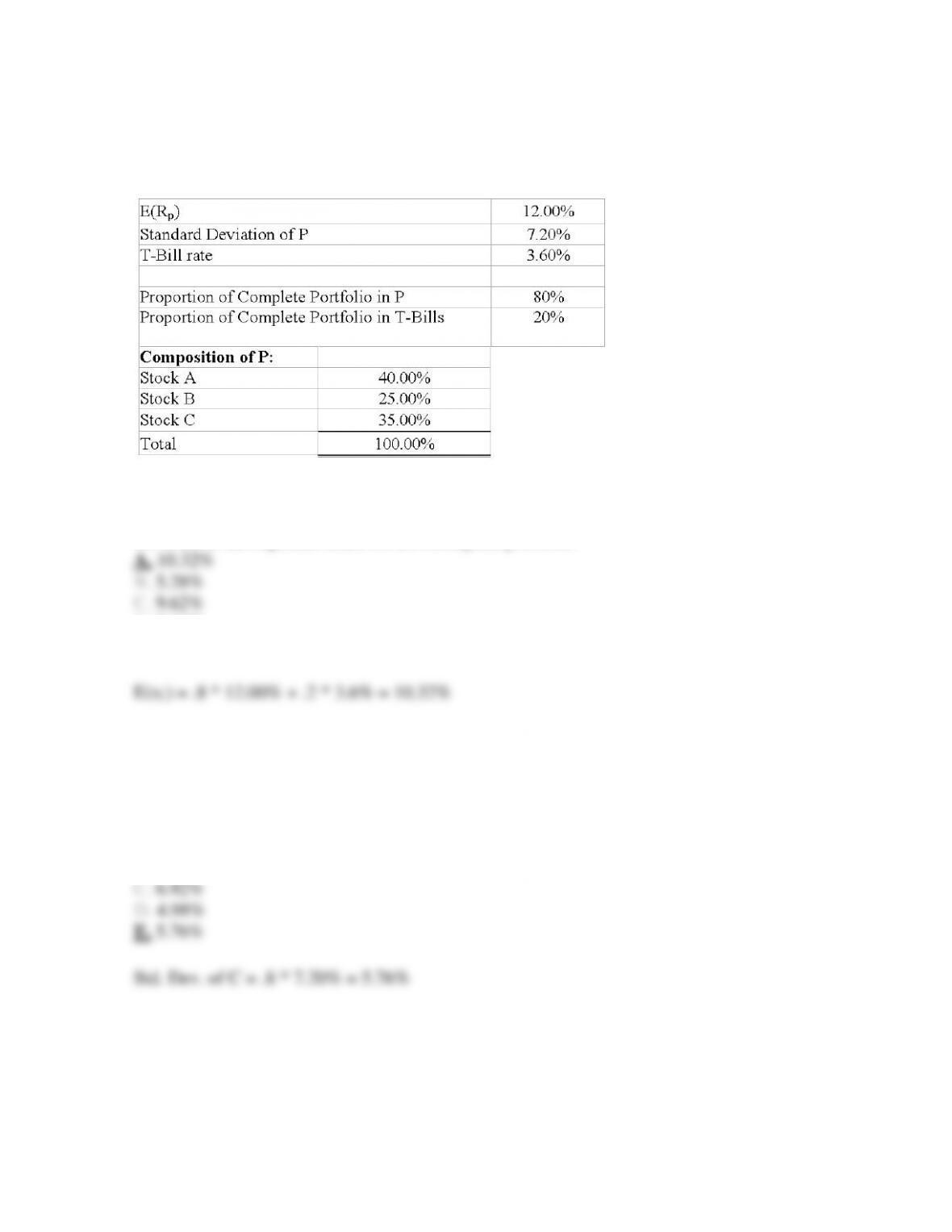
Your client, Bo Regard, holds a complete portfolio that consists of a portfolio of risky assets
(P) and T-Bills. The information below refers to these assets.
48. What is the expected return on Bo’s complete portfolio?
D. 8.44%
E. 7.58%
Difficulty: Easy
49. What is the standard deviation of Bo’s complete portfolio?
A. 7.20%
B. 5.40%
Difficulty: Easy
Chapter 06 – Risk Aversion and Capital Allocation to Risky Assets
6-22
50. What is the equation of Bo’s Capital Allocation Line?
D. E(rC) = 0.2 + 1.167 * Standard Deviation of C
E. E(rC) = 3.6 + 0.857 * Standard Deviation of C
Difficulty: Moderate
51. What are the proportions of Stocks A, B, and C, respectively in Bo’s complete portfolio?
A. 40%, 25%, 35%
B. 8%, 5%, 7%
Difficulty: Moderate
52. To build an indifference curve we can first find the utility of a portfolio with 100% in the
risk-free asset, then
A. find the utility of a portfolio with 0% in the risk-free asset.
B. change the expected return of the portfolio and equate the utility to the standard deviation.
Difficulty: Difficult
Chapter 06 – Risk Aversion and Capital Allocation to Risky Assets
6-23
53. The Capital Market Line
I) is a special case of the Capital Allocation Line.
II) represents the opportunity set of a passive investment strategy.
III) has the one-month T-Bill rate as its intercept.
IV) uses a broad index of common stocks as its risky portfolio.
A. I, III, and IV
B. II, III, and IV
Difficulty: Moderate
54. An investor invests 40 percent of his wealth in a risky asset with an expected rate of return
of 0.18 and a variance of 0.10 and 60 percent in a T-bill that pays 4 percent. His portfolio’s
expected return and standard deviation are __________ and __________, respectively.
A. 0.114; 0.112
B. 0.087; 0.063
Difficulty: Moderate
Chapter 06 – Risk Aversion and Capital Allocation to Risky Assets
6-24
55. An investor invests 70 percent of his wealth in a risky asset with an expected rate of return
of 0.11 and a variance of 0.12 and 30 percent in a T-bill that pays 3 percent. His portfolio’s
expected return and standard deviation are __________ and __________, respectively.
D. 0.087; 0.182
E. none of the above
Difficulty: Moderate
You invest $100 in a risky asset with an expected rate of return of 0.11 and a standard
deviation of 0.20 and a T-bill with a rate of return of 0.03.
56. What percentages of your money must be invested in the risky asset and the risk-free
asset, respectively, to form a portfolio with an expected return of 0.08?
A. 85% and 15%
B. 75% and 25%
Difficulty: Moderate
Chapter 06 – Risk Aversion and Capital Allocation to Risky Assets
6-25
57. What percentages of your money must be invested in the risk-free asset and the risky
asset, respectively, to form a portfolio with a standard deviation of 0.08?
A. 30% and 70%
B. 50% and 50%
Difficulty: Moderate
58. The slope of the Capital Allocation Line formed with the risky asset and the risk-free asset
is equal to
A. 0.47
Difficulty: Moderate
You invest $1000 in a risky asset with an expected rate of return of 0.17 and a standard
deviation of 0.40 and a T-bill with a rate of return of 0.04.
Chapter 06 – Risk Aversion and Capital Allocation to Risky Assets
6-26
59. What percentages of your money must be invested in the risky asset and the risk-free
asset, respectively, to form a portfolio with an expected return of 0.11?
D. 46.1% and 53.8%
E. Cannot be determined.
Difficulty: Moderate
60. What percentages of your money must be invested in the risk-free asset and the risky
asset, respectively, to form a portfolio with a standard deviation of 0.20?
D. 40% and 60%
E. Cannot be determined.
Difficulty: Moderate
61. The slope of the Capital Allocation Line formed with the risky asset and the risk-free asset
is equal to
D. 0.407.
E. Cannot be determined.
Difficulty: Moderate
Chapter 06 – Risk Aversion and Capital Allocation to Risky Assets
6-27
You invest $100 in a risky asset with an expected rate of return of 0.11 and a standard
deviation of 0.21 and a T-bill with a rate of return of 0.045.
62. What percentages of your money must be invested in the risky asset and the risk-free
asset, respectively, to form a portfolio with an expected return of 0.13?
E. cannot be determined
Difficulty: Moderate
63. What percentages of your money must be invested in the risk-free asset and the risky
asset, respectively, to form a portfolio with a standard deviation of 0.08?
A. 301% and 69.9%
B. 50.5% and 49.50%
Difficulty: Moderate
Chapter 06 – Risk Aversion and Capital Allocation to Risky Assets
6-28
64. A portfolio that has an expected outcome of $114 is formed by
A. investing $100 in the risky asset.
B. investing $80 in the risky asset and $20 in the risk-free asset.
Difficulty: Difficult
65. The slope of the Capital Allocation Line formed with the risky asset and the risk-free asset
is equal to
A. 0.4667.
B. 0.8000.
Difficulty: Moderate
Chapter 06 – Risk Aversion and Capital Allocation to Risky Assets
6-29
Short Answer Questions
66. Discuss the differences between investors who are risk averse, risk neutral, and risk
loving.
The investor who is risk averse will take additional risk only if that risk-taking is likely to be
rewarded with a risk premium. This investor examines the potential risk-return trade-offs of
investment alternatives. The investor who is risk neutral looks only at the expected returns of
the investment alternative and does not consider risk; this investor will select the investment
Difficulty: Easy
67. In the utility function: U = E(r) – -0.005As2, what is the significance of “A”?
A is simply a scale factor indicating the investor’s degree of risk aversion. The higher the
value of A, the more risk averse the investor. Of course, the investment advisor must spend
some time with client, either via personal conversation or the administration of a “risk
Difficulty: Easy
Chapter 06 – Risk Aversion and Capital Allocation to Risky Assets
6-30
68. What is a fair game? Explain how the term relates to a risk-averse investor’s attitude
toward speculation and risk and how the utility function reflects this attitude.
A fair game is a prospect that has a zero risk premium. Investors who are risk averse reject
investment portfolios that are fair games or worse. They will consider risk-free investments
and risky investments with positive risk premiums. The risk-averse investor “penalizes” the
expected rate of return of a risky portfolio by a certain percent to account for the risk
Difficulty: Moderate
69. Draw graphs that represent indifference curves for the following investors: Harry, who is
a risk-averse investor; Eddie, who is a risk-neutral investor; and Ozzie, who is a risk-loving
investor. Discuss the nature of each curve and the reasons for its shape.
The graph for Harry should show upward-sloping curves because he needs to be compensated
with additional expected return to maintain a certain level of satisfaction when he takes on
Difficulty: Moderate
Chapter 06 – Risk Aversion and Capital Allocation to Risky Assets
6-31
70. Toby and Hannah are two risk-averse investors. Toby is more risk-averse than Hannah.
Draw one indifference curve for Toby and one indifference curve for Hannah on the same
graph. Show how these curves illustrate their relative levels of risk aversion.
The curves may or may not intersect within the range of the graph. Toby’s curve will have a
steeper slope than Hannah’s. The levels of risk aversion can be illustrated by examining the
curves’ slopes over a fixed range. Because Toby’s curve is steeper than Hannah’s, for a fixed
Difficulty: Moderate
71. Discuss the characteristics of indifference curves, and the theoretical value of these
curves in the portfolio building process
Indifference curves represent the trade-off between two variables. In portfolio building, the
choice is between risk and return. The investor is indifferent between all possible portfolios
lying on one indifference curve. However, indifference curves are contour maps, with all
curves parallel to each other. The curve plotting in the most northwest position is the curve
Difficulty: Moderate
Chapter 06 – Risk Aversion and Capital Allocation to Risky Assets
6-32
72. Describe how an investor may combine a risk-free asset and one risky asset in order to
obtain the optimal portfolio for that investor.
The investor may combine a risk-free asset (U.S. T-bills or a money market mutual fund and a
risky asset, such as an indexed mutual fund in the proper portions to obtain the desired risk-
return relationship for that investor. The investor must realize that the risk-return relationship
is a linear one, and that in order to earn a higher return, the investor must be willing to assume
more risk. The investor must first determine the amount of risk that he or she can tolerate (in
Difficulty: Moderate
Chapter 06 – Risk Aversion and Capital Allocation to Risky Assets
6-33
73. The optimal proportion of the risky asset in the complete portfolio is given by the equation
y* = [E(rP) – rf] / (.01A * Variance of P). For each of the variables on the right side of the
equation, discuss the impact the variable’s effect on y* and why the nature of the relationship
makes sense intuitively. Assume the investor is risk averse.
The optimal proportion in y is the one that maximizes the investor’s utility. Utility is
positively related to the risk premium [E(rP) – rf]. This makes sense because the more
expected return an investor gets, the happier he is. The variable “A” represents the degree of
Difficulty: Difficult
Chapter 06 – Risk Aversion and Capital Allocation to Risky Assets
6-34
74. You are evaluating two investment alternatives. One is a passive market portfolio with an
expected return of 10% and a standard deviation of 16%. The other is a fund that is actively
managed by your broker. This fund has an expected return of 15% and a standard deviation of
20%. The risk-free rate is currently 7%. Answer the questions below based on this
information.
a. What is the slope of the Capital Market Line?
b. What is the slope of the Capital Allocation Line offered by your broker’s fund?
c. Draw the CML and the CAL on one graph.
d. What is the maximum fee your broker could charge and still leave you as well off as if you
had invested in the passive market fund? (Assume that the fee would be a percentage of the
investment in the broker’s fund, and would be deducted at the end of the year.)
e. How would it affect the graph if the broker were to charge the full amount of the fee?
a. The slope of the CML is (10 – 7)/16 = 0.1875.
b. The slope of the CAL is (15 – 7)/20 = 0.40.
Difficulty: Difficult