Chapter 06 – Risk Aversion and Capital Allocation to Risky Assets
6-1
Chapter 06
Risk Aversion and Capital Allocation to Risky Assets
Multiple Choice Questions
1. Which of the following statements regarding risk-averse investors is true?
A. They only care about the rate of return.
B. They accept investments that are fair games.
Difficulty: Moderate
2. Which of the following statements is (are) true?
I) Risk-averse investors reject investments that are fair games.
II) Risk-neutral investors judge risky investments only by the expected returns.
III) Risk-averse investors judge investments only by their riskiness.
IV) Risk-loving investors will not engage in fair games.
A. I only
B. II only
Chapter 06 – Risk Aversion and Capital Allocation to Risky Assets
6-2
3. Which of the following statements is (are) false?
I) Risk-averse investors reject investments that are fair games.
II) Risk-neutral investors judge risky investments only by the expected returns.
III) Risk-averse investors judge investments only by their riskiness.
IV) Risk-loving investors will not engage in fair games.
A. I only
B. II only
Difficulty: Moderate
4. In the mean-standard deviation graph an indifference curve has a ________ slope.
A. negative
B. zero
Difficulty: Easy
Chapter 06 – Risk Aversion and Capital Allocation to Risky Assets
6-3
5. In the mean-standard deviation graph, which one of the following statements is true
regarding the indifference curve of a risk-averse investor?
A. It is the locus of portfolios that have the same expected rates of return and different
standard deviations.
B. It is the locus of portfolios that have the same standard deviations and different rates of
return.
Difficulty: Moderate
6. In a return-standard deviation space, which of the following statements is (are) true for
risk-averse investors? (The vertical and horizontal lines are referred to as the expected return–
axis and the standard deviation-axis, respectively.)
I) An investor’s own indifference curves might intersect.
II) Indifference curves have negative slopes.
III) In a set of indifference curves, the highest offers the greatest utility.
IV) Indifference curves of two investors might intersect.
A. I and II only
B. II and III only
Difficulty: Moderate
Chapter 06 – Risk Aversion and Capital Allocation to Risky Assets
6-4
7. Elias is a risk-averse investor. David is a less risk-averse investor than Elias. Therefore,
A. for the same risk, David requires a higher rate of return than Elias.
B. for the same return, Elias tolerates higher risk than David.
Difficulty: Moderate
8. When an investment advisor attempts to determine an investor’s risk tolerance, which factor
would they be least likely to assess?
A. the investor’s prior investing experience
B. the investor’s degree of financial security
Difficulty: Moderate
Assume an investor with the following utility function: U = E(r) – 3/2(s2).
Chapter 06 – Risk Aversion and Capital Allocation to Risky Assets
6-5
9. To maximize her expected utility, she would choose the asset with an expected rate of
return of _______ and a standard deviation of ________, respectively.
A. 12%; 20%
B. 10%; 15%
Difficulty: Moderate
10. To maximize her expected utility, which one of the following investment alternatives
would she choose?
A. A portfolio that pays 10 percent with a 60 percent probability or 5 percent with 40 percent
probability.
B. A portfolio that pays 10 percent with 40 percent probability or 5 percent with a 60 percent
Difficulty: Difficult
Chapter 06 – Risk Aversion and Capital Allocation to Risky Assets
6-6
11. A portfolio has an expected rate of return of 0.15 and a standard deviation of 0.15. The
risk-free rate is 6 percent. An investor has the following utility function: U = E(r) – (A/2)s2.
Which value of A makes this investor indifferent between the risky portfolio and the risk-free
asset?
A. 5
B. 6
Difficulty: Difficult
12. According to the mean-variance criterion, which one of the following investments
dominates all others?
D. E(r) = 0.15; Variance = 0.25
E. none of these is dominates the other alternatives.
Difficulty: Difficult
Chapter 06 – Risk Aversion and Capital Allocation to Risky Assets
6-7
13. Consider a risky portfolio, A, with an expected rate of return of 0.15 and a standard
deviation of 0.15, that lies on a given indifference curve. Which one of the following
portfolios might lie on the same indifference curve?
A. E(r) = 0.15; Standard deviation = 0.20
B. E(r) = 0.15; Standard deviation = 0.10
Difficulty: Difficult
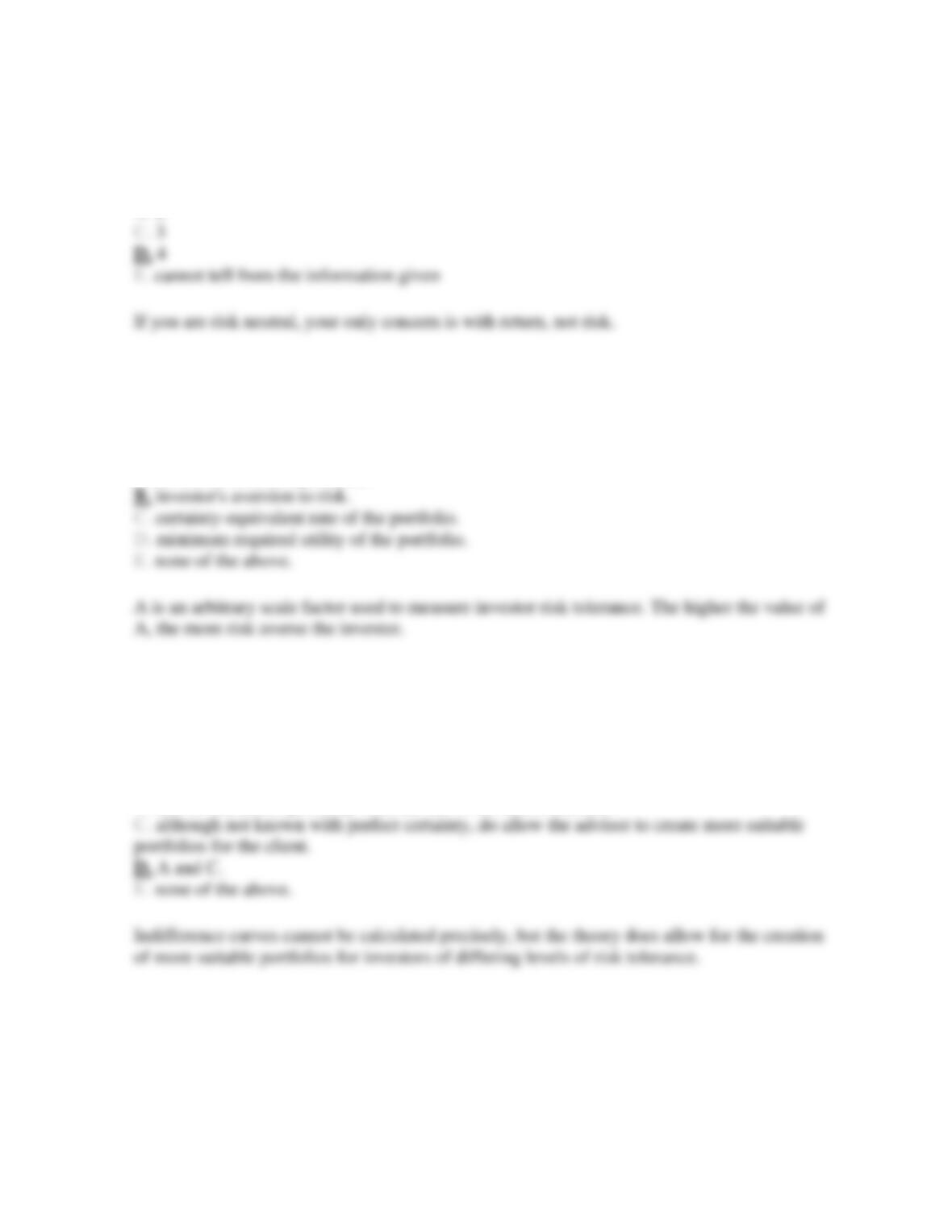
U = E(r) – (A/2)s2, where A = 4.0.
14. Based on the utility function above, which investment would you select?
A. 1
Difficulty: Difficult
Chapter 06 – Risk Aversion and Capital Allocation to Risky Assets
6-8
15. Which investment would you select if you were risk neutral?
A. 1
B. 2
Difficulty: Difficult
16. The variable (A) in the utility function represents the:
A. investor’s return requirement.
Difficulty: Moderate
17. The exact indifference curves of different investors
A. cannot be known with perfect certainty.
B. can be calculated precisely with the use of advanced calculus.
Difficulty: Easy
Chapter 06 – Risk Aversion and Capital Allocation to Risky Assets
6-9
18. The riskiness of individual assets
A. should be considered for the asset in isolation.
B. should be considered in the context of the effect on overall portfolio volatility.
Difficulty: Easy
19. A fair game
A. will not be undertaken by a risk-averse investor.
B. is a risky investment with a zero risk premium.
Difficulty: Moderate
20. The presence of risk means that
A. investors will lose money.
Difficulty: Easy
Chapter 06 – Risk Aversion and Capital Allocation to Risky Assets
6-10
21. The utility score an investor assigns to a particular portfolio, other things equal,
A. will decrease as the rate of return increases.
B. will decrease as the standard deviation increases.
Difficulty: Easy
22. The certainty equivalent rate of a portfolio is
D. the rate that equates “A” in the utility function with the average risk aversion coefficient
for all risk-averse investors.
E. represented by the scaling factor “-.005” in the utility function.
Difficulty: Moderate
Chapter 06 – Risk Aversion and Capital Allocation to Risky Assets
6-11
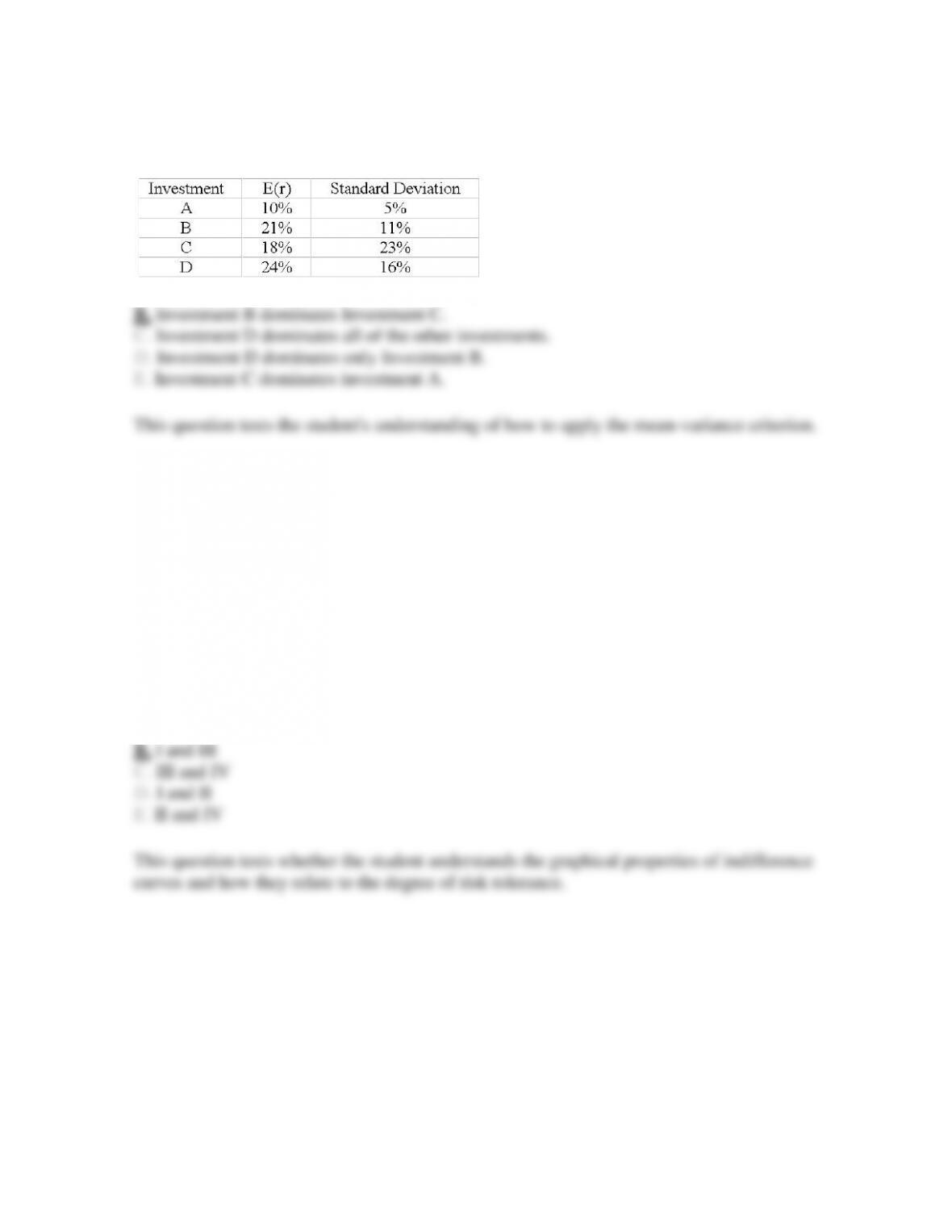
23. According to the mean-variance criterion, which of the statements below is correct?
A. Investment B dominates Investment A.
Difficulty: Moderate
24. Steve is more risk-averse than Edie. On a graph that shows Steve and Edie’s indifference
curves, which of the following is true? Assume that the graph shows expected return on the
vertical axis and standard deviation on the horizontal axis.
I) Steve and Edie’s indifference curves might intersect.
II) Steve’s indifference curves will have flatter slopes than Edie’s.
III) Steve’s indifference curves will have steeper slopes than Edie’s.
IV) Steve and Edie’s indifference curves will not intersect.
V) Steve’s indifference curves will be downward sloping and Edie’s will be upward sloping.
A. I and V
Difficulty: Moderate
Chapter 06 – Risk Aversion and Capital Allocation to Risky Assets
6-12
25. The Capital Allocation Line can be described as the
D. line on which lie all portfolios with the same expected rate of return and different standard
deviations.
E. none of the above.
Difficulty: Moderate
26. Which of the following statements regarding the Capital Allocation Line (CAL) is false?
A. The CAL shows risk-return combinations.
B. The slope of the CAL equals the increase in the expected return of a risky portfolio per unit
Difficulty: Moderate
Chapter 06 – Risk Aversion and Capital Allocation to Risky Assets
6-13
27. Given the capital allocation line, an investor’s optimal portfolio is the portfolio that
A. maximizes her expected profit.
B. maximizes her risk.
Difficulty: Moderate
28. An investor invests 30 percent of his wealth in a risky asset with an expected rate of return
of 0.15 and a variance of 0.04 and 70 percent in a T-bill that pays 6 percent. His portfolio’s
expected return and standard deviation are __________ and __________, respectively.
A. 0.114; 0.12
B. 0.087;0.06
C. 0.295; 0.12
D. 0.087; 0.12
E. none of the above
E(rP) = 0.3(15%) + 0.7(6%) = 8.7%; sP = 0.3(0.04)1/2 = 6%.
Difficulty: Moderate
29. An investor invests 30 percent of his wealth in a risky asset with an expected rate of return
of 0.13 and a variance of 0.03 and 70 percent in a T-bill that pays 6 percent. His portfolio’s
expected return and standard deviation are __________ and __________, respectively.
A. 0.114; 0.128
B. 0.087;0.063
Difficulty: Moderate
Chapter 06 – Risk Aversion and Capital Allocation to Risky Assets
6-14
30. An investor invests 40 percent of his wealth in a risky asset with an expected rate of return
of 0.17 and a variance of 0.08 and 60 percent in a T-bill that pays 4.5 percent. His portfolio’s
expected return and standard deviation are __________ and __________, respectively.
A. 0.114; 0.126
B. 0.087;0.068
Difficulty: Moderate
31. An investor invests 70 percent of his wealth in a risky asset with an expected rate of return
of 0.15 and a variance of 0.04 and 30 percent in a T-bill that pays 5 percent. His portfolio’s
expected return and standard deviation are __________ and __________, respectively.
D. 0.087; 0.12
E. none of the above
Difficulty: Moderate
You invest $100 in a risky asset with an expected rate of return of 0.12 and a standard
deviation of 0.15 and a T-bill with a rate of return of 0.05.
Chapter 06 – Risk Aversion and Capital Allocation to Risky Assets
6-15
32. What percentages of your money must be invested in the risky asset and the risk-free
asset, respectively, to form a portfolio with an expected return of 0.09?
A. 85% and 15%
B. 75% and 25%
9% = w1(12%) + (1 – w1)(5%); 9% = 12%w1 + 5% – 5%w1; 4% = 7%w1; w1 = 0.57; 1 – w1 =
0.43; 0.57(12%) + 0.43(5%) = 8.99%.
Difficulty: Moderate
33. What percentages of your money must be invested in the risk-free asset and the risky
asset, respectively, to form a portfolio with a standard deviation of 0.06?
A. 30% and 70%
B. 50% and 50%
Difficulty: Moderate
34. A portfolio that has an expected outcome of $115 is formed by
A. investing $100 in the risky asset.
B. investing $80 in the risky asset and $20 in the risk-free asset.
Difficulty: Difficult
Chapter 06 – Risk Aversion and Capital Allocation to Risky Assets
6-16
35. The slope of the Capital Allocation Line formed with the risky asset and the risk-free asset
is equal to
D. 0.41667.
E. Cannot be determined.
Difficulty: Moderate
36. Consider a T-bill with a rate of return of 5 percent and the following risky securities:
Security A: E(r) = 0.15; Variance = 0.04
Security B: E(r) = 0.10; Variance = 0.0225
Security C: E(r) = 0.12; Variance = 0.01
Security D: E(r) = 0.13; Variance = 0.0625
From which set of portfolios, formed with the T-bill and any one of the 4 risky securities,
would a risk-averse investor always choose his portfolio?
A. The set of portfolios formed with the T-bill and security A.
B. The set of portfolios formed with the T-bill and security B.
Difficulty: Difficult
You are considering investing $1,000 in a T-bill that pays 0.05 and a risky portfolio, P,
constructed with 2 risky securities, X and Y. The weights of X and Y in P are 0.60 and 0.40,
respectively. X has an expected rate of return of 0.14 and variance of 0.01, and Y has an
expected rate of return of 0.10 and a variance of 0.0081.
Chapter 06 – Risk Aversion and Capital Allocation to Risky Assets
6-17
37. If you want to form a portfolio with an expected rate of return of 0.11, what percentages
of your money must you invest in the T-bill and P, respectively?
A. 0.25; 0.75
E. cannot be determined
Difficulty: Moderate
38. If you want to form a portfolio with an expected rate of return of 0.10, what percentages
of your money must you invest in the T-bill, X, and Y, respectively if you keep X and Y in
the same proportions to each other as in portfolio P?
A. 0.25; 0.45; 0.30
B. 0.19; 0.49; 0.32
Difficulty: Difficult