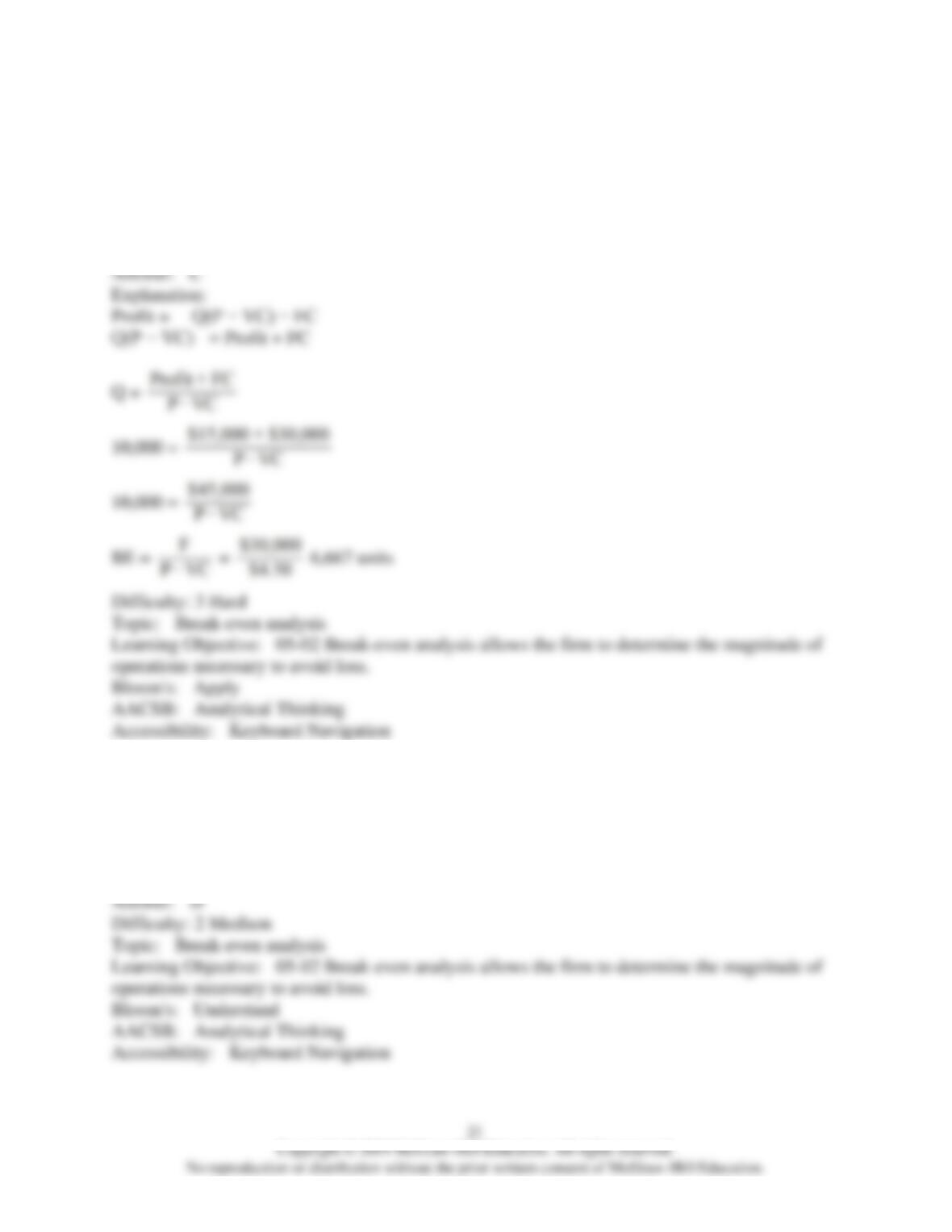
65) A firm has operating profit of $15,000 on unit sales of 10,000 units. Fixed costs are $30,000.
What is the firm’s break-even in units?
A) Less than 6,000 units.
B) 6,000 units.
C) More than 6,000 units
D) There is not enough information to determine the unit break-even point.
66) A firm’s break-even point will rise if
A) fixed costs decrease.
B) contribution margin increases.
C) sales price per unit rises.
D) variable cost per unit rises.
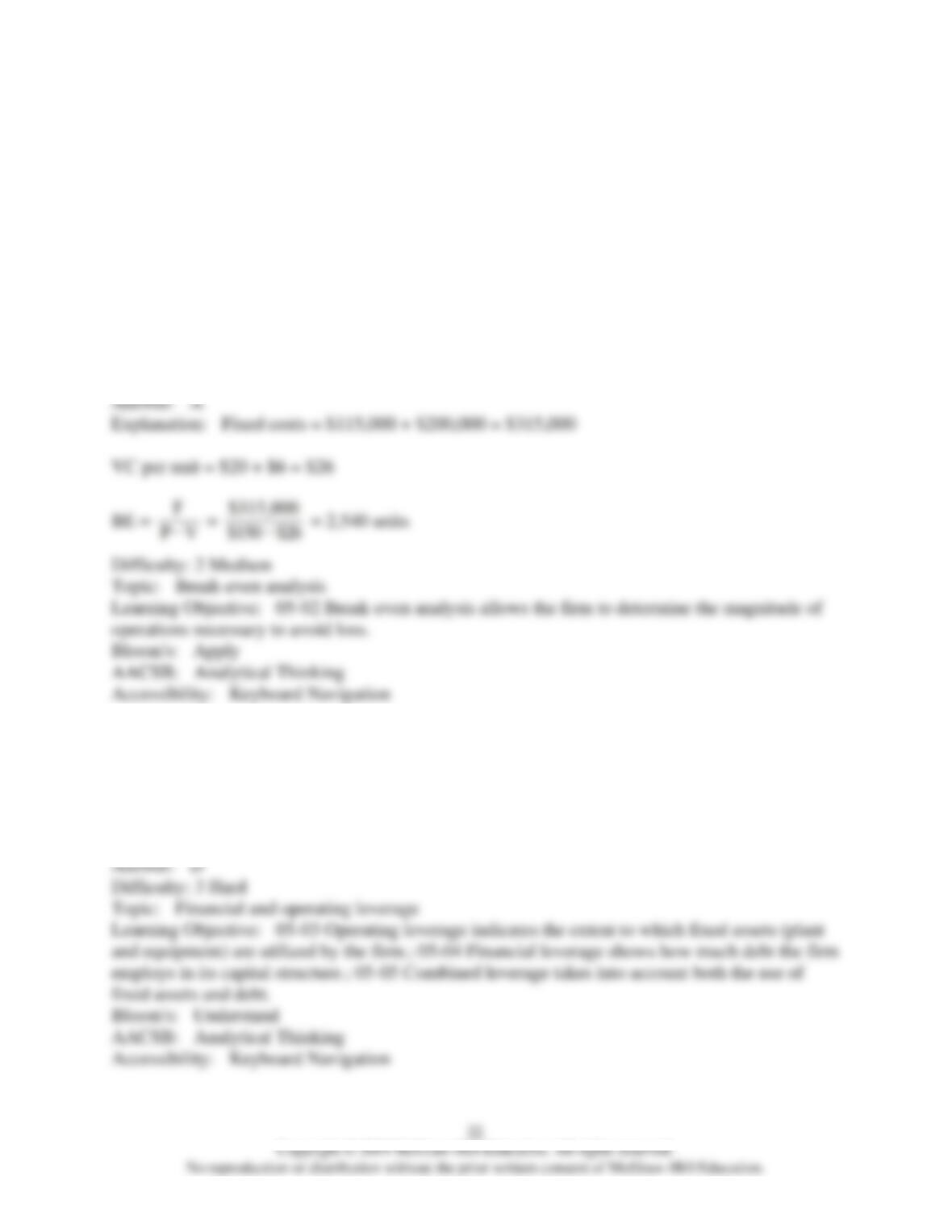
67) Davison Toaster Corp. sells its products for $150 per unit. It has the following costs:
Rent
$
115,000
Factory labor
$
20
per unit
Executive salaries
$
200,000
Raw materials
$
6
per unit
The break-even point is
A) less than 3,000 units.
B) 3,000 units.
C) more than 3,500 units.
D) Not enough information has been provided to determine the break-even point.
68) Which of the following is true about the concept of leverage?
A) At the break-even point, operating leverage is equal to zero.
B) Combined leverage measures the impact of operating and financial leverage on EBIT.
C) Financial leverage measures the impact of fixed costs on earnings.
D) None of the options are true.
69) A weakness of break-even analysis is that it assumes
A) revenue and costs are a linear (constant) function of volume.
B) sales prices and costs increase when the economy is strong and confidence is high.
C) the cost of goods sold goes up as revenue increases.
D) None of the options are true.
70) Which of the following statements regarding financial leverage are true.
A) financial leverage reflects the amount of debt used in the capital structure of the firm.
B) financial leverage primarily affects the right side of the balance sheet.
C) financial leverage determines how the operation is to be financed.
D) all of the above.
71) A high degree of operating leverage means
A) there are high labor costs.
B) there is high debt.
C) there is a large amount of equity.
D) there are high fixed costs.
72) Which of the following is concerned with the change in operating profit as a result of a
change in unit volume?
A) Financial leverage
B) Break-even point
C) Operating leverage
D) Combined leverage
73) Cash break-even analysis
A) is helpful in analyzing the short-term outlook of the firm, particularly when it is in trouble
financially.
B) is important when analyzing long-term profitability.
C) includes depreciation expense as a fixed cost when calculating the degree of financial
leverage.
D) None of the options are true.
74) The degree of operating leverage may be defined as
A) the percent change in operating income divided by the percent change in unit volume.
B) Q(P − VC) divided by Q(P − VC) − FC.
C) S − TVC divided by S − TVC − FC.
D) All of the options are true.
75) Loretta & Niece’s fixed costs are $425,000, including $25,000 of depreciation expense. The
price of each unit sold is $120, and the variable cost per unit is $60. How many units must the
firm sell to reach the cash break-even point?
A) 6,667 units
B) 7,333 units
C) 7,083 units
D) 3,542 units
76) Conservatively leveraged Firm A and highly leveraged Firm B operate at the same level of
earnings before interest and taxes. Which firm has a higher change in volume?
A) Firm A
B) Firm B
C) The change in volume does not affect the amount of leverage.
D) There is not enough information to answer the question.
77) The degree of operating leverage is computed as
A) percent change in operating profit divided by percent change in net income.
B) percent change in unit volume divided by percent change in operating profit.
C) percent change in EPS divided by percent change in operating income.
D) percent change in operating income divided by percent change in unit volume.
78) Firm A employs a high degree of operating leverage; Firm B takes a more conservative
approach. Which of the following comparative statements about firms A and B is true?
A) Firm A has a lower break-even point than Firm B, but Firm A’s profit grows faster after the
breakeven.
B) Firm A has a higher break-even point than Firm B, but Firm A’s profit grows slower after the
breakeven.
C) Firm B has a lower break-even point than Firm A, but Firm A’s profit grows faster after the
breakeven.
D) Firm B has a lower break-even point than Firm A, and profit grows the same rate for both
companies after the break-even point
79) Firms with a high degree of operating leverage are
A) easily capable of surviving large changes in sales volume.
B) usually trading off lower levels of risk for higher profits.
C) significantly affected by changes in interest rates.
D) trading off higher fixed costs for lower per-unit variable costs.
80) Financial leverage deals with
A) the relationship of fixed and variable costs.
B) the relationship of debt and equity in the capital structure.
C) the entire income statement.
D) the entire balance sheet.
81) A conservative financing plan involves
A) heavy reliance on debt.
B) heavy reliance on equity.
C) a high degree of financial leverage.
D) a high degree of combined leverage.
82) A firm’s earnings per share is not impacted by its financing plan at the point when
A) debt is equal to equity.
B) return on assets equals return on equity.
C) the cost of borrowed funds equals the return on equity.
D) the cost of borrowed funds equals the return on assets.
83) If EBIT equals $200,000 and interest equals $40,000, what is the degree of financial
leverage?
A) 5.33x
B) 1.25x
C) 0.8125x
D) 4.33x
84) The degree of financial leverage is concerned with the relationship between
A) changes in volume and changes in EPS.
B) changes in volume and changes in EBIT.
C) changes in EBIT and changes in EPS.
D) changes in EBIT and changes in operating income.
85) When a firm employs no debt
A) it has a financial leverage of one.
B) it has a financial leverage of zero.
C) its operating leverage is equal to its financial leverage.
D) it will not be profitable.
86) If a firm has the lowest possible degree of operating leverage and the lowest possible degree
of financial leverage, then
A) DOL equals 1, and DFL equals 0.
B) DOL equals 0, and DFL equals 1.
C) DOL equals 1, and DFL equals 1.
D) None of the options
87) Combined leverage is concerned with the relationship between
A) changes in EBIT and changes in EPS.
B) changes in volume and changes in EPS.
C) changes in volume and changes in EBIT.
D) changes in EBIT and changes in net income.
88) Which of the following is not true about leverage?
A) Operating leverage influences the top half of the income statement, determining EBIT.
B) Financial leverage deals with the bottom half of the income statement, determining EPS.
C) Combined leverage utilizes the entire income statement, showing the impact of change in
volume on EBIT.
D) None of the options
89) If the business cycle is just beginning its upswing, which firm would you anticipate would be
likely to show the best growth in EPS over the next year? Firm A has high combined leverage
and Firm B has low combined leverage.
A) Firm A
B) Firm B
C) Indifferent between the two
D) It depends on how much financial leverage each firm has