Chapter 05 Risk, Return, and the Historical Record Answer Key
Multiple Choice Questions
1.
Over the past year you earned a nominal rate of interest of 10% on your money. The
inflation rate was 5% over the same period. The exact actual growth rate of your
purchasing power was
2.
Over the past year you earned a nominal rate of interest of 8% on your money. The
inflation rate was 4% over the same period. The exact actual growth rate of your
purchasing power was
3.
A year ago, you invested $1,000 in a savings account that pays an annual interest rate of
9%. What is your approximate annual real rate of return if the rate of inflation was 4% over
the year?
4.
A year ago, you invested $10,000 in a savings account that pays an annual interest rate of
5%. What is your approximate annual real rate of return if the rate of inflation was 3.5%
over the year?
5.
If the annual real rate of interest is 5% and the expected inflation rate is 4%, the nominal
rate of interest would be approximately
6.
If the annual real rate of interest is 2.5% and the expected inflation rate is 3.7%, the
nominal rate of interest would be approximately
7.
You purchased a share of stock for $20. One year later you received $1 as a dividend and
sold the share for $29. What was your holding-period return?
8.
You purchased a share of stock for $68. One year later you received $3.00 as a dividend
and sold the share for $74.50. What was your holding-period return?
9.
Which of the following determine(s) the level of real interest rates?
I) The supply of savings by households and business firms
II) The demand for investment funds
III) The government’s net supply and/or demand for funds
10.
Which of the following statement(s) is(are) true?
I) The real rate of interest is determined by the supply and demand for funds.
II) The real rate of interest is determined by the expected rate of inflation.
III) The real rate of interest can be affected by actions of the Fed.
IV) The real rate of interest is equal to the nominal interest rate plus the expected rate of
inflation.
11.
Which of the following statement(s) is(are) true?
12.
Other things equal, an increase in the government budget deficit
Difficulty: Intermediate
Topic: Interest Rate Determinants
13.
Ceteris paribus, a decrease in the demand for loanable funds
14.
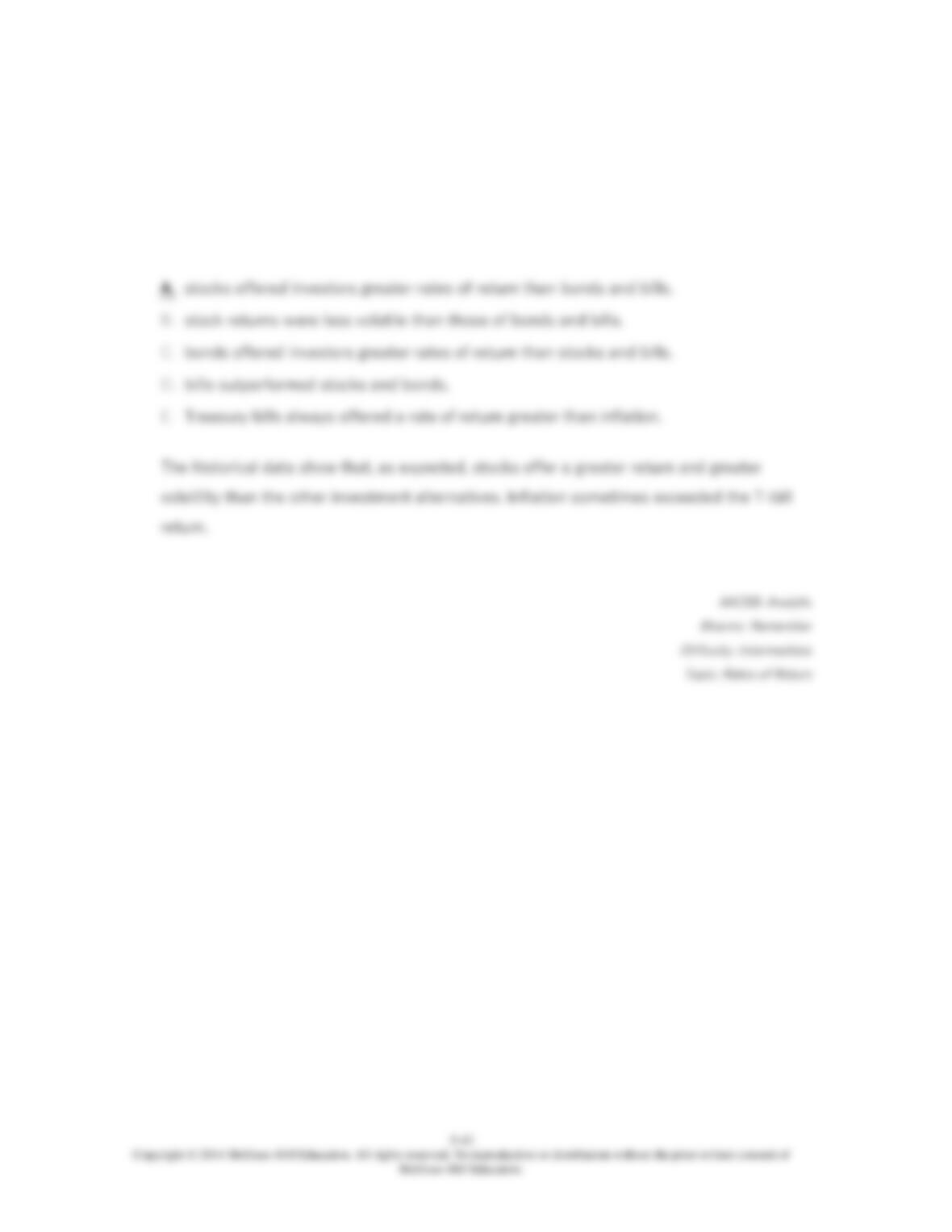
The holding-period return (HPR) on a share of stock is equal to
Topic: Risk
15.
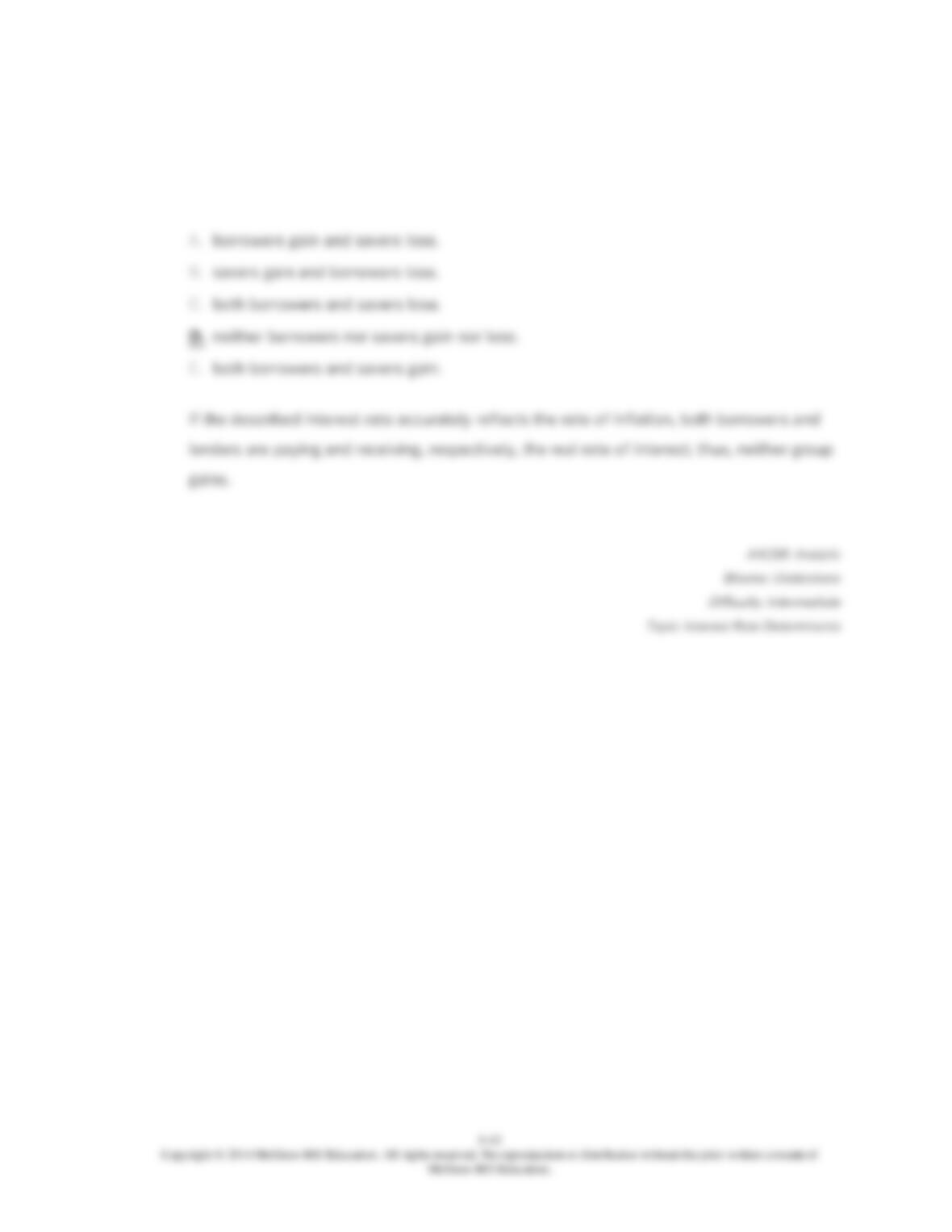
Historical records regarding return on stocks, Treasury bonds, and Treasury bills between
1926 and 2012 show that
16.
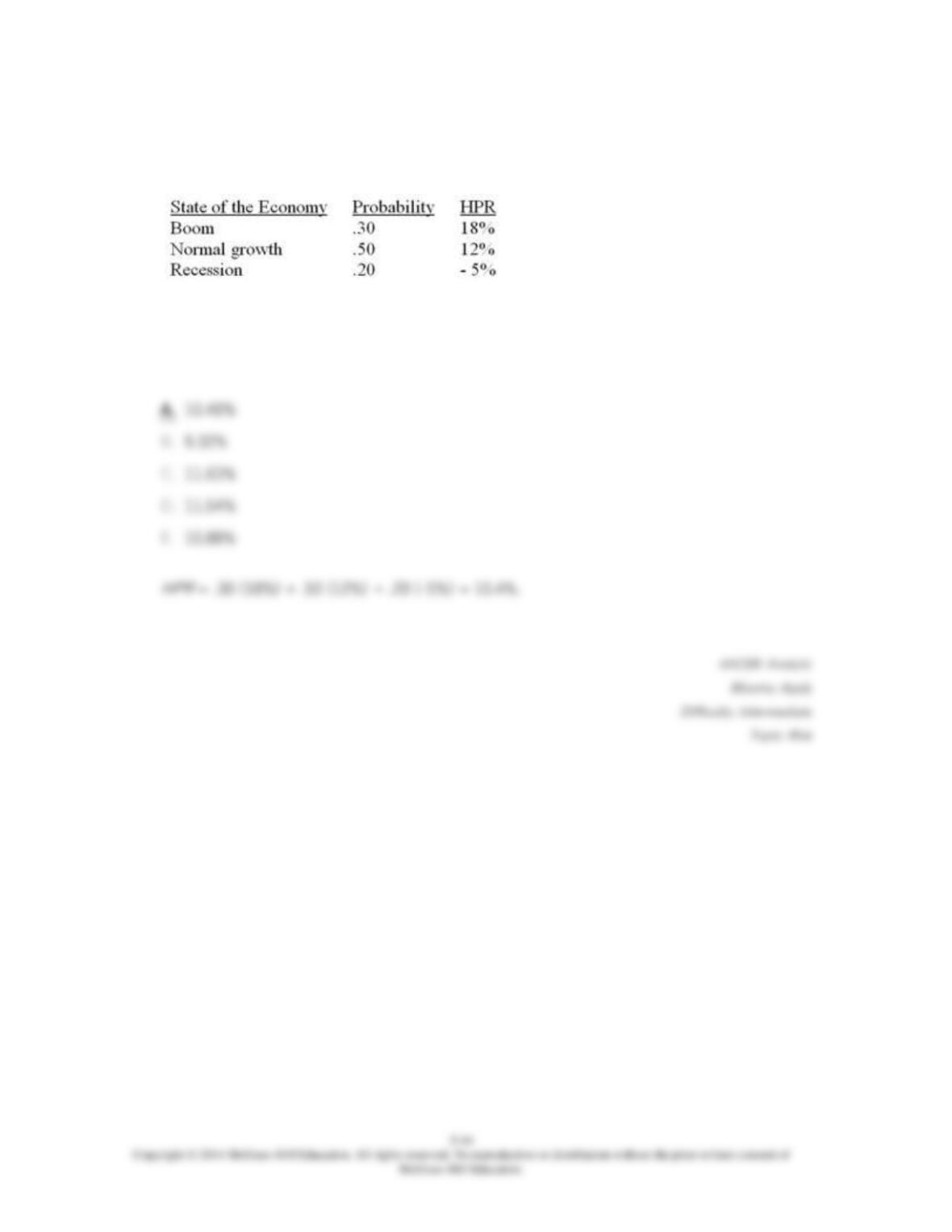
If the interest rate paid by borrowers and the interest rate received by savers accurately
reflect the realized rate of inflation,
17.
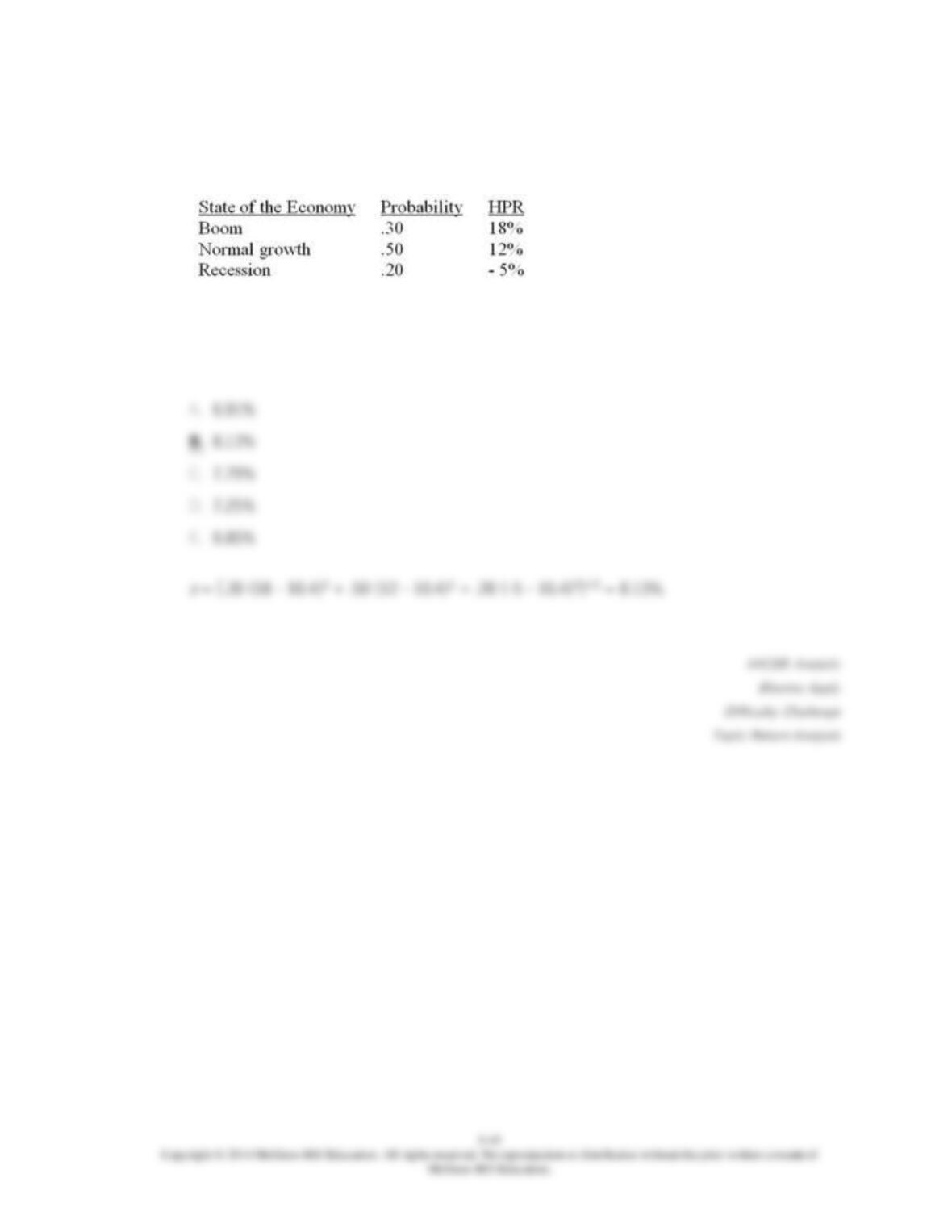
You have been given this probability distribution for the holding-period return for KMP
stock:
What is the expected holding-period return for KMP stock?
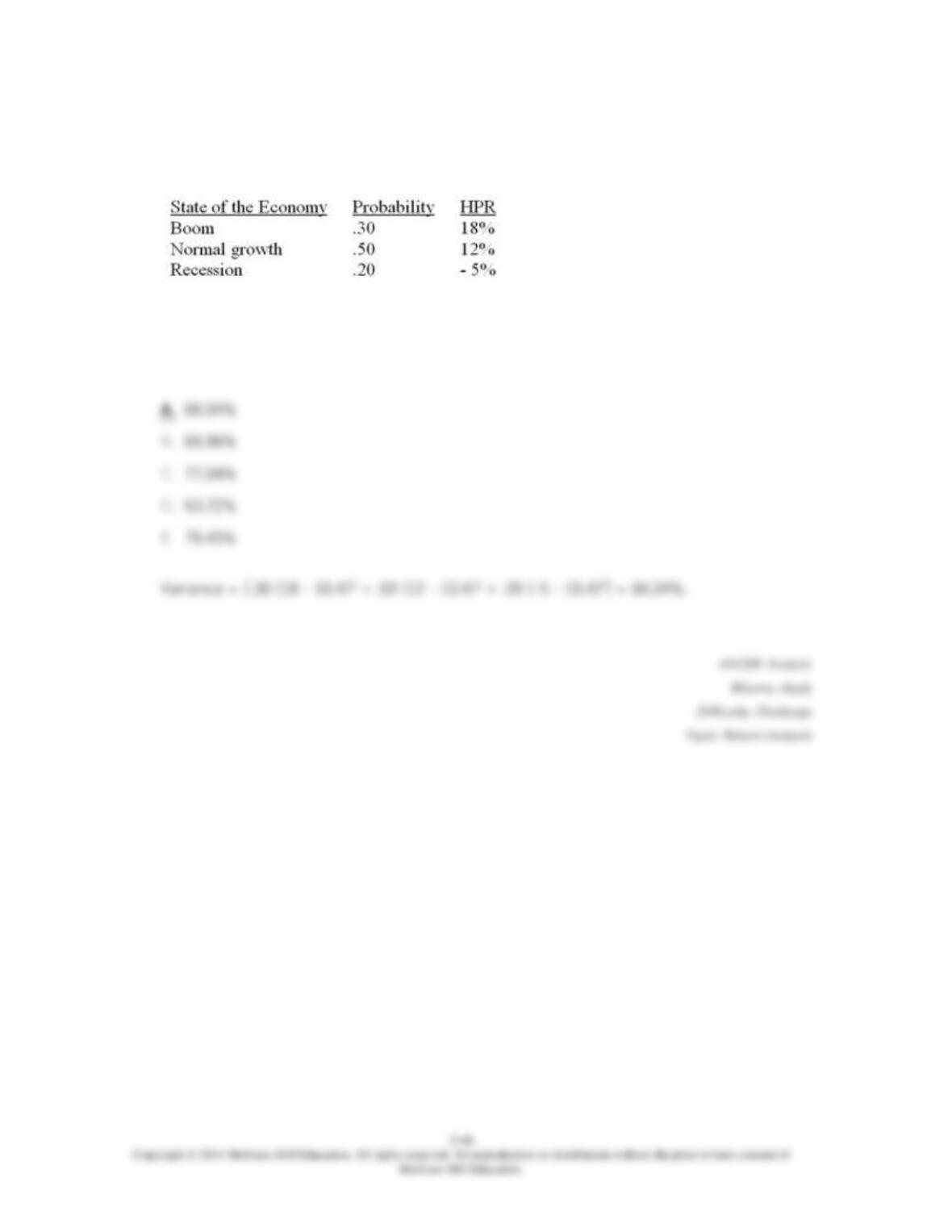
18.
You have been given this probability distribution for the holding-period return for KMP
stock:
What is the expected standard deviation for KMP stock?
19.
You have been given this probability distribution for the holding-period return for KMP
stock:
What is the expected variance for KMP stock?
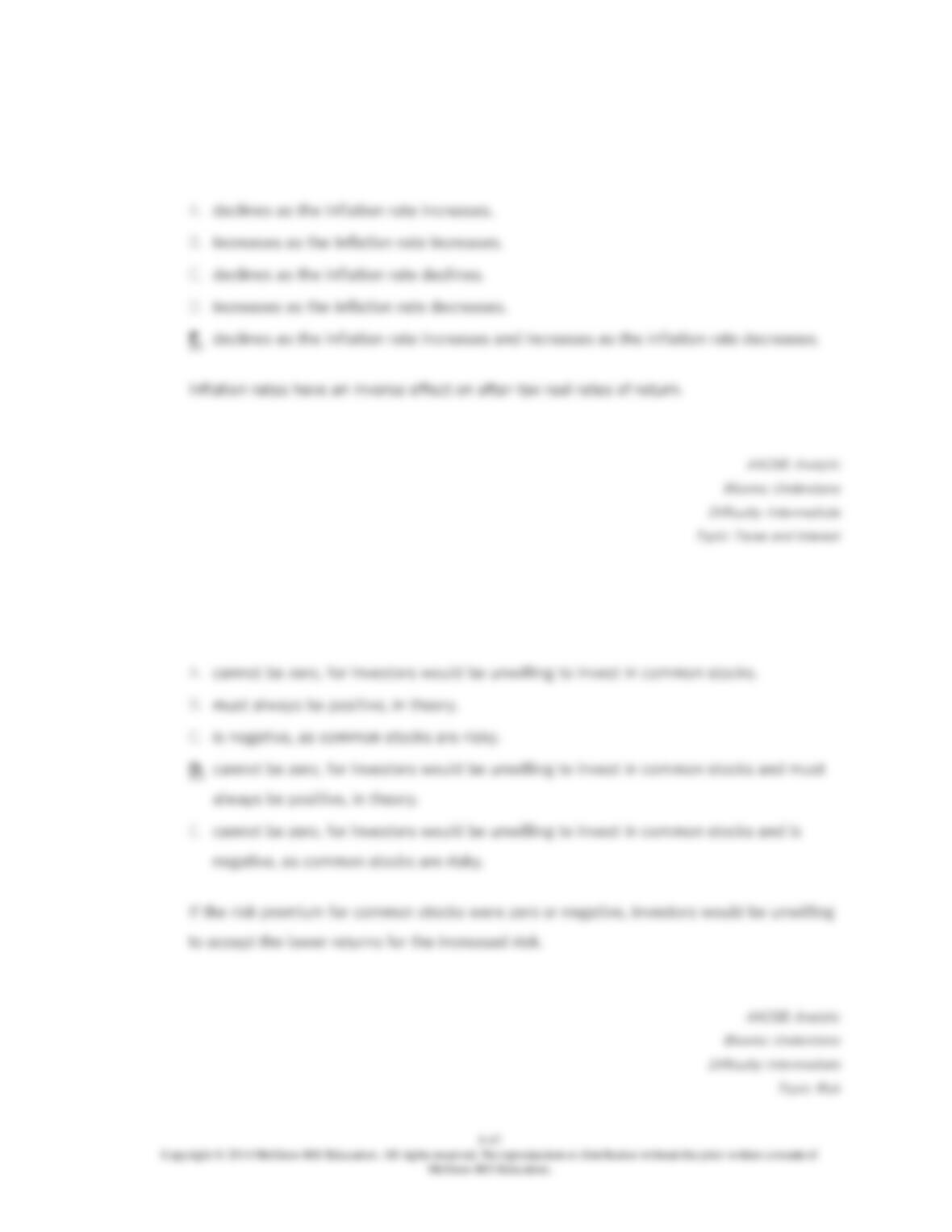
20.
If the nominal return is constant, the after-tax real rate of return
21.
The risk premium for common stocks
22.
If a portfolio had a return of 18%, the risk-free asset return was 5%, and the standard
deviation of the portfolio’s excess returns was 34%, the risk premium would be
23.
You purchase a share of Boeing stock for $90. One year later, after receiving a dividend of
$3, you sell the stock for $92. What was your holding-period return?
24.
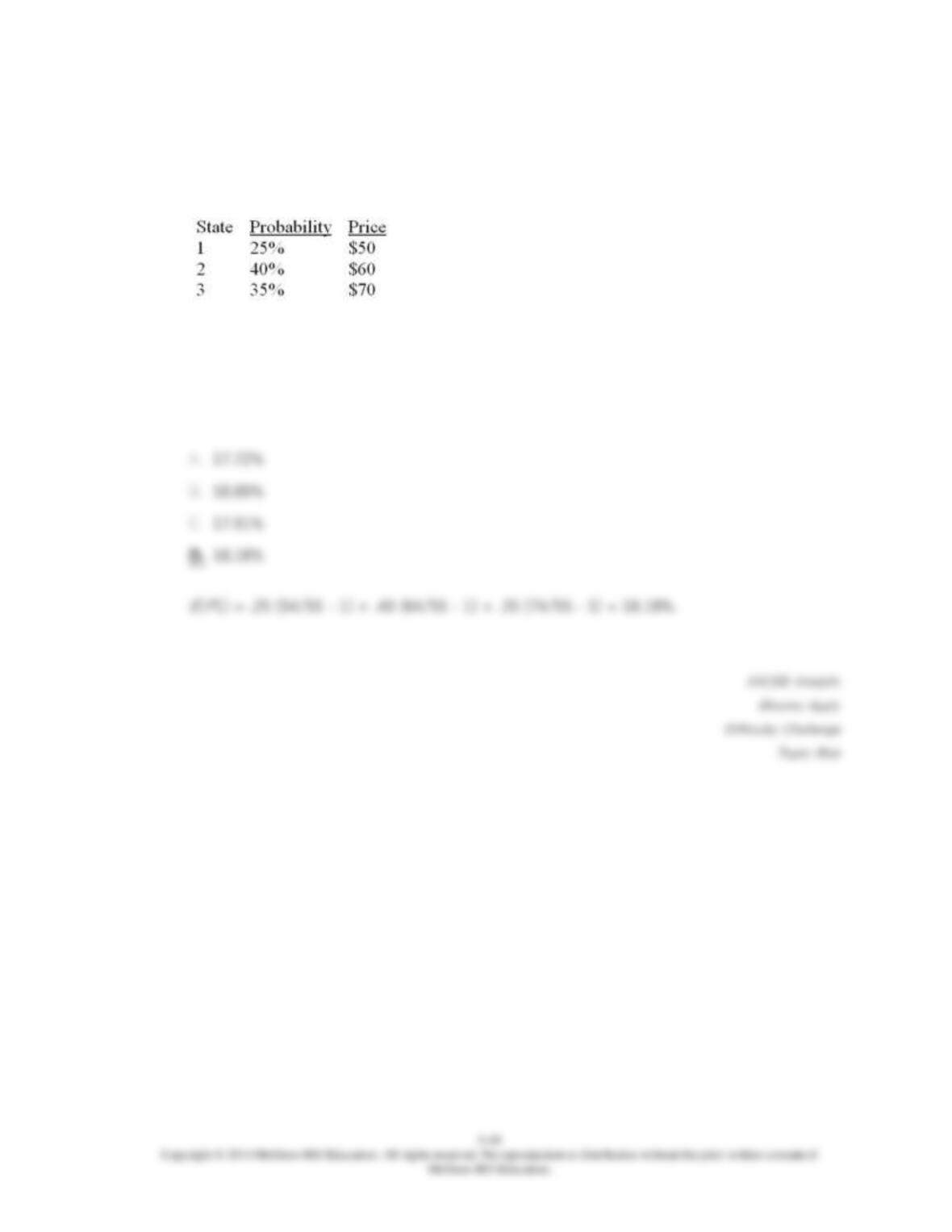
Toyota stock has the following probability distribution of expected prices one year from
now:
If you buy Toyota today for $55 and it will pay a dividend during the year of $4 per share,
what is your expected holding-period return on Toyota?
25.
Which of the following factors would not be expected to affect the nominal interest rate?
26.
If a portfolio had a return of 11%, the risk-free asset return was 6%, and the standard
deviation of the portfolio’s excess returns was 25%, the risk premium would be
27.
In words, the real rate of interest is approximately equal to
28.
If the Federal Reserve lowers the discount rate, ceteris paribus, the equilibrium levels of
funds lent will __________ and the equilibrium level of real interest rates will ___________.
29.
What has been the relationship between T-Bill rates and inflation rates since the 1980s?
30.
“Bracket Creep” happens when
31.
The holding-period return (HPR) for a stock is equal to