Foundations of Financial Management, 17e (Block)
Chapter 5 Operating and Financial Leverage
1) “Operating leverage” is the use of fixed costs to magnify returns at high levels of operation.
2) Operating leverage works best when product volume is increasing.
3) Operating leverage emphasizes the impact of using fixed assets in the business.
4) When a business decides to go with a heavy commitment to fixed costs in the manufacturing
process, they are employing operating leverage.
5) Financial leverage emphasizes the impact of using debt in the business.
6) When a business decides to use debt in financing their firm, they are engaging in financial
leverage.
7) Operating leverage determines how income from operations is to be divided between debt
holders and stockholders.
8) Operating leverage will change when a firm alters the mix of fixed capital resources and
variable labor that it uses.
9) Contribution margin is equal to fixed costs minus variable costs.
10) Contribution margin represents the amount of sales left over after fixed costs are paid.
11) Property taxes and depreciation expense are examples of variable costs.
12) Sales commissions and raw materials are variable costs.
13) The difference between variable cost and fixed cost is that the cost amount fluctuates
differently based on how many units are sold.
14) The contribution margin is equal to sales price per unit minus total costs per unit.
15) As the contribution margin rises, the break-even point goes down.
16) To determine the break-even point for a company, you divide the contribution margin by the
fixed costs.
17) Break-even analysis helps a company determine what amount of quantity it needs to sell in
order to reach zero profit.
18) A lower sales price for the firm’s product will reduce the firm’s break-even point.
19) If economic conditions were expected to be favorable, an investor would likely prefer a firm
with a low degree of leverage.
20) The use of financial leverage must consider both risk and maximizing profit.
21) The use of debt is not typically needed for firms in industries that offer some degree of
stability, are in a positive stage of growth, and are operating in favorable economic conditions.
22) Managers who are risk-averse and uncertain about the future would most likely minimize
combined leverage.
23) Management should tailor the use of leverage to meet the company’s own risk-taking desires.
24) Cash break-even analysis eliminates the non-cash charges from fixed costs in order to obtain
the amount of quantity sold which is necessary in order for cash inflow to equal the cash outflow.
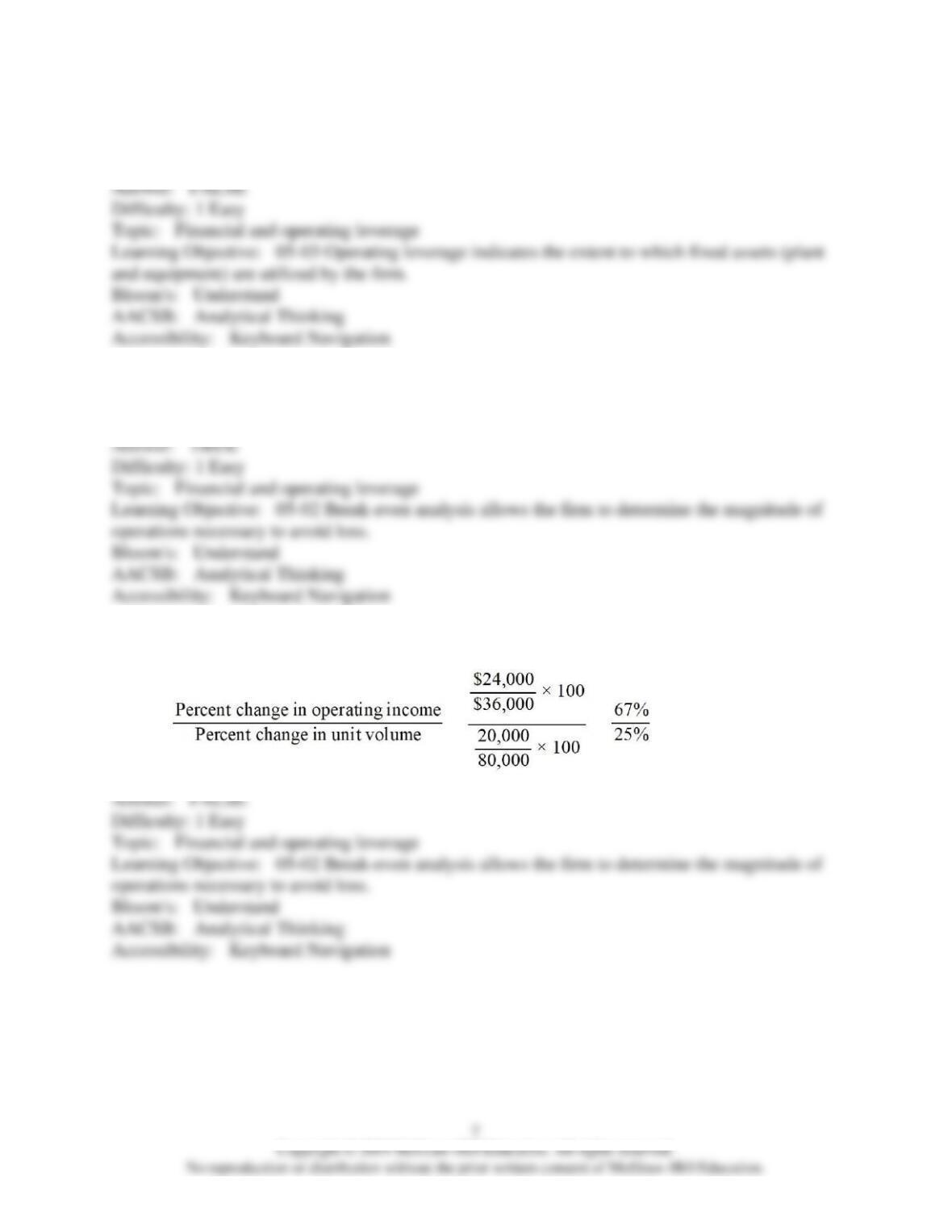
25) The degree of operating leverage is a number indicating the relationship between the
percentage change in sales to the percentage change in earnings per share.
26) The lower a firm’s break-even point, the lower amount of quantity which needs to be sold in
order to reach a profit of zero.
27) Based on the example in the textbook, the calculation below is of a conservative firm.
DOL = = = = 2.7
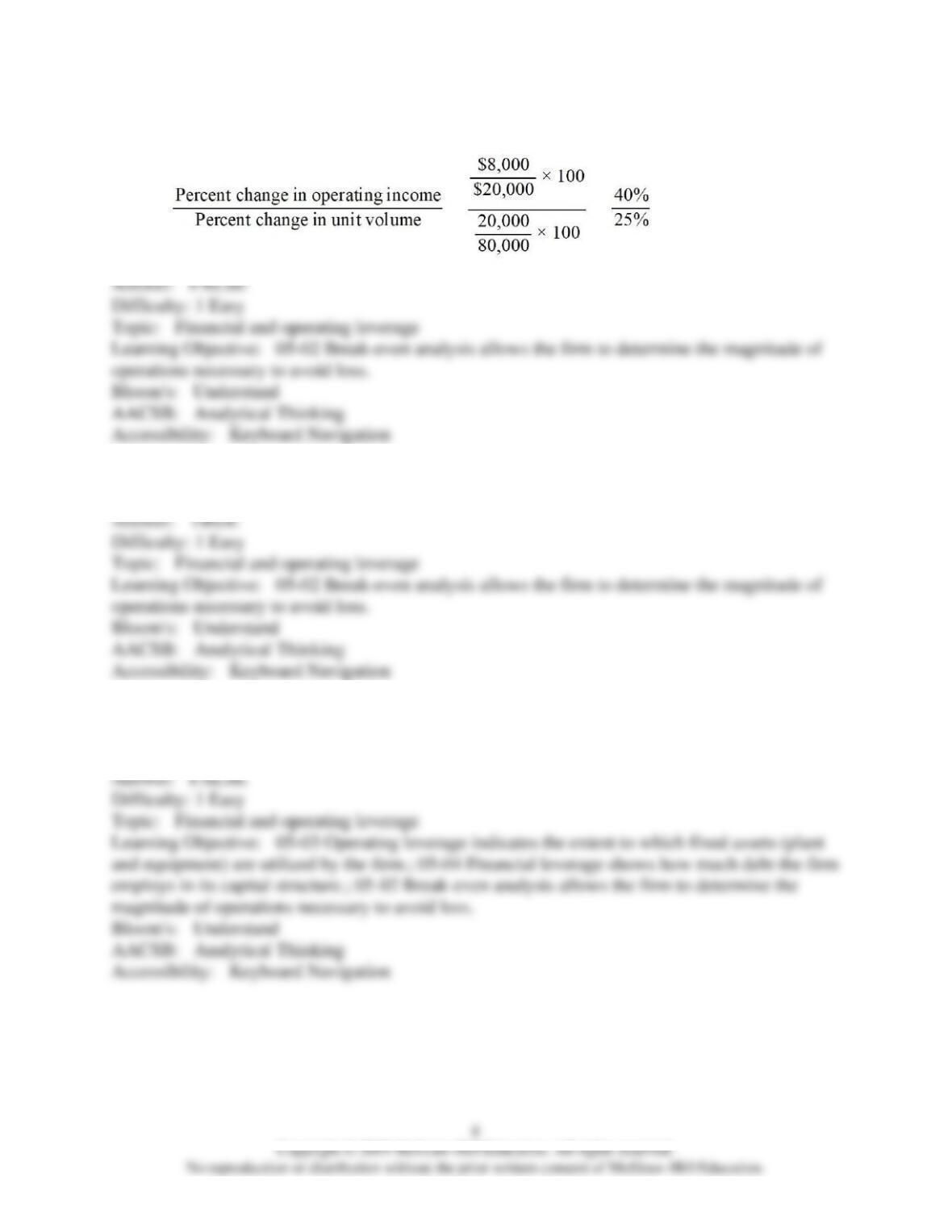
28) Based on the example in the textbook, the calculation below is of a leveraged firm.
DOL = = = = 1.6
29) The lower a firm’s break-even point, the better for the firm.
30) The closer a firm is to its break-even point, the lower the degree of operating leverage it will
be.
31) Degree of operating leverage should be computed only over a profitable range of business
operations.
32) Linear break-even analysis assumes that the change in costs have the same relationship with
the change in volume.
33) Linear break-even analysis and operating leverage are only valid within a relevant range of
unit production.
34) Financial leverage primarily affects the asset side of the balance sheet.
35) Operating leverage primarily affects the asset side of the balance sheet, while financial
leverage affects the liabilities and net worth side of the balance sheet.
36) The degree of financial leverage measures the percentage change in earnings per share (EPS)
for every percentage change in earnings before interest and taxes (EBIT).
37) If a firm has a degree of financial leverage (DFL) of 2.0, earnings per share will change 2%
for every 1% change in sales volume.
38) The degree of financial leverage is not influenced by the interest rate on debt, only the
amount borrowed.
39) A firm with a high degree of financial leverage could face financial difficulty even though it
is in a stable industry.
40) Operating income is not the same thing as earnings before interest and taxes (EBIT).
41) Operating leverage influences the bottom half of the income statement while financial
leverage deals with the top half.
42) The degree of combined leverage is the sum of the degree of operating leverage and the
degree of financial leverage.
43) A firm with a high degree of combined leverage will, other things being equal, experience
higher earnings in the expansionary part of the business cycle.
44) Firms with cyclical sales should employ a high degree of leverage.
45) In order to conduct a cash break-even analysis, the analyst must add back depreciation from
fixed costs.
46) An example of an adjustment for a cash break-even analysis would be adding back increases
in accounts receivable.
47) Degree of combined leverage considers the impact of a change in volume on the change in
operating income.
48) Reducing the number of outstanding shares will always increase financial leverage since
earnings per share will be higher, all else stays the same.
49) The concept of operating leverage involves the use of ________ to magnify returns at high
levels of operation.
A) fixed costs
B) variable costs
C) marginal costs
D) semivariable costs
50) Which of the following questions does break-even analysis attempt to address?
A) How much do changes in volume affect costs and profits?
B) At what point does the firm have zero profit?
C) What is the most efficient level of fixed assets to employ?
D) All of the options
51) In break-even analysis, the contribution margin is defined as
A) sales price minus variable cost.
B) sales price minus fixed cost.
C) variable cost minus fixed cost.
D) fixed cost minus variable cost.
52) At the break-even point, a firm’s profits are
A) greater than zero.
B) less than zero.
C) equal to zero.
D) Not enough information is given to determine.
53) If a firm sells 40,000 units and the contribution margin on the firm’s single product is $4.00
per unit and fixed costs are $60,000, what will the firm’s operating profit be at this level of sales
volume?
A) $100,000
B) $30,000
C) $15,000
D) $145,000
54) If sales units exceeds the break-even point in units, the firm will experience
A) an operating loss.
B) an operating profit.
C) an increase in plant and equipment.
D) an increase in stock price.
55) The break-even point can be calculated as
A) variable costs divided by contribution margin per unit.
B) total costs divided by contribution margin per unit.
C) variable costs times contribution margin per unit.
D) fixed costs divided by contribution margin per unit.
56) A highly automated plant would generally have
A) more variable than fixed costs.
B) more fixed than variable costs.
C) all fixed costs.
D) all variable costs.
57) If fixed costs rise while other variables stay constant
A) the break-even point rises.
B) the degree of operating leverage increases.
C) total profit declines.
D) All of the options are true.
58) If the sales price per unit decreases because of competition but the cost structure remains the
same
A) the break-even point rises.
B) the degree of combined leverage declines.
C) the degree of financial leverage declines.
D) All of the options are true.
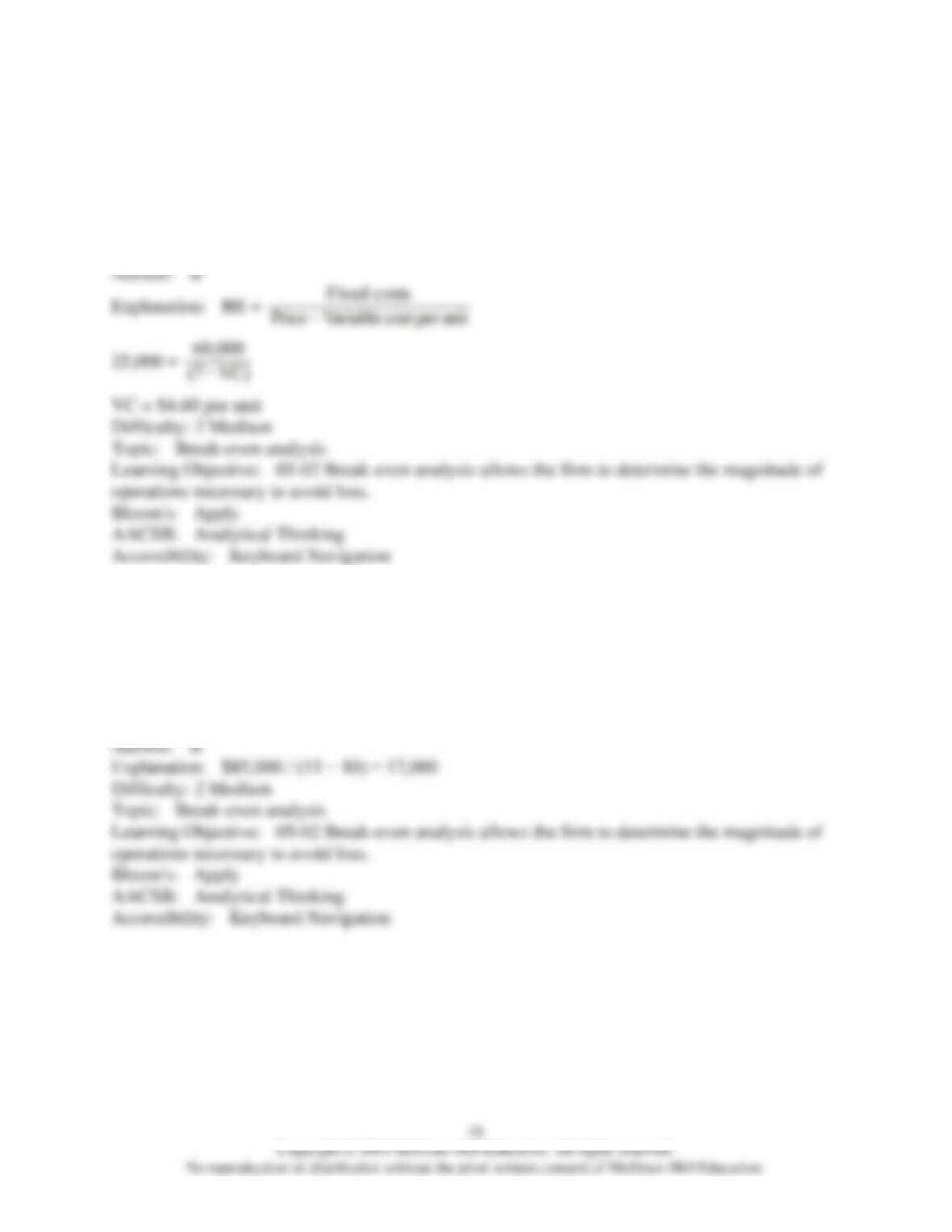
59) If a firm has fixed costs of $60,000, a sales price of $7.00 per unit, and a break-even point of
25,000 units, the variable cost per unit is ________.
A) $5.00
B) $4.60
C) $5.40
D) $4.00
60) If a firm has fixed costs of $85,000, a variable cost per unit of $10 and sales price per unit of
$15, what is the firm’s breakeven point in units?
A) 15,000 units
B) 17,000 units
C) 5,667 units
D) 3,400 units
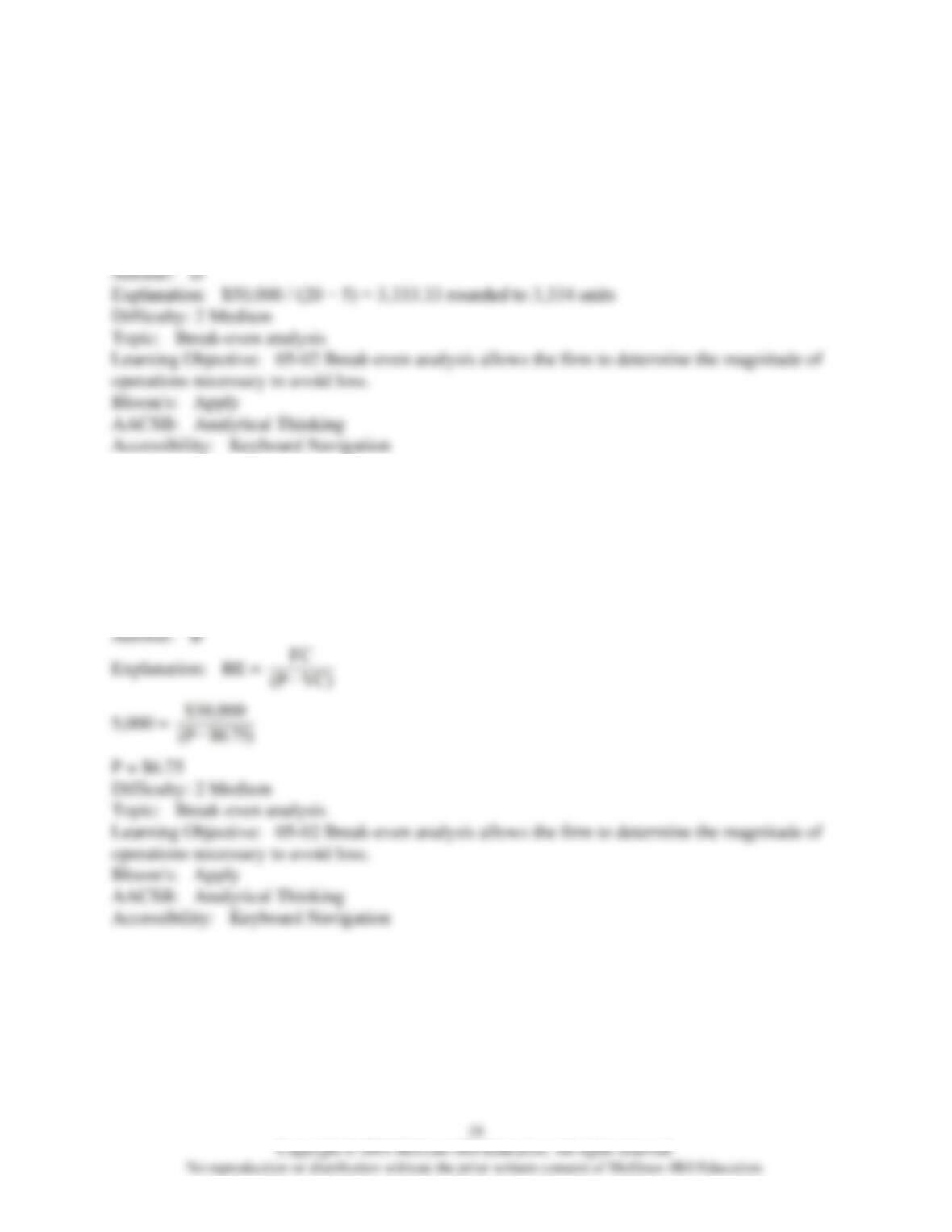
61) If a firm has fixed costs of $50,000, a variable cost per unit of $5 and sales price per unit of
$20, what is the firm’s breakeven point in units?
A) 3,333 units
B) 10,000 units
C) 4,667 units
D) 3,334 units
62) If a firm has fixed costs of $30,000, a variable cost per unit of $.75, and a break-even point
of 5,000 units, the sales price per unit is ________.
A) $2.50
B) $6.75
C) $4.00
D) $4.50
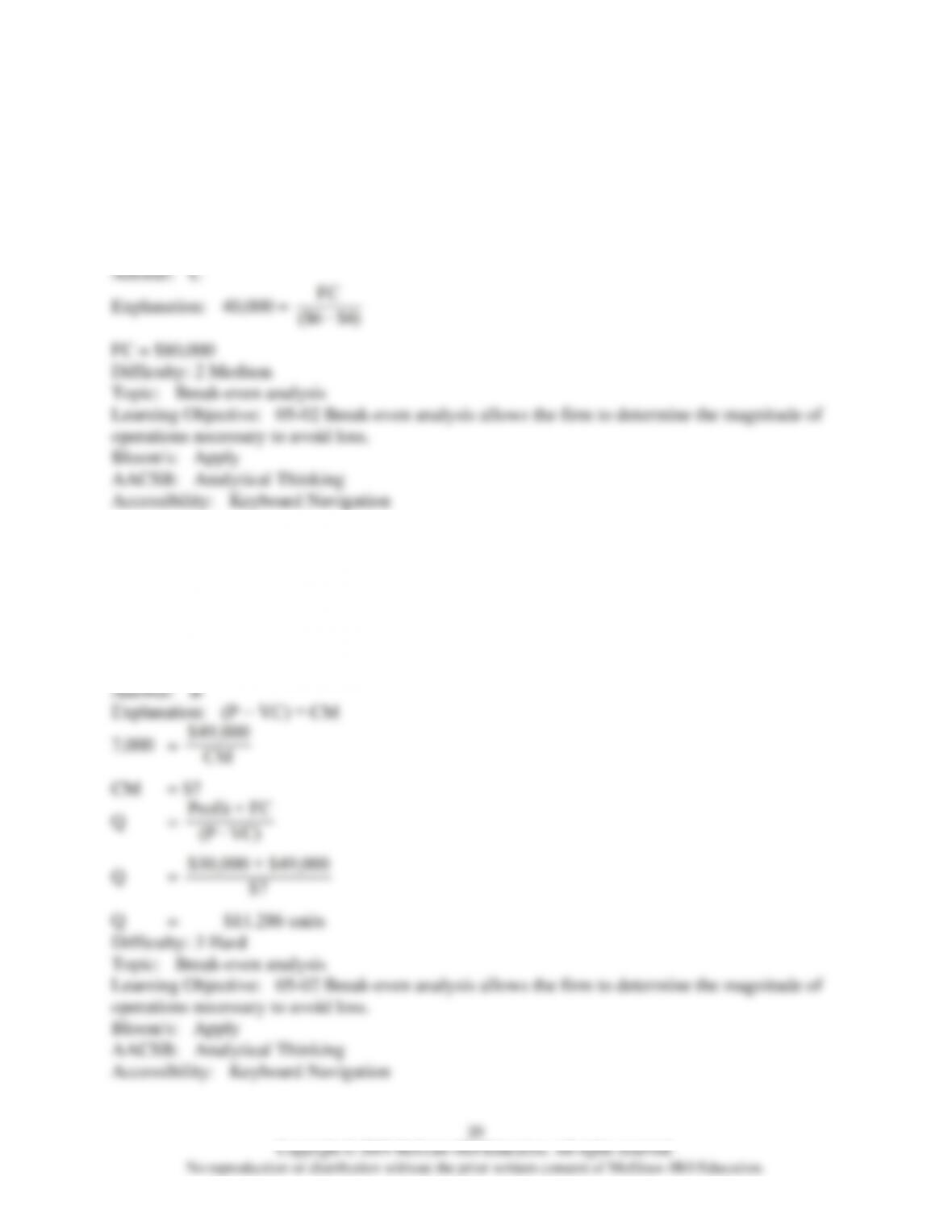
63) If a firm has a sales price per unit of $6.00, a variable cost per unit of $4.00, and a break-
even point of 40,000 units, fixed costs are equal to ________.
A) $27,000
B) $90,000
C) $80,000
D) $50,000
64) If a firm with $49,000 in fixed costs breaks even on 7,000 units, how many units must the
firm sell to earn $30,000 in operating profit?
A) 30,000 units
B) 11,286 units
C) 15,824 units
D) There is not enough information to determine the unit sales required.