Chapter 05 – Learning about Return and Risk from the Historical Record
5-17
42. A year ago, you invested $2,500 in a savings account that pays an annual interest rate of
2.5%. What is your approximate annual real rate of return if the rate of inflation was 3.4%
over the year?
A. 0.9%.
B. -0.9%.
Difficulty: Easy
43. A year ago, you invested $12,000 in an investment that produced a return of 16%. What is
your approximate annual real rate of return if the rate of inflation was 2% over the year?
A. 18%.
B. 2%.
Difficulty: Easy
44. If the annual real rate of interest is 3.5% and the expected inflation rate is 2.5%, the
nominal rate of interest would be approximately
A. 3.5%.
B. 2.5%.
Difficulty: Easy
Chapter 05 – Learning about Return and Risk from the Historical Record
5-18
45. If the annual real rate of interest is 2.5% and the expected inflation rate is 3.4%, the
nominal rate of interest would be approximately
A. 4.9%.
B. 0.9%.
Difficulty: Easy
46. If the annual real rate of interest is 4% and the expected inflation rate is 3%, the nominal
rate of interest would be approximately
A. 4%.
B. 3%.
Difficulty: Easy
47. You purchased a share of stock for $12. One year later you received $0.25 as dividend and
sold the share for $12.92. What was your holding period return?
D. 11.25%
E. none of the above
Difficulty: Moderate
Chapter 05 – Learning about Return and Risk from the Historical Record
5-19
48. You purchased a share of stock for $120. One year later you received $1.82 as dividend
and sold the share for $136. What was your holding period return?
A. 16.43%
B. 22.12%
Difficulty: Moderate
49. You purchased a share of stock for $65. One year later you received $2.37 as dividend and
D. 1.63%
E. none of the above
Difficulty: Moderate
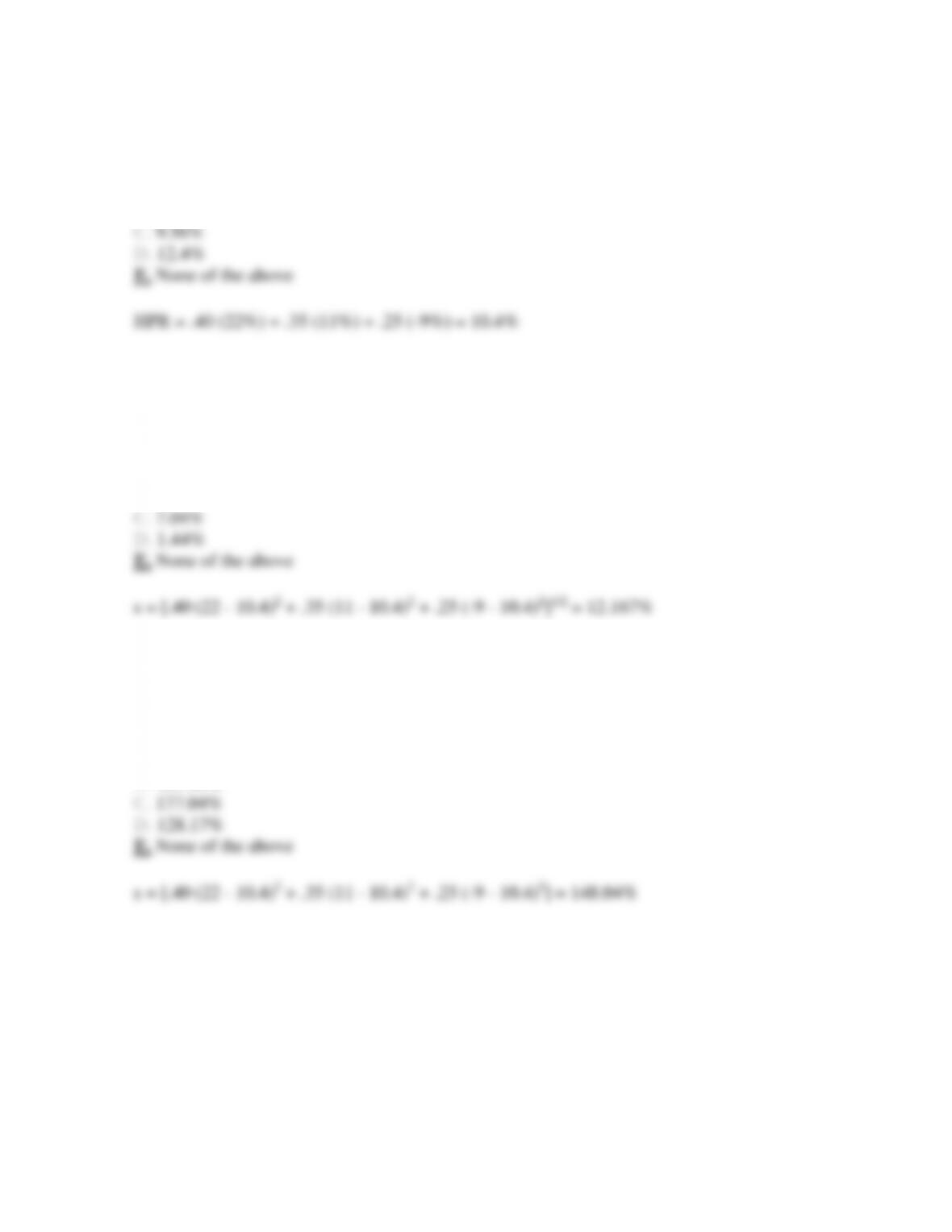
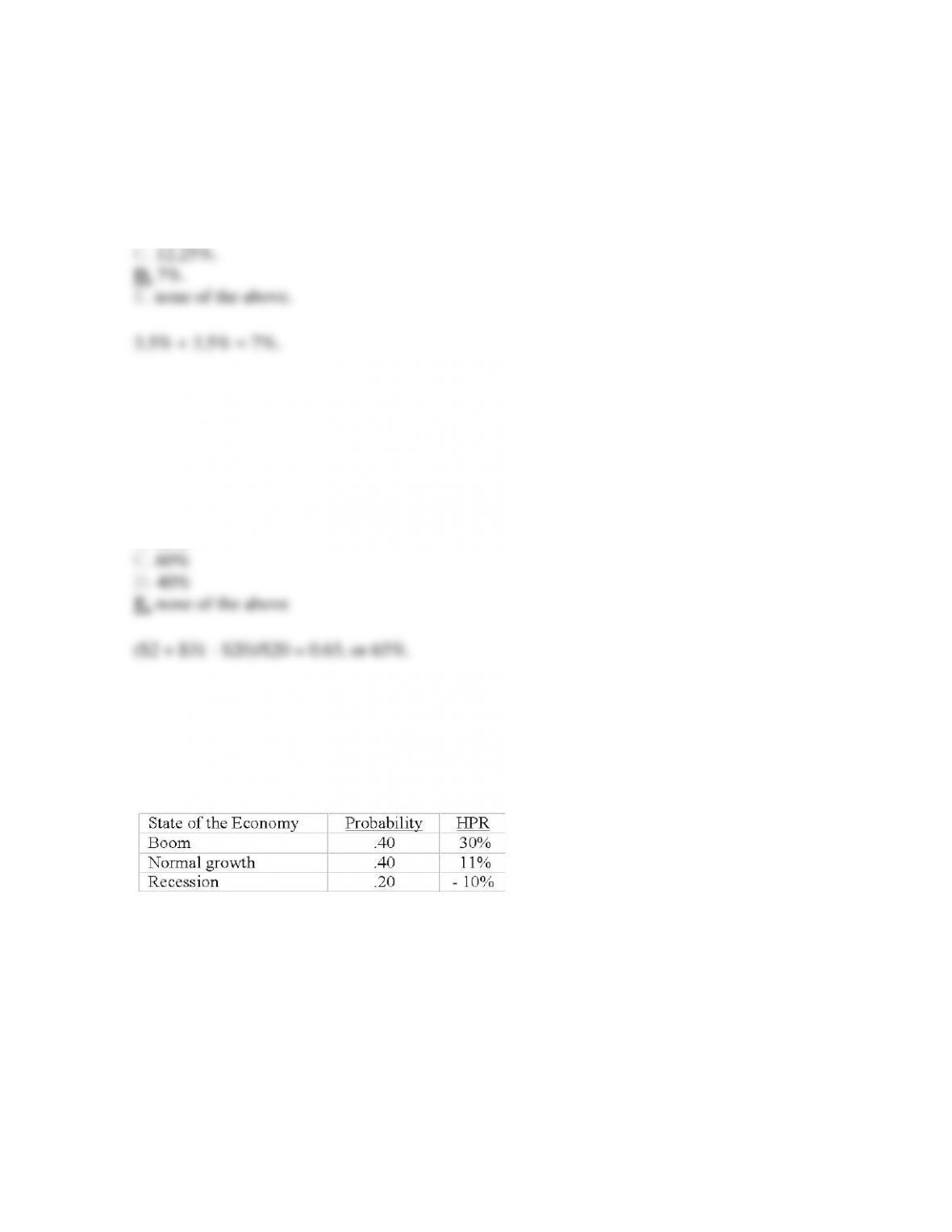
You have been given this probability distribution for the holding period return for a stock:
Chapter 05 – Learning about Return and Risk from the Historical Record
5-20
50. What is the expected holding period return for the stock?
A. 11.67%
B. 8.33%
Difficulty: Moderate
51. What is the expected standard deviation for the stock?
A. 2.07%
B. 9.96%
Difficulty: Difficult
52. What is the expected variance for the stock?
A. 142.07%
B. 189.96%
Difficulty: Difficult
Chapter 05 – Learning about Return and Risk from the Historical Record
5-21
53. Which of the following measures of risk best highlights the potential loss from extreme
negative returns?
A. Standard deviation
B. Variance
Difficulty: Moderate
54. Over the past year you earned a nominal rate of interest of 3.6 percent on your money.
The inflation rate was 3.1 percent over the same period. The exact actual growth rate of your
purchasing power was
A. 3.6%.
B. 3.1%.
Difficulty: Moderate
55. A year ago, you invested $1,000 in a savings account that pays an annual interest rate of
4.3%. What is your approximate annual real rate of return if the rate of inflation was 3% over
the year?
A. 4.3%.
B. -1.3%.
Difficulty: Easy
Chapter 05 – Learning about Return and Risk from the Historical Record
5-22
56. If the annual real rate of interest is 3.5% and the expected inflation rate is 3.5%, the
nominal rate of interest would be approximately
A. 0%.
B. 3.5%.
Difficulty: Easy
57. You purchased a share of CSCO stock for $20. One year later you received $2 as dividend
and sold the share for $31. What was your holding period return?
A. 45%
B. 50%
Difficulty: Moderate
You have been given this probability distribution for the holding period return for GM stock:
Chapter 05 – Learning about Return and Risk from the Historical Record
5-23
58. What is the expected holding period return for GM stock?
A. 10.4%
B. 11.4%
Difficulty: Moderate
59. What is the expected standard deviation for GM stock?
A. 16.91%
B. 16.13%
Difficulty: Difficult
60. What is the expected variance for GM stock?
A. 200.00%
Difficulty: Difficult
Chapter 05 – Learning about Return and Risk from the Historical Record
5-24
61. You purchase a share of CAT stock for $90. One year later, after receiving a dividend of
$4, you sell the stock for $97. What was your holding period return?
A. 14.44%
Difficulty: Moderate
62. When comparing investments with different horizons the ____________ provides the
more accurate comparison.
A. arithmetic average
Difficulty: Easy
63. Annual Percentage Rates (APRs) are computed using
E. none of the above.
Difficulty: Easy
Chapter 05 – Learning about Return and Risk from the Historical Record
5-25
64. An investment provides a 2% return semi-annually, its effective annual rate is
A. 2%.
Difficulty: Moderate
65. An investment provides a 1.25% return quarterly, its effective annual rate is
A. 5.23%.
Difficulty: Moderate
66. An investment provides a 0.78% return monthly, its effective annual rate is
A. 9.36%.
Difficulty: Moderate
Chapter 05 – Learning about Return and Risk from the Historical Record
5-26
67. An investment provides a 3% return semi-annually, its effective annual rate is
E. none of the above
Difficulty: Moderate
E. none of the above
Difficulty: Moderate
69. Skewnes is a measure of ____________.
A. how fat the tails of a distribution are
Difficulty: Moderate
Chapter 05 – Learning about Return and Risk from the Historical Record
5-27
70. Kurtosis is a measure of ____________.
A. how fat the tails of a distribution are
B. the downside risk of a distribution
Difficulty: Moderate
71. When a distribution is positively skewed, ____________.
D. the tails are fatter than in a normal distribution
E. none of the above
Difficulty: Moderate
72. When a distribution is negatively skewed, ____________.
A. standard deviation overestimates risk
B. standard deviation correctly estimates risk
Difficulty: Moderate
Chapter 05 – Learning about Return and Risk from the Historical Record
5-28
73. If a distributions has “fat tails” is exhibits
A. positive skewness
B. negative skewness
Difficulty: Moderate
74. If a portfolio had a return of 8%, the risk free asset return was 3%, and the standard
deviation of the portfolio’s excess returns was 20%, the Sharpe measure would be _____.
A. 0.08
B. 0.03
Difficulty: Moderate
75. If a portfolio had a return of 12%, the risk free asset return was 4%, and the standard
deviation of the portfolio’s excess returns was 25%, the Sharpe measure would be _____.
A. 0.12
B. 0.04
Difficulty: Moderate
Chapter 05 – Learning about Return and Risk from the Historical Record
5-29
76. If a portfolio had a return of 15%, the risk free asset return was 5%, and the standard
deviation of the portfolio’s excess returns was 30%, the Sharpe measure would be _____.
A. 0.20
B. 0.35
Difficulty: Moderate
77. If a portfolio had a return of 12%, the risk free asset return was 4%, and the standard
deviation of the portfolio’s excess returns was 25%, the risk premium would be _____.
D. 21%
E. 29%
Difficulty: Moderate
78. If a portfolio had a return of 10%, the risk free asset return was 4%, and the standard
deviation of the portfolio’s excess returns was 25%, the risk premium would be _____.
A. 14%
Difficulty: Moderate
Chapter 05 – Learning about Return and Risk from the Historical Record
5-30
79. If a portfolio had a return of 15%, the risk free asset return was 3%, and the standard
deviation of the portfolio’s excess returns was 34%, the risk premium would be _____.
A. 31%
B. 18%
Difficulty: Moderate
Short Answer Questions
80. Discuss the relationships between interest rates (both real and nominal), expected inflation
rates, and tax rates on investment returns.
The nominal interest rate is the quoted interest rate; however this rate is approximately equal
to the real rate of interest plus the expected rate of inflation. Thus, an investor is expecting to
Difficulty: Moderate
Chapter 05 – Learning about Return and Risk from the Historical Record
5-31
81. Discuss why common stocks must earn a risk premium.
Most investors are risk averse; that is, in order to accept the risk involved in investing in
common stocks, the investors expect a return from the stocks over and above the return the
investors could earn from a risk-free investment, such as U.S. Treasury issues. This excess
Difficulty: Easy
82. Discuss the law of one price and how this concept relates to the possibility of earning
arbitrage profits?
The law of one price states that equivalent securities are equally (or almost equally) priced
when sold on different markets. As a result, risk-free arbitrage profits should not be possible.
Difficulty: Moderate
Chapter 05 – Learning about Return and Risk from the Historical Record
5-32
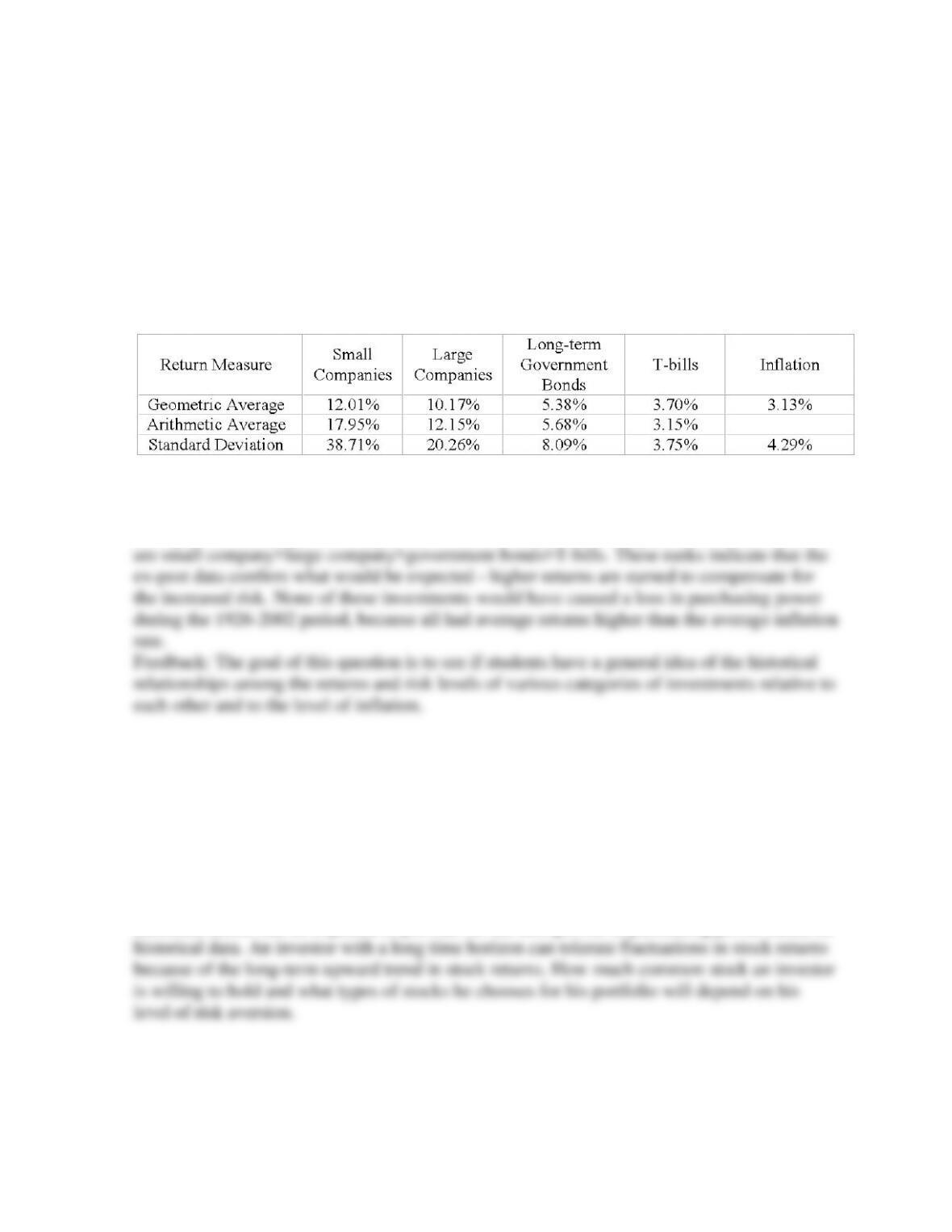
83. Discuss the historical distributions of each of the following in terms of their average
return and the dispersion of their returns: U.S. small company stocks, U.S. large company
stocks, U.S. long-term government bonds, and U.S. T-bills. Would any of these investments
cause a loss in purchasing power during a 1926-2005 holding period?
The data given in Tables 5.3 & 5.5
Whether the averages are measured on a geometric basis or an arithmetic basis, the ranking is
always the same, with small company average>large company average>government bond
average>T-bill average. With regard to risk, the relationships among the standard deviations
Difficulty: Difficult
84. Discuss some reasons why an investor with a long time horizon might choose to invest in
common stocks, even though they have historically been riskier than government bonds or T-
bills.
Common stocks can be expected to provide for the best growth in purchasing power based on
Difficulty: Easy