Chapter 05 – Learning about Return and Risk from the Historical Record
5-1
Chapter 05
Learning about Return and Risk from the Historical Record
Multiple Choice Questions
1. Over the past year you earned a nominal rate of interest of 10 percent on your money. The
inflation rate was 5 percent over the same period. The exact actual growth rate of your
purchasing power was
A. 15.5%.
B. 10.0%.
Difficulty: Moderate
2. Over the past year you earned a nominal rate of interest of 8 percent on your money. The
inflation rate was 4 percent over the same period. The exact actual growth rate of your
purchasing power was
A. 15.5%.
B. 10.0%.
Difficulty: Moderate
Chapter 05 – Learning about Return and Risk from the Historical Record
5-2
3. A year ago, you invested $1,000 in a savings account that pays an annual interest rate of
7%. What is your approximate annual real rate of return if the rate of inflation was 3% over
the year?
D. 3%.
E. none of the above.
Difficulty: Easy
4. A year ago, you invested $10,000 in a savings account that pays an annual interest rate of
5%. What is your approximate annual real rate of return if the rate of inflation was 3.5% over
the year?
D. 3%.
E. none of the above.
Difficulty: Easy
5. If the annual real rate of interest is 5% and the expected inflation rate is 4%, the nominal
rate of interest would be approximately
A. 1%.
Difficulty: Easy
Chapter 05 – Learning about Return and Risk from the Historical Record
5-3
6. If the annual real rate of interest is 2.5% and the expected inflation rate is 3.7%, the
nominal rate of interest would be approximately
A. 3.7%.
Difficulty: Easy
7. You purchased a share of stock for $20. One year later you received $1 as dividend and
sold the share for $29. What was your holding period return?
A. 45%
Difficulty: Moderate
8. You purchased a share of stock for $30. One year later you received $1.50 as dividend and
D. 11.8%
E. none of the above
Difficulty: Moderate
Chapter 05 – Learning about Return and Risk from the Historical Record
5-4
9. Which of the following determine(s) the level of real interest rates?
I) the supply of savings by households and business firms
II) the demand for investment funds
III) the government’s net supply and/or demand for funds
A. I only
B. II only
Difficulty: Moderate
10. Which of the following statement(s) is (are) true?
I) The real rate of interest is determined by the supply and demand for funds.
II) The real rate of interest is determined by the expected rate of inflation.
III) The real rate of interest can be affected by actions of the Fed.
IV) The real rate of interest is equal to the nominal interest rate plus the expected rate of
inflation.
A. I and II only.
Difficulty: Moderate
Chapter 05 – Learning about Return and Risk from the Historical Record
5-5
11. Which of the following statements is true:
A. Inflation has no effect on the nominal rate of interest.
B. The realized nominal rate of interest is always greater than the real rate of interest.
Difficulty: Moderate
12. Other things equal, an increase in the government budget deficit
A. drives the interest rate down.
Difficulty: Moderate
Chapter 05 – Learning about Return and Risk from the Historical Record
5-6
13. Ceteris paribus, a decrease in the demand for loanable funds
D. results from an increase in business prospects and a decrease in the level of savings.
E. none of the above.
Difficulty: Moderate
14. The holding period return (HPR) on a share of stock is equal to
A. the capital gain yield during the period, plus the inflation rate.
Difficulty: Moderate
15. Historical records regarding return on stocks, Treasury bonds, and Treasury bills between
1926 and 2005 show that
D. bills outperformed stocks and bonds.
E. treasury bills always offered a rate of return greater than inflation.
Difficulty: Moderate
Chapter 05 – Learning about Return and Risk from the Historical Record
5-7
16. If the interest rate paid by borrowers and the interest rate received by savers accurately
reflects the realized rate of inflation:
A. borrowers gain and savers lose.
B. savers gain and borrowers lose.
Difficulty: Moderate
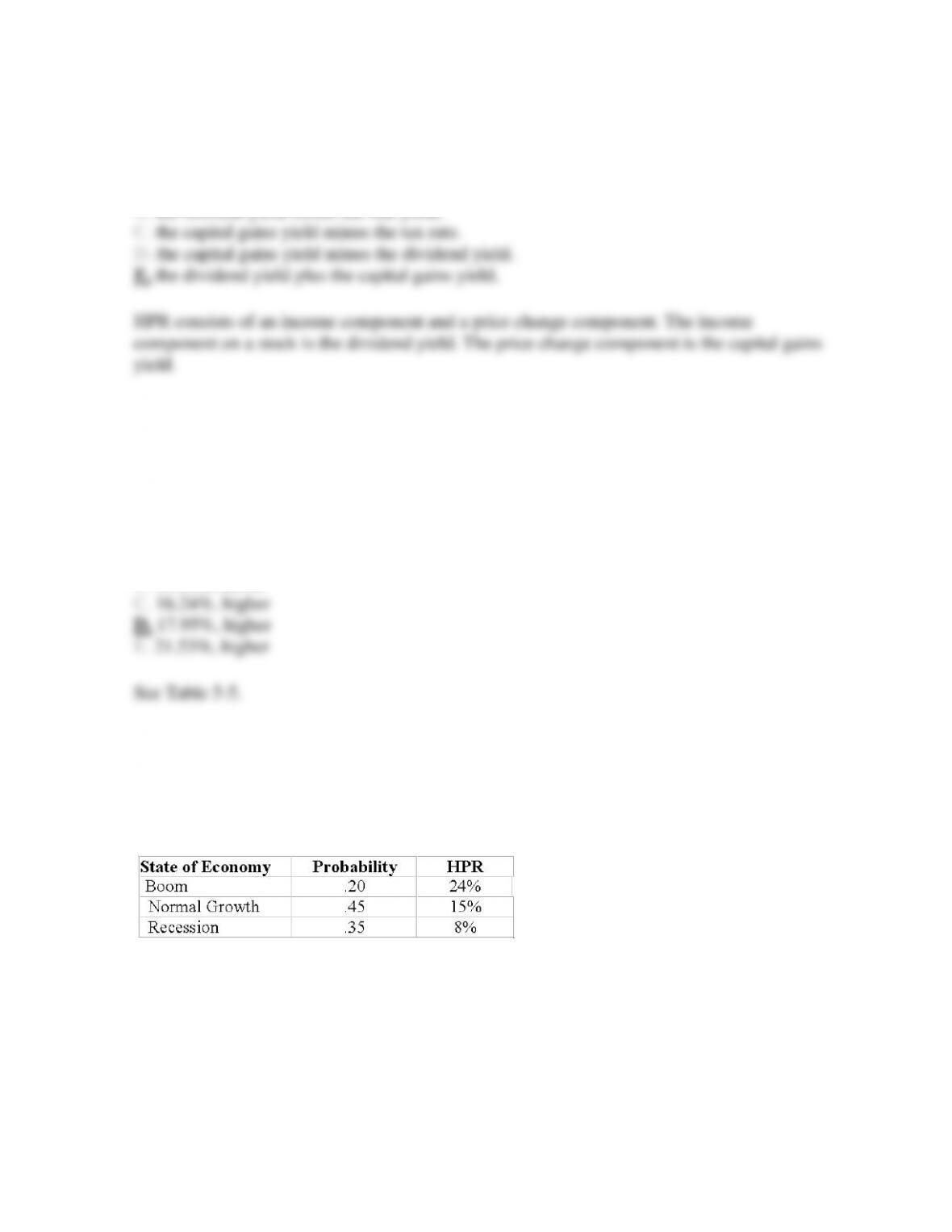
You have been given this probability distribution for the holding period return for KMP
stock:
17. What is the expected holding period return for KMP stock?
D. 11.54%
E. 10.88%
Difficulty: Moderate
Chapter 05 – Learning about Return and Risk from the Historical Record
5-8
18. What is the expected standard deviation for KMP stock?
A. 6.91%
Difficulty: Difficult
19. What is the expected variance for KMP stock?
D. 63.72%
E. 78.45%
Difficulty: Difficult
20. If the nominal return is constant, the after-tax real rate of return
A. declines as the inflation rate increases.
B. increases as the inflation rate increases.
Difficulty: Moderate
Chapter 05 – Learning about Return and Risk from the Historical Record
5-9
21. The risk premium for common stocks
A. cannot be zero, for investors would be unwilling to invest in common stocks.
B. must always be positive, in theory.
Difficulty: Moderate
22. A risk-free intermediate or long-term investment
A. is free of all types of risk.
Difficulty: Moderate
23. You purchase a share of Boeing stock for $90. One year later, after receiving a dividend
of $3, you sell the stock for $92. What was your holding period return?
A. 4.44%
B. 2.22%
Difficulty: Moderate
Chapter 05 – Learning about Return and Risk from the Historical Record
5-10
24. Toyota stock has the following probability distribution of expected prices one year from
now:
If you buy Toyota today for $55 and it will pay a dividend during the year of $4 per share,
what is your expected holding period return on Toyota?
A. 17.72%
B. 18.89%
Difficulty: Difficult
25. Which of the following factors would not be expected to affect the nominal interest rate?
A. the supply of loanable funds
B. the demand for loanable funds
Difficulty: Easy
Chapter 05 – Learning about Return and Risk from the Historical Record
5-11
26. Your Certificate of Deposit will mature in one week and you are considering how to
invest the proceeds. If you invest in a 30-day CD the bank will pay you 4%. If you invest in a
2-year CD the bank will pay you 6% interest. Which option would you choose?
A. the 30-day CD, no matter what you expect interest rates to do in the future
Difficulty: Moderate
27. In words, the real rate of interest is approximately equal to
D. the inflation rate divided by the nominal rate.
E. the nominal rate plus the inflation rate.
Difficulty: Easy
Chapter 05 – Learning about Return and Risk from the Historical Record
5-12
28. If the Federal Reserve lowers the discount rate, ceteris paribus, the equilibrium levels of
funds lent will __________ and the equilibrium level of real interest rates will ___________.
A. increase; increase
Difficulty: Moderate
29. What has been the relationship between T-Bill rates and inflation rates since the 1980s?
A. The T-Bill rate was sometimes higher than and sometimes lower than the inflation rate.
B. The T-Bill rate has equaled the inflation rate plus a constant percentage.
Difficulty: Moderate
30. “Bracket Creep” happens when
A. tax liabilities are based on real income and there is a negative inflation rate.
B. tax liabilities are based on real income and there is a positive inflation rate.
Difficulty: Moderate
Chapter 05 – Learning about Return and Risk from the Historical Record
5-13
31. The holding-period return (HPR) for a stock is equal to
A. the real yield minus the inflation rate.
B. the nominal yield minus the real yield.
Difficulty: Easy
32. The historical arithmetic rate of return on small stocks over the 1926-2005 period has
been _______. The standard deviation of small stocks’ returns has been ________ than the
standard deviation of large stocks’ returns.
A. 12.43%, lower
B. 13.11%, lower
Difficulty: Moderate
You have been given this probability distribution for the holding period return for Cheese,
Inc stock:
Chapter 05 – Learning about Return and Risk from the Historical Record
5-14
33. Assuming that the expected return on Cheese’s stock is 14.35%, what is the standard
deviation of these returns?
A. 4.72%
B. 6.30%
Difficulty: Moderate
34. An investor purchased a bond 45 days ago for $985. He received $15 in interest and sold
the bond for $980. What is the holding period return on his investment?
A. 1.52%
B. 0.50%
Difficulty: Easy
35. An investor purchased a bond 63 days ago for $980. He received $17 in interest and sold
the bond for $987. What is the holding period return on his investment?
Difficulty: Easy
Chapter 05 – Learning about Return and Risk from the Historical Record
5-15
36. Over the past year you earned a nominal rate of interest of 8 percent on your money. The
inflation rate was 3.5 percent over the same period. The exact actual growth rate of your
purchasing power was
A. 15.55%.
Difficulty: Moderate
37. Over the past year you earned a nominal rate of interest of 14 percent on your money. The
inflation rate was 2 percent over the same period. The exact actual growth rate of your
D. 14.32%.
E. none of the above.
Difficulty: Moderate
38. Over the past year you earned a nominal rate of interest of 12.5 percent on your money.
The inflation rate was 2.6 percent over the same period. The exact actual growth rate of your
purchasing power was
A. 9.15%.
B. 9.90%.
Difficulty: Moderate
Chapter 05 – Learning about Return and Risk from the Historical Record
5-16
39. A year ago, you invested $1,000 in a savings account that pays an annual interest rate of
4%. What is your approximate annual real rate of return if the rate of inflation was 2% over
the year?
A. 4%.
Difficulty: Easy
40. A year ago, you invested $10,000 in a savings account that pays an annual interest rate of
3%. What is your approximate annual real rate of return if the rate of inflation was 4% over
the year?
A. 1%.
Difficulty: Easy
41. A year ago, you invested $2,500 in a savings account that pays an annual interest rate of
2.5%. What is your approximate annual real rate of return if the rate of inflation was 1.6%
over the year?
A. 4.1%.
Difficulty: Easy