90) Use the below information to answer the following question.
Sales (100,000 units)
$
1,000,000
Variable costs
300,000
Contribution margin
700,000
Fixed manufacturing costs
200,000
Operating income
500,000
Interest
75,000
Earnings before taxes
425,000
Taxes (30%)
127,500
Net income
$
297,500
Refer to the table. The degree of operating leverage is ________.
A) 1.40x
B) 1.56x
C) 3.33x
D) 2.22x
91) Use the below information to answer the following question.
Sales (100,000 units)
$
1,000,000
Variable costs
300,000
Contribution margin
700,000
Fixed manufacturing costs
200,000
Operating income
500,000
Interest
75,000
Earnings before taxes
425,000
Taxes (30%)
127,500
Net income
$
297,500
Refer to the table. The degree of financial leverage is ________.
A) 1.29x
B) 4.20x
C) 3.50x
D) 1.18x
92) Use the below information to answer the following question.
Sales (100,000 units)
$
1,000,000
Variable costs
300,000
Contribution margin
700,000
Fixed manufacturing costs
200,000
Operating income
500,000
Interest
75,000
Earnings before taxes
425,000
Taxes (30%)
127,500
Net income
$
297,500
Refer to the table. The degree of combined leverage is ________.
A) 2.22x
B) 1.90x
C) 2.95x
D) 1.65x
93) Use the below information to answer the following question.
Sales (1,000 units)
$
200,000
Variable costs
110,000
Contribution margin
90,000
Fixed manufacturing costs
40,000
Operating income
50,000
Interest
10,000
Earnings before taxes
40,000
Taxes (30%)
12,000
Net income
$
28,000
Shares Outstanding
1,000
Refer to the table. This firm’s break-even point in units is
A) 445 units.
B) 634 units.
C) 714 units.
D) 180 units.
94) Use the below information to answer the following question.
Sales (1,000 units)
$
200,000
Variable costs
110,000
Contribution margin
90,000
Fixed manufacturing costs
40,000
Operating income
50,000
Interest
10,000
Earnings before taxes
40,000
Taxes (30%)
12,000
Net income
$
28,000
Shares Outstanding
1,000
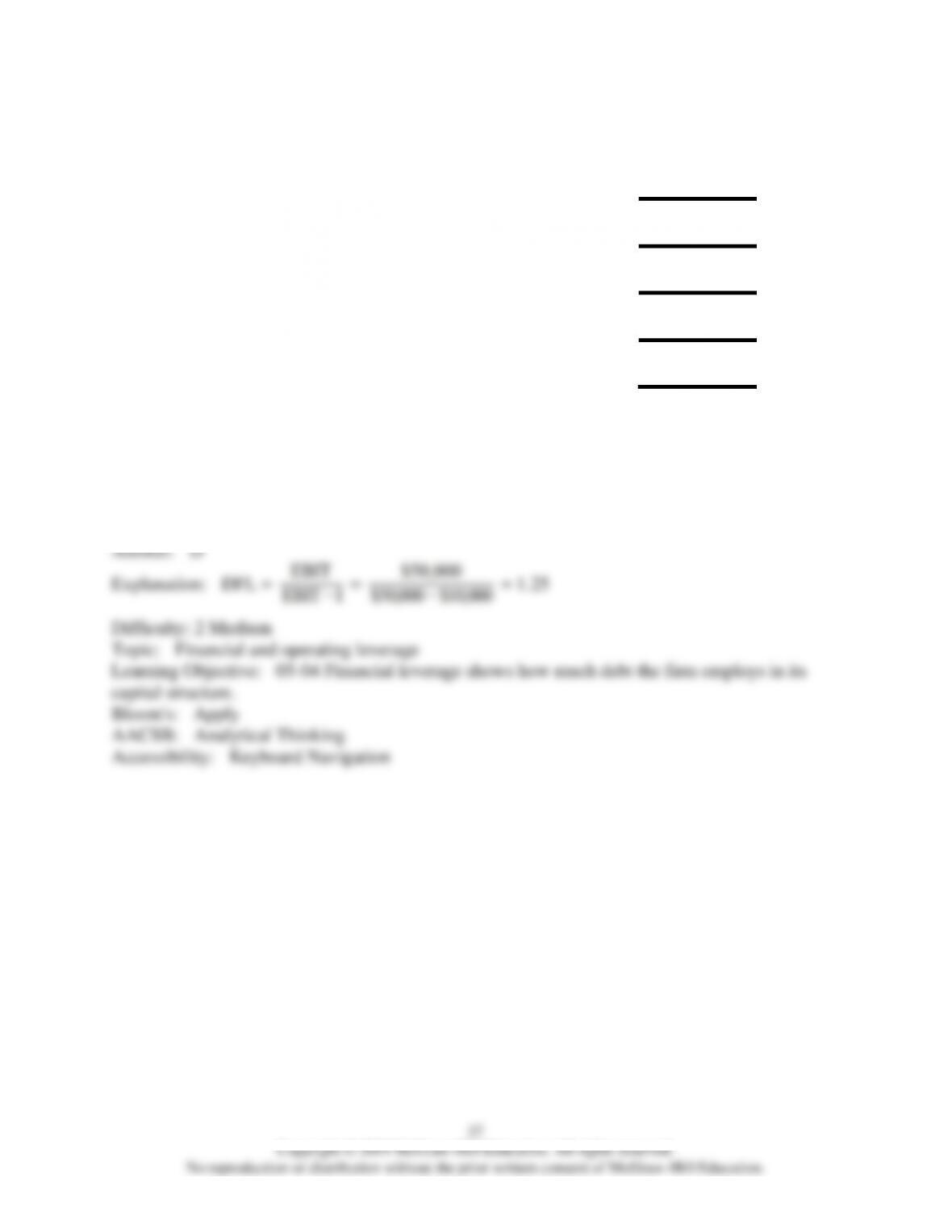
Refer to the table. The degree of operating leverage (DOL) is ________.
A) 1.62x
B) 1.80x
C) 3.50x
D) 1.40x
95) Use the below information to answer the following question.
Sales (1,000 units)
$
200,000
Variable costs
110,000
Contribution margin
90,000
Fixed manufacturing costs
40,000
Operating income
50,000
Interest
10,000
Earnings before taxes
40,000
Taxes (30%)
12,000
Net income
$
28,000
Shares Outstanding
1,000
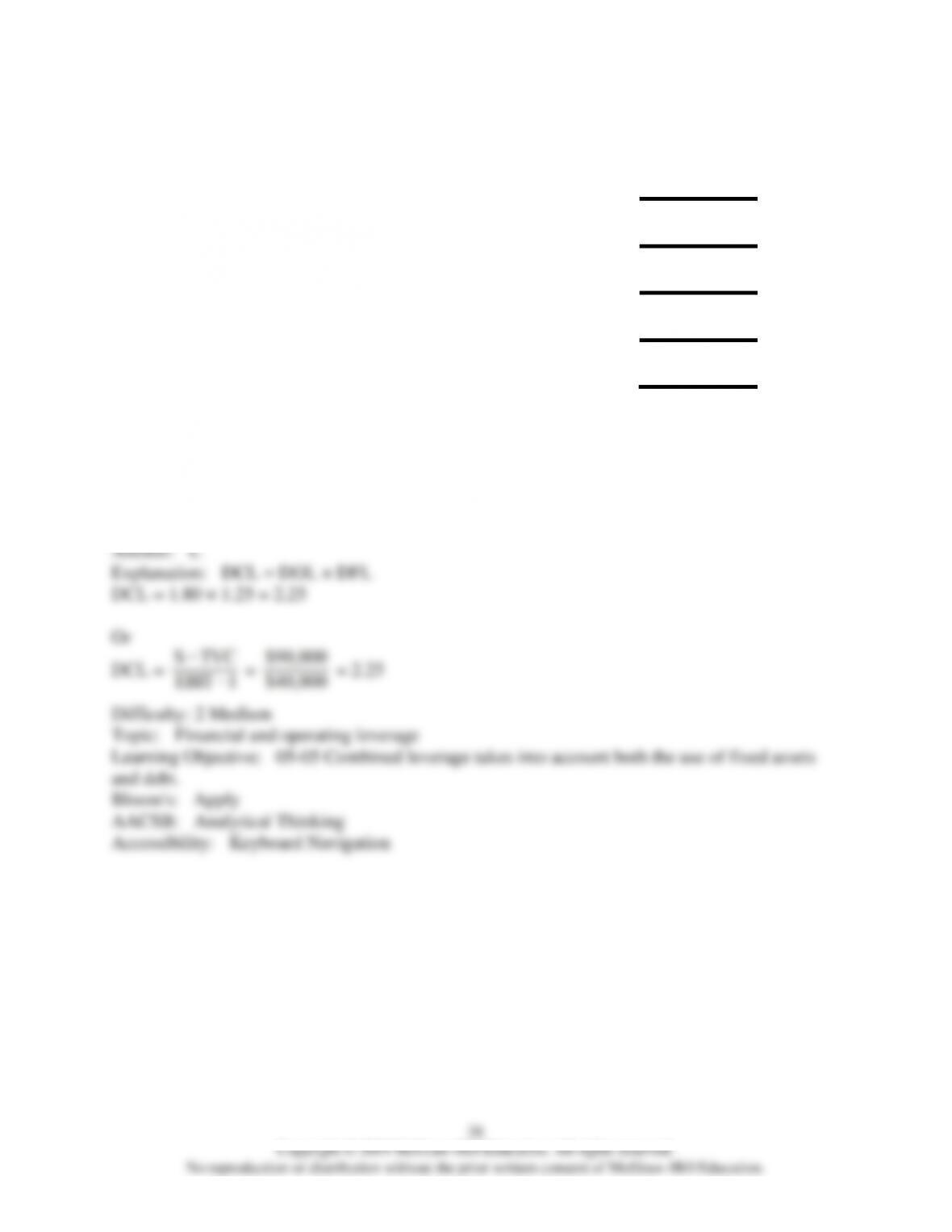
Refer to the table. The degree of financial leverage (DFL) is ________.
A) 3.50x
B) 1.40x
C) 1.95x
D) 1.25x
96) Use the below information to answer the following question.
Sales (1,000 units)
$
200,000
Variable costs
110,000
Contribution margin
90,000
Fixed manufacturing costs
40,000
Operating income
50,000
Interest
10,000
Earnings before taxes
40,000
Taxes (30%)
12,000
Net income
$
28,000
Shares Outstanding
1,000
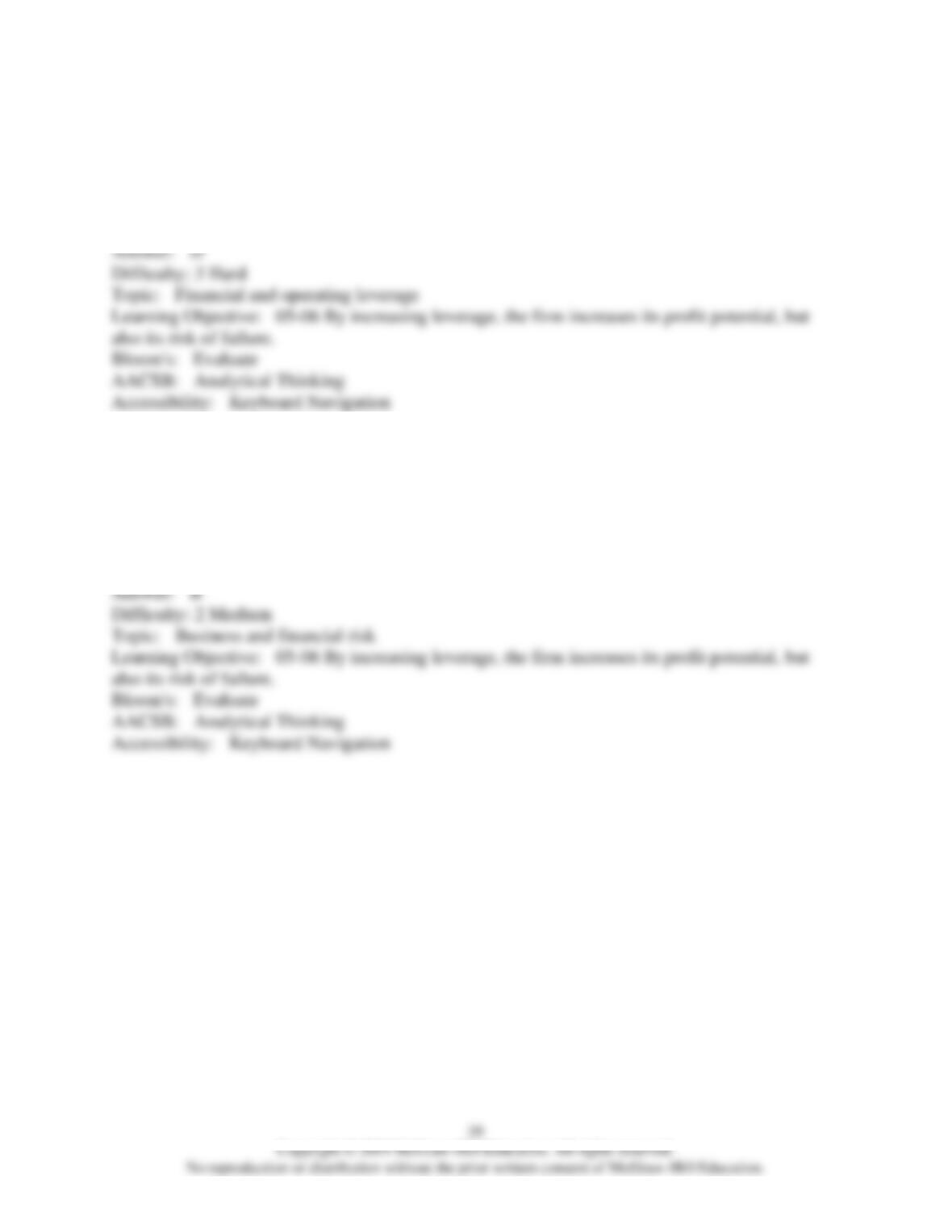
Refer to the table. The degree of combined leverage (DCL) is ________.
A) 3.08x
B) 5.45x
C) 2.25x
D) 6.83x
97) Heavy use of long-term debt may be beneficial in an inflationary economy because
A) the debt may be repaid in more “expensive” dollars.
B) nominal interest rates exceed real interest rates.
C) inflation is associated with the peak of a business cycle.
D) the debt may be repaid in “cheaper” dollars.
98) Under which of the following conditions could the overuse of financial leverage be
detrimental to the firm?
A) In a stable industry.
B) When there is cyclical demand for the firm’s products.
C) During an upswing in the business cycle.
D) When there is low interest cost compared to return on assets.
99) Firm A produces semiconductors using highly technical machinery; Firm B is a retail
clothing store with little use of machinery. Consider which firm employs a higher degree of
operating leverage and then answer the following question: “Which of the following comparative
statements about firms A and B is true?”
A) A has a lower break-even point than B, but A’s profit grows faster after the breakeven.
B) A has a higher break-even point than B, but A’s profit grows slower after the breakeven.
C) B has a lower break-even point than A, but A’s profit grows faster after the breakeven.
D) B has a lower break-even point than A, and profit grows at the same rate for both companies
after the break-even point.
100) A factory that relies on highly technical machinery may choose to reduce its overall
leverage position by
A) selling its machinery.
B) increasing its accounts receivable.
C) utilizing a higher level of equity.
D) decreasing their variable costs per unit.
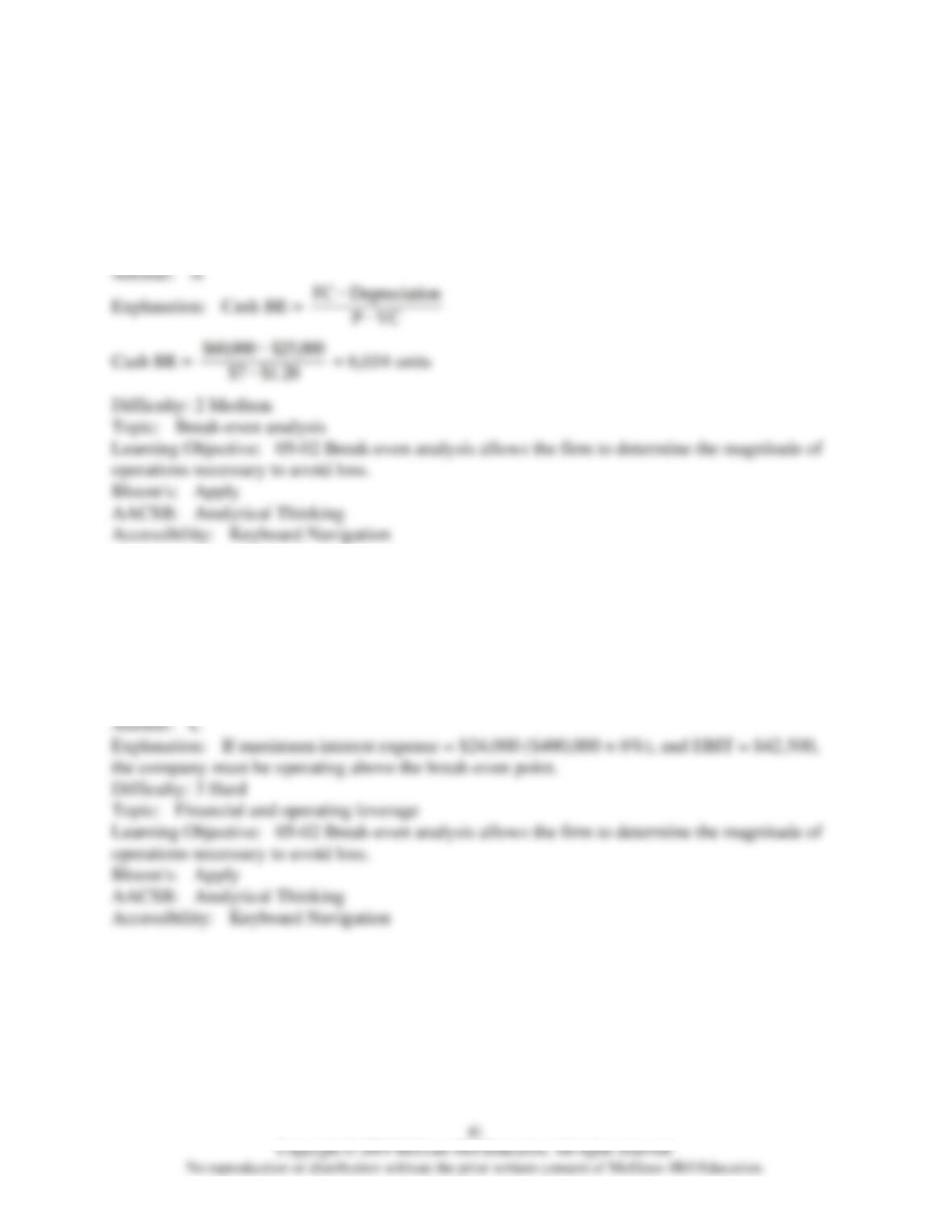
101) If TechCor has fixed costs of $60,000, variable costs of $1.20/unit, a sales price/unit of $7,
and depreciation expense of $25,000, what is its cash breakeven in units?
A) 6,034 units
B) 11,458 units
C) 12,375 units
D) 45,833 units
102) Green Co. has total debt of $400,000, a cost to borrow funds of 6%, and an EBIT of
$42,500. From a financial perspective, Green Co. has profits at
A) breaking even.
B) lower than the breakeven point.
C) higher than the break-even point.
D) in need of new financing.