63) A quick ratio that is much smaller than the current ratio reflects
A) a small portion of current assets is in inventory.
B) a large portion of current assets is in inventory.
C) that the firm will have a high inventory turnover.
D) that the firm will have a high return on assets.
64) A firm’s long-term assets = $100,000, total assets = $400,000, inventory = $50,000 and
current liabilities = $200,000. What are the firm’s current ratio and quick ratio?
A) Current ratio = 0.5; quick ratio = 1.25
B) Current ratio = 1.0; quick ratio = 2.0
C) Current ratio = 1.5; quick ratio = 1.25
D) Current ratio = 2.5; quick ratio = 2.0
65) Investors and financial analysts wanting to evaluate the operating efficiency of a firm’s
managers would primarily look at the firm’s
A) debt utilization ratios.
B) liquidity ratios.
C) asset utilization ratios.
D) profitability ratios.
66) An increasing average receivables collection period indicates
A) the firm is generating more income.
B) accounts receivable are going down.
C) the company is becoming more efficient in its collection policy.
D) the company is becoming less efficient in its collection policy.
67) In addition to comparison with industry ratios, it is also helpful to analyze ratios using
A) future projections
B) historical data
C) only industry ratios provide valid comparisons.
D) trend analysis and historical comparisons.
68) If a firm has both a fixed interest expense and fixed lease payments,
A) times interest earned ratio will be smaller than fixed charge coverage ratio.
B) times interest earned ratio will be greater than fixed charge coverage ratio.
C) times interest earned ratio will be the same as fixed charge coverage ratio.
D) fixed charge coverage ratio cannot be computed.
69) A firm has operating profit of $210,000 after deducting fixed lease payments of $30,000. The
fixed interest expense is $50,000. What is the firm’s fixed charge coverage ratio?
A) 6.00x
B) 2.33x
C) 2.00x
D) 3.00x
70) A firm has total assets of $3,000,000 and stockholders equity is $1,000,000. What is the
debt-to-total asset ratio?
A) 45%
B) 75%
C) 55%
D) 67%
71) The higher a firm’s debt utilization ratios, excluding debt-to-total assets, the
A) less risky the firm’s financial position.
B) more risky the firm’s financial position.
C) more easily the firm will be able to pay dividends.
D) None of the options
72) If fixed lease payments are reduced and everything else remains constant,
A) times interest earned goes up.
B) fixed charge coverage goes up.
C) fixed charge coverage stays the same.
D) debt to total assets goes down.
73) Industries most sensitive to inflation-induced profits are those with
A) seasonal products.
B) cyclical products.
C) consumer products.
D) high-profit products.
74) Replacement cost accounting (current cost method) during a period of inflation will usually
A) increase assets, decrease net income before taxes, and lower the return on equity.
B) increase assets, increase net income before taxes, and increase the return on equity.
C) decrease assets, increase net income before taxes, and increase the return on equity.
D) None of the options apply.
75) During inflation, replacement cost accounting will
A) increase the value of assets.
B) lower the debt-to-asset ratio.
C) reduce incomes.
D) All of the options
76) Income can be distorted by factors other than inflation. The most important causes of
distortion for inter-industry comparisons are
A) timing of revenue receipts and nonrecurring gains or losses.
B) tax write-off policy and use of different inventory methods.
C) Both of these.
D) None of the options
77) Disinflation may cause
A) an increase in the value of gold, silver, and gems.
B) a reduced required return demanded by investors on financial assets.
C) additional profits through falling inventory costs.
D) None of the options are true
78) Disinflation, as compared to inflation, would normally be good for investments in
A) bonds.
B) gold.
C) collectible antiques.
D) textbooks.
79) Industries most sensitive to inflation-induced profits are:
A) cyclical products like lumber, copper, and rubber
B) food products
C) industries which inventory is a significant percentage of sales and profits.
D) all of the above.
80) A conservative company experiencing rapid price increases for its products would use LIFO
to try to:
A) Allow the inventory that was just purchased at a higher price to be moved to cost of goods
sold, showing a lower net income.
B) Allow the inventory that was just purchased at a higher price to remain in ending inventory
values and move older inventory to cost of goods sold, showing a higher net income.
C) Allow the inventory that was just purchased at a lower price to remain in ending inventory
values and move older inventory to cost of goods sold, showing a lower net income.
D) Allow the inventory that was just purchased at a lower price to be moved to cost of goods
sold, showing a higher net income.
81) The ________ method of inventory costing is least likely to lead to inflation-induced profits.
A) FIFO
B) LIFO
C) Weighted average
D) Lower of cost or market
82) Assuming proper accounting disclosure is used, a large extraordinary loss has what effect on
the normal operating profits in the future?
A) It raises it.
B) It lowers it.
C) It has no effect.
D) More information is needed to determine the effect.
83) Which of the following is a potential problem of utilizing ratio analysis?
A) Trends and industry averages are historical in nature.
B) Financial data may be distorted due to price-level changes.
C) Firms within an industry may not use similar accounting methods.
D) All of the options
84) If government bonds pay 7.0% interest and insured savings accounts pay 5.0% interest,
stockholders in a moderately risky firm would expect return-on-equity values of
A) 5.0%.
B) 7.0%.
C) 9.0%.
D) above 7.0%.
85) The most rigorous test of a firm’s ability to pay its short-term obligations is its
A) current ratio.
B) quick ratio.
C) debt-to-assets ratio.
D) times-interest-earned ratio.
86) If the company’s accounts receivable turnover is increasing, the average collection period
A) is going up slightly.
B) is going down.
C) could be moving in either direction.
D) is going up by a significant amount.

31
87)
MEGAFRAME COMPUTER COMPANY
Balance Sheet
As of December 31
ASSETS
Cash
$
50,000
Accounts receivable
70,000
Inventory
110,000
Net plant and equipment
220,000
Total assets
$
450,000
LIABILITIES AND STOCKHOLDERS’ EQUITY
Accounts payable
$
70,000
Accrued expenses
50,000
Long-term debt
130,000
Common stock
70,000
Paid-in capital
40,000
Retained earnings
90,000
Total liabilities and stockholders’ equity
$
450,000
MEGAFRAME COMPUTER COMPANY
Income Statement
For the year ended December 31
Sales (all on credit)
$
875,000
Cost of goods sold
600,000
Gross profit
$
275,000
Sales and administrative expenses
30,000
Depreciation
55,000
Operating profit
$
190,000
Interest expense
25,000
Profit before taxes
$
165,000
Taxes (30%)
49,500
Net income
$
115,500
Refer to the tables above. Using the DuPont method, return on assets (investment) for
Megaframe Computer is approximately
A) 13%.
B) 22%.
C) 26%.
D) 35%.
32
Copyright © 2019 McGraw-Hill Education. All rights reserved.
No reproduction or distribution without the prior written consent of McGraw-Hill Education.
Answer: C
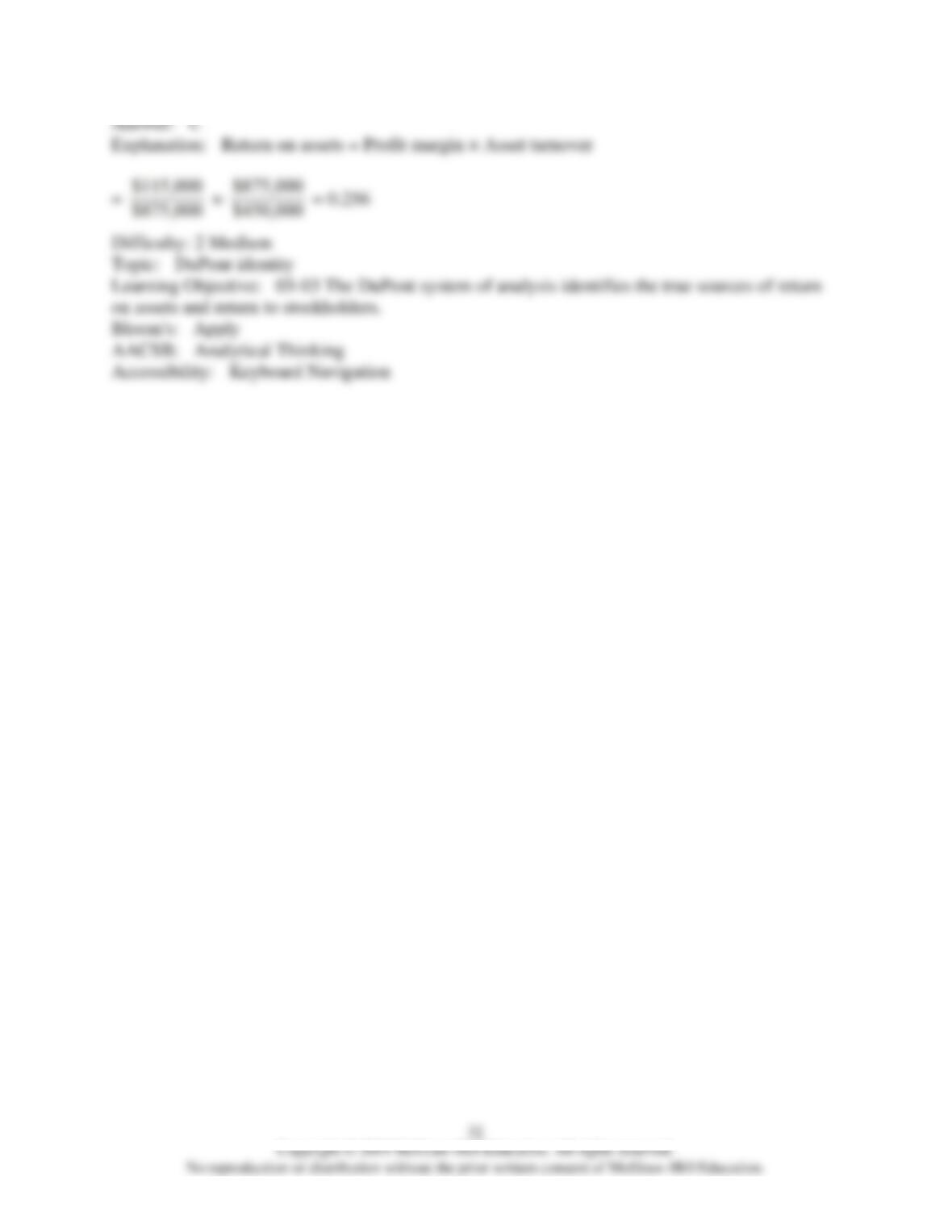
Explanation: Return on assets = Profit margin × Asset turnover
= × = 0.256
Difficulty: 2 Medium
Topic: DuPont identity
Learning Objective: 03-03 The DuPont system of analysis identifies the true sources of return
on assets and return to stockholders.
Bloom’s: Apply
AACSB: Analytical Thinking
Accessibility: Keyboard Navigation

33
88)
MEGAFRAME COMPUTER COMPANY
Balance Sheet
As of December 31
ASSETS
Cash
$
50,000
Accounts receivable
70,000
Inventory
110,000
Net plant and equipment
220,000
Total assets
$
450,000
LIABILITIES AND STOCKHOLDERS’ EQUITY
Accounts payable
$
70,000
Accrued expenses
50,000
Long-term debt
130,000
Common stock
70,000
Paid-in capital
40,000
Retained earnings
90,000
Total liabilities and stockholders’ equity
$
450,000
MEGAFRAME COMPUTER COMPANY
Income Statement
For the year ended December 31
Sales (all on credit)
$
875,000
Cost of goods sold
600,000
Gross profit
$
275,000
Sales and administrative expenses
30,000
Depreciation
55,000
Operating profit
$
190,000
Interest expense
25,000
Profit before taxes
$
165,000
Taxes (30%)
49,500
Net income
$
115,500
Refer to the tables above. Compute Megaframe’s after-tax profit margin.
A) 5.7%
B) 13.2%
C) 15.4%
D) 18.9%
34
Copyright © 2019 McGraw-Hill Education. All rights reserved.
No reproduction or distribution without the prior written consent of McGraw-Hill Education.
Answer: B
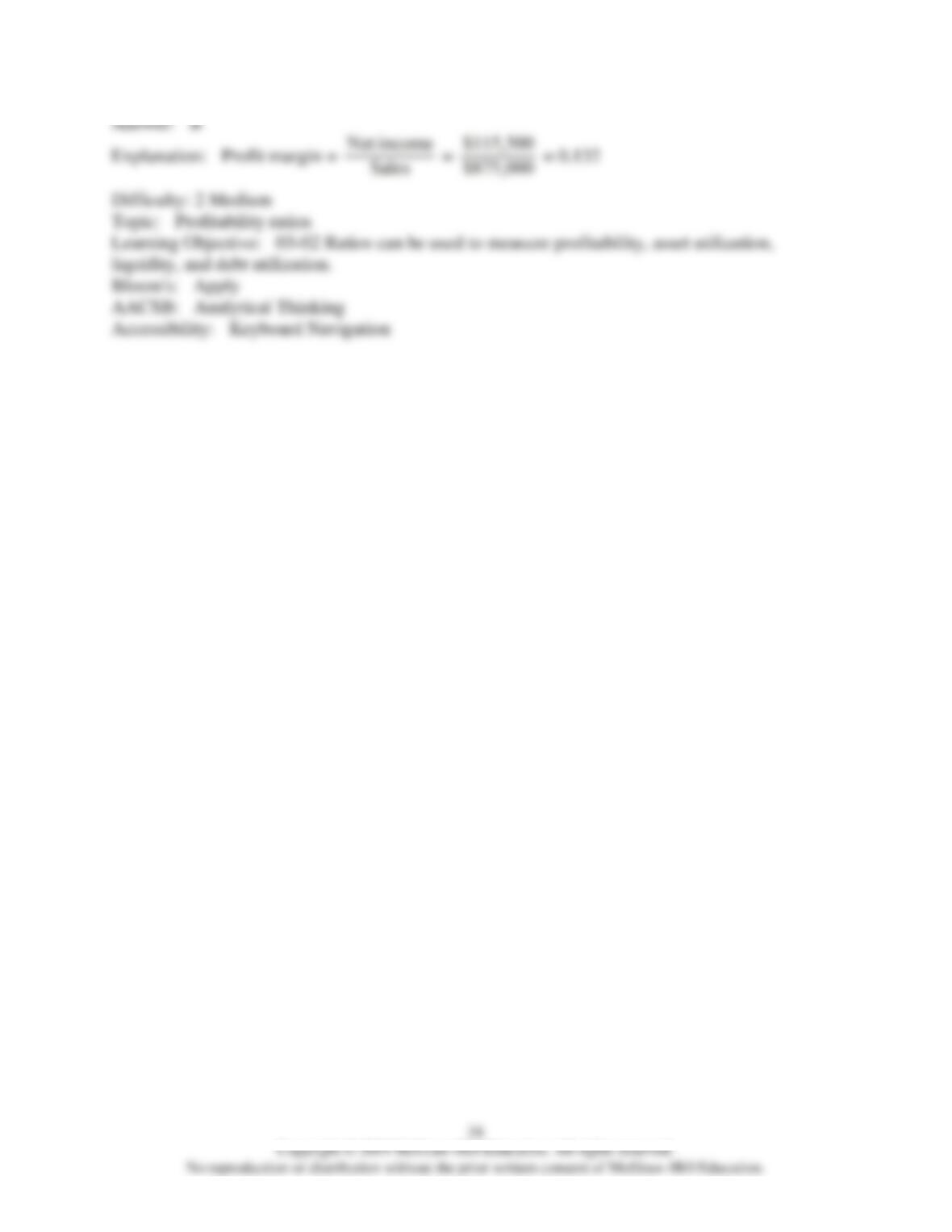
Explanation: Profit margin = = = 0.132
Difficulty: 2 Medium
Topic: Profitability ratios
Learning Objective: 03-02 Ratios can be used to measure profitability, asset utilization,
liquidity, and debt utilization.
Bloom’s: Apply
AACSB: Analytical Thinking
Accessibility: Keyboard Navigation

35
89)
MEGAFRAME COMPUTER COMPANY
Balance Sheet
As of December 31
ASSETS
Cash
$
50,000
Accounts receivable
70,000
Inventory
110,000
Net plant and equipment
220,000
Total assets
$
450,000
LIABILITIES AND STOCKHOLDERS’ EQUITY
Accounts payable
$
70,000
Accrued expenses
50,000
Long-term debt
130,000
Common stock
70,000
Paid-in capital
40,000
Retained earnings
90,000
Total liabilities and stockholders’ equity
$
450,000
MEGAFRAME COMPUTER COMPANY
Income Statement
For the year ended December 31
Sales (all on credit)
$
875,000
Cost of goods sold
600,000
Gross profit
$
275,000
Sales and administrative expenses
30,000
Depreciation
55,000
Operating profit
$
190,000
Interest expense
25,000
Profit before taxes
$
165,000
Taxes (30%)
49,500
Net income
$
115,500
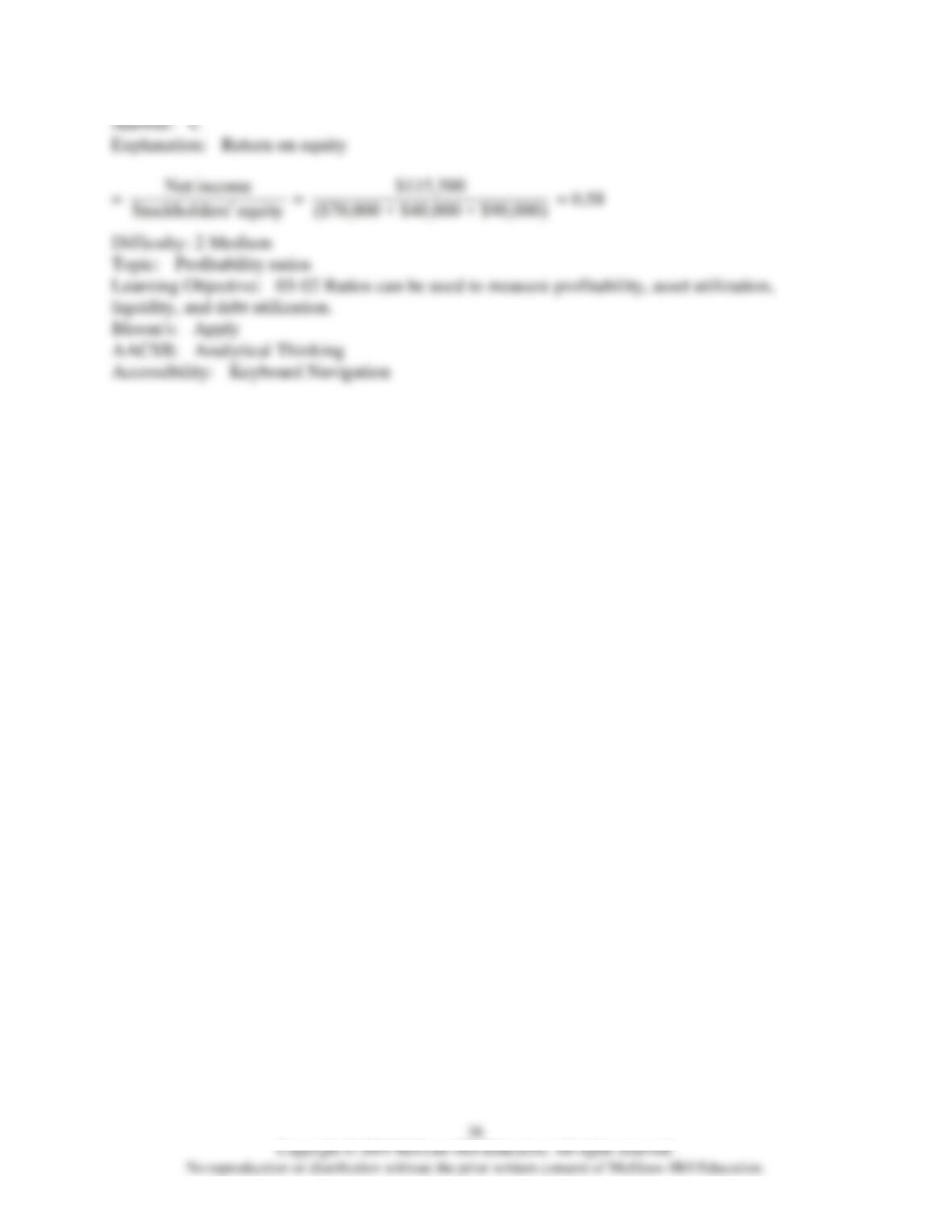
Refer to the tables above. The firm’s return on equity is
A) 23%.
B) 56%.
C) 58%.
D) 100%.
36
Copyright © 2019 McGraw-Hill Education. All rights reserved.
No reproduction or distribution without the prior written consent of McGraw-Hill Education.
Answer: C
Explanation: Return on equity
= = = 0.58
Difficulty: 2 Medium
Topic: Profitability ratios
Learning Objective: 03-02 Ratios can be used to measure profitability, asset utilization,
liquidity, and debt utilization.
Bloom’s: Apply
AACSB: Analytical Thinking
Accessibility: Keyboard Navigation

37
90)
MEGAFRAME COMPUTER COMPANY
Balance Sheet
As of December 31
ASSETS
Cash
$
50,000
Accounts receivable
70,000
Inventory
110,000
Net plant and equipment
220,000
Total assets
$
450,000
LIABILITIES AND STOCKHOLDERS’ EQUITY
Accounts payable
$
70,000
Accrued expenses
50,000
Long-term debt
130,000
Common stock
70,000
Paid-in capital
40,000
Retained earnings
90,000
Total liabilities and stockholders’ equity
$
450,000
MEGAFRAME COMPUTER COMPANY
Income Statement
For the year ended December 31
Sales (all on credit)
$
875,000
Cost of goods sold
600,000
Gross profit
$
275,000
Sales and administrative expenses
30,000
Depreciation
55,000
Operating profit
$
190,000
Interest expense
25,000
Profit before taxes
$
165,000
Taxes (30%)
49,500
Net income
$
115,500
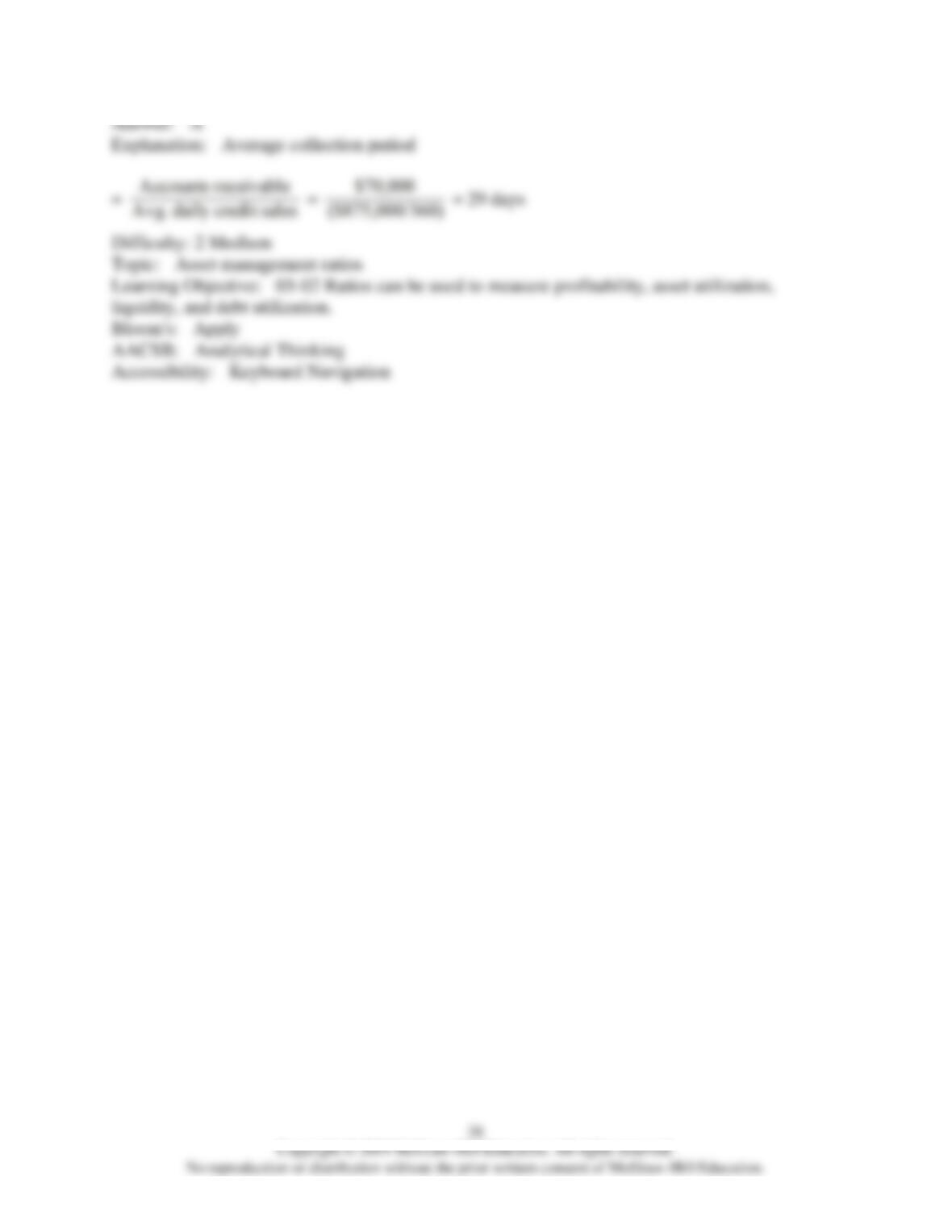
Refer to the tables above. What is the firm’s average collection period? Assume a 360-day
calendar year.
A) 29 days
B) 25 days
C) 13 days
D) 20 days
38
Copyright © 2019 McGraw-Hill Education. All rights reserved.
No reproduction or distribution without the prior written consent of McGraw-Hill Education.
Answer: A
Explanation: Average collection period
= = = 29 days
Difficulty: 2 Medium
Topic: Asset management ratios
Learning Objective: 03-02 Ratios can be used to measure profitability, asset utilization,
liquidity, and debt utilization.
Bloom’s: Apply
AACSB: Analytical Thinking
Accessibility: Keyboard Navigation

39
91)
MEGAFRAME COMPUTER COMPANY
Balance Sheet
As of December 31
ASSETS
Cash
$
50,000
Accounts receivable
70,000
Inventory
110,000
Net plant and equipment
220,000
Total assets
$
450,000
LIABILITIES AND STOCKHOLDERS’ EQUITY
Accounts payable
$
70,000
Accrued expenses
50,000
Long-term debt
130,000
Common stock
70,000
Paid-in capital
40,000
Retained earnings
90,000
Total liabilities and stockholders’ equity
$
450,000
MEGAFRAME COMPUTER COMPANY
Income Statement
For the year ended December 31
Sales (all on credit)
$
875,000
Cost of goods sold
600,000
Gross profit
$
275,000
Sales and administrative expenses
30,000
Depreciation
55,000
Operating profit
$
190,000
Interest expense
25,000
Profit before taxes
$
165,000
Taxes (30%)
49,500
Net income
$
115,500
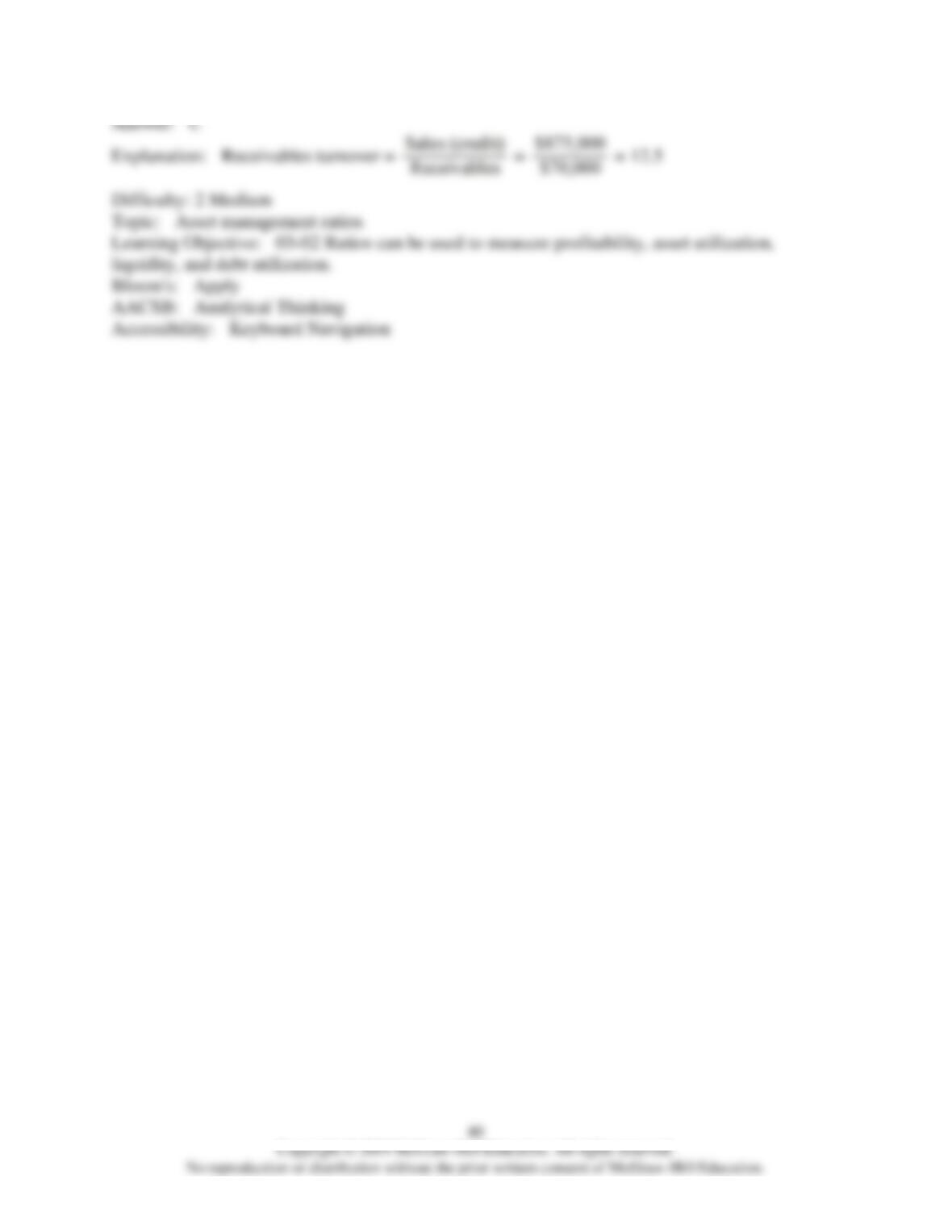
Refer to the tables above. The firm’s receivable turnover is ________. Assume a 360-day
calendar year.
A) 4.4x
B) 10x
C) 12.5x
D) 28.8x
40
Copyright © 2019 McGraw-Hill Education. All rights reserved.
No reproduction or distribution without the prior written consent of McGraw-Hill Education.
Answer: C
Explanation: Receivables turnover = = = 12.5
Difficulty: 2 Medium
Topic: Asset management ratios
Learning Objective: 03-02 Ratios can be used to measure profitability, asset utilization,
liquidity, and debt utilization.
Bloom’s: Apply
AACSB: Analytical Thinking
Accessibility: Keyboard Navigation