Chapter 03 – How Securities are Traded
3-18
46. In a typical underwriting arrangement the investment banking firm
I) sells shares to the public via an underwriting syndicate.
II) purchases the securities from the issuing company.
III) assumes the full risk that the shares may not be sold at the offering price.
IV) agrees to help the firm sell the issue to the public but does not actually purchase the
securities.
Difficulty: Moderate
47. Which of the following is true regarding private placements of primary security
offerings?
A. Extensive and costly registration statements are required by the SEC.
Difficulty: Moderate
Chapter 03 – How Securities are Traded
3-19
48. A specialist on the AMEX Stock Exchange is offering to buy a security for $37.50. A
broker in Oklahoma City wants to sell the security for his client. The Intermarket Trading
System shows a bid price of $37.375 on the NYSE. What should the broker do?
D. Route half of the order to AMEX and the other half to the NYSE.
E. It doesn’t matter – he should flip a coin and go with it.
Difficulty: Moderate
49. You sold short 100 shares of common stock at $45 per share. The initial margin is 50%.
Your initial investment was
A. $4,800.
B. $12,000.
Difficulty: Moderate
50. You sold short 150 shares of common stock at $27 per share. The initial margin is 45%.
Your initial investment was
A. $4,800.60.
B. $12,000.25.
Difficulty: Moderate
Chapter 03 – How Securities are Traded
3-20
51. You purchased 100 shares of XON common stock on margin at $60 per share. Assume the
initial margin is 50% and the maintenance margin is 30%. Below what stock price level
would you get a margin call? Assume the stock pays no dividend; ignore interest on margin.
D. $80.34
E. none of the above
Difficulty: Difficult
52. You purchased 1000 shares of CSCO common stock on margin at $19 per share. Assume
the initial margin is 50% and the maintenance margin is 30%. Below what stock price level
would you get a margin call? Assume the stock pays no dividend; ignore interest on margin
A. $12.86
B. $15.75
Difficulty: Difficult
Chapter 03 – How Securities are Traded
3-21
53. You purchased 100 shares of common stock on margin at $40 per share. Assume the
initial margin is 50% and the stock pays no dividend. What would the maintenance margin be
if a margin call is made at a stock price of $25? Ignore interest on margin.
A. 0.33
B. 0.55
Difficulty: Difficult
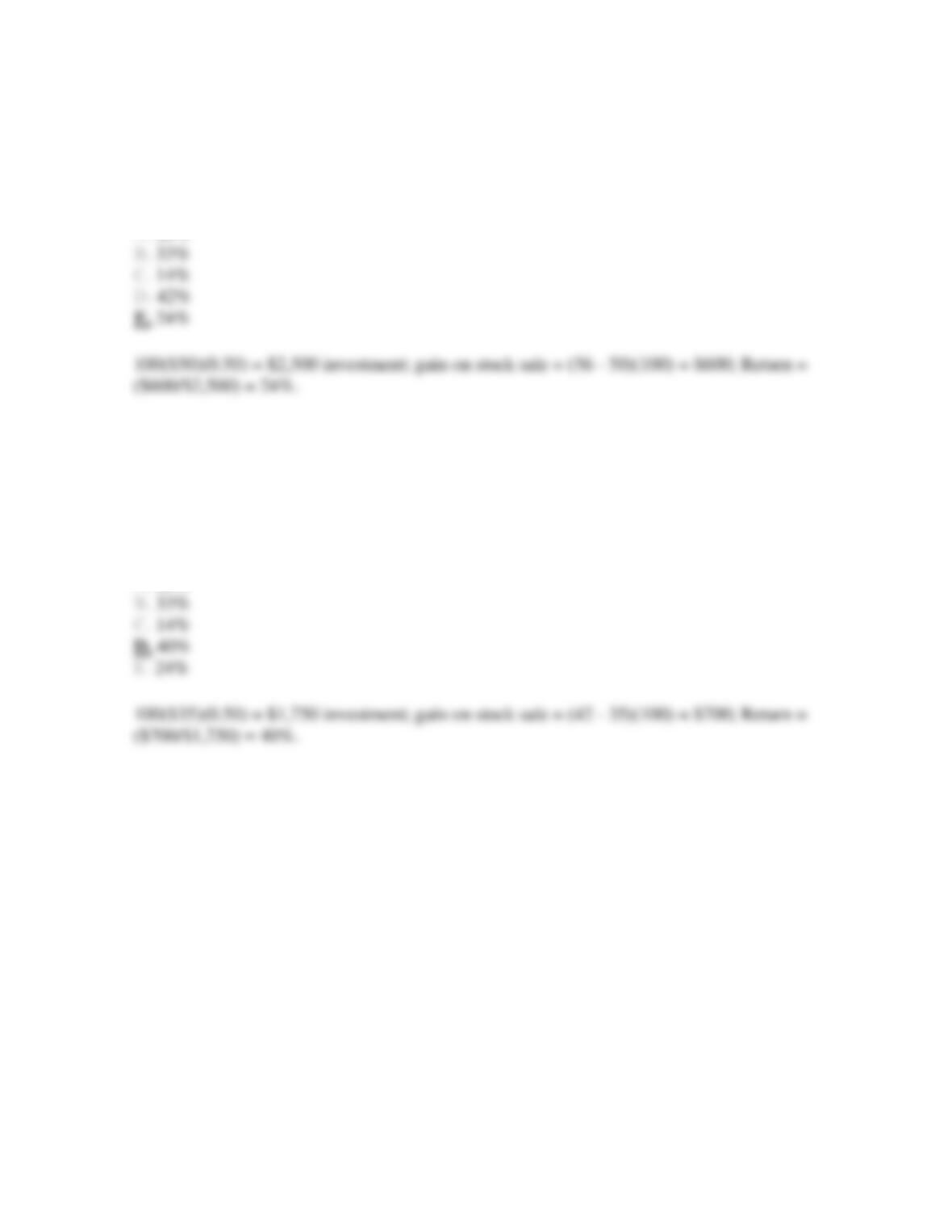
54. You purchased 1000 shares of common stock on margin at $30 per share. Assume the
initial margin is 50% and the stock pays no dividend. What would the maintenance margin be
if a margin call is made at a stock price of $24? Ignore interest on margin.
A. 0.33
Difficulty: Difficult
Chapter 03 – How Securities are Traded
3-22
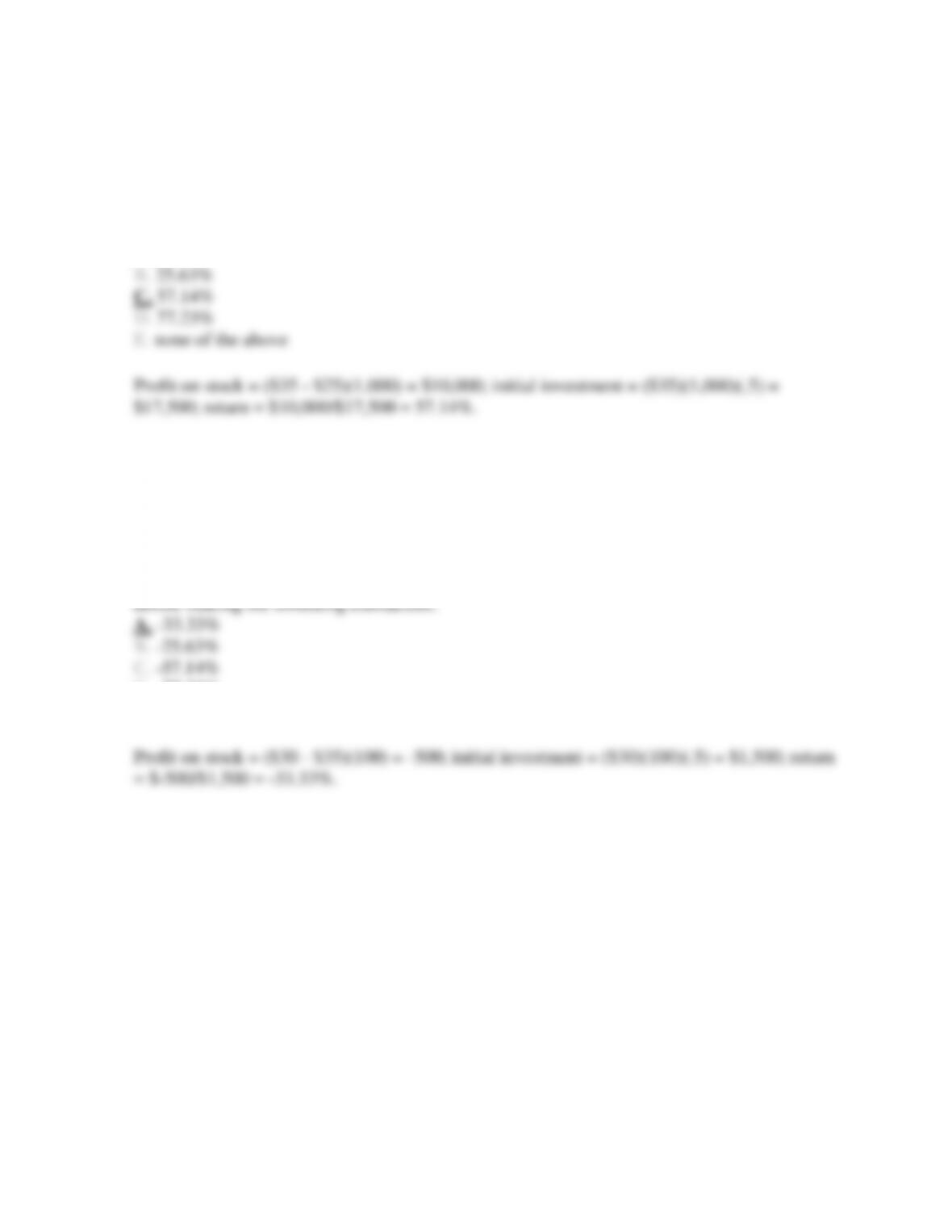
55. You purchased 100 shares of common stock on margin for $50 per share. The initial
margin is 50% and the stock pays no dividend. What would your rate of return be if you sell
the stock at $56 per share? Ignore interest on margin.
A. 28%
Difficulty: Difficult
56. You purchased 100 shares of common stock on margin for $35 per share. The initial
margin is 50% and the stock pays no dividend. What would your rate of return be if you sell
the stock at $42 per share? Ignore interest on margin.
A. 28%
Difficulty: Difficult
Chapter 03 – How Securities are Traded
3-23
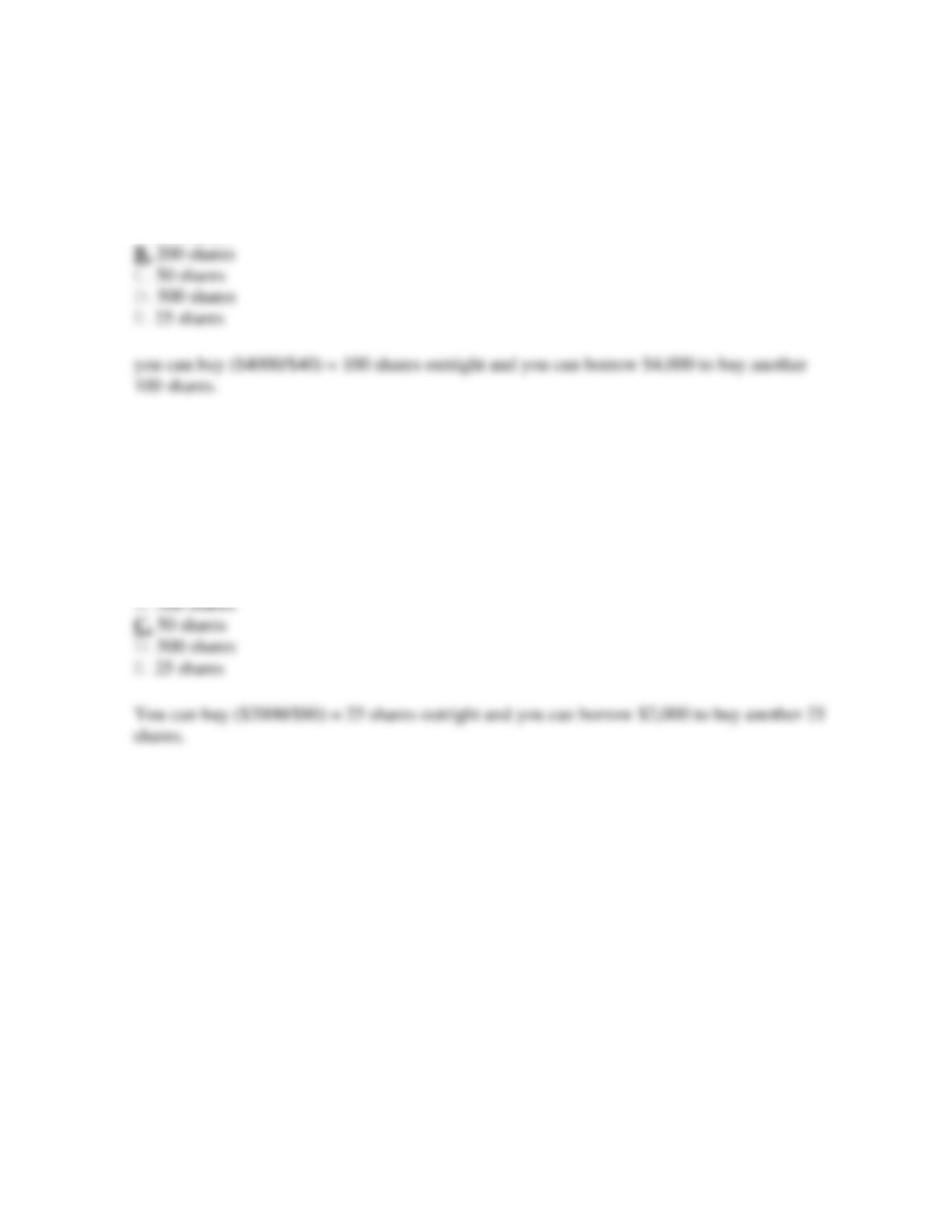
57. Assume you sell short 1000 shares of common stock at $35 per share, with initial margin
at 50%. What would be your rate of return if you repurchase the stock at $25/share? The stock
paid no dividends during the period, and you did not remove any money from the account
before making the offsetting transaction.
A. 20.47%
Difficulty: Moderate
58. Assume you sell short 100 shares of common stock at $30 per share, with initial margin at
50%. What would be your rate of return if you repurchase the stock at $35/share? The stock
paid no dividends during the period, and you did not remove any money from the account
D. -77.23%
E. none of the above
Difficulty: Moderate
Chapter 03 – How Securities are Traded
3-24
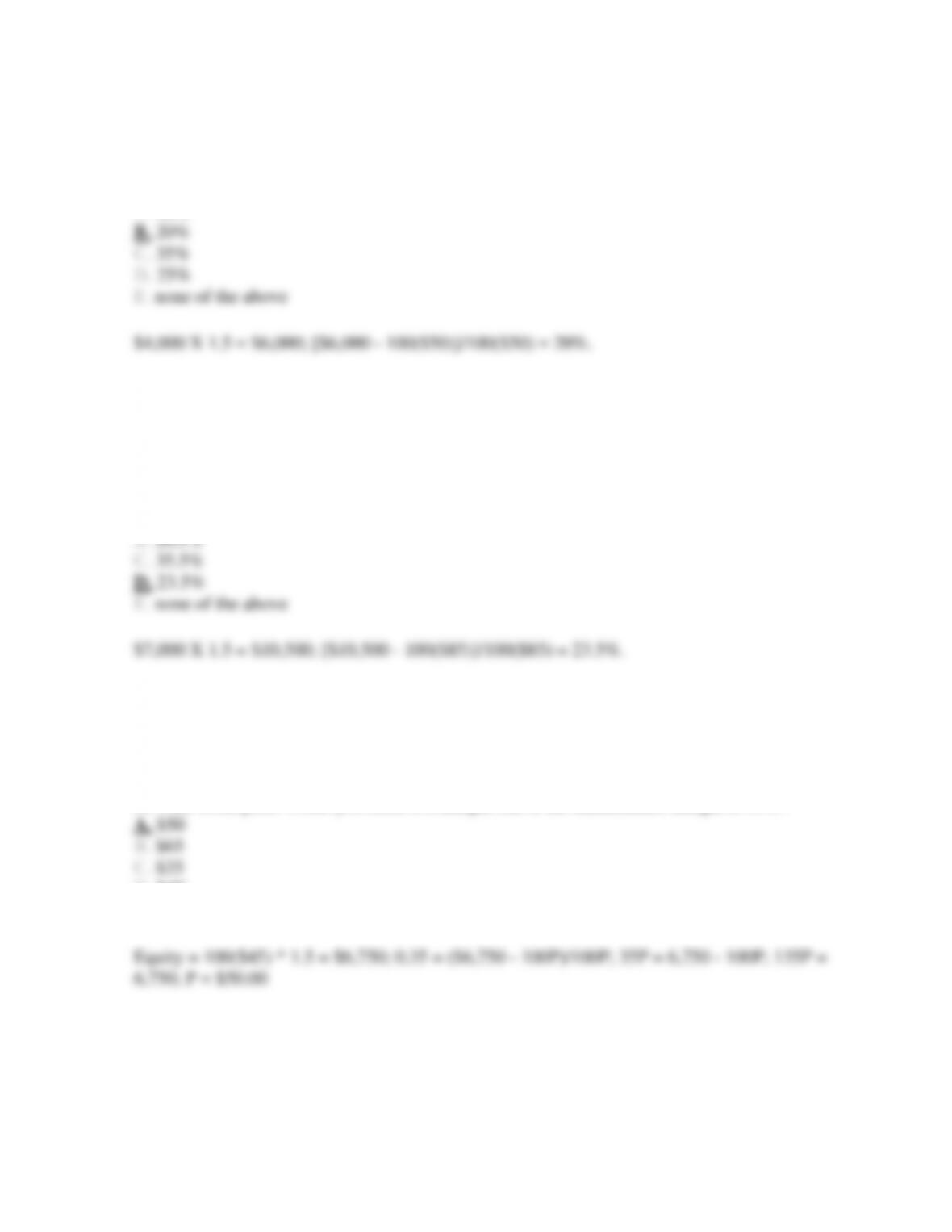
59. You want to purchase GM stock at $40 from your broker using as little of your own
money as possible. If initial margin is 50% and you have $4000 to invest, how many shares
can you buy?
A. 100 shares
Difficulty: Moderate
60. You want to purchase IBM stock at $80 from your broker using as little of your own
money as possible. If initial margin is 50% and you have $2000 to invest, how many shares
can you buy?
A. 100 shares
Difficulty: Moderate
Chapter 03 – How Securities are Traded
3-25
61. Assume you sold short 100 shares of common stock at $40 per share. The initial margin is
50%. What would be the maintenance margin if a margin call is made at a stock price of $50?
A. 40%
Difficulty: Difficult
62. Assume you sold short 100 shares of common stock at $70 per share. The initial margin is
50%. What would be the maintenance margin if a margin call is made at a stock price of $85?
A. 40.5%
Difficulty: Difficult
63. You sold short 100 shares of common stock at $45 per share. The initial margin is 50%.
At what stock price would you receive a margin call if the maintenance margin is 35%?
D. $40
E. none of the above
Difficulty: Difficult
Chapter 03 – How Securities are Traded
3-26
64. You sold short 100 shares of common stock at $75 per share. The initial margin is 50%.
At what stock price would you receive a margin call if the maintenance margin is 30%?
A. $90.23
Difficulty: Difficult
65. IPO average first-day returns are largest in ____________.
A. The United States
B. Denmark
Difficulty: Easy
66. Despite large first-day IPO returns, average first-year returns in the US are approximately
____________ percent.
D. 4.8
E. 9.1
Difficulty: Easy
Chapter 03 – How Securities are Traded
3-27
67. Average second-year IPO returns in the US are approximately ____________ percent.
A. 6.7
Difficulty: Easy
68. Average third-year IPO returns in the US are approximately ____________ percent.
A. 6.7
B. 18.2
Difficulty: Easy
69. The preliminary prospectus is referred to as a ____________.
D. tombstone
E. headstone
Difficulty: Easy
Chapter 03 – How Securities are Traded
3-28
70. The minimum revenue required for an initial listing on the New York Stock Exchange is
A. $2,000,000
Difficulty: Moderate
71. The minimum annual pretax income in the previous two years required for an initial
listing on the New York Stock Exchange is
D. $75,000,000
E. 100,000,000
Difficulty: Moderate
72. The daily dollar volume of trading on the NYSE in 2006 was approximately
D. $4 billion
E. none of the above
Difficulty: Easy
Chapter 03 – How Securities are Traded
3-29
73. The average daily number of shares traded on the NYSE in 2006 was approximately
____________ dollars.
D. 4 trillion
E. none of the above
Difficulty: Easy
74. The ____________ had the largest trading volume of securities in 2006.
A. NASDAQ
Difficulty: Easy
Chapter 03 – How Securities are Traded
3-30
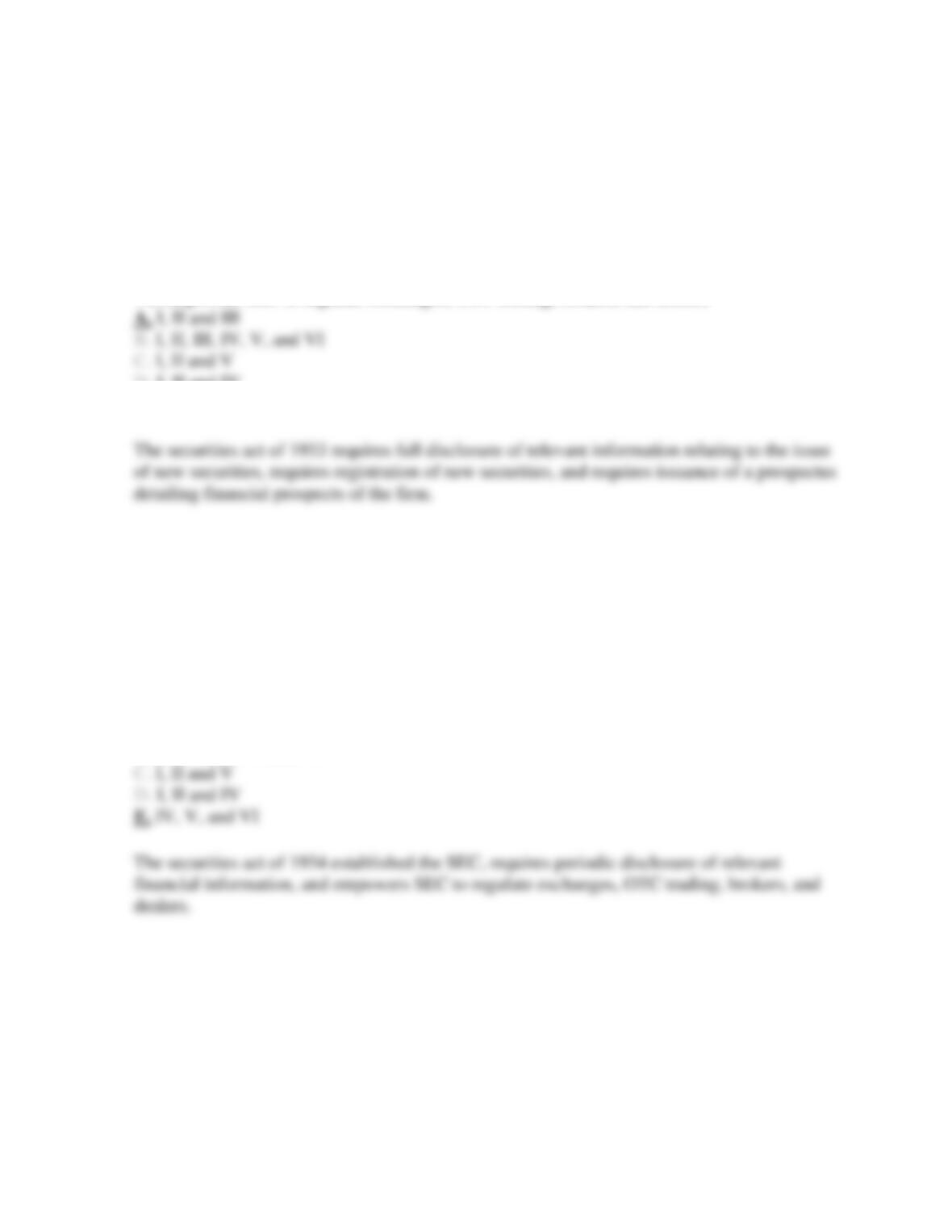
75. The securities act of 1933 ____________.
I) requires full disclosure of relevant information relating to the issue of new securities
II) requires registration of new securities
III) requires issuance of a prospectus detailing financial prospects of the firm
IV) established the SEC
V) requires periodic disclosure of relevant financial information
VI) empowers SEC to regulate exchanges, OTC trading, brokers, and dealers
D. I, II and IV
E. IV only
76. The securities act of 1934 ____________.
I) requires full disclosure of relevant information relating to the issue of new securities
II) requires registration of new securities
III) requires issuance of a prospectus detailing financial prospects of the firm
IV) established the SEC
V) requires periodic disclosure of relevant financial information
VI) empowers SEC to regulate exchanges, OTC trading, brokers, and dealers
A. I, II and III
B. I, II, III, IV, V, and VI
Difficulty: Easy
Chapter 03 – How Securities are Traded
3-31
77. Which of the following is not required under the CFA Institute standards of professional
conduct?
A. knowledge of all applicable laws, rules and regulations
Difficulty: Moderate
78. According to the CFA Institute Standards of Professional Conduct, CFA Institute
D. the employer
E. clients and prospective clients
Difficulty: Moderate
Chapter 03 – How Securities are Traded
3-32
Short Answer Questions
79. Of the secondary stock markets, which have been expanding and which have been
contracting? Give some of the reasons for the changes.
The over the counter market (OTC) has grown dramatically in recent years. The market has
become much more automated and information-efficient. The National Association of
Security Dealers Automated Quotations (NASDAQ) system is part of the reason for this
growth. NASDAQ consists of the more broadly traded OTC stocks. Up to date price
Difficulty: Moderate
Chapter 03 – How Securities are Traded
3-33
80. Discuss margin buying of common stocks. Include in your discussion the advantages and
disadvantages, the types of margin requirements, how these requirements are met, and who
determines these requirements.
Buying stock on margin means buying stock with partially borrowed funds. These funds are
borrowed from your broker, who has borrowed the funds from a commercial bank. The initial
margin requirement is the percent of the funds that must be your own. The current initial
margin requirement is 50% and is set by the Federal Reserve System. Margin is simply equity
as a percent of the value of your account. Subsequent to opening the account, stock prices
Difficulty: Moderate
Chapter 03 – How Securities are Traded
3-34
81. List three factors that are listing requirements for the New York Stock Exchange. Why
does the exchange have such requirements?
Factors include, but are not limited to, minimum pretax income in the last year, minimum
average annual pretax income in the previous two years, minimum market value of publicly
Difficulty: Moderate