Foundations of Financial Management, 17e (Block)
Chapter 3 Financial Analysis
1) Ratios are used to compare different firms in the same industry.
2) Ratios are not considered as important to non-accounting functional areas of a business such
as marketing, head of production and human resources.
3) Asset utilization ratios include receivable turnover, average collection period, inventory
turnover, fixed asset turnover and total asset turnover.
4) Financial ratios are used to weigh and evaluate the operational performance of the firm.
5) Liquidity ratios indicate how fast a firm can generate cash to pay bills.
6) Asset utilization ratios describe how capital is being utilized to buy assets.
7) Profitability ratios allow one to measure the ability of the firm to earn an adequate profit
compared to sales, total assets, and invested capital.
8) Asset utilization ratios measure the net returns on various assets such as return on total assets.
9) A trade creditor is most concerned about a firm’s profitability ratios.
10) Ratios are only useful for those areas of business that involve investment decisions.
11) Debt utilization ratios are used to evaluate the firm’s debt position with regard to its asset
base and earning power.
12) The DuPont system of analysis emphasizes that profit generated by assets can be derived by
a combination of profit levels and how fast an asset can turnover.
13) Satisfactory return on assets may be achieved through high profit margins or rapid turnover
of assets, but not a combination of both.
14) Heavy use of long-term debt can be of benefit to a firm to help expand, although it adds to
the firm’s overall level of risk.
15) Return on equity will be higher than return on assets if there is higher amounts of debt in the
capital structure.
16) Higher debt utilization ratios will always increase a firm’s return on equity given a positive
return on assets.
17) Return on equity will not change if the firm increases its use of debt.
18) The age of the firm’s assets is not necessary for analyzing ratios.
19) Asset utilization ratios relate balance sheet assets to income statement net income.
20) A current ratio of 2 to 1 is always acceptable for a company in any industry.
21) To compute the quick ratio, accounts receivable are not included in current assets.
22) Asset utilization ratios can be used to measure the effectiveness of a firm’s managers.
23) Ratios are not misleading by inflation.
24) Profitability ratios are distorted by inflation because profits are stated in current dollars,
while assets and equity are stated in historical dollars.
25) As long as prices of products continue to rise faster than costs in an inflationary
environment, reported profits will generally continue to rise.
26) Industries with cyclical products such as lumber and copper are more sensitive to inflation–
induced profits because many sales prices and/or expenses are set by the market.
27) Although Apple Computers has a profit margin significantly greater than that of a long-time
industry giant such as IBM, IBM continues to have a higher return on equity than Apple. The
primary reason for this unusual condition is that IBM has a much greater equity than Apple.
28) The stock market tends to move up when inflation goes up.
29) Economists believe that prices of goods may rise before 2020 since the prices of most goods
fell during the 2008-2009 recession.
30) Under generally acceptable accounting principles, two companies with identical operating
results may not report identical net incomes.
31) Inflation causes phantom sources of profit that may mislead even the most alert analyst.
32) One of the major problems during inflationary times is that revenue is almost always stated
in current dollars, whereas plant and equipment or inventory may have been purchased at lower
levels.
33) During disinflation, stock prices tend to go up because the investor’s required rate of return
goes down.
34) LIFO and FIFO are two ways that companies following the generally accepted accounting
principles value their inventory. One method may be preferred over the other during inflationary
time periods, which results in different profits, even though both methods are legal to use.
35) Analysts agree that extraordinary gains/losses should be excluded from ratio analysis
because they are one-time events, and can distort annual results from normal operations.
36) LIFO inventory pricing does a better job than FIFO in equating current costs with current
revenue.
37) Trend analysis is used to project the future performance of an industry.
38) If two companies have the same return on equity (ROE), they will also have the same return
on assets (ROA).
39) A company can improve its return on equity (ROE) by changing its capital structure.
40) Because ratios are historic, they have minimal value to an investor.
41) Times interest earned is an example of a profitability ratio.
42) Investors are most concerned with the liquidity ratios of a company.
43) Ratio analysis can be useful for
A) historical trend analysis within a firm.
B) comparison of ratios within a single industry.
C) measuring the effects of debt or equity financing.
D) All of the options are true.
44) In examining the liquidity ratios, the primary emphasis is the firm’s
A) ability to effectively employ its resources.
B) overall debt position.
C) ability to pay short-term obligations on time.
D) ability to earn an adequate return or profits.
45) Which of the following is not an asset utilization ratio?
A) Inventory turnover
B) Return on assets
C) Fixed asset turnover
D) Average collection period
46) Which of the following is not a debt utilization ratio?
A) Debt to total assets
B) Times interest earned
C) Fixed asset turnover
D) Fixed charge coverage
47) A short-term creditor would be most interested in
A) profitability ratios.
B) asset utilization ratios.
C) liquidity ratios.
D) debt utilization ratios.
48) Which of the following is not considered to be a profitability ratio?
A) Profit margin
B) Times interest earned
C) Return on equity
D) Return on assets (investment)
49) Which two ratios are used in the DuPont system to create return on assets?
A) Return on assets and asset turnover
B) Profit margin and asset turnover
C) Return on total capital and profit margin
D) Inventory turnover and return on fixed assets
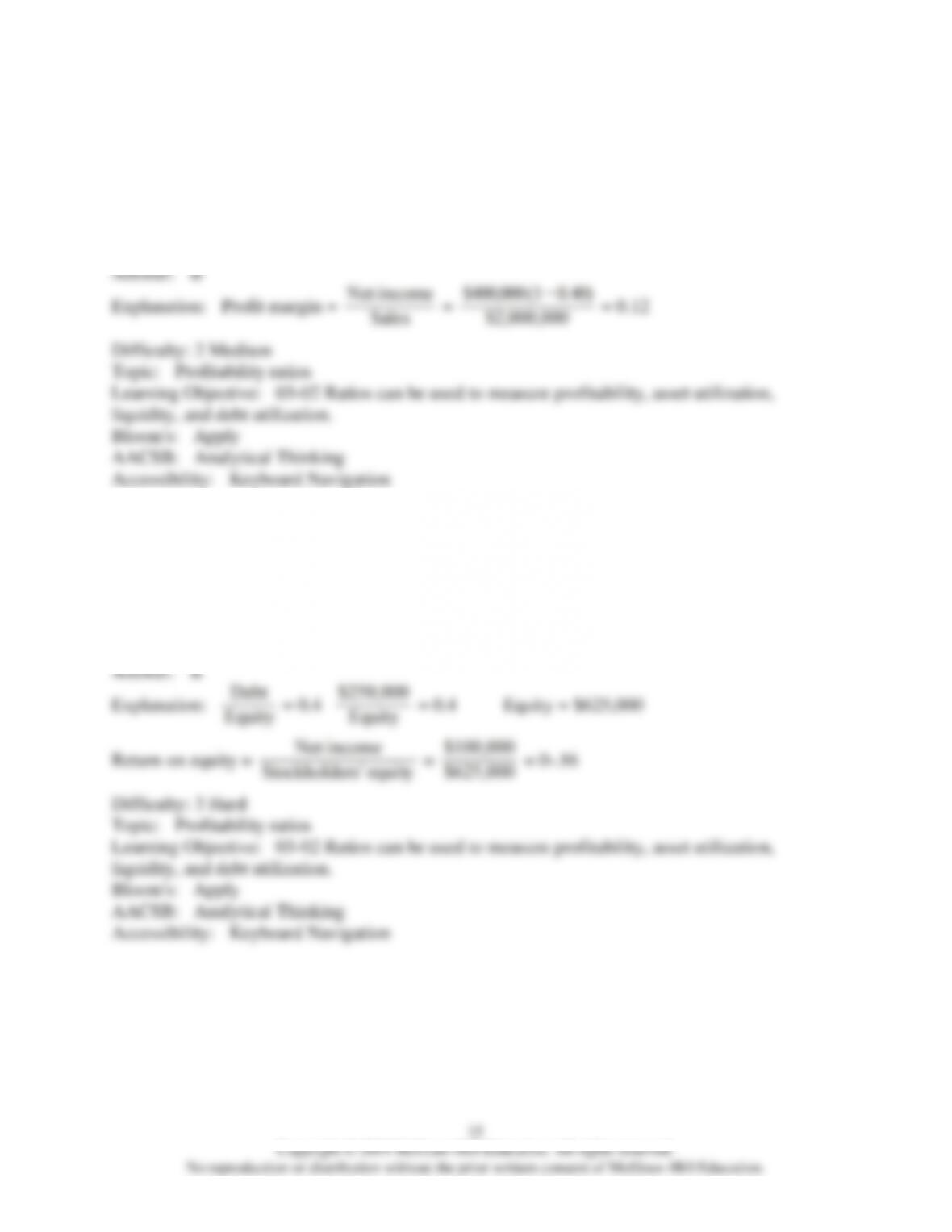
50) The Bubba Corp. had earnings before taxes of $400,000 and sales of $2,000,000. If it is in
the 40% tax bracket, its after-tax profit margin is
A) 40%.
B) 12%.
C) 20%.
D) 25%.
51) A firm has a debt-to-equity ratio of 40%, a debt of $250,000, and a net income of $100,000.
The return on equity is
A) 60%.
B) 16%.
C) 30%.
D) There’s not enough information to determine the return on equity.
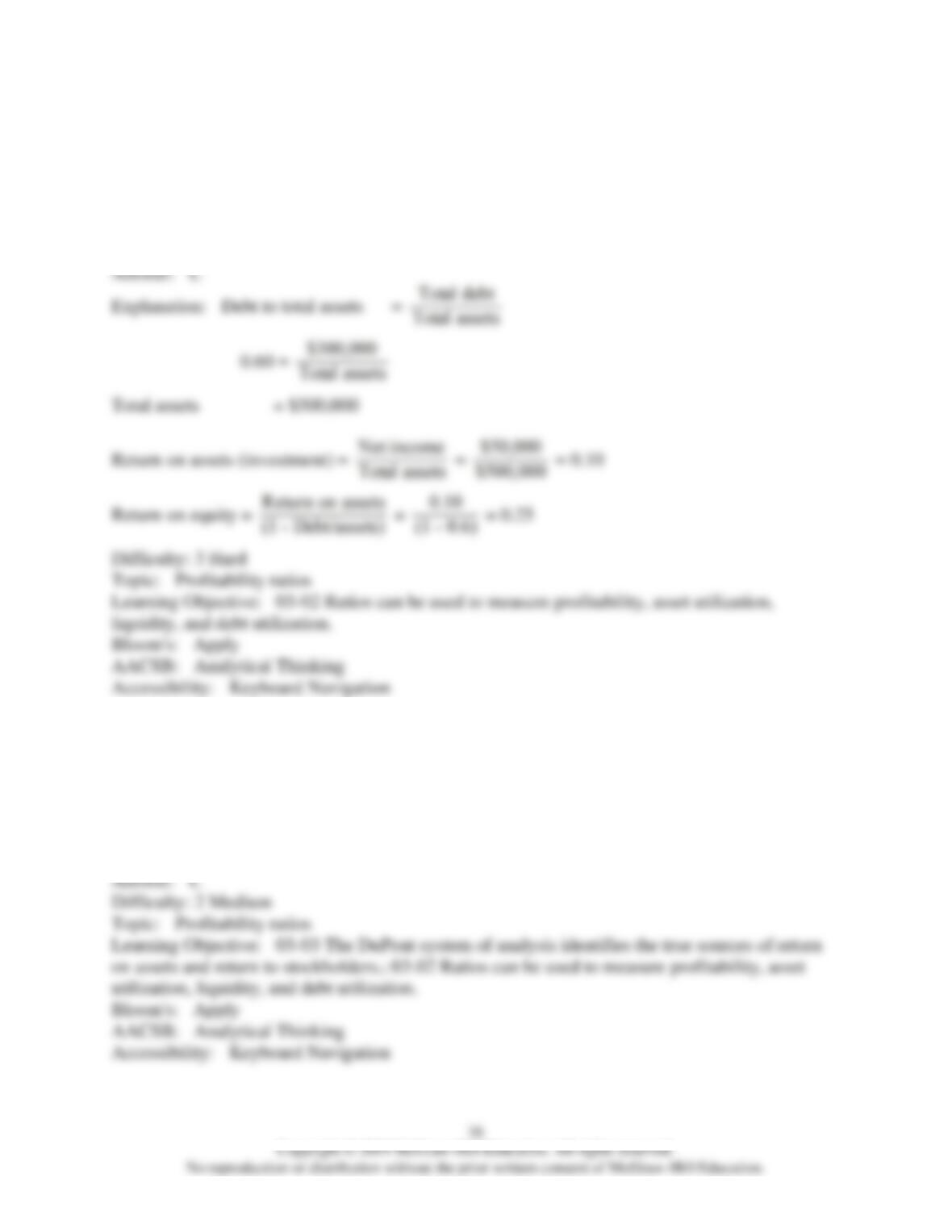
52) A firm has a debt-to-total assets ratio of 60%, $300,000 in debt, and a net income of $50,000.
Calculate return on equity.
A) 40%
B) 20%
C) 25%
D) There is not enough information to calculate return on equity.
53) For a given level of profitability as measured by profit margin, the firm’s return on equity
will
A) increase as its debt-to-assets ratio decreases.
B) decrease as its current ratio increases.
C) increase as its debt-to-assets ratio increases.
D) decrease as its times-interest-earned ratio decreases.
54) ABC Co. has an average collection period of 90 days for its accounts receivable. If total
credit sales for the year were $6,000,000, what is the balance in accounts receivable at year-end?
Assume a 360-day calendar year.
A) $150,000
B) $2,250,000
C) $1,500,000
D) $40,000
55) Asset utilization ratios
A) relate balance sheet assets to income statement sales.
B) measure how much cash is available for reinvestment into current assets.
C) are most important to stockholders.
D) measure the firm’s ability to generate a profit on sales.
56) XYZ’s receivables turnover is 4x. The accounts receivable at year-end are $600,000. The
average collection period is 90 days. What was the sales figure for the year assuming all sales are
on credit?
A) $60,000
B) $6,000,000
C) $2,400,000
D) $54,000,000
57) If ABC’s sales are $1,000,000, while accounts receivable is $100,000, inventory is $45,000,
and fixed assets are $132,000, what is ABC’s fixed asset turnover?
A) 7.58
B) 10.00
C) 0.13
D) 22.22
58) If XYZ’s receivables turnover is 4x, what does that mean?
A) XYZ’s total sales are rotated four times a year.
B) XYZ has a really good receivables turnover rate.
C) XYZ is able to collect its receivables every 90 days, or 4 times a year.
D) XYZ generates four times as much sales through receivables than sales through cash.
59) A decreasing average receivables collection period could be associated with
A) increasing account receivable.
B) decreasing sales.
C) increasing sales and decreasing accounts receivable.
D) none of the answers are correct.
60) If accounts receivable stays the same, and credit sales go up
A) the average collection period will go up.
B) the average collection period will go down.
C) accounts receivable turnover will decrease.
D) the average collection period will go down and accounts receivable turnover will decrease.
61) Total asset turnover indicates the firm’s
A) liquidity.
B) debt position.
C) ability to use its assets to generate sales.
D) profitability.
62) A firm only has current assets and fixed assets. Its current assets are $100,000 and total
assets are $300,000. The firm’s sales are $900,000. The firm’s fixed asset turnover is
A) 4.5x.
B) 12.0x.
C) 2.4x.
D) 5.0x.