Chapter 27 – The Theory of Active Portfolio Management
27–12
29. A purely passive strategy is defined as
Difficulty: Easy
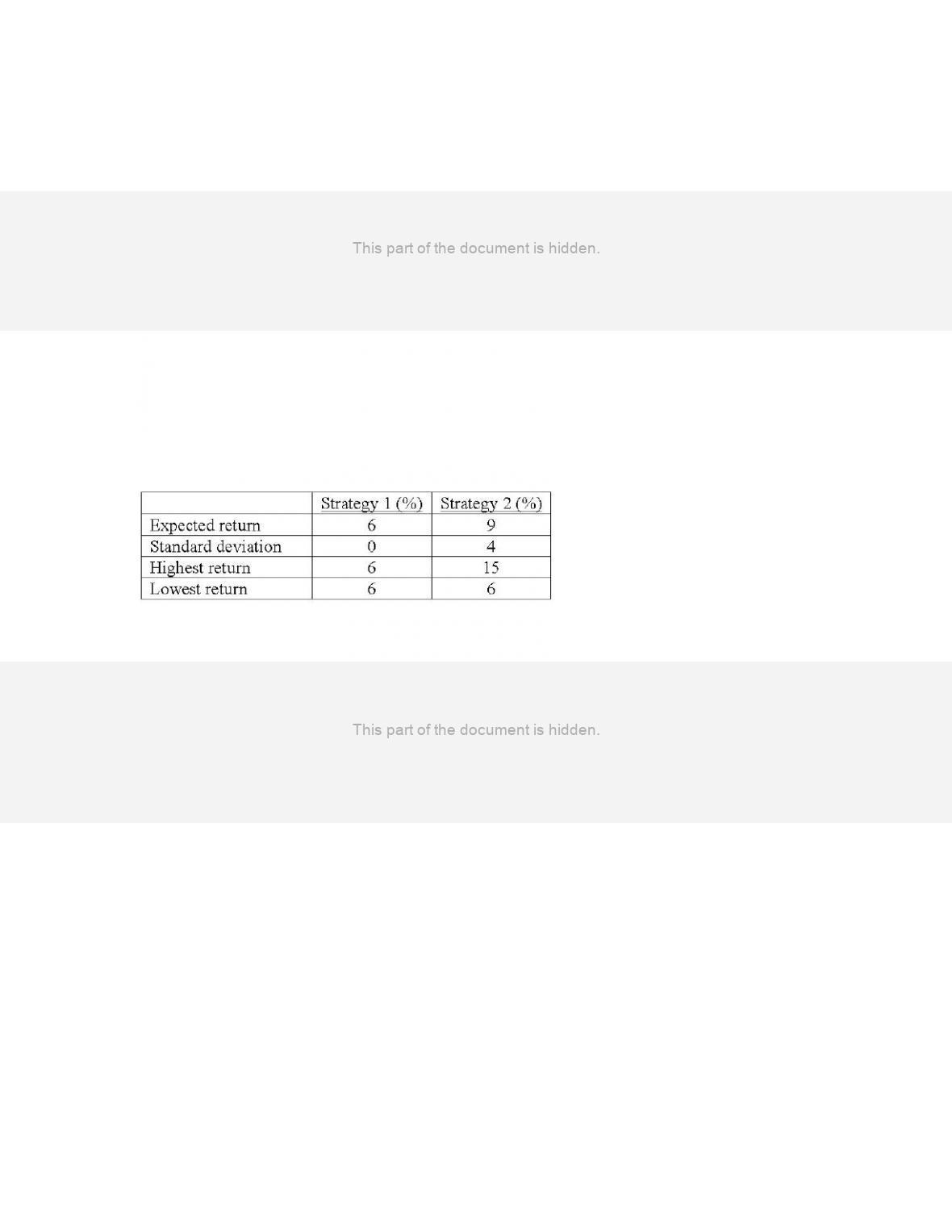
30. Consider these two investment strategies:
Strategy ___ is the dominant strategy because __________.
Difficulty: Moderate
27–13
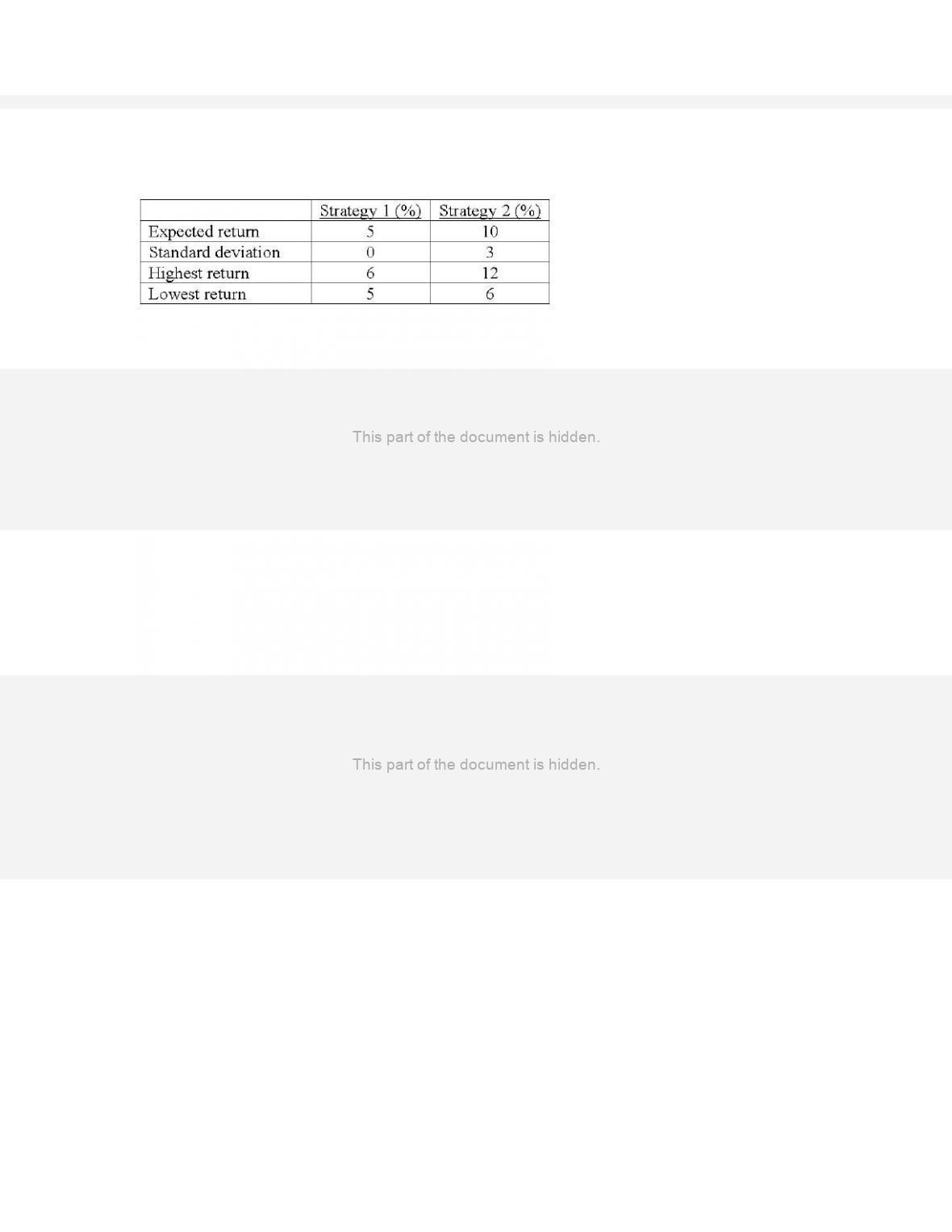
31. Consider these two investment strategies:
Strategy ___ is the dominant strategy because __________.
Difficulty: Moderate
32. The Treynor-Black model assumes that
Difficulty: Moderate

27–14
33. The Treynor-Black model does not assume that
Difficulty: Moderate
34. Consider the Treynor-Black model. The alpha of an active portfolio is 3%. The expected
return on the market index is 18%. The standard deviation of the return on the market
portfolio is 25%. The nonsystematic standard deviation of the active portfolio is 15%. The
risk-free rate of return is 6%. The beta of the active portfolio is 1.2. The optimal proportion to
invest in the active portfolio is __________.
Difficulty: Difficult

27–16
38. A manager who uses the mean-variance theory to construct an optimal portfolio will
satisfy
Difficulty: Easy
39. Ideally, clients would like to invest with the portfolio manager who has
Difficulty: Easy

27–17
40. An active portfolio manager faces a tradeoff between
I) using the Sharpe measure.
II) using mean-variance analysis.
III) exploiting perceived security mispricings.
IV) holding too much of the risk-free asset.
V) letting a few stocks dominate the portfolio.
Difficulty: Difficult
41. To determine the optimal risky portfolio in the Treynor-Black Model, macroeconomic
forecasts are used for the _________ and composite forecasts are used for the __________.
Difficulty: Moderate

27–18
42. The beta of an active portfolio is 1.45. The standard deviation of the returns on the market
index is 22%. The nonsystematic variance of the active portfolio is 3%. The standard
deviation of the returns on the active portfolio is __________.
Difficulty: Difficult
43. Consider the Treynor-Black model. The alpha of an active portfolio is 1%. The expected
return on the market index is 11%. The variance of return on the market portfolio is 6%. The
nonsystematic variance of the active portfolio is 2%. The risk-free rate of return is 4%. The
beta of the active portfolio is 1.1. The optimal proportion to invest in the active portfolio is
__________.
Difficulty: Difficult

27–19
44. Consider the Treynor-Black model. The alpha of an active portfolio is 3%. The expected
return on the market index is 10%. The variance of the return on the market portfolio is 4%.
The nonsystematic variance of the active portfolio is 2%. The risk-free rate of return is 3%.
The beta of the active portfolio is 1.15. The optimal proportion to invest in the active portfolio
is __________.
Difficulty: Difficult
45. Consider the Treynor-Black model. The alpha of an active portfolio is 2%. The expected
return on the market index is 12%. The variance of the return on the market portfolio is 4%.
The nonsystematic variance of the active portfolio is 2%. The risk-free rate of return is 3%.
The beta of the active portfolio is 1.15. The optimal proportion to invest in the active portfolio
is __________.
Difficulty: Difficult

27–20
46. Perfect timing ability is equivalent to having __________ on the market portfolio.
Difficulty: Easy
47. Kane, Marcus, and Trippi (1999) show that the annualized fee that investor should be
willing to pay for active management, over and above the fee charged by a passive index
fund, depends on
I) the investor’s coefficient of risk aversion
II) the value of at-the-money call option on the market portfolio
III) the value of out-of-the-money call option on the market portfolio
IV) the precision of the security analyst
V) the distribution of the squared information ratio of in the universe of securities
Difficulty: Moderate
27–21
48. Kane, Marcus, and Trippi (1999) show that the annualized fee that investor should be
willing to pay for active management, over and above the fee charged by a passive index
fund, does not depend on
I) the investor’s coefficient of risk aversion
II) the value of at-the-money call option on the market portfolio
III) the value of out-of-the-money call option on the market portfolio
IV) the precision of the security analyst
V) the distribution of the squared information ratio of in the universe of securities
Difficulty: Moderate
Short Answer Questions
49. Discuss the Treynor-Black model.
Difficulty: Moderate

27–22
50. You have a record of an analyst’s past forecasts of alpha. Describe how you would use this
information within the context of the Treynor-Black model to determine the forecasting
ability of the analyst.
You can use the index model and valid estimates of beta, you can estimate the ex-post alphas
from the average realized return and the return on the market index. The equation is
Difficulty: Difficult