31.
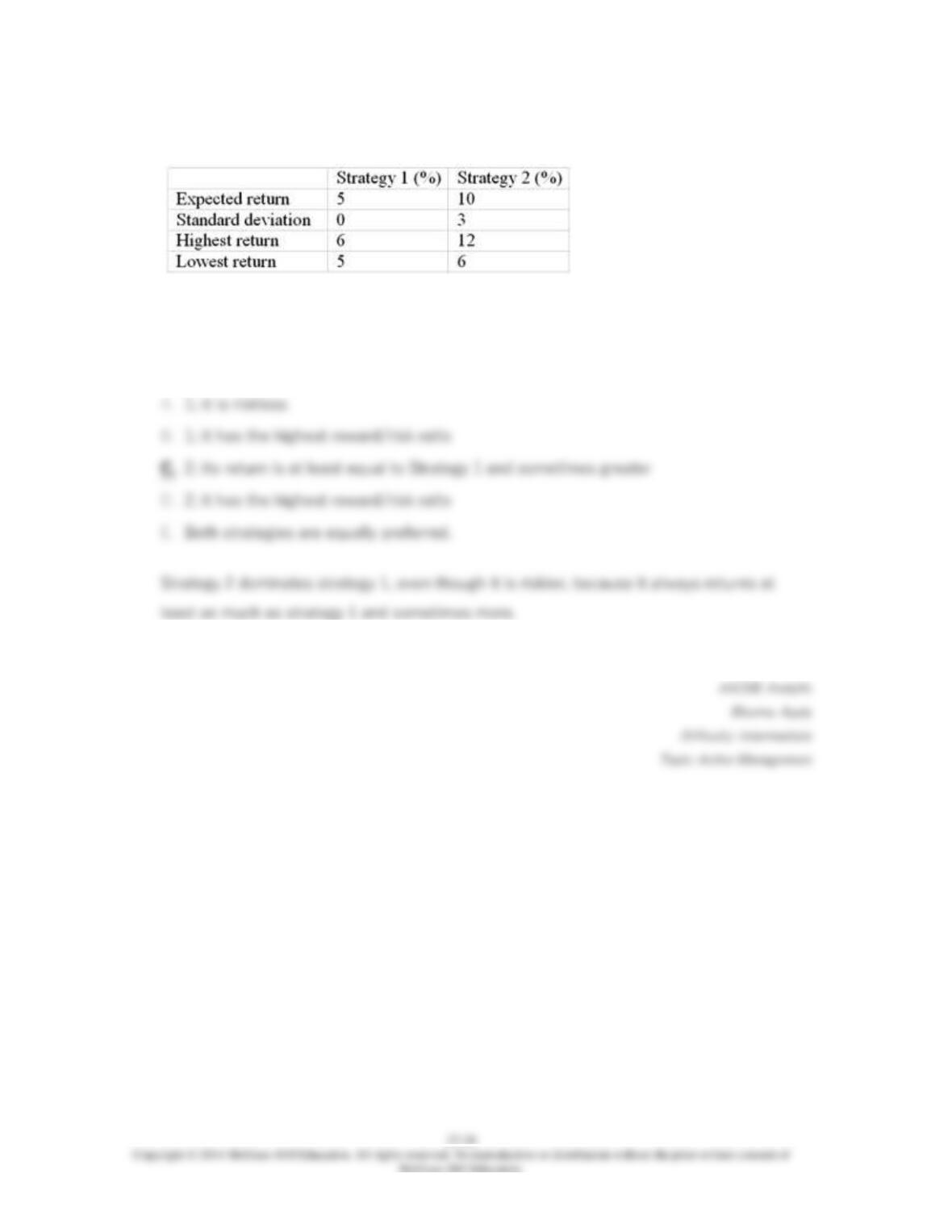
Consider these two investment strategies:
Strategy __________ is the dominant strategy because __________.
32.
The Treynor-Black model assumes that
33.
The Treynor-Black model does not assume that
34.
Consider the Treynor-Black model. The alpha of an active portfolio is 3%. The expected
return on the market index is 18%. The standard deviation of the return on the market
portfolio is 25%. The nonsystematic standard deviation of the active portfolio is 15%. The
risk-free rate of return is 6%. The beta of the active portfolio is 1.2. The optimal proportion
to invest in the active portfolio is
35.
According to the Treynor-Black model, the weight of a security in the active portfolio
depends on the ratio of __________ to __________.
36.
One property of a risky portfolio that combines an active portfolio of mispriced securities
with a market portfolio is that, when optimized, its squared Sharpe measure increases by
the square of the active portfolio’s
37.
A purely passive strategy
38.
A manager who uses the mean-variance theory to construct an optimal portfolio will
satisfy
39.
Ideally, clients would like to invest with the portfolio manager who has
40.
An active portfolio manager faces a trade-off between
I) using the Sharpe measure.
II) using mean-variance analysis.
III) exploiting perceived security mispricings.
IV) holding too much of the risk-free asset.
V) letting a few stocks dominate the portfolio.
41.
To determine the optimal risky portfolio in the Treynor-Black model, macroeconomic
forecasts are used for the _________ and composite forecasts are used for the __________.
42.
The beta of an active portfolio is 1.45. The standard deviation of the returns on the market
index is 22%. The nonsystematic variance of the active portfolio is 3%. The standard
deviation of the returns on the active portfolio is
43.
Consider the Treynor-Black model. The alpha of an active portfolio is 1%. The expected
return on the market index is 11%. The variance of return on the market portfolio is 6%.
The nonsystematic variance of the active portfolio is 2%. The risk-free rate of return is 4%.
The beta of the active portfolio is 1.1. The optimal proportion to invest in the active
portfolio is
44.
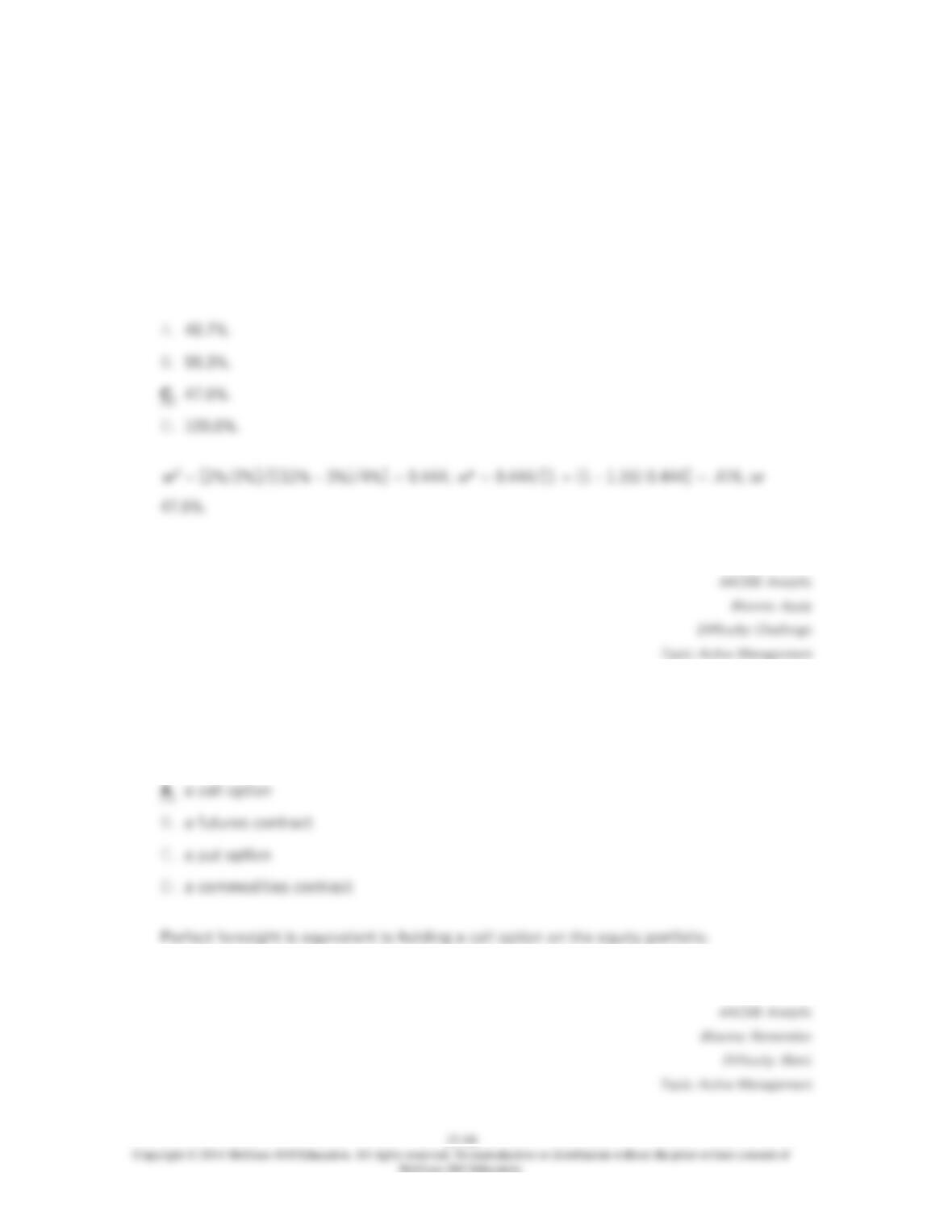
Consider the Treynor-Black model. The alpha of an active portfolio is 3%. The expected
return on the market index is 10%. The variance of the return on the market portfolio is 4%.
The nonsystematic variance of the active portfolio is 2%. The risk-free rate of return is 3%.
The beta of the active portfolio is 1.15. The optimal proportion to invest in the active
portfolio is
45.
Consider the Treynor-Black model. The alpha of an active portfolio is 2%. The expected
return on the market index is 12%. The variance of the return on the market portfolio is 4%.
The nonsystematic variance of the active portfolio is 2%. The risk-free rate of return is 3%.
The beta of the active portfolio is 1.15. The optimal proportion to invest in the active
portfolio is
46.
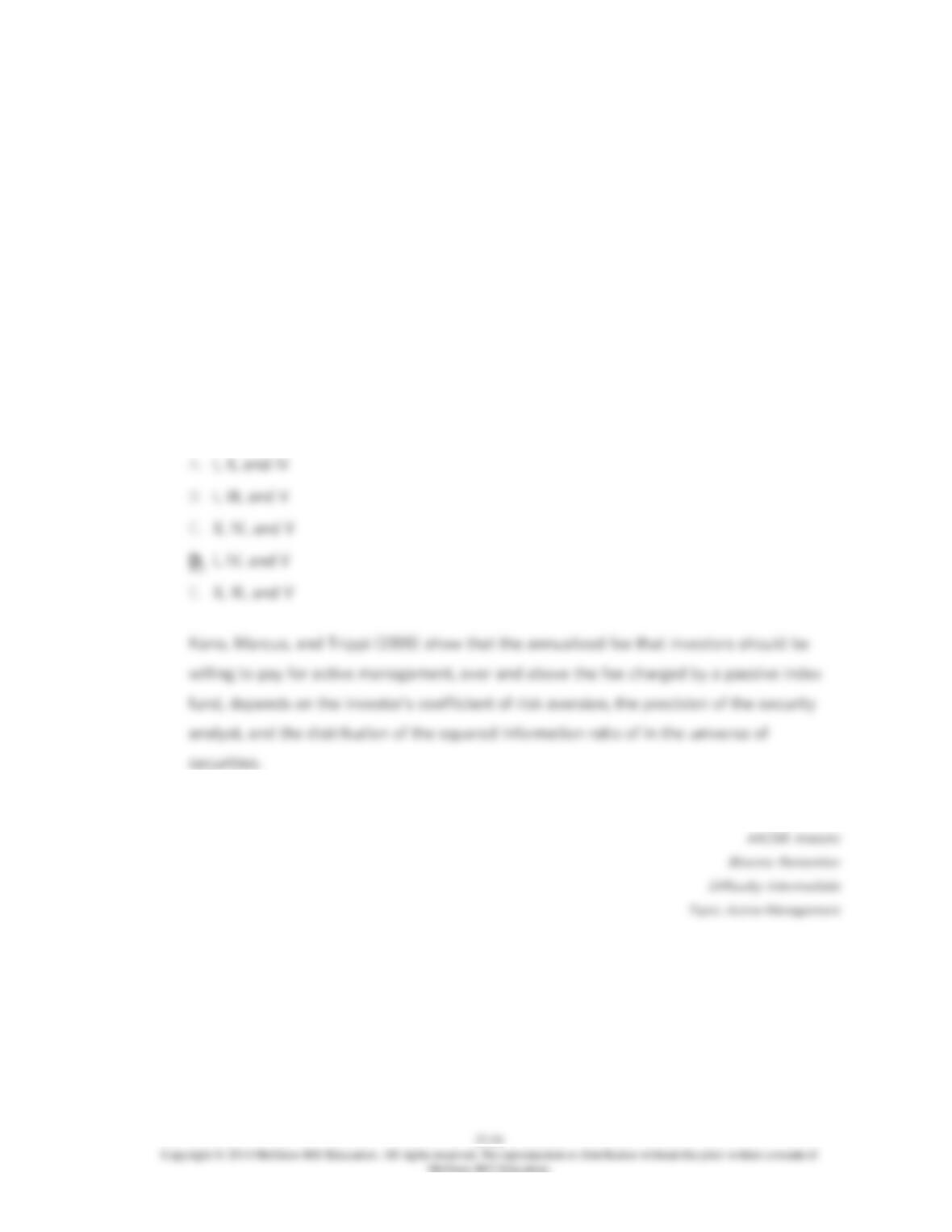
Perfect timing ability is equivalent to having __________ on the market portfolio.
47.
Kane, Marcus, and Trippi (1999) show that the annualized fee that investors should be
willing to pay for active management, over and above the fee charged by a passive index
fund, depends on
I) the investor’s coefficient of risk aversion.
II) the value of at-the-money call option on the market portfolio.
III) the value of out-of–the-money call option on the market portfolio.
IV) the precision of the security analyst.
V) the distribution of the squared information ratio of in the universe of securities.
27–52
48.
Kane, Marcus, and Trippi (1999) show that the annualized fee that investors should be
willing to pay for active management, over and above the fee charged by a passive index
fund, does not depend on
I) the investor’s coefficient of risk aversion.
II) the value of at-the-money call option on the market portfolio.
III) the value of out-of–the-money call option on the market portfolio.
IV) the precision of the security analyst.
V) the distribution of the squared information ratio of in the universe of securities.
Short Answer Questions
49.
Discuss the Treynor-Black model.
50.
You have a record of an analyst’s past forecasts of alpha. Describe how you would use
this information within the context of the Treynor-Black model to determine the
forecasting ability of the analyst.